Exceptions to Compulsory Jurisdiction Under Article 298 of UNCLOS: Sovereignty, Delimitation, and Military Restraint
A scholarly analysis of Article 298 UNCLOS, dissecting how optional exceptions for boundary delimitation, historic titles, and military activities govern international dispute settlement.
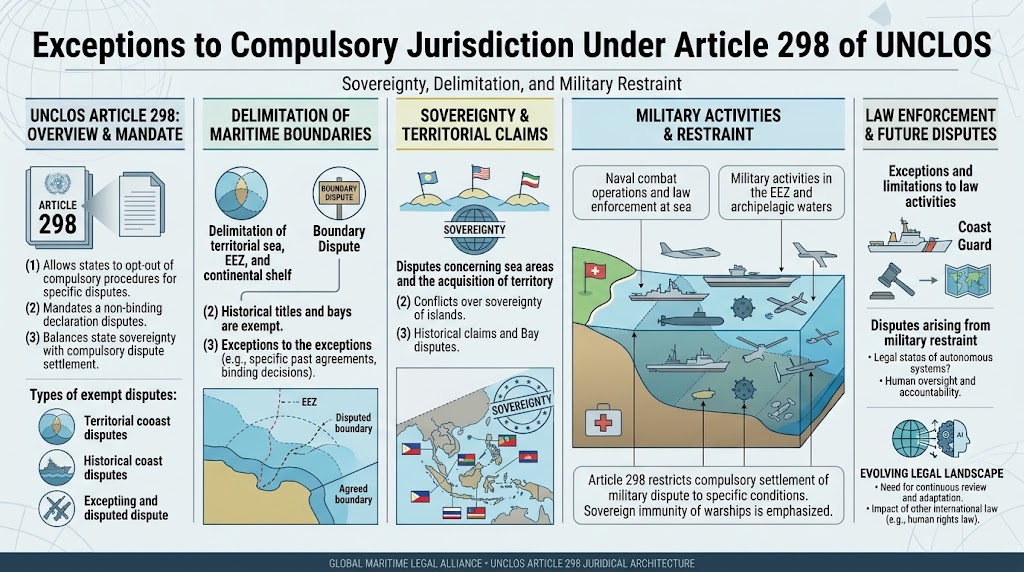
The United Nations Convention on the Law of the Sea (UNCLOS) is often heralded as a constitution for the oceans, not least because of its compulsory dispute settlement system embodied in Part XV, Section 2. Under Article 286, any dispute concerning the interpretation or application of the Convention that cannot be settled by consensual means may, in principle, be submitted unilaterally to a court or tribunal possessing jurisdiction under Article 287. Yet this compulsory architecture was acceptable to sovereign States during the Third United Nations Conference on the Law of the Sea (UNCLOS III) only by virtue of a carefully negotiated system of safety valves. Alongside the automatic statutory limitations set out in Article 297, Article 298 provides States with the prerogative to make written declarations opting out of compulsory procedures entailing binding decisions with respect to three sensitive categories of maritime controversies: disputes concerning sea boundary delimitations and historic bays or titles; disputes concerning military activities and certain law enforcement activities; and disputes in respect of which the United Nations Security Council is exercising its assigned Charter functions.
Far from operating as peripheral carve-outs, these optional exceptions sit at the structural fault line between sovereign prerogative and the international rule of law. The practical invocation of Article 298 raises fundamental questions of judicial characterization, the objective assessment of military maneuvers, the boundary between maritime entitlement and boundary delimitation, and the legal consequences of non-appearance in international adjudication. Recent jurisprudence from the Permanent Court of Arbitration (PCA) and the International Tribunal for the Law of the Sea (ITLOS)—notably in the South China Sea Arbitration, the Timor Sea Conciliation, and the Kerch Strait Incident—demonstrates that while Article 298 shields core sovereign acts from judicial decree, international tribunals have developed sophisticated interpretive techniques to prevent the exceptions from swallowing compulsory jurisdiction whole.
What is the scope of Article 298 optional exceptions?
To comprehend the structural function of Article 298, one must distinguish its mechanics from the mandatory limitations prescribed in Article 297. Whereas Article 297 operates ipso jure to shield certain coastal State sovereign rights—primarily the exercise of discretionary authority regarding marine scientific research under Article 246 and sovereign rights over living resources in the exclusive economic zone (EEZ) under Articles 61 and 62—Article 298 requires an affirmative, written declaration deposited with the Secretary-General of the United Nations. In the absence of an explicit declaration under Article 298(1), a State Party remains fully bound by Section 2 of Part XV regarding all categories of disputes enumerated therein, subject only to the general jurisdictional requirements of Article 288.
Declarations made under Article 298 may be formulated at the time of signature, ratification, or accession, or at any time thereafter. A State may invoke any or all of the three delineated exceptions:
- Article 298(1)(a): Disputes concerning maritime delimitations under Articles 15, 74, and 83, or those involving historic bays or titles.
- Article 298(1)(b): Disputes concerning military activities by government vessels and aircraft engaged in non-commercial service, alongside law enforcement activities connected to the sovereign rights or jurisdiction excluded under Article 297(2) or (3).
- Article 298(1)(c): Disputes in respect of which the Security Council of the United Nations is exercising the functions assigned to it by the Charter of the United Nations, unless the Security Council decides to remove the matter from its agenda.
Critically, Article 298(3) anchors these exceptions in the structural principle of reciprocity. A State Party that has deposited an exclusionary declaration cannot unilaterally haul another State Party before an Article 287 forum to litigate a dispute falling within its own excluded category. Conversely, any respondent State may invoke an applicant State’s Article 298 declaration against that applicant on a reciprocal basis, irrespective of whether the respondent has itself made such a declaration. This reciprocal dynamic establishes a systemic equilibrium, preventing States from strategically exploiting Section 2 against geopolitical rivals while immunizing their own vulnerable maritime operations.
Can a state avoid UNCLOS arbitration through historic title claims?
The first major category of optional exclusion, codified in Article 298(1)(a)(i), shields sea boundary delimitations under Articles 15 (territorial sea), 74 (EEZ), and 83 (continental shelf), alongside disputes involving historic bays or titles. Historically, boundary delimitations and historic entitlements were perceived by sovereign States as matters touching upon territorial integrity and national prestige, rendering binding third-party adjudication politically unpalatable. However, the precise jurisdictional breadth of this exclusion became the centerpiece of the landmark South China Sea Arbitration (Philippines v. China) (PCA Case No. 2013-19).
In that dispute, China had deposited a formal declaration under Article 298 in 2006, excluding all categories of disputes specified in Article 298(1)(a), (b), and (c). When the Philippines initiated arbitration under Annex VII in 2013, challenging China's maritime claims based on the historic rights encapsulated within the nine-dash line, China published a Position Paper arguing that the arbitral tribunal lacked jurisdiction. Beijing contended that the true essence of the dispute concerned maritime delimitation and historic titles, both of which were shielded by its 2006 declaration. The arbitral tribunal was thus forced to formulate an authoritative jurisprudential distinction between a dispute concerning maritime delimitation and a dispute concerning maritime entitlement and the status of insular features.
Characterization of Claims: Delimitation Versus Entitlement
The Annex VII Tribunal held that maritime delimitation is conceptually distinct from the prior question of maritime entitlement. Delimitation is an exercise in resolving overlapping sovereign entitlements between coastal States whose coastlines are adjacent or opposite. Before two States can delimit an overlapping maritime area, the legal nature and geographic extent of the maritime zones generated by coastal features must first be ascertained pursuant to Part VIII of UNCLOS, specifically Article 121. The Tribunal observed that determining whether a maritime feature is a low-tide elevation, an isolated rock incapable of sustaining human habitation or economic life, or a fully entitled island generating an EEZ and continental shelf is an objective assessment under Article 121 that precedes maritime delimitation.
The Tribunal emphasized that a dispute concerning whether an insular feature generates a territorial sea or an EEZ is an autonomous dispute regarding the status and entitlement of features under the Convention, not a dispute concerning sea boundary delimitation under Articles 15, 74, or 83. Consequently, an Article 298(1)(a)(i) declaration cannot immunize a State from compulsory proceedings seeking to clarify the legal entitlement of a geographic feature, provided the claimant does not ask the tribunal to draw an actual delimitation line.
Similarly, the Tribunal scrutinized China's argument regarding historic titles. The Tribunal drew a rigorous distinction between historic bays or titles in the strict legal sense—which imply a claim of full territorial sovereignty over maritime space analogized to internal waters or historic territorial seas—and claims of historic rights to living and non-living resources within an area that would otherwise constitute the exclusive economic zone or high seas of another State. It determined that China’s asserted rights within the nine-dash line were non-sovereign historic rights of an economic nature, which had been superseded by the comprehensive legal regime of the Convention upon China's accession. Because China did not assert full historic sovereignty over the entirety of the South China Sea as historic internal waters, the exception in Article 298(1)(a)(i) concerning historic bays or titles was held inapplicable to the Philippines' submissions.
Compulsory Conciliation as a Fallback under Article 298(1)(a)(i)
An Article 298(1)(a)(i) declaration does not grant absolute immunity from international oversight. Where a maritime delimitation dispute arises subsequent to the entry into force of UNCLOS and no bilateral agreement has been reached within a reasonable period, Article 298(1)(a)(i) mandates that the dispute must, at the request of any party, be submitted to compulsory conciliation under Annex V, Section 2. Although a conciliation commission produces a report that is formally non-binding on the parties, the procedure itself is non-consensual; a State cannot unilaterally boycott the constitution of the commission or avoid participating in good faith without violating Part XV.
This mechanism was deployed for the first time in the Timor Sea Conciliation (Timor-Leste v. Australia) (PCA Case No. 2016-10). Australia had deposited an Article 298 declaration in 2002 excluding maritime boundary delimitation disputes from Part XV compulsory adjudication. In 2016, Timor-Leste initiated compulsory conciliation under Annex V, compelling Australia to participate. Despite preliminary jurisdictional objections raised by Australia regarding preexisting bilateral treaties, the Conciliation Commission affirmed its competence. The resulting structured diplomatic dialogue culminated in the signing of the 2018 Treaty Between Australia and the Democratic Republic of Timor-Leste Establishing Their Maritime Boundaries in the Timor Sea, demonstrating that the compulsory conciliation framework under Article 298(1)(a)(i) can serve as an effective legal bridge toward resolving intractable boundary disputes where binding adjudication is barred.
How does the military activities exception function in international adjudication?
Article 298(1)(b) contains perhaps the most politically volatile carve-out in UNCLOS, allowing States to exclude disputes concerning military activities, including military activities by government vessels and aircraft engaged in non-commercial service. The rationale underpinning this exception is obvious: major maritime powers, including the United States, Russia, China, the United Kingdom, and France, have consistently maintained that naval operations, national defense maneuvers, and intelligence collection in international waters must remain beyond the purview of international judicial tribunals.
The central difficulty of Article 298(1)(b) lies in the complete absence of a definition for military activities within the text of UNCLOS. The drafting history demonstrates that negotiations during UNCLOS III deliberately avoided a prescriptive definition to preserve consensus. As a consequence, international tribunals have had to resolve whether the characterization of an action as a military activity is subject to the unilateral discretion of the acting State or whether it requires an objective assessment by the adjudicative body itself.
The Objective Versus Subjective Characterization Test
In both the South China Sea Arbitration and the subsequent Dispute Concerning the Detention of Ukrainian Naval Vessels and Servicemen (Ukraine v. Russian Federation) (PCA Case No. 2019-28, Kerch Strait Incident), respondents maintained that the classification of an act as military is fundamentally a subjective political determination made by the sovereign State conducting the operation. This view posits that if a State designates its naval maneuvers or enforcement actions as military defense measures, a tribunal must defer to that characterization without second-guessing sovereign military authority.
International jurisprudence has squarely rejected the subjective doctrine. In the South China Sea Award on Jurisdiction and Admissibility (2015), the Tribunal affirmed its judicial duty under Article 288(4) to objectively characterize the dispute before it:
The characterization of an activity as military or civilian cannot be determined solely by the unilateral assertion of one party. If a mere assertion by a State were sufficient to invoke Article 298(1)(b), compulsory dispute settlement under Part XV would be rendered entirely illusory, allowing States to insulate any unlawful maritime conduct from judicial review merely by dispatching naval personnel or asserting national security imperatives.
In evaluating the Philippines' claims concerning military activities at Mischief Reef, the PCA established an objective criterion: it evaluated the nature of the feature, the civilian versus military functions of the installations constructed, and whether the disputed conduct involved the actual use or threat of armed force. Finding that China’s construction activities at Mischief Reef had evolved into extensive military facilities, the Tribunal determined that those specific claims did indeed touch upon military activities and were accordingly barred from its jurisdiction by virtue of China's Article 298(1)(b) declaration.
Differentiating Military Operations from Maritime Law Enforcement
The boundary between military activities and law enforcement operations has become increasingly blurred due to the proliferation of coast guards, maritime constabulary forces, and so-called grey-zone operations where civilian fishing militias operate under state naval coordination. Under Article 298(1)(b), law enforcement activities are explicitly excluded from Part XV jurisdiction only if they relate to the sovereign rights or jurisdiction over marine scientific research or fisheries as outlined in Article 297(2) and (3). Consequently, generic maritime law enforcement—such as anti-piracy operations, customs enforcement, or navigation policing outside the specified exceptions—remains subject to compulsory jurisdiction unless it is classified as a military activity.
This delicate dichotomy was directly litigated in the Kerch Strait Incident between Ukraine and the Russian Federation. In November 2018, the Russian Coast Guard, supported by Russian naval assets, intercepted, fired upon, and arrested three Ukrainian naval vessels (the Berdyansk, the Nikopol, and the Yany Kapu) and their 24 crew members as they attempted to transit the Kerch Strait to the Sea of Azov. Russia asserted that the incident constituted a military clash involving foreign military vessels that had illegally crossed its sovereign border, thereby triggering Russia's 1997 declaration under Article 298(1)(b).
In its 2020 Award on Preliminary Objections, the Annex VII Tribunal presided over by Donald McRae held that the classification of the dispute depended on an objective examination of all surrounding circumstances, including:
- The nature of the actors involved and the identity of the vessels;
- The objective operational intent and instructions of the respective forces;
- The operational context, specifically whether the encounter occurred within the framework of an international armed conflict or constituted a peacetime navigational enforcement measure.
The Tribunal highlighted that the presence of naval warships does not inherently transform a peaceful navigational passage into a military activity within the meaning of Article 298(1)(b). If military vessels are merely engaged in the exercise of the right of innocent passage or transit through a strait without undertaking hostile offensive maneuvers, standard state interactions with coastal authorities typically remain law enforcement in nature. However, where coercive military force is deployed to repel what a coastal state views as a sovereign security breach, the line is crossed. The Kerch Strait tribunal ultimately joined Russia's preliminary objection under Article 298(1)(b) to the merits, affirming that the military versus law enforcement distinction cannot be determined abstractly without assessing the complete factual record of the confrontation.
The Enrica Lexie Precedent
A parallel nuance emerged in the Enrica Lexie Incident (Italy v. India) (PCA Case No. 2015-28). The dispute arose from the shooting of two Indian fishermen aboard an Indian fishing vessel, the St. Antony, off the coast of Kerala by two Italian marines stationed on board the Italian-flagged commercial oil tanker Enrica Lexie as a Vessel Protection Detachment. India argued, inter alia, that the action of the Italian marines constituted an unauthorized military exercise within India's contiguous zone and EEZ.
Although India had not deposited a declaration under Article 298(1)(b), the Tribunal was forced to evaluate whether the deployment of state military personnel aboard private merchant ships to protect against piracy qualified as a military activity or law enforcement. The Tribunal observed that the marines were acting as state officials performing an official sovereign security function under Italian domestic law, which conferred functional immunity. Nevertheless, because neither party had formally exempted military disputes under Article 298, the Tribunal proceeded to adjudicate the claims of jurisdictional competence, holding that while Italy had breached India's freedom of navigation under Article 87, the marines were entitled to immunity from India's domestic criminal jurisdiction.
Security Council Competence and Article 298(1)(c)
The third optional exception, enshrined in Article 298(1)(c), permits States to exclude from compulsory settlement disputes in respect of which the Security Council of the United Nations is exercising the functions assigned to it by the Charter of the United Nations, unless the Security Council decides to remove the matter from its agenda or calls upon the parties to settle it by the means provided for in the Convention.
This provision is rooted in the structural hierarchy established by Article 103 of the UN Charter, which dictates that obligations under the Charter prevail over conflicting international agreements. Under Article 12 of the Charter, while the Security Council is exercising in respect of any dispute or situation the functions assigned to it in the Charter, the General Assembly shall not make any recommendation with regard to that dispute. Article 298(1)(c) imports a similar deferential safeguard into UNCLOS, seeking to prevent parallel judicial proceedings from disrupting ongoing Chapter VII peace enforcement or Chapter VI diplomatic mediation handled by the Security Council.
Subsidiarity and Parallel Competence in Practice
In practice, the Article 298(1)(c) exception has been invoked far less frequently than those concerning delimitations or military activities. This infrequency is explained by the jurisprudence of the International Court of Justice (ICJ) regarding the co-existence of judicial settlement and Security Council proceedings. In the landmark Military and Paramilitary Activities in and against Nicaragua (Nicaragua v. United States of America) case (Jurisdiction and Admissibility, 1984), the ICJ decisively ruled that the Security Council's responsibility for the maintenance of international peace and security under Article 24 of the UN Charter is primary, but not exclusive:
The Court observed that there is no necessary inconsistency between the Council acting to maintain peace under political criteria and the Court resolving legal aspects of the same dispute under judicial norms. Both bodies perform complementary, autonomous functions.
Consequently, an arbitral tribunal or court interpreting Article 298(1)(c) must determine whether the Security Council is actively exercising its functions regarding the specific legal dispute submitted to the tribunal, rather than merely maintaining a broad geopolitical situation on its general agenda. If the Security Council has merely adopted general resolutions calling for peace or has deadlocked due to the exercise of a permanent member's veto, the dispute cannot be said to be currently handled by the Council in a manner that completely paralyzes the compulsory jurisdiction of Part XV.
Comparative Analysis of Article 298 Invocations
The practical application of Article 298 across international jurisprudence reveals stark patterns in how tribunals navigate jurisdictional barriers, as synthesized in the comparative table below:
| Case Name and Forum | Relevant Article 298 Opt-Out Invoked | Respondent Defense Argument | Tribunal Jurisprudential Characterization | Substantive Outcome |
|---|---|---|---|---|
| South China Sea Arbitration (PCA, Annex VII, 2015/2016) | Article 298(1)(a)(i) (Delimitation/Historic Titles) & Article 298(1)(b) (Military Activities) | All claims related inextricably to sovereignty, maritime delimitation, historic titles, and military garrisoning. | Severability doctrine applied: Status of insular features is an autonomous question of entitlement distinct from delimitation. Mischief Reef construction characterized as military. | Jurisdiction affirmed over feature entitlements and environmental claims; jurisdiction denied over Mischief Reef military activities. |
| Timor Sea Conciliation (PCA, Annex V, 2016–2018) | Article 298(1)(a)(i) (Boundary Delimitation) | Australia asserted bilateral treaties precluded third-party procedures; boundary was excluded from Part XV adjudication. | Article 298(1)(a)(i) expressly triggers compulsory conciliation under Annex V, which is non-binding but legally mandatory upon notification. | Australia’s preliminary objections rejected; comprehensive bilateral maritime boundary treaty successfully negotiated in 2018. |
| Kerch Strait Incident (PCA, Annex VII, 2019/2020) | Article 298(1)(b) (Military Activities) | Passage of warships and subsequent naval interdiction constituted a military encounter excluded from arbitration. | Objective assessment test applied: Warship presence does not automatically render an encounter military. Nature of passage versus coastal enforcement examined. | Objection joined to the merits; tribunal asserted power to objectively evaluate military characterization rather than defer to the state. |
| Arctic Sunrise Arbitration (PCA, Annex VII, 2014) | Article 298(1)(b) (Law Enforcement / Sovereign Rights) | Russia claimed the boarding of the Arctic Sunrise in its EEZ was a law enforcement action exempt from dispute settlement. | Boarding of a commercial protest vessel to enforce safety zones around an offshore platform did not fall within the specific exclusions of Art 297(2)/(3) or 298(1)(b). | Russia’s jurisdictional objection rejected; seizure held unlawful under UNCLOS Part V and Part VII. |
| Chagos Marine Protected Area (PCA, Annex VII, 2015) | Article 298 (Delimitation / Sovereignty context) | United Kingdom argued dispute concerned underlying sovereignty over the Chagos Archipelago, outside UNCLOS jurisdiction. | UNCLOS cannot resolve disputes where the true core of the claim requires an adjudication of underlying sovereignty over land territory. | Tribunal declined jurisdiction over sovereignty claims but accepted jurisdiction over UK's bilateral undertakings under Article 56(2). |
What are the legal consequences of invoking an Article 298 declaration?
When a respondent State effectively invokes an Article 298 declaration, the legal consequences reverberate through both procedural and substantive levels of the international dispute settlement architecture. It is an elementary principle of international law, codified in Article 298(3), that exclusion of jurisdiction affects only the judicial enforcement mechanism and does not negate the substantive validity of the underlying legal obligations.
The Invariance of Substantive Legality
An Article 298 opt-out is purely procedural. It removes the competence of an Article 287 court or tribunal to issue a binding judgment against the declaring State. However, it does not alter, diminish, or extinguish that State’s substantive duties under UNCLOS. For instance, a State that invokes Article 298(1)(b) to shield its military vessels from arbitral scrutiny is nonetheless legally bound by Article 95 (immunity of warships), Article 39 (duties of ships and aircraft during transit passage), and Article 300 (good faith and abuse of rights). The absence of a judicial forum does not render unlawful actions lawful; the state remains internationally responsible for breaches of international law, capable of incurring legal liability through state-to-state diplomatic claims, regional countermeasures, or political accountability mechanisms.
Severability and the Ancillary Claims Strategy
The existence of an Article 298 declaration incentivizes applicant States to structure their applications through the doctrine of severability. Instead of pleading an outright maritime boundary dispute or challenging a direct military encounter, applicants surgically carve out collateral violations of the Convention that fall outside the Article 298 exceptions. This procedural strategy was perfected by the Philippines in the South China Sea Arbitration, where the applicant formulated fifteen discrete submissions focusing on:
- The legal capacity of maritime features to generate entitlements under Article 121;
- The legality of environmental degradation caused by land reclamation under Articles 192 and 194;
- Navigational safety violations under Article 94;
- Interference with traditional fishing rights in the territorial sea under customary international law and UNCLOS.
By disaggregating complex, multifaceted disputes into distinct legal components, applicant States prevent respondents from deploying Article 298 as an impenetrable shield. As long as a specific claim does not require the tribunal to establish a boundary delimitation line or rule directly on the command-and-control decisions of naval warfare, compulsory jurisdiction can be successfully established over those severed elements.
The Doctrine of Non-Appearance
A recurring phenomenon linked to the invocation of Article 298 is the non-appearance of the respondent State before the adjudicative body. In both the South China Sea Arbitration and the Arctic Sunrise Arbitration, the respondents (China and Russia, respectively) refused to appear, arguing that because the dispute fell within their declared Article 298 exceptions, the arbitral tribunals were acting ultra vires and lacked basic competence to entertain the proceedings.
Article 9 of Annex VII provides an explicit solution to this dilemma: absence of a party or failure of a party to defend its case shall not constitute a bar to the proceedings. Before making its award, the arbitral tribunal must satisfy itself not only that it has jurisdiction over the dispute, but also that the claim is well-founded in fact and law. In practice, non-appearance does not paralyze Part XV proceedings; tribunals conduct exhaustive independent examinations of jurisdiction, often treating official government position papers, public statements, and diplomatic notes as informal submissions of the non-appearing State.
Far from benefiting the boycotting State, non-appearance forfeits the opportunity to cross-examine factual witnesses, present contrary hydrographic and cartographic evidence, or directly shape the tribunal’s interpretation of contested treaty terms. The awards rendered in these proceedings are final, binding upon both parties under Article 296, and systematically registered in international jurisprudence.
The Future of Article 298 in Contemporary Ocean Governance
The operational landscape of the world’s oceans is undergoing profound structural shifts that test the integrity of Article 298. The rise of hybrid naval warfare, the militarization of artificial island features, deep seabed mining controversies in areas where boundaries remain contested, and the deployment of unmanned underwater vehicles (UUVs) have introduced ambiguities that the drafters of UNCLOS in 1982 could hardly foresee.
First, the increasing use of civilian proxies—such as maritime militias, coast guards subordinated to military commands, and commercial research vessels conducting dual-use hydrographic surveys for submarine warfare—strains the binary distinction between military activities and law enforcement under Article 298(1)(b). As tribunals continue to apply an objective analysis, States attempting to rely on Article 298 will find it increasingly difficult to obscure the true nature of hybrid maritime coercion.
Second, as maritime boundaries remain unsettled across the Arctic, the Eastern Mediterranean, and the Indo-Pacific, the Annex V compulsory conciliation process inaugurated by the Timor Sea case presents a vital institutional alternative. By decoupling binding adjudication from third-party facilitated negotiations, Article 298(1)(a)(i) conciliation permits sovereign States to maintain their doctrinal positions on territorial sovereignty while arriving at pragmatic delimitation settlements.
Ultimately, Article 298 is neither a catastrophic structural loophole nor an absolute fortress of sovereignty. It is an intentional, indispensable compromise that made the universal adoption of UNCLOS possible. Through the vigilant, objective characterization of claims, international courts and tribunals have shown that while genuine boundary disputes and sovereign military activities remain insulated from judicial decree, Article 298 declarations cannot be converted into instruments of jurisdictional evasion. The architecture of Part XV maintains that where maritime entitlements, environmental obligations, and peaceful navigational freedoms are at stake, the rule of law at sea continues to govern.
Comments
No comments yet.