Legal Analysis, Structural Overview, and Key Provisions of MARPOL
A comprehensive academic legal analysis of the MARPOL Convention, examining its structural framework, technical annexes, enforcement mechanisms, and jurisdictional challenges.
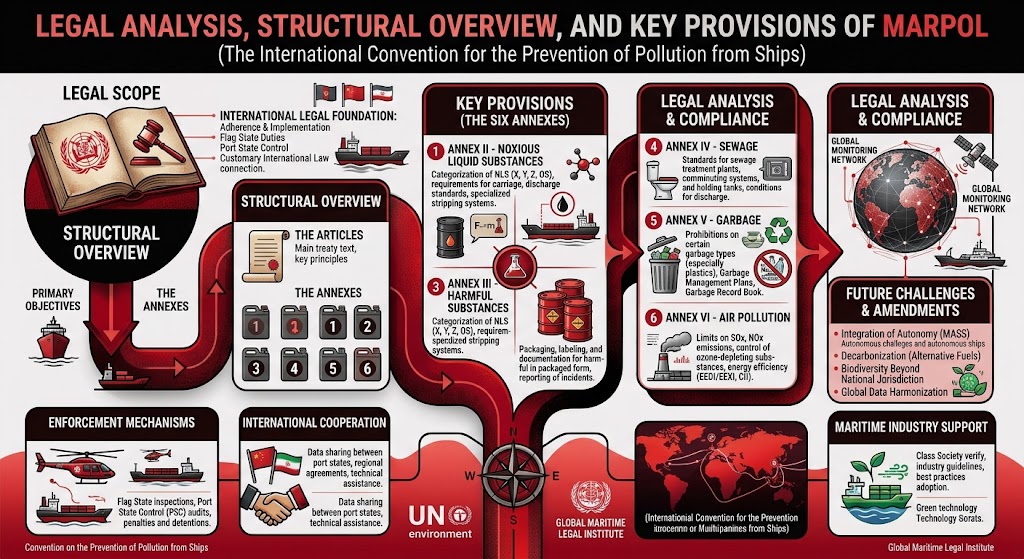
Abstract: The International Convention for the Prevention of Pollution from Ships (MARPOL) constitutes the principal international treaty governing the prevention of marine pollution by ships from operational or accidental causes. This article provides an exhaustive academic legal analysis of MARPOL, tracing its historical evolution from the 1954 OILPOL convention through the adoption of the 1973 instrument and its 1978 Protocol. It evaluates the structural architecture of the Convention, the legal character of its six Annexes, flag State and port State enforcement mechanisms, jurisdictional limitations under the United Nations Convention on the Law of the Sea (UNCLOS), and contemporary legal challenges such as greenhouse gas decarbonization and enforcement in polar regions.
Historical Background and Genesis of the Convention
The international community's initial attempts to regulate operational pollution from maritime transport materialized through the International Convention for the Prevention of Pollution of the Sea by Oil (OILPOL), adopted in 1954 under the auspices of the United Kingdom and subsequently deposited with the Inter-Governmental Maritime Consultative Organization (IMCO), which later became the International Maritime Organization (IMO). OILPOL 1954 focused primarily on deliberate discharges of persistent oils resulting from tank cleaning and ballasting operations, establishing prohibited zones near coasts. However, the regulatory efficacy of OILPOL was severely hampered by deficient enforcement mechanisms, vague discharge standards, and a lack of mandatory fitting requirements for retention on board systems, such as the load-on-top method.
Following catastrophic maritime casualties in the late 1960s and early 1970s—most notably the grounding of the supertanker Torrey Canyon off the coast of Cornwall in 1967, which spilled approximately 120,000 tonnes of crude oil—the inadequacy of existing legal regimes became glaringly apparent. The Torrey Canyon disaster exposed critical jurisdictional voids regarding salvage operations on the high seas, the limits of flag State control, and the right of coastal States to intervene beyond their territorial waters to protect their marine environments. This crisis catalyzed diplomatic momentum within the IMO, culminating in the convening of the International Conference on Marine Pollution in 1973.
The resulting International Convention for the Prevention of Pollution from Ships, adopted on 2 November 1973, represented a paradigm shift. Rather than addressing merely oil pollution, the 1973 Convention sought to establish a comprehensive legal architecture covering all forms of intentional and accidental ship-source pollution. Nevertheless, technological hurdles, stringent financial implications regarding reception facilities, and protracted domestic ratification processes threatened to stall the entry into force of the 1973 instrument. To circumvent these delays, a Conference on Tanker Safety and Pollution Prevention was convened in 1978, adopting the Protocol of 1978 relating to the International Convention for the Prevention of Pollution from Ships, 1973. The 1978 Protocol absorbed the parent convention, creating a single unified instrument commonly referred to as MARPOL 73/78, which formally entered into force on 2 October 1983 with respect to Annexes I and II.
Legal Status, Scope, and Objectives
MARPOL occupies a central position in the hierarchy of international environmental law and the law of the sea. Operating as a specialized treaty framework under the institutional umbrella of the IMO, MARPOL interacts dynamically with broader foundational instruments, notably the United Nations Convention on the Law of the Sea (UNCLOS). Article 211 of UNCLOS specifically obligates States Parties to establish international rules and standards to prevent, reduce, and control pollution of the marine environment from vessels, designating the competent international organization—universally recognized as the IMO acting through MARPOL—as the primary forum for formulating such standards.
The explicit objective of MARPOL, as articulated in its preamble and Article 1, is to achieve the complete elimination of intentional pollution of the marine environment by oil and other harmful substances and the minimization of accidental discharge of such substances. Unlike terrestrial environmental treaties that rely on territorial sovereignty, MARPOL governs activities occurring across fluid jurisdictional zones, ranging from internal waters and territorial seas to Exclusive Economic Zones (EEZs) and the high seas. The legal scope of the Convention is broad, applying to any ship entitled to fly the flag of a Party to MARPOL, as well as non-party ships under the principle of no more favorable treatment enshrined in customary international law and specific treaty provisions, ensuring that vessels of non-parties do not enjoy competitive regulatory advantages.
Treaty Structure and the Technical Annexes
The structural anatomy of MARPOL is bifurcated into a concise set of constitutional and administrative articles and a series of voluminous, highly technical Annexes. The core articles establish the general obligations, application parameters, certification procedures, inspection regimes, violation reporting mechanisms, and amendment processes. Conversely, the technical Annexes operationalize the substantive environmental standards. This modular architecture allows the IMO to update technical requirements expeditiously through the tacit acceptance procedure set forth in Article 16, bypassing the arduous, protracted domestic parliamentary ratification cycles typically required for formal treaty amendments.
- Annex I: Regulations for the Prevention of Pollution by Oil (entered into force 2 October 1983).
- Annex II: Regulations for the Control of Pollution by Noxious Liquid Substances in Bulk (entered into force 6 April 1987).
- Annex III: Prevention of Pollution by Harmful Substances Carried by Sea in Packaged Form (entered into force 1 July 1992).
- Annex IV: Prevention of Pollution by Sewage from Ships (entered into force 27 September 2003).
- Annex V: Prevention of Pollution by Garbage from Ships (entered into force 31 December 1988).
- Annex VI: Prevention of Air Pollution from Emissions from Ships (entered into force 19 May 2005).
While Annexes I and II are mandatory for all States ratifying the Convention, Annexes III through VI are optional upon accession, though subsequent protocols and widespread ratifications have rendered nearly all Annexes virtually universal among maritime nations.
Analysis of Principal Provisions and Substantive Obligations
The operational core of MARPOL is anchored in strict discharge criteria, mandatory equipment standards, and operational documentation. Under Annex I, discharges of oil or oily mixtures from machinery space bilges and cargo areas of oil tankers are strictly prohibited unless specific cumulative conditions are satisfied, such as the ship being proceeding en route, the oil content of the effluent not exceeding 15 parts per million, and the operation of approved oil-filtering equipment and an automatic stopping device. Annex I also revolutionized tanker design by mandating segregated ballast tanks and, subsequently following 1992 amendments, double-hull configurations for all new and existing oil tankers to mitigate accidental pollution resulting from collisions or groundings.
Annex II categorizes noxious liquid substances into distinct hazard categories (X, Y, Z, and Other Substances) based on their toxicity to aquatic life and human health, imposing stringent stripping and pre-wash requirements prior to the discharge of tank washings into reception facilities. Annex III regulates packaged hazardous materials in accordance with the International Maritime Dangerous Goods Code, focusing on proper stowing, labeling, and packaging to prevent loss overboard. Annex IV governs sewage discharges from passenger vessels and other ships, prohibiting untreated sewage discharges within specified distances from the nearest land. Annex V institutes a sweeping ban on the disposal of all plastics into the sea while establishing differentiated discharge regimes for food waste, cargo residues, and operational garbage based on geographical zones and ecological sensitivity.
Annex VI, representing the modern environmental frontier of MARPOL, addresses atmospheric emissions, establishing global caps on sulfur oxide (SOx) and nitrogen oxide (NOx) emissions from marine diesel engines. It introduces Emission Control Areas (ECAs) with highly stringent sulfur limits (currently 0.10% m/m), and incorporates mandatory energy efficiency frameworks, including the Energy Efficiency Design Index (EEDI) for new ships and the Ship Energy Efficiency Management Plan (SEEMP) for all vessels, designed to curtail greenhouse gas emissions.
What are the jurisdictional limits and enforcement mechanisms under MARPOL?
Enforcement under MARPOL operates through a decentralized, multi-tiered jurisdictional framework dividing responsibilities primarily between the flag State, the port State, and the coastal State. Under Article 4 of MARPOL, any violation of the Convention's requirements is prohibited, and sanctions must be established under the law of the administration of the ship concerned, wherever the violation occurs. This establishes the primacy of flag State jurisdiction: the State whose flag the ship is entitled to fly bears the fundamental legal duty to investigate alleged violations, institute judicial or administrative proceedings, and enforce penal sanctions commensurate with the gravity of the infraction.
However, recognizing the systemic shortcomings of flag States of convenience—which frequently lack the administrative capacity or economic incentive to penalize delinquent shipowners—MARPOL, in harmony with UNCLOS Article 218, empowers port States to exercise robust enforcement jurisdiction. Port State Control (PSC) officers are authorized to board foreign vessels visiting their ports to inspect certificates, operational equipment, and the Oil Record Book. If clear grounds exist—defined as evidence that the ship, its equipment, or its condition does not correspond substantially with the particulars of the international certificates—the port State may initiate a more detailed inspection and, where necessary, detain the vessel until rectifying actions are undertaken or refer the matter back to the flag State.
Furthermore, coastal States retain limited enforcement powers within their territorial seas and EEZs pursuant to UNCLOS Articles 220. Where there are clear grounds for believing that a vessel navigating in the territorial sea has violated applicable MARPOL discharge standards, the coastal State may undertake physical inspection of the vessel and, where warranted by the evidence, institute proceedings including detention. Within the EEZ, enforcement is circumscribed; physical inspection is permissible only where the vessel has committed a violation resulting in a substantial discharge causing or threatening significant pollution of the marine environment, and where the vessel has refused to give information or provided manifestly false information.
Institutional Mechanisms and Treaty Implementation
The institutional machinery driving MARPOL is anchored within the Marine Environment Protection Committee (MEPC), a principal subsidiary organ of the IMO comprising all Member States. The MEPC serves as the primary legislative and deliberative forum for evaluating technological developments, debating regulatory revisions, adopting amendments to the Annexes, and issuing unified interpretations of contentious provisions. The Committee functions via working groups and technical sub-committees, ensuring that legal frameworks keep pace with maritime engineering innovations.
To address persistent concerns regarding systemic non-compliance and variable implementation standards across national maritime administrations, the IMO established the IMO Member State Audit Scheme (IMSAMS). Originally operating on a voluntary basis, the audit scheme became mandatory upon the entry into force of the Protocol of 2014 and the corresponding amendments to MARPOL Article 6. IMSAMS systematically reviews how Parties discharge their obligations as flag, port, and coastal States under MARPOL and other mandatory IMO instruments, enhancing accountability, transparency, and uniform global implementation.
Dispute Settlement and Relevant International Jurisprudence
Dispute settlement under MARPOL is governed by Article 10 of the Convention, which provides that disputes between Parties relating to the interpretation or application of the treaty should be settled through negotiation or diplomatic channels. If such informal methods fail, the dispute may be submitted to arbitration or, by mutual consent, to the International Court of Justice (ICJ). In practice, however, direct inter-State litigation concerning MARPOL interpretation is exceptionally rare before the ICJ or arbitral tribunals.
Instead, disputes involving MARPOL provisions are frequently subsumed within broader law of the sea jurisprudence adjudicated by the International Tribunal for the Law of the Sea (ITLOS) or Annex VII arbitral tribunals, particularly within the context of prompt release proceedings under UNCLOS Article 292 or cases concerning the arrest of vessels for alleged pollution offenses. Landmark decisions by ITLOS—such as the SAIGA cases, the Voltaic Hope case, and the Enrica Lexie incident—have profoundly shaped the legal parameters governing boarding on the high seas, the necessity of posting reasonable bonds for vessel release, and the procedural due rights of flag States when port or coastal States detain ships for environmental infractions.
Relationship with Other Legal Instruments
MARPOL does not operate in a legal vacuum; it forms an integral pillar of a complex, interlocking ecosystem of international law regulating the maritime domain. Its primary statutory counterpart is UNCLOS, which establishes the constitutional framework for ocean governance. While UNCLOS articulates the overarching rights and duties of States regarding the protection and preservation of the marine environment, it explicitly delegates the elaboration of international rules and standards to competent international organizations, cementing MARPOL as the authoritative lex specialis for vessel-source pollution.
Additionally, MARPOL intersects with regional seas conventions, such as the Barcelona Convention for the Protection of the Marine Environment and the Coastal Region of the Mediterranean, which frequently designate their respective regional zones as Special Areas under MARPOL Annexes I, II, and V, thereby triggering enhanced discharge protections. Furthermore, liability and compensation conventions—such as the International Convention on Civil Liability for Oil Pollution Damage (CLC) and the International Convention on the Establishment of an International Fund for Compensation for Oil Pollution Damage (Fund Convention)—operate alongside MARPOL to address the civil law financial ramifications of pollution incidents, ensuring a seamless continuum between preventive administrative regulation and compensatory private law remedies.
How do contemporary legal challenges affect the implementation of MARPOL?
The contemporary maritime legal landscape subjects MARPOL to unprecedented pressures, primarily driven by climate change imperatives and the diversification of global shipping operations. One of the most acute contemporary legal controversies revolves around the decarbonization of international shipping and the intersection of MARPOL Annex VI with unilateral regional market-based measures, such as the European Union’s inclusion of maritime transport within its Emissions Trading System (EU ETS).
While Annex VI establishes global technical efficiency frameworks like the Carbon Intensity Indicator (CII) and EEDI, critics and developing maritime nations argue that regional regulatory overlays risk fragmenting the uniform global application mandated by IMO treaties, potentially conflicting with customary international law principles of flag State exclusivity on the high seas. Moreover, legal scholars debate whether the IMO's incremental greenhouse gas reduction targets align adequately with the objectives of the Paris Agreement, raising questions regarding the legal accountability of the organization under international environmental law.
A second major contemporary challenge involves operational compliance and enforcement in polar waters. The Polar Code, adopted jointly through amendments to MARPOL and the International Convention for the Safety of Life at Sea (SOLAS), establishes mandatory standards for ships operating in the harsh, ecologically fragile waters of the Arctic and Antarctic. However, enforcing MARPOL discharge prohibitions and environmental protection measures in remote polar regions presents formidable practical and legal hurdles, including inadequate search and rescue infrastructure, scarce emergency towing capacity, a profound lack of designated waste reception facilities in high-latitude ports, and complex jurisdictional overlays involving polar coastal States and indigenous rights.
Critical Assessment of Legal Deficits and Structural Limitations
Despite its undeniable historical success in driving a dramatic reduction in operational oil discharges from tankers, MARPOL is subject to significant structural and legal limitations. A foundational vulnerability lies in its heavy reliance on flag State enforcement. Flag States that operate open registries or flags of convenience frequently maintain minimal administrative oversight over their registered fleets, resulting in tokenistic inspections, lax disciplinary proceedings, and nominal financial penalties for non-compliance that fail to deter willful illegal discharges at sea, such as illicit bilge water pumping under the cover of darkness.
Another critical legal deficit involves the persistent inadequacy of port reception facilities globally. MARPOL Annexes mandate that Parties ensure the provision of adequate reception facilities for residues and oily mixtures without causing undue delay to ships. In practice, however, numerous developing port States fail to establish or maintain such facilities due to prohibitive financial and infrastructural costs. This creates a systemic enforcement dilemma: shipmasters are legally prohibited from discharging residues at sea but are practically unable to discharge them safely in port without incurring exorbitant fees or catastrophic commercial delays, inadvertently incentivizing illegal clandestine discharges.
Finally, evidentiary hurdles continue to plague MARPOL enforcement. Proving that an illegal discharge occurred beyond territorial waters requires sophisticated satellite surveillance, remote sensing technology, hydrocarbon sniffer aircraft, or rigorous forensic sampling of oily residues. In the absence of mandatory continuous monitoring equipment or infallible electronic record books, prosecuting environmental crimes under MARPOL frequently founders on evidentiary standards of proof required in municipal criminal courts.
Conclusion
The International Convention for the Prevention of Pollution from Ships stands as the undisputed cornerstone of international ship-source pollution control. Through its sophisticated modular architecture, technical Annexes, and dynamic integration with UNCLOS, MARPOL has successfully transformed global maritime practices over the past four decades, mitigating catastrophic operational and accidental environmental degradation. However, the Convention's long-term legal efficacy depends on its capacity to adapt to contemporary ecological imperatives, particularly global decarbonization, rigorous port State enforcement, and the amelioration of flag State compliance deficits. Addressing these systemic vulnerabilities is essential to ensuring that MARPOL remains a robust, legally authoritative instrument for the protection of the marine environment for future generations.
References
- United Nations Convention on the Law of the Sea (UNCLOS), opened for signature 10 December 1982, 1833 UNTS 3 (entered into force 16 November 1994).
- International Convention for the Prevention of Pollution from Ships (MARPOL), opened for signature 2 November 1973, 1340 UNTS 184 (entered into force 2 October 1983).
- Protocol of 1978 relating to the International Convention for the Prevention of Pollution from Ships, 1973, 1340 UNTS 61.
- International Maritime Organization (IMO). The Evolution of MARPOL Annex VI: Regulatory Frameworks for Air Pollution and Greenhouse Gas Emissions from Ships. IMO Publishing, London.
- International Tribunal for the Law of the Sea (ITLOS). Cases concerning the M/V “SAIGA” (No. 2) (Saint Vincent and the Grenadines v. Guinea), Judgment of 20 July 1999.
- Birnie, P., Boyle, A., and Redgwell, C. International Law and the Environment. Oxford University Press, 3rd edition.
- Molenaar, E. J. Port State and Regional Jurisdiction to Prevent and Punish Marine Pollution. Martinus Nijhoff Publishers.
Comments
No comments yet.