Legal Analysis, Structural Overview, and Key Provisions of the London Convention
A comprehensive academic legal analysis of the London Convention on the Prevention of Marine Pollution by Dumping of Wastes.
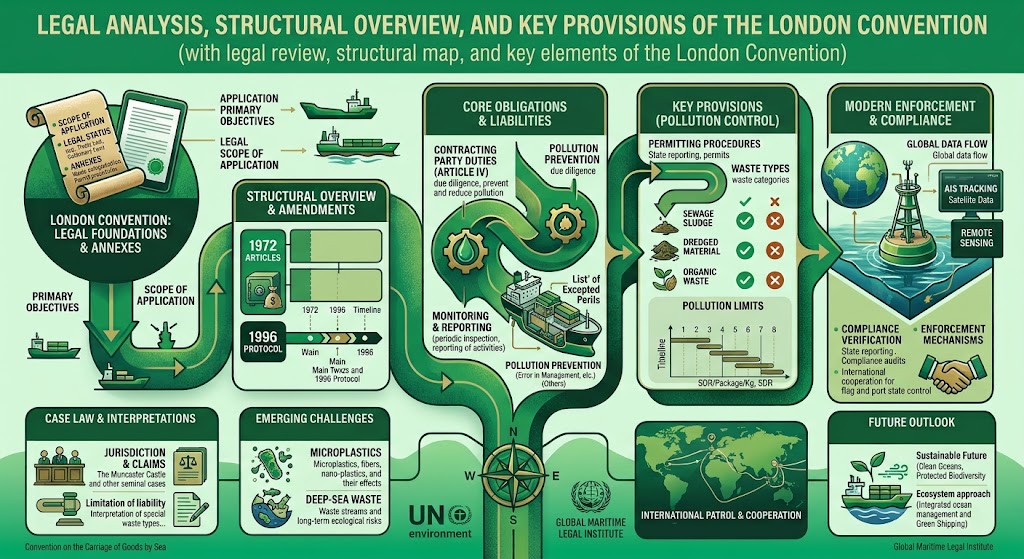
Abstract: This article offers an exhaustive legal analysis of the Convention on the Prevention of Marine Pollution by Dumping of Wastes and Other Matter, 1972, commonly known as the London Convention, alongside its 1996 Protocol. It evaluates the treaty's historical background, legal status, material and spatial scope, structural mechanics, rights and obligations, jurisdictional framework, enforcement regimes, and dispute settlement mechanisms. Furthermore, it examines the treaty's relationship with other international instruments, addresses contemporary legal challenges such as carbon capture and storage (CCS) and geoengineering, and provides a critical assessment of its efficacy in modern international environmental law.
Introduction and Historical Background
The acceleration of industrialization in the mid-twentieth century brought with it an unprecedented volume of waste materials, prompting industrialized nations to seek cost-effective disposal solutions. The world's oceans, historically perceived as an infinite sink capable of assimilating anthropogenic refuse, became primary receptacles for industrial sludge, toxic chemicals, radioactive waste, and dredged material. By the late 1960s, mounting scientific evidence revealed severe degradation of marine ecosystems, bioaccumulation of heavy metals in marine organisms, and tangible threats to human health. International consensus emerged recognizing that national regulation alone was insufficient to combat a transboundary crisis of this magnitude.
The foundational turning point occurred at the 1972 United Nations Conference on the Human Environment held in Stockholm. Principle 7 of the Stockholm Declaration explicitly called upon states to take all possible steps to prevent pollution of the seas by substances that create hazards to human health, harm living resources and marine life, or damage amenities. This momentum culminated in the Inter-Governmental Conference on the Dumping of Wastes at Sea, convened in London in November 1972. The resulting text, formally titled the Convention on the Prevention of Marine Pollution by Dumping of Wastes and Other Matter (London Convention), was adopted on December 29, 1972, and entered into force on August 30, 1975.
While the 1972 Convention successfully established a multilateral framework to regulate ocean dumping, its regulatory architecture relied heavily on a "blacklist and grey-list" approach, which permitted the dumping of unlisted substances under specific licensing conditions. Recognizing that this approach was inadequate to address the evolving realities of modern environmental protection, the international community negotiated the 1996 Protocol to the London Convention. The 1996 Protocol fundamentally modernized the legal regime by introducing the precautionary approach and reversing the regulatory presumption: whereas the 1972 Convention permitted dumping unless explicitly prohibited, the 1996 Protocol prohibited all dumping except for a strictly enumerated list of accepted wastes. Today, the London Convention and its 1996 Protocol operate in tandem, though the Protocol increasingly supersedes the original convention among modern state parties.
Legal Status, Scope, and Objectives
The London Convention constitutes a specialized treaty within the broader framework of the law of the sea, operating as a vital environmental component supplementing the United Nations Convention on the Law of the Sea (UNCLOS). Specifically, Article 210 of UNCLOS obligates states to adopt laws and regulations to prevent, reduce, and control pollution of the marine environment by dumping, specifying that such laws shall be no less effective than global rules and standards—a direct reference to the standards established under the London Convention.
The primary objective of the London Convention, as articulated in its preamble and operational articles, is to promote the effective control of all sources of marine pollution and to pledge spécialement to take all practicable steps to prevent the pollution of the sea by the dumping of waste and other matter that is liable to create hazards to human health, to harm living resources and marine life, to damage amenities, or to interfere with other legitimate uses of the sea.
The material scope of the treaty encompasses any deliberate disposal at sea of wastes or other matter from vessels, aircraft, platforms, or other man-made structures at sea, as well as the deliberate disposal of vessels, aircraft, platforms, or other man-made structures themselves. However, the treaty's definition of "dumping" explicitly excludes:
- The disposal at sea of wastes or other matter incidental to, or derived from, the normal operations of vessels, aircraft, platforms, or other man-made structures at sea and their equipment, provided that such disposal does not derogate from the purpose of the convention; and
- Placement of matter for a purpose other than the mere disposal thereof, provided that such placement is not contrary to the aims of the convention.
The spatial scope covers all marine waters other than the internal waters of states. While internal waters are formally excluded from the direct jurisdictional reach of the convention, Article VII mandates that each contracting party shall apply the measures required under the convention to all vessels and aircraft registered in its territory or flying its flag, and to all vessels and aircraft loading in its territory or territorial sea wastes or other matter intended for dumping, wherever such dumping may occur.
What are the fundamental treaty structures and principal provisions of the London Convention?
The structural anatomy of the 1972 London Convention comprises a preamble, twenty-two operational articles, and three technical annexes. The 1996 Protocol adopts a similar framework but introduces structural modernizations, most notably the elimination of the original annexes in favor of a consolidated framework supported by specific guidelines.
The core of the 1972 Convention rests on its annex system:
- Annex I (The Blacklist): Prohibits the dumping of specified hazardous substances, including organohalogen compounds, mercury and mercury compounds, cadmium and cadmium compounds, persistent plastics, crude oil and petroleum products, high-level radioactive wastes, and materials designed for biological and chemical warfare. An exception is made under Article IV(2) for substances posing no more than a trace contaminant risk, or harmless materials subject to a special permit.
- Annex II (The Grey-List): Requires a prior special permit for the dumping of wastes containing significant amounts of noxious substances, such as arsenic, lead, copper, zinc, cyanides, fluorides, and low-level radioactive wastes, as well as containers and heavy scrap metal.
- Annex III: Establishes detailed provisions to be considered in establishing criteria governing the issuance of special and general permits, encompassing the characteristics and composition of the matter, characteristics of the dumping site, and general considerations such as economic and operational impacts.
Under Article IV, the issuance of permits requires competent national authorities to evaluate comprehensive environmental impact assessments. For substances not listed in Annexes I or II, a general permit is required under Annex III provisions. The institutional machinery relies on Consultative Meetings of the Contracting Parties, supported by a Secretariat hosted by the International Maritime Organization (IMO). These Consultative Meetings possess the authority to adopt amendments to the annexes, a process that operates under tacit acceptance procedures designed to streamline regulatory updates without requiring full parliamentary ratification across all member states.
Rights, Obligations, and Jurisdictional Framework
The allocation of rights and obligations under the London Convention is structured around the principle of state responsibility for marine environmental protection. Contracting parties undertake the primary obligation individually and collectively to protect and preserve the marine environment against pollution caused by dumping. To effectuate this, Article VII requires each party to take appropriate measures to prevent and punish conduct in contravention of the provisions of the convention.
The jurisdictional framework relies heavily on flag state, port state, and coastal state competencies:
- Flag State Jurisdiction: Parties must enforce the convention's provisions against vessels flying their flag or registered in their territory, regardless of where the dumping activity occurs.
- Port State Jurisdiction: Parties are obligated to take measures against vessels and aircraft loading wastes in their territory or territorial sea that are intended for dumping.
- Coastal State Jurisdiction: Parties exercise jurisdiction within their territorial seas and exclusive economic zones to ensure that foreign vessels do not engage in unauthorized dumping, consistent with international law as codified in UNCLOS.
Exceptions to the strict prohibitions are provided under Article V in cases of force majeure. Specifically, the prohibitions do not apply when the safety of human life or of a vessel, aircraft, platform, or other man-made structure is threatened by complete destruction or total loss, or in any case constituting a danger to life, if dumping appears to be the only way of averting the threat and if there is every probability that the damage consequent upon such dumping will be less than would otherwise occur. Such emergency dumping must be reported immediately to the IMO and any state that is likely to be affected.
How does the 1996 Protocol modernize and alter the obligations of the London Convention?
The adoption of the 1996 Protocol marked a profound paradigm shift in international environmental jurisprudence. Rather than amending the text of the 1972 Convention directly, the Protocol established an autonomous legal regime that eventually superseded the original convention for the states that ratified it.
The foundational philosophical shift of the 1996 Protocol is embodied in Article 3, which mandates the application of the precautionary approach. Under this principle, appropriate preventative measures are to be taken when there is reason to believe that wastes or other matter introduced into the marine environment are likely to cause harm even when there is no conclusive scientific evidence to prove a causal relation between inputs and their effects.
Furthermore, Article 3 embeds the "polluter pays" principle, stipulating that the polluter should, in principle, bear the cost of pollution. Most importantly, Article 4 reverses the regulatory presumption through the introduction of the "reverse list" approach. It states:
Contracting Parties shall prohibit the dumping of any wastes or other matter other than those listed in Annex 1 to this Protocol.
Annex 1 of the 1996 Protocol enumerates only a restricted category of materials whose dumping may be considered, namely:
- Dredged material;
- Sewage sludge;
- Fish waste or material resulting from industrial fish processing operations;
- Vessels and platforms or other man-made structures at sea;
- Inert, inorganic geological material;
- Organic material of natural origin; and
- Bulky items primarily comprising iron, steel, concrete, and similar non-harmful materials, for use in circumstances where such physical placement is designed to enhance marine life, only in locations where such wastes cannot be recycled or disposed of on land without unacceptable risk or cost.
Article 4 explicitly prohibits the incineration at sea of wastes or other matter, a practice previously regulated under the 1972 Convention, and bans the export of wastes and other matter to non-parties for dumping or incineration at sea. This modernization ensures that the treaty aligns with contemporary standards of sustainable development and international environmental governance.
Enforcement, Compliance, and Dispute Settlement
The enforcement regime of the London Convention relies primarily upon the domestic legal systems of the contracting parties. Article VII(1) mandates that each contracting party shall apply the measures required under the convention to all vessels and aircraft registered in its territory or flying its flag, and to all vessels and aircraft loading in its territory or territorial sea wastes or other matter intended for dumping. If a party observes actions in violation of the convention, it is obligated to report the matter to the flag state and, where appropriate, to the IMO.
Despite these mandates, the decentralized nature of enforcement has historically posed challenges. Unlike specialized regional conventions with dedicated maritime inspection fleets, the London Convention depends on the vigilance of individual flag and port states to investigate and prosecute violations. To bolster compliance, the governing bodies introduced non-confrontational, facilitative compliance procedures under the 1996 Protocol, aiming to assist states in meeting their obligations rather than relying solely on punitive measures.
Dispute settlement under the 1972 Convention is governed by Article XI, which provides for negotiation, referral to the Consultative Meeting of the Contracting Parties, or, failing resolution, submission to arbitration in accordance with procedures to be adopted by the parties. The 1996 Protocol enhances these mechanisms by incorporating a comprehensive annex on arbitral procedures, drawing heavily upon standard international dispute settlement models found in UNCLOS and other multilateral environmental agreements. These mechanisms provide for binding third-party adjudication when diplomatic channels fail to resolve disputes regarding the interpretation or application of the treaty provisions.
Relationships with Other International Legal Instruments
The London Convention does not operate in a legal vacuum; its efficacy depends upon harmonious interaction with a complex matrix of international, regional, and national legal instruments. At the global level, its primary symbiotic relationship is with the United Nations Convention on the Law of the Sea (UNCLOS). Article 210 of UNCLOS establishes the overarching duty of states to adopt national laws and international rules to prevent marine pollution from dumping, explicitly tying the standard of national legislation to global rules established through competent international organizations—namely, the IMO acting via the London Convention framework.
Regionally, the London Convention coexists with a network of specialized regional seas conventions, such as the Oslo-Paris (OSPAR) Convention for the Protection of the Marine Environment of the North-East Atlantic, the Barcelona Convention for the Protection of the Marine Environment and the Coastal Region of the Mediterranean, and the Helsinki Convention on the Protection of the Marine Environment of the Baltic Sea Area. Article VIII of the London Convention explicitly encourages contracting parties with common interests to enter into regional agreements consistent with the global convention. In practice, regional agreements often establish stricter environmental standards than the global baseline, creating a tiered regulatory architecture where regional bodies act as laboratories for advanced marine protection.
Furthermore, the London Convention intersects with international waste management regimes, particularly the Basel Convention on the Control of Transboundary Movements of Hazardous Wastes and Their Disposal. While the Basel Convention excludes wastes derived from the normal operations of ships or governed by other specific international regimes, jurisdictional overlaps occasionally arise regarding the transboundary movement of hazardous materials intended for final disposal or processing, requiring careful institutional coordination between the IMO and the Secretariat of the Basel Convention.
What are the contemporary legal challenges and emerging issues facing the London Convention?
As maritime industries evolve and technological innovations emerge to combat global climate change, the London Convention and its 1996 Protocol face novel legal challenges that test the elasticity of their textual provisions. Two prominent areas of contemporary debate involve Carbon Capture and Storage (CCS) and marine geoengineering.
Under the traditional framework of the 1972 Convention, the sub-seabed geological sequestration of carbon dioxide streams captured from industrial processes was legally precarious, as it could be construed as unauthorized dumping or disposal of industrial waste. Recognizing the imperative to facilitate carbon mitigation technologies, the contracting parties adopted a groundbreaking amendment to Annex 1 of the 1996 Protocol in 2006. This amendment explicitly permitted the storage of $ ext{CO}_2$ streams from industrial capture processes in sub-seabed geological formations, provided that the storage is into a sub-seabed geological formation, the $ ext{CO}_2$ stream consists overwhelmingly of carbon dioxide, and no wastes or other matter are added for the purpose of disposing of those wastes or other matter. To address the export of $ ext{CO}_2$ for sub-seabed disposal—a critical issue for landlocked or small island states lacking domestic storage sites—parties subsequently adopted an amendment to Article 6 of the Protocol in 2009 to permit such transboundary export under strict bilateral or multilateral arrangements, though securing universal ratification has proven politically and legally demanding.
Marine geoengineering presents an even more complex regulatory frontier. Techniques designed to alter the Earth's climate system through large-scale manipulation of the marine environment—such as ocean fertilization to stimulate phytoplankton growth for carbon sequestration, ocean alkalinization, and artificial upwelling—threaten to bypass traditional waste-dumping definitions. In response, the contracting parties adopted a historic resolution in 2008 and a binding amendment in 2013 (Resolution LP.4(8)) to amend the 1996 Protocol. This amendment establishes a rigorous regulatory framework for marine geoengineering, prohibiting ocean fertilization activities unless authorized by specific assessment frameworks, and extending the treaty's mandate beyond traditional "waste dumping" to encompass the intentional introduction of matter for non-waste purposes that pose potential risks to the marine environment. This evolution demonstrates the treaty's capacity to adapt from a narrow waste-disposal regulation into a comprehensive instrument for safeguarding ocean integrity against anthropogenic climate interventions.
Critical Assessment
A rigorous critical assessment of the London Convention and its 1996 Protocol reveals a legal regime characterized by significant normative achievements alongside persistent structural limitations. On the positive side, the treaty has successfully transformed global consciousness regarding the oceans, shifting the prevailing mid-twentieth-century attitude of unrestrained oceanic disposal to one of strict precautionary regulation. The complete phase-out of industrial waste dumping at sea, the prohibition of radioactive waste dumping, and the successful modernization achieved through the 1996 Protocol represent major milestones in international environmental law.
However, several structural weaknesses remain. First, the enforcement mechanism is heavily reliant on the political will and administrative capacity of individual flag and port states. Unlike international trade or civil aviation regimes with robust centralized inspection mechanisms, the London Convention lacks an independent enforcement agency capable of independently patrolling international waters or conducting binding compliance audits without state consent.
Second, the dual-track legal reality—whereby some contracting parties remain bound exclusively by the 1972 Convention while others have transitioned to the 1996 Protocol—creates legal fragmentation and uneven standards across different maritime regions. Although the 1996 Protocol is steadily replacing the original convention, the persistence of the 1972 text in certain jurisdictions dilutes the global enforcement floor.
Finally, the expanding mandate of the treaty into areas such as climate intervention and marine geoengineering, while necessary to fill regulatory vacuums, strains the institutional capacity of the IMO and national administrations. The technical complexity of assessing the long-term ecological risks of geoengineering projects requires sophisticated scientific input that may outpace the administrative resources of developing nation parties, risking a compliance divide.
Conclusion
The Convention on the Prevention of Marine Pollution by Dumping of Wastes and Other Matter, 1972, and its 1996 Protocol constitute an indispensable pillar of international environmental and maritime law. By transitioning from a permissive regulatory model based on prohibited blacklists to a rigorous precautionary framework centered on reverse listing, the treaty regime has demonstrated remarkable institutional adaptability. While challenges regarding decentralized enforcement, jurisdictional fragmentation, and the regulation of emerging climate technologies persist, the London Convention remains the primary international bulwark protecting the global marine environment from the deleterious impacts of anthropogenic waste disposal and ocean manipulation.
References
- Convention on the Prevention of Marine Pollution by Dumping of Wastes and Other Matter, Dec. 29, 1972, 26 U.S.T. 2403, 1046 U.N.T.S. 120.
- 1996 Protocol to the Convention on the Prevention of Marine Pollution by Dumping of Wastes and Other Matter, 1972, Nov. 7, 1996, 36 I.L.M. 1.
- United Nations Convention on the Law of the Sea (UNCLOS), Dec. 10, 1982, 1833 U.N.T.S. 3.
- International Maritime Organization (IMO). London Convention and Protocol: Overview. Available via official IMO legal publications.
- Resolution LP.4(8) on the Amendment to the 1996 Protocol to the London Convention, 2013 (Marine Geoengineering).
Comments
No comments yet.