Legal Analysis, Structural Overview, and Key Provisions of the Torremolinos Convention for Fishing Vessel Safety
This academic analysis explores the legal evolution, technical standards, and enforcement mechanisms of the Torremolinos Convention and the 2012 Cape Town Agreement.
Abstract: This article provides a rigorous legal analysis of the Torremolinos International Convention for the Safety of Fishing Vessels (SFV), its subsequent 1993 Protocol, and the definitive 2012 Cape Town Agreement. Despite the maritime industry’s reliance on international standards like SOLAS, the fishing sector has historically operated under a fragmented regulatory regime. This study examines the convention's historical background, legal character, jurisdictional implications, and the technical annexes governing vessel stability, construction, and life-saving appliances. By analyzing the intersection of flag state duties and port state control, the article evaluates the convention’s role in mitigating the high mortality rates in global fisheries and its contribution to the broader international maritime legal order.
Introduction to the Legal Framework for Fishing Vessel Safety
The global fishing industry is recognized by the International Labour Organization (ILO) and the Food and Agriculture Organization (FAO) as one of the most hazardous occupations in the world. Historically, while merchant shipping benefited from the comprehensive safety standards of the International Convention for the Safety of Life at Sea (SOLAS), fishing vessels were largely excluded from these international mandates due to the unique nature of their operations, diverse hull designs, and varied regional practices. The Torremolinos International Convention for the Safety of Fishing Vessels (1977) was the first global attempt to establish a uniform legal regime for the design, construction, and equipment of fishing vessels. However, the path toward a binding international instrument has been fraught with legal and political obstacles, leading to a decades-long evolution toward the 2012 Cape Town Agreement (CTA).
Historical Background: From 1977 to the Cape Town Agreement
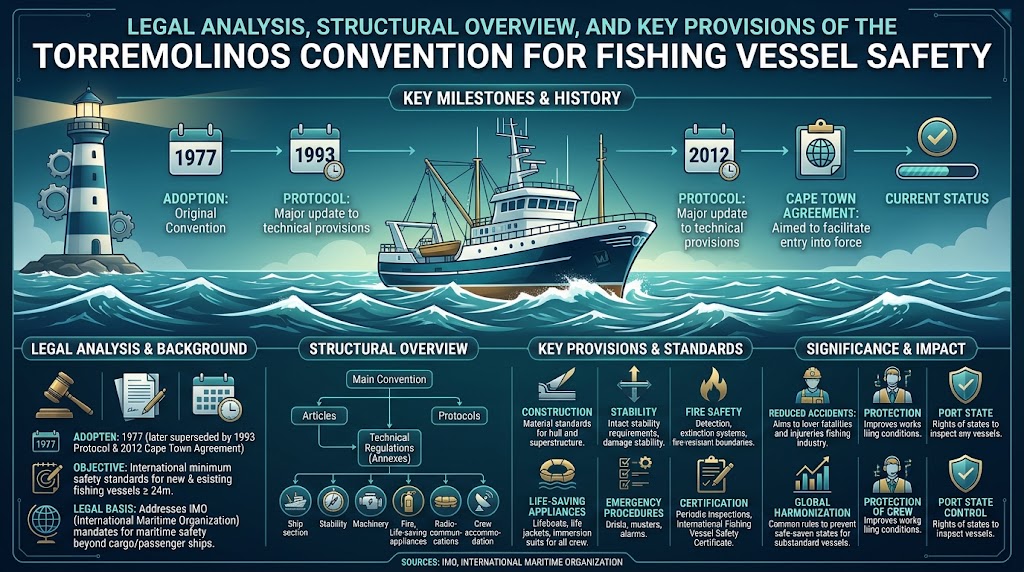
The original 1977 Convention, adopted in Torremolinos, Spain, sought to provide safety standards for fishing vessels of 24 meters in length and over. Despite its pioneering nature, the convention failed to enter into force because the required number of ratifying states, particularly those with large fishing fleets, could not be reached. The technical nature of the requirements was deemed too onerous for many developing nations and those with specialized fleets.
In response, the IMO convened another conference in 1993 to adopt the Torremolinos Protocol. This protocol was intended to update the 1977 Convention and introduce more flexible regional standards. Nevertheless, the 1993 Protocol also remained stagnant, failing to meet the entry-into-force criteria. The legal impasse was finally addressed in 2012 through the Cape Town Agreement, which significantly amended the technical requirements and simplified the ratification process, aiming to provide a realistic pathway for the convention’s principles to become mandatory international law.
What are the main objectives of the Torremolinos Convention?
The primary objective of the Torremolinos Convention and its successor instruments is the protection of human life at sea within the fishing sector. Legally, this objective is pursued through three primary avenues:
- Harmonization of Standards: To establish a uniform set of technical regulations for vessel stability, machinery, and electrical installations that apply across all jurisdictions, thereby eliminating the safety gaps created by disparate national laws.
- Flag State Accountability: To clarify the legal obligations of flag states in ensuring that vessels under their registry comply with rigorous safety audits and certification processes.
- Reduction of Maritime Casualties: To lower the incidence of vessel capsizing, fires, and equipment failures, which are the leading causes of death in the industry.
Beyond safety, a secondary but increasingly vital objective is the suppression of Illegal, Unreported, and Unregulated (IUU) fishing. By requiring mandatory safety certifications, the convention provides maritime authorities with a legal lever to identify and detain non-compliant vessels often involved in illicit fishing activities.
Legal Status and Structure of the Convention
The legal status of the Torremolinos regime currently rests on the 2012 Cape Town Agreement. For the Agreement to enter into force, it requires ratification by at least 22 states with an aggregate number of 3,600 fishing vessels of 24 meters in length and over operating on the high seas. This threshold is specifically designed to ensure that the regime captures a significant portion of the global industrial fishing fleet.
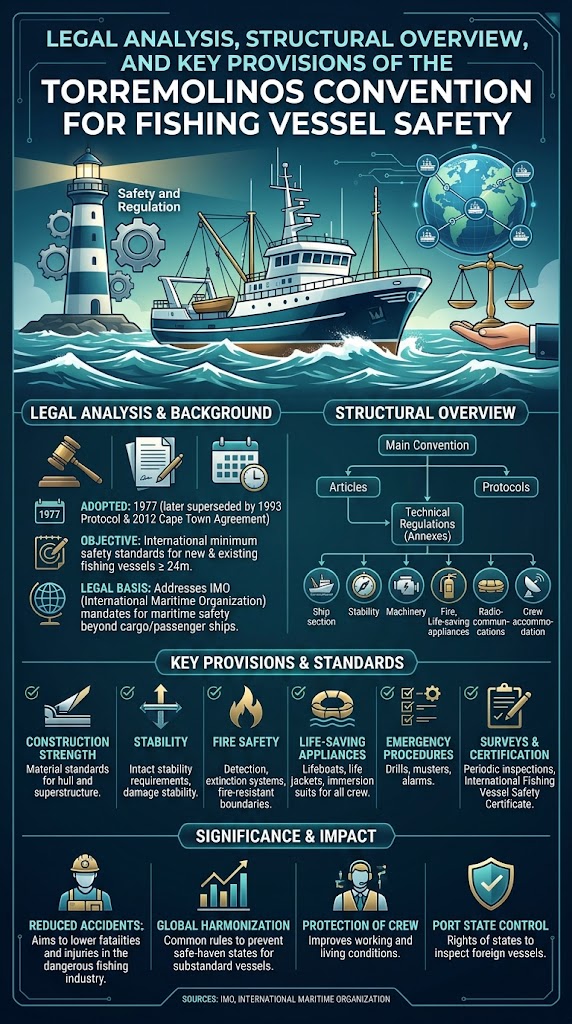
The structure of the convention is hierarchical. The main body contains the articles governing the legal obligations, entry into force, amendment procedures, and dispute settlement. The technical core is found in the Annex, which contains ten chapters covering:
- General Provisions (Definitions and Scope)
- Construction, Watertight Integrity, and Equipment
- Stability and Associated Seaworthiness
- Machinery and Electrical Installations
- Fire Protection, Fire Detection, Fire Extinction, and Fire Fighting
- Protection of the Crew
- Life-Saving Appliances and Arrangements
- Emergency Procedures, Musters, and Drills
- Radiocommunications
- Shipborne Navigational Equipment and Arrangements
Which vessels are covered by the Torremolinos Convention?
The scope of the convention is defined by the ratione materiae and ratione dimensionis of the vessel. Generally, the convention applies to new fishing vessels of 24 meters in length and over. However, the 2012 Agreement allows for certain exemptions and phased implementations for existing vessels, recognizing the economic burden of retrofitting older fleets. Vessels used solely for sport or recreation, or those not engaged in commercial fishing activities, are excluded from the scope. Furthermore, while the primary threshold is 24 meters, certain chapters regarding radiocommunications and navigational equipment may apply to smaller vessels depending on the domestic regulations of the contracting party and the vessel’s area of operation.
Principal Provisions and Technical Standards
The heart of the convention lies in its technical provisions. Chapter II focuses on watertight integrity, requiring vessels to withstand various sea states through specific hull design and closing mechanisms for hatches and ports. Chapter III, concerning stability, is perhaps the most critical for fishing vessels, which often carry heavy gear and changing loads of catch. It mandates a minimum metacentric height and stability curves that must be verified through inclining tests.
Chapter VII introduces mandatory requirements for life-saving appliances (LSAs), such as lifeboats, life rafts, and immersion suits. Unlike the general SOLAS requirements, these are tailored to the specific deck configurations of fishing vessels, where space is often limited by fishing gear. The convention also emphasizes fire safety (Chapter V), noting that fire in a remote fishing ground is significantly more lethal than in a coastal environment.
How does port state control apply to fishing vessels?
One of the most powerful legal mechanisms within the Cape Town Agreement is the provision for Port State Control (PSC). Under Article 4 of the Agreement, and consistent with the general principles of international maritime law as seen in the United Nations Convention on the Law of the Sea (UNCLOS), a port state has the authority to inspect foreign fishing vessels to ensure compliance with international safety standards.
If an inspector finds that a vessel does not meet the standards prescribed in the convention, the port state can prevent the vessel from sailing until it no longer poses a danger to the crew or the environment. This is known as the "No More Favourable Treatment" principle. It ensures that vessels from non-contracting states do not gain a competitive advantage by operating at lower safety levels when visiting the ports of states that have ratified the convention. This provides a robust enforcement mechanism that extends the reach of the convention even to states that are not yet parties to it.
Why has the Cape Town Agreement not entered into force?
The delay in the entry into force of the Cape Town Agreement is a subject of significant legal and political scrutiny. Several factors contribute to this sluggish adoption:
"The primary barrier is the perceived cost of compliance for developing nations and the technical complexity of surveying large, decentralized fishing fleets that often operate in remote regions far from administrative oversight."
Legally, some states argue that their domestic maritime administrations lack the technical expertise to conduct the specialized surveys required by the convention. Additionally, there has been a historical lack of political will to prioritize fishing vessel safety over economic output. However, recent global campaigns by the IMO and non-governmental organizations like The Pew Charitable Trusts have accelerated ratifications, with many major maritime nations now viewing the CTA as a prerequisite for sustainable ocean governance.
What is the relationship between fishing safety and IUU fishing?
There is a documented legal and operational nexus between the safety of fishing vessels and the suppression of Illegal, Unreported, and Unregulated (IUU) fishing. Vessels engaged in IUU fishing frequently disregard safety standards to maximize profits and minimize detection. By operating substandard vessels, these actors endanger their crews and evade the regulatory reach of flag states.
The Cape Town Agreement serves as a pillar of the "Triple Pillar" approach to ocean governance, alongside the FAO Port State Measures Agreement (PSMA) and the IMO STCW-F Convention on training. When a vessel is inspected for safety under the CTA, it creates a paper trail (certificates of registry, safety certificates, crew lists) that allows authorities to verify the vessel's identity and activity. Failure to produce valid safety documentation is often a "red flag" for other illicit activities, including labor abuses and illegal harvesting of marine resources.
Institutional Mechanisms and Dispute Settlement
The International Maritime Organization serves as the depositary and institutional home for the convention. The Maritime Safety Committee (MSC) of the IMO is responsible for the ongoing technical updates to the Annexes. In terms of dispute settlement, the convention typically relies on the standard maritime legal framework, where parties are encouraged to settle disputes through negotiation or mediation. If these fail, disputes regarding the interpretation of the convention may be referred to the International Tribunal for the Law of the Sea (ITLOS) or an arbitral tribunal, provided the parties involved have accepted such jurisdiction under UNCLOS.
Critical Assessment: Challenges and Practical Implications
A critical assessment of the Torremolinos regime reveals both its necessity and its limitations. The primary limitation is the 24-meter threshold. While this covers industrial vessels responsible for a large portion of the global catch, it excludes millions of smaller artisanal and semi-industrial fishing vessels where the majority of fatalities occur. Critics argue that until international law addresses the safety of the small-scale fleet, the global mortality rate in fishing will remain high.
Furthermore, the reliance on flag state implementation remains a weakness. Flags of convenience often lack the desire or capacity to enforce technical standards, creating "safety havens" for substandard operators. The effectiveness of the Cape Town Agreement will therefore depend heavily on the rigorous application of Port State Control to create a global environment where non-compliance is economically and operationally non-viable.
Conclusion
The Torremolinos International Convention, through its modernization in the 2012 Cape Town Agreement, represents the most significant legal development in maritime safety of the 21st century. By establishing mandatory technical standards for fishing vessels, it seeks to close a dangerous gap in the international maritime regulatory framework. Although the journey toward entry into force has been protracted, the legal effects of the convention are already being felt through the proactive adoption of its standards by leading maritime nations and regional port state control regimes. For the legal professional, the convention offers a complex interplay of administrative law, international treaty law, and technical regulation that is essential for the future of sustainable and safe ocean exploitation.
References
- International Maritime Organization. (2012). Cape Town Agreement of 2012 on the Implementation of the Provisions of the Torremolinos Protocol of 1993 relating to the Torremolinos International Convention for the Safety of Fishing Vessels, 1977.
- Food and Agriculture Organization of the United Nations. (2020). The State of World Fisheries and Aquaculture: Sustainability in Action.
- Pew Charitable Trusts. (2021). The Cape Town Agreement: Explaining the International Treaty for Fishing Vessel Safety.
- United Nations Convention on the Law of the Sea (UNCLOS), 1982.
- International Labour Organization. (2007). Work in Fishing Convention (No. 188).
- IMO Resolution A.1107(29). (2015). Strategic Plan for the Organization for the Six-Year Period 2016 to 2021.
Comments
No comments yet.