Algorithmic Seaworthiness and Navigational Fault: Reconstructing Maritime Liability for Autonomous Vessels
This study investigates how autonomous maritime surface ships destabilize international admiralty law, analyzing fault liability, seaworthiness, and collision conventions.
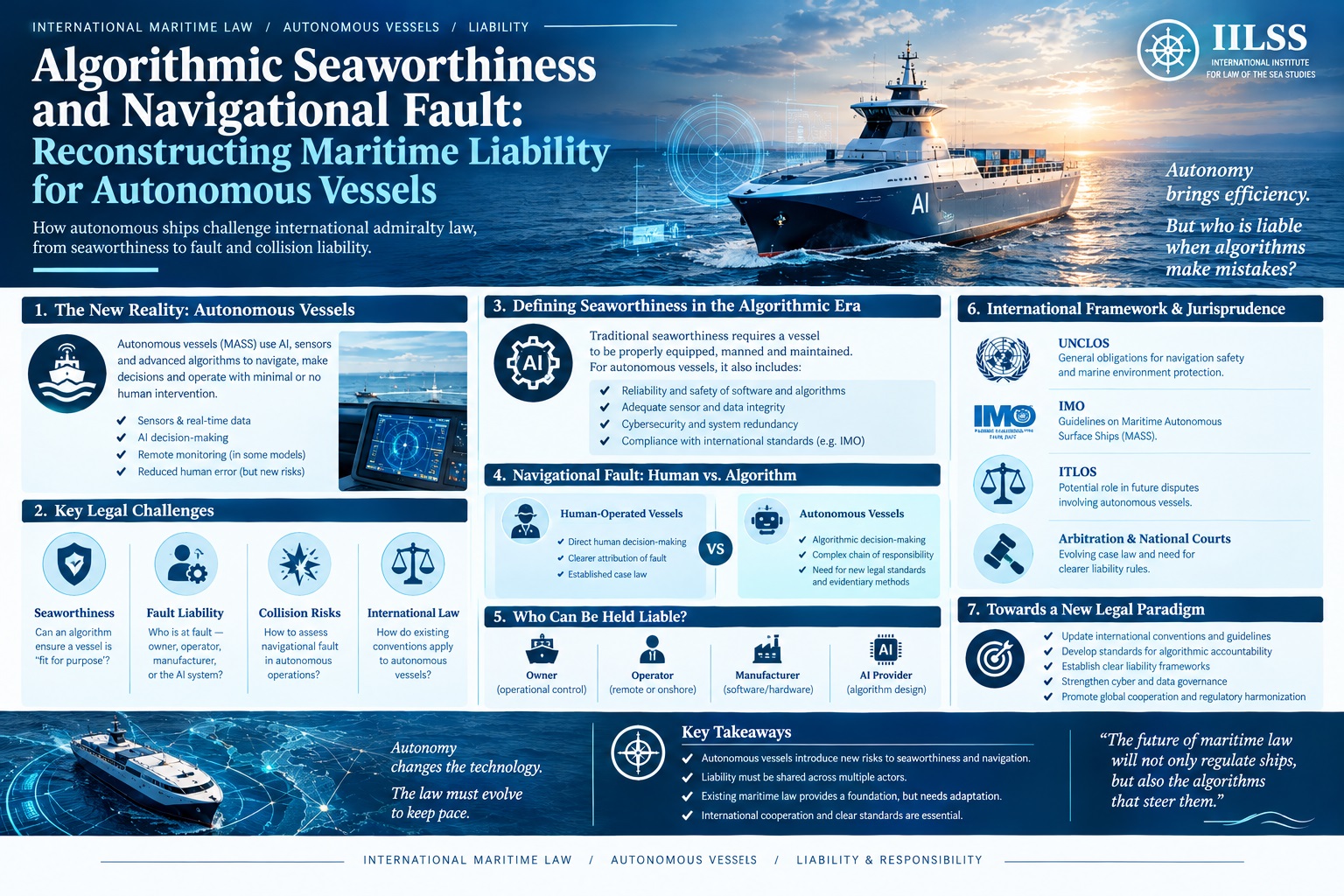
The advent of Maritime Autonomous Surface Ships (MASS) introduces profound structural friction into the corpus of public and private maritime law. For centuries, admiralty jurisprudence has anchored its allocation of risk, fault, and liability upon an indelible premise: the physical presence of a human master and crew exercising professional discretion on the high seas. This human-centric edifice, crystallized in instruments such as the United Nations Convention on the Law of the Sea 1982 (UNCLOS), the Convention on the International Regulations for Preventing Collisions at Sea 1972 (COLREGs), and the International Convention for the Safety of Life at Sea 1974 (SOLAS), faces systemic destabilization as decision-making authority migrates from human mariners to synthetic neural networks, deterministic algorithms, and shore-based remote operators.
The International Maritime Organization (IMO) classifies autonomous vessels into four distinct operational degrees, ranging from ships with automated processes and decision support (Degree One) to fully autonomous systems wherein the vessel operating system calculates consequences and executes actions unassisted by human intervention (Degree Four). While operational trials continue across sovereign littorals, the legal architecture governing international shipping remains deeply tethered to fault-based liability paradigms. The intersection of algorithmic agency with international maritime conventions precipitates critical jurisprudential inquiries regarding the legal status of the master, the scope of the duty of prudent seamanship, and the viability of centuries-old liability limitation regimes.
The Doctrinal Tension Between Public Maritime Law and Unmanned Navigation
At the inter-State level, the threshold barrier to the operation of autonomous vessels lies within UNCLOS Article 94. Under this provision, every flag State must effectively exercise its jurisdiction and control in administrative, technical, and social matters over ships flying its flag. Specifically, Article 94(3)(b) and Article 94(4)(b) mandate that every State take necessary measures to ensure that each ship is in the charge of a master and officers who possess appropriate qualifications, and that the crew is appropriate in qualification and numbers for the size, type, machinery, and equipment of the ship.
A textualist reading of Article 94 suggests that physical crew embarkation constitutes an immutable prerequisite of flag State compliance. In the M/V Saiga (No. 2) Case (Saint Vincent and the Grenadines v. Guinea), the International Tribunal for the Law of the Sea (ITLOS) reaffirmed that the duties enumerated under Article 94 are binding obligations intended to guarantee maritime safety and order across the international commons. If an autonomous vessel operates without a physical master or crew, does the flag State breach its international due diligence obligations, thereby attracting State responsibility under customary international law as codified in the Articles on Responsibility of States for Internationally Wrongful Acts?
Scholarly discourse diverges along two primary interpretive methodologies. The traditionalist approach contends that the ordinary meaning of terms under Article 31 of the Vienna Convention on the Law of Treaties dictates that a master must be an identifiable, natural person physically stationed on board the vessel. Conversely, an evolutionary interpretation posits that the regulatory teleology of Article 94 centers upon safe navigational management rather than somatic embodiment. Under this view, an ashore remote operations center (ROC) controller, or an authorized corporate entity superintending automated navigation, fulfills the functional duties historically entrusted to the shipmaster. Nevertheless, this teleological adaptation encounters acute friction with parallel international standards, particularly the International Convention on Standards of Training, Certification and Watchkeeping for Seafarers 1978 (STCW), whose competencies presuppose human sensory perception and psychological endurance on the bridge.
Can an unmanned ship be legally seaworthy?
Within the private law sphere, particularly in the law of carriage of goods by sea, seaworthiness constitutes an overarching undertaking. Under Article III, Rule 1 of the Hague and Hague-Visby Rules, the carrier is bound, before and at the beginning of the voyage, to exercise due diligence to make the ship seaworthy, properly man, equip, and supply the ship, and make the holds fit and safe for cargo reception. Historically, the common law established an absolute warranty of seaworthiness at the commencement of each voyage stage, as articulated in early English authorities like Kopitoff v. Wilson (1876) and Steel v. State Line Steamship Co. (1877), which statute subsequently attenuated to a non-delegable duty of due diligence.
The standard of seaworthiness has never been static; it reflects an objective assessment of whether a prudent shipowner would have sent the vessel to sea had they possessed knowledge of the relevant defect at the relevant time, a test tracing back to McFadden v. Blue Star Line (1905). Traditionally, seaworthiness incorporates three distinct dimensions: physical hull and engine integrity, cargoworthiness, and human competency. In The Makedonia (1958), the court reinforced that a vessel lacking an adequately trained or competent crew is unseaworthy as a matter of law.
The deployment of autonomous platforms fundamentally recasts this taxonomy. In an unmanned ship, does software replace the human element of crew competence, or does it assimilate entirely into the mechanical seaworthiness of the vessel? If algorithmic decision-making models rely on probabilistic deep-learning frameworks that are inherently opaque—the classic black box dilemma—can a carrier demonstrate the exercise of due diligence under Article III, Rule 1? If an autonomous container ship runs aground due to an unprecedented edge-case scenario unrecognized by its training dataset, the carrier cannot claim navigational error under the contractual exemptions if the failure demonstrates an intrinsic algorithmic deficiency existing prior to voyage commencement.
This dynamic shifts the battleground of maritime claims. Under Article IV, Rule 2(a) of the Hague-Visby Rules, the carrier is insulated from liability for cargo loss or damage arising from the act, neglect, or default of the master, mariner, pilot, or the servants of the carrier in the navigation or in the management of the ship. This nautical fault exception represents one of the most significant defenses available to shipowners. However, this exception is strictly conditioned upon the prior fulfillment of the carrier’s due diligence obligation to provide a seaworthy ship, as established in Maxine Footwear Co. Ltd. v. Canadian Government Merchant Marine Ltd. (1959). If systemic algorithmic vulnerability or obsolete sensor calibration is characterized as unseaworthiness rather than navigational fault, the carrier loses the protection of Rule 2(a) entirely.
Who is liable for an autonomous ship collision?
In high seas collisions, the determination of civil liability remains grounded in the International Convention for the Unification of Certain Rules of Law with respect to Collisions between Vessels 1910 (the Collision Convention 1910). The core premise of the Convention, expressed in Articles 2, 3, and 4, is that liability follows fault: if the collision is caused by the fault of one of the vessels, liability to make good the damages attaches to that vessel, and if two or more vessels are in fault, the liability of each vessel is in proportion to the degree of the faults respectively committed.
Fault in maritime collision law is traditionally gauged against compliance with the COLREGs. Two provisions create acute legal friction for autonomous systems: Rule 5, governing look-out, and Rule 2, establishing the responsibility of the master and crew to adhere to the ordinary practice of seamen. Rule 5 mandates that every vessel shall at all times maintain a proper look-out by sight and hearing as well as by all available means appropriate in the prevailing circumstances and conditions so as to make a full appraisal of the situation and of the risk of collision.
The literal phrasing—by sight and hearing—has historically mandated human perception. In landmark English Admiralty Court rulings, such as The Pelopidas (1981) and The Roseline (1981), courts repeatedly emphasized that electronic navigation aids, including radar and automatic radar plotting aids, supplement but cannot displace human visual and auditory vigilance. In the context of an autonomous vessel equipped with synthetic aperture radar, light detection and ranging (LiDAR), optical cameras, and acoustic sensors, can machine perception satisfy the legal mandate of Rule 5? If an autonomous ship fails to identify a small wooden fishing vessel without a radar reflector—an obstacle an experienced human watchkeeper might have discerned visually—the algorithmic ship is instantly exposed to a finding of statutory breach and presumption of fault.
Furthermore, Rule 2 demands adherence to the ordinary practice of seamen or the special circumstances of the case. Algorithmic navigational systems operate via predefined logic, cost-function minimization, and statistical inference. They lack common sense, contextual intuition, and the capacity to balance competing non-quantifiable values during emergent perils. When an algorithm strictly follows the steering rules of COLREGs (Rules 11 through 18) but fails to depart from them under Rule 2(b) to avoid immediate danger, the legal system must determine the point of fault.
Liability attribution fragments into several distinct streams when an uncrewed ship collides at sea:
- The Shipowner: Remains the primary defendant under maritime tort law. The shipowner may face direct liability for corporate negligence in deploying unvetted autonomous architectures, or vicarious liability for the actions of shore-based controllers.
- The Shore-Based Remote Operator: If the vessel operates under Degree Two or Three autonomy, the shore controller’s failure to intervene in a timely manner constitutes standard human negligence, retaining conventional vicarious liability chains through the doctrine of respondeat superior.
- The Autonomous Software Vendor and System Integrator: If collision stems from a computational anomaly, corrupted software patch, or latency in machine-vision pipelines, the dispute enters the domain of product liability. However, maritime law systems are structurally ill-equipped to integrate cross-jurisdictional product liability claims alongside traditional in rem admiralty actions.
- The Classification Society: If classification rules fail to detect lethal software logic loops during system verification, claimants may attempt to target classification societies, though immunity doctrines and restrictive duty of care precedents, such as Marc Rich & Co. AG v. Bishop Rock Marine Co. Ltd. (The Nicholas H) (1995), create near-insurmountable hurdles for plaintiffs.
Comparative Analysis of Liability Across IMO Autonomy Degrees
The distribution of legal duties and the corresponding locus of liability vary fundamentally depending on the degree of vessel autonomy. The following matrix illustrates the doctrinal shifts across regulatory, operational, and tort frameworks:
| Autonomy Classification | Operational Paradigm | Compliance with COLREGs Rule 5 | Primary Fault Attribution | Applicable Defense Framework |
|---|---|---|---|---|
| Degree One: Automated Processes and Decision Support | Seafarers on board; systems automate individual tasks and provide collision warnings. | Maintained by physical bridge watchkeepers using human visual and auditory facilities. | Shipmaster and watchkeeping crew under conventional negligence standards. | Nautical fault exception under Hague-Visby Art. IV, r. 2(a); classical limitation regimes. |
| Degree Two: Remotely Controlled Ship with Seafarers on Board | Vessel controlled from ashore; crew remains aboard to assume control or handle physical operations. | Maintained concurrently by on-board personnel and shore-based telemetric surveillance. | Apportioned between shipboard crew, shore controllers, and shipowner vicarious liability. | Shared fault allocations under the Collision Convention 1910; dual-operational defenses. |
| Degree Three: Remotely Controlled Ship Without Seafarers | Vessel entirely operated from a Remote Operations Centre (ROC); no humans aboard. | Maintained exclusively via shore-based sensor feeds, real-time video, and data links. | Remote operator negligence, telecommunication failures, and shore facility breach of duty. | Carrier duty of due diligence prior to voyage; loss of onboard human error exceptions. |
| Degree Four: Fully Autonomous Ship | Operating system makes decisions and determines actions entirely independently. | Maintained through algorithmic machine vision, LiDAR, radar, and edge processing. | Direct shipowner liability for unseaworthiness; software developer product liability. | Latent defect defenses; challenge to traditional limitation rights due to systemic acts. |
Limitation of Liability and the Erosion of the Privity Standard
One of the foundational privileges of maritime commerce is the right of shipowners to limit their financial liability for maritime claims. The governing global framework, the Convention on Limitation of Liability for Maritime Claims 1976 as amended by the 1996 Protocol (LLMC), grants shipowners, salvors, and any person for whose act, neglect or default the shipowner is responsible, the right to cap aggregate liabilities pursuant to the tonnage of the vessel.
Under Article 4 of the LLMC, this right to limit is virtually unbreakable. A person liable shall not be entitled to limit their liability only if it is proved that the loss resulted from their personal act or omission, committed with the intent to cause such loss, or recklessly and with knowledge that such loss would probably result. The jurisprudence surrounding Article 4, exemplified by English decisions such as The Bowbelle (1990) and The Ert Stefanie (1989), illustrates the exceptional threshold required to break the limit: there must be personal fault (the alter ego doctrine of corporate responsibility) characterized by actual subjective knowledge of the probable catastrophic outcome.
The introduction of autonomous fleets radically alters the application of this rule. In human-crewed shipping, the acts and omissions causing marine casualties almost invariably occur at the operational level on board the vessel—far removed from the corporate boardrooms of the shipowning entity. Under the principle articulated in Grand Champion Tankers Ltd. v. Norpipe Freightways Ltd. (The Marion) (1984), a failure of management systems can constitute personal fault if the directing mind of the company failed to put proper supervision in place.
In a Degree Four fully autonomous context, there is no operational crew on board to commit an isolated navigational error. Every operational action taken by the vessel is the direct, unmediated consequence of decisions made during code compilation, system architecture selection, edge computing deployment, and maintenance oversight executed at the corporate head office or ashore control hub. If a shipowner elects to deploy a machine-learning algorithm known to possess edge-case vulnerabilities, or fails to install safety-critical cyber-patches to avoid vessel downtime, such a decision emanates directly from the directing mind and will of the company.
Consequently, claimants in catastrophic autonomous collisions will increasingly argue that failures of algorithmic navigation are direct, personal omissions of the shipowner. If proven that corporate management accepted algorithmic operational risks with conscious awareness that navigational miscalculations would probably result, the limitation right under Article 4 could be successfully pierced. This would expose autonomous ship operators to uncapped, balance-sheet-threatening liabilities that standard protection and indemnity (P&I) clubs and hull and machinery underwriters are unprepared to absorb.
State Responsibility, Transboundary Harm, and International Tribunals
The international legal dimensions of autonomous vessel deployment extend beyond private admiralty claims into inter-State dispute resolution. In instances where an autonomous vessel suffers catastrophic navigation failure resulting in massive transboundary pollution—such as an uncrewed tanker running aground within an archipelagic state or an environmentally sensitive marine sanctuary—the responsibility of the flag State comes under intense scrutiny before bodies like the International Court of Justice (ICJ) or ITLOS.
In the landmark Corfu Channel Case (United Kingdom v. Albania) (1949), the ICJ established that every State has an obligation not to allow knowingly its territory to be used for acts contrary to the rights of other States. Transposed into the maritime domain via UNCLOS Article 194, States bear an international obligation of due diligence to prevent, reduce, and control pollution of the marine environment. In the Pulp Mills on the River Uruguay Case (Argentina v. Uruguay) (2010), the ICJ emphasized that the obligation of due diligence requires not only the adoption of appropriate rules and measures, but also a certain level of vigilance in their enforcement and the exercise of administrative control.
This principle received definitive reinforcement in the ITLOS Seabed Disputes Chamber Advisory Opinion on Responsibilities and Obligations of States with Respect to Activities in the Area (2011). The Chamber clarified that a State’s due diligence obligation is an obligation of conduct, not of result, demanding the adoption of regulatory frameworks no less stringent than international standards. Furthermore, in the South China Sea Arbitration (Philippines v. China) (2016), the Permanent Court of Arbitration (PCA) under UNCLOS Annex VII confirmed that a flag State violates its due diligence duties when it fails to prevent vessels flying its flag from engaging in hazardous practices that imperil navigational safety and degrade the marine environment.
If a flag State unilaterally certifies and flags Degree Four autonomous vessels without an established, globally endorsed IMO international code, and such a vessel causes catastrophic transboundary environmental damage, the flag State faces substantial exposure. Affected coastal States could initiate contentious proceedings before ITLOS or the ICJ, arguing that by authorizing autonomous navigation absent comprehensive international safety norms, the flag State failed to exercise due diligence under UNCLOS Articles 94, 194, and 211, thereby triggering direct State responsibility for transboundary ecological damage.
Toward a Unified Lex Robotica Maritima
The existing maritime legal regime, predicated on the human agent at sea, cannot maintain systemic equilibrium through ad hoc judicial reinterpretation of outdated terms. As algorithmic navigation matures from experimental coastal prototypes to transoceanic commercial fleets, the international community must engineer a comprehensive, coherent revision of international maritime conventions. The ongoing IMO regulatory scoping exercises (RSE) for the use of MASS represent an essential preliminary initiative, but they demonstrate the difficulty of retrofitting conventions drafted during the steam and mechanical eras to the digital frontier.
To resolve the profound ambiguities surrounding fault, seaworthiness, and financial exposure, international maritime law must transition toward a two-tiered doctrinal reform:
- Functional Equivalency and the Codification of the Remote Master: Public international law conventions, particularly UNCLOS Article 94 and SOLAS Chapter V, must explicitly incorporate functional equivalency provisions. These amendments must formally recognize that the legal personality and non-delegable responsibilities of the shipmaster can be exercised by designated, certified ashore operators within Remote Operations Centres.
- A Strict Liability and Mandatory Compensation Scheme: The traditional fault-based collision regime under the 1910 Convention is conceptually incongruent with probabilistic, autonomous computing. Maritime law should mirror the successful structure of the International Convention on Civil Liability for Oil Pollution Damage 1992 (CLC) and the International Fund for Compensation for Oil Pollution Damage (Fund Convention). A dedicated strict liability regime for MASS—channeling liability directly to the registered shipowner irrespective of fault, backed by mandatory high-limit insurance and an international software risk compensation fund—would provide certainty to commercial actors, protect innocent collision victims, and liberate admiralty courts from the near-impossible task of parsing algorithmic fault under centuries-old common law doctrines.
Without such proactive statutory reconstruction, the integration of autonomous vessels will trigger unprecedented legal friction, generating unpredictable liability outcomes that threaten the financial foundations of maritime trade and compromise the systemic integrity of the international law of the sea.
Comments
No comments yet.