Sovereignty and Passage: The Legal Regime of the Persian Gulf and the Strait of Hormuz
A comprehensive scholarly investigation into the competing treaty frameworks, customary international law, and geopolitical disputes governing maritime transit and delimitation in the Persian Gulf.
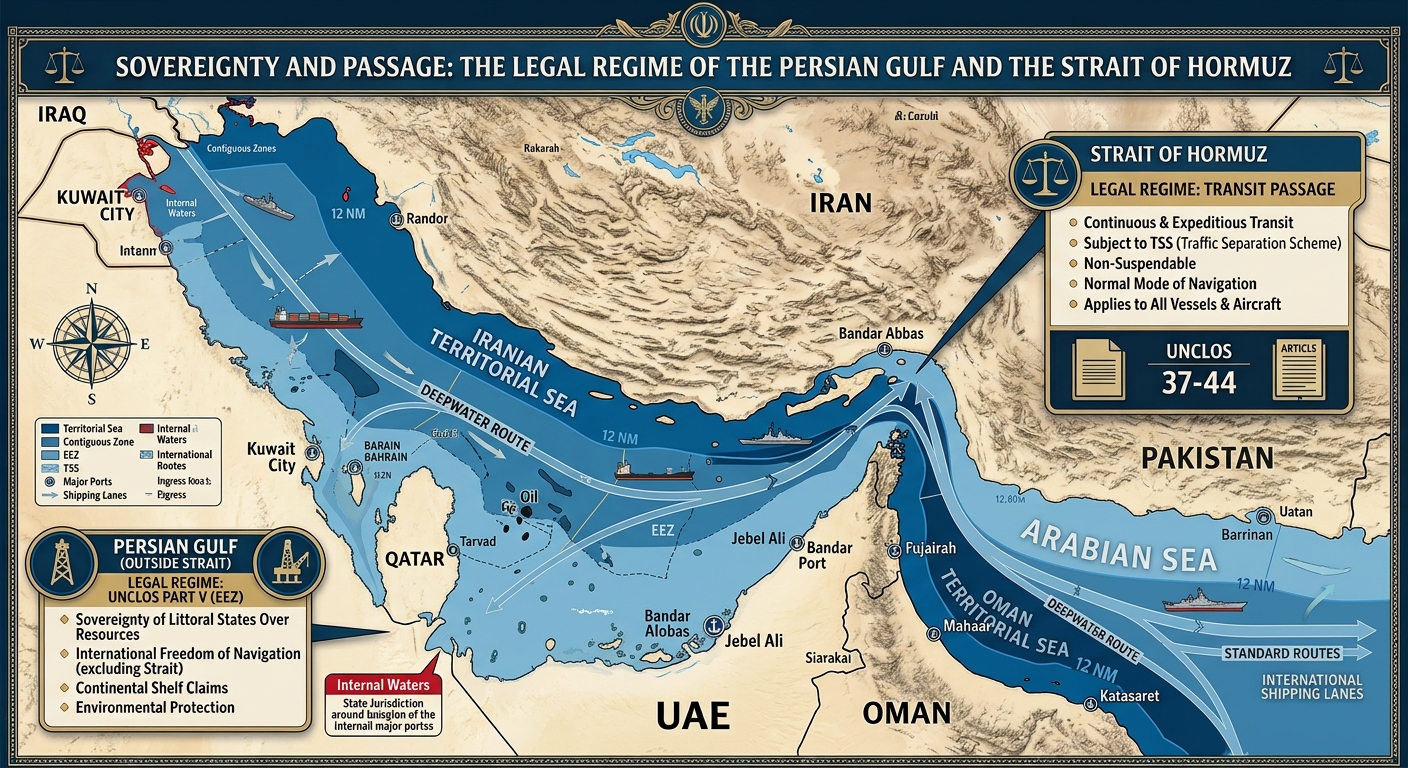
The Persian Gulf and its singular maritime gateway, the Strait of Hormuz, represent one of the most geopolitically sensitive and economically vital marine spaces on Earth. As a semi-enclosed sea under the definition provided by Article 122 of the United Nations Convention on the Law of the Sea (UNCLOS), the Persian Gulf is surrounded by eight littoral states with highly diverse political structures, economic interests, and levels of commitment to the modern law of the sea. These states include Bahrain, Iran, Iraq, Kuwait, Oman, Qatar, Saudi Arabia, and the United Arab Emirates (UAE). The legal framework governing these waters is characterized by a complex interplay between customary international law, bilateral delimitation agreements, regional environmental treaties, and multilateral conventions.
At the center of this legal landscape is the tension between the sovereign rights of coastal states to protect their national security and marine environment, and the broader interest of the international community in maintaining the freedom of navigation. Because a substantial portion of the world’s petroleum exports transits through the Strait of Hormuz daily, any legal uncertainty or physical disruption within this narrow corridor has immediate global implications. This article examines the intricate legal regime of the Persian Gulf and the Strait of Hormuz, analyzing the friction between transit passage and innocent passage, the application of treaty law to non-party states, the history of maritime boundary delimitation in the region, and the institutional frameworks established to protect this highly vulnerable marine environment.
Geographical Reality and Geopolitical Context
To understand the legal issues governing the region, one must first grasp the physical geography of the Persian Gulf and the Strait of Hormuz. The Persian Gulf is a relatively shallow body of water, with an average depth of only thirty-five meters and a maximum depth of approximately one hundred meters. It extends over an area of roughly two hundred and forty thousand square kilometers, stretching from the Shatt al-Arab river delta in the northwest to the Strait of Hormuz in the southeast.
The Strait of Hormuz serves as the sole natural entrance to the Gulf, connecting it through the Gulf of Oman to the Arabian Sea and the wider Indian Ocean. The strait is approximately one hundred and sixty-seven kilometers long, with its narrowest point measuring only twenty-one nautical miles between Larak Island, which belongs to Iran, and the Quoin Islands, which belong to Oman. Because both Iran and Oman claim a twelve-nautical-mile territorial sea, the entirety of the Strait of Hormuz falls within the overlapping territorial waters of these two coastal states. There is no strip of high seas or exclusive economic zone (EEZ) running through the strait.
Consequently, all international shipping transiting the strait must pass through the territorial seas of either Iran or Oman. To manage the immense volume of maritime traffic safely, international shipping utilizes a traffic separation scheme established by the International Maritime Organization. This scheme features two primary transit lanes, each two nautical miles wide, separated by a two-mile-wide buffer zone. The inbound lane lies within Omani territorial waters, while the outbound lane also passes through Omani waters, though vessels entering or leaving the wider Gulf must navigate within the broader maritime zones of both littoral states. This geographical reality transforms a spatial bottleneck into a major arena of international legal disputation.
What is the legal status of the Strait of Hormuz under international law?
The legal status of the Strait of Hormuz is defined by a historical transition from customary maritime rules to codified treaty regimes, resulting in a dual-track legal reality. Historically, the regime of straits used for international navigation was governed by customary international law, which was famously articulated by the International Court of Justice (ICJ) in the 1949 Corfu Channel Case. In that landmark decision, the court ruled that there is a right of innocent passage for foreign warships through straits connecting two parts of the high seas without prior authorization from the coastal state, and that coastal states do not have the right to suspend such passage during peacetime.
This customary rule was subsequently codified in Article 16 paragraph 4 of the 1958 Geneva Convention on the Territorial Sea and the Contiguous Zone. This provision declared that there shall be no suspension of the innocent passage of foreign ships through straits which are used for international navigation between one part of the high seas and another part of the high seas or the territorial sea of a foreign state. Both Iran and the United States signed the 1958 Geneva Convention, though their subsequent ratifications and interpretations of these provisions diverged significantly over time.
The adoption of UNCLOS in 1982 introduced a revolutionary legal regime specifically tailored for straits used for international navigation: the concept of transit passage, detailed in Part III of the convention. Under Article 37 of UNCLOS, the transit passage regime applies to straits which are used for international navigation between one part of the high seas or an exclusive economic zone and another part of the high seas or an exclusive economic zone. Under Article 38, all ships and aircraft enjoy the right of transit passage, which cannot be suspended by coastal states.
Transit passage is a much more permissive regime for navigating vessels than innocent passage. Under transit passage, ships must proceed without delay, refrain from any threat or use of force against the sovereignty of the coastal state, and comply with international maritime safety and pollution regulations. Crucially, the right of transit passage includes the right of submarines to transit submerged, a practice that is strictly prohibited under the rules of innocent passage, which require submarines to navigate on the surface and show their flag. Furthermore, transit passage encompasses the right of overflight for civil and military aircraft, whereas innocent passage applies strictly to surface vessels and does not include an automatic right of aerial overflight without coastal state consent.
The legal status of the Strait of Hormuz is therefore suspended between these two frameworks. For states that are parties to UNCLOS, the strait is governed by the treaty-based regime of transit passage. However, for states that are not parties to the convention, or those that reject the customary nature of transit passage, the applicable legal regime remains a matter of intense diplomatic and legal debate, with coastal states asserting varying degrees of sovereign control over their territorial waters.
Is transit passage allowed through the Strait of Hormuz?
The question of whether transit passage is allowed through the Strait of Hormuz depends on which state’s jurisdiction is being traversed and how that state interprets the relationship between treaty law and customary international law. The primary actors in this debate are Iran, Oman, and the United States.
Iran signed UNCLOS in 1982 but has never ratified it. Upon signing the treaty, the Iranian government made an explicit interpretative declaration designed to limit the application of the transit passage regime. The Iranian declaration asserted that the right of transit passage is a purely contractual treaty right, created by the convention for the benefit of its contracting parties. Consequently, Iran argues that only states that have ratified UNCLOS are entitled to enjoy the right of transit passage through the Iranian territorial sea in the Strait of Hormuz.
For states that are not parties to UNCLOS, most notably the United States, Iran maintains that the applicable legal regime is innocent passage, as codified in the 1958 Geneva Convention or reflected in older customary international law. Under Iran’s interpretation of innocent passage, foreign warships must obtain prior authorization or provide advance notification before entering its territorial sea. Furthermore, Iran reserves the right to suspend innocent passage if it deems that the transit of a particular vessel threatens its peace, good order, or security, a standard of domestic determination that grants the coastal state immense discretionary power.
Oman, which controls the southern shore of the Strait of Hormuz, ratified UNCLOS in 1989. However, Oman also attached a declaration to its ratification, expressing its own security concerns. The Omani declaration stated that the passage of foreign warships through its territorial sea, including those portions within the Strait of Hormuz, is subject to prior permission or notification. Oman also asserted its right to establish specific navigation regulations for nuclear-powered ships and vessels carrying hazardous materials. While Oman has generally taken a highly pragmatic and cooperative approach to managing traffic in the strait, its formal legal position maintains a reservation regarding the absolute freedom of warship transit.
Conversely, the United States, along with other major maritime powers, argues that transit passage is indeed allowed for all nations through the Strait of Hormuz. The United States argues that the transit passage provisions of UNCLOS did not merely create new treaty rights but rather codified existing customary international law, or at the very least, have crystallized into customary law through widespread and uniform state practice since 1982. From this perspective, the right of transit passage is an inherent global right that applies to all states, regardless of whether they are parties to UNCLOS or whether the coastal state has ratified the convention. The United States demonstrates this legal position through continuous naval transits, transiting the Strait of Hormuz with warships and submerged submarines without seeking permission or giving prior notification to either Iran or Oman.
This fundamental disagreement creates a persistent legal friction. While the day-to-day maritime traffic flows smoothly due to practical coordination, the underlying legal dispute remains unresolved. In times of geopolitical tension, Iran has repeatedly threatened to close the Strait of Hormuz or restrict passage to vessels from hostile states, citing its sovereign rights under the innocent passage regime. Maritime powers respond by asserting their right to unimpeded transit passage, backed by naval presence, illustrating how these competing legal theories have direct, real-world security implications.
How does UNCLOS apply to non-party states in the Persian Gulf?
The application of UNCLOS to non-party states in the Persian Gulf is a complex question of treaty law, state responsibility, and the formation of customary international law. To analyze this issue, one must examine the legal positions of the two primary non-parties in this context: the United States, which is a major naval actor in the Gulf, and Iran, which is a key coastal state.
Under the Vienna Convention on the Law of Treaties (VCLT), specifically Article 34, a treaty does not create either obligations or rights for a third state without its consent. This principle, known as pacta tertiis nec nocent nec prosunt, is a cornerstone of international treaty law. Because the United States has not ratified UNCLOS and Iran has signed but not ratified it, neither state can be directly bound by the convention as a treaty per se. However, Article 38 of the VCLT recognizes that a rule set forth in a treaty can become binding upon a third state as a customary rule of international law, provided that there is a sufficient combination of state practice and opinio juris.
The United States has consistently maintained since 1983 that the navigational provisions of UNCLOS, including those relating to the territorial sea, the contiguous zone, the EEZ, and transit passage through international straits, represent customary international law. This position was formally declared in President Ronald Reagan’s Ocean Policy Statement of March 10, 1983. The United States argues that while it is not bound by the administrative or deep-seabed mining parts of the convention, it enjoys all the rights and must respect all the obligations concerning navigation and overflight as a matter of customary law. Therefore, the United States applies the rules of UNCLOS to its own operations in the Persian Gulf and expects the littoral states to do the same.
"The United States will recognize the rights of other states in the waters off their coasts, as reflected in the Convention, so long as the rights and freedoms of such United States and all other states under international law are recognized by such coastal states."
Iran strongly rejects this legal construction. The Iranian government argues that UNCLOS is a package deal, a single, integrated legal instrument that was negotiated as a comprehensive compromise. According to this package-deal doctrine, a state cannot selectively adopt those parts of the convention that serve its interests, such as transit passage, while rejecting other parts, such as the dispute settlement procedures or the common heritage of mankind regime for the deep seabed. Under this view, because the United States has refused to ratify UNCLOS, it cannot claim the expansive navigational rights created by the treaty, particularly transit passage through the sovereign territorial waters of other nations.
This debate extends to other aspects of maritime law in the Gulf. For instance, the determination of baselines is crucial for measuring the width of the territorial sea and the EEZ. Some Gulf states, including Iran, have claimed straight baselines along highly indented coastlines or where there is a fringe of islands. Non-party states like the United States have challenged these baselines when they believe they do not conform to the strict requirements of customary international law, which are codified in Article 7 of UNCLOS. The United States regularly conducts Freedom of Navigation Operations to protest baseline claims and maritime security zones that it deems excessive, demonstrating that the application of UNCLOS rules to non-party states is a process of continuous diplomatic and military assertion.
How are maritime boundaries delimited in the Persian Gulf?
The physical geography of the Persian Gulf, characterized by its narrow width and shallow depth, makes maritime boundary delimitation exceptionally complicated. Because no point in the Persian Gulf is more than eighty-five nautical miles from a coastline, there are no areas of high seas within the Gulf. Every square mile of water and seabed falls within the potential territorial sea, contiguous zone, or exclusive economic zone of at least two, and sometimes three, coastal states. Consequently, the delimitation of the continental shelf and the EEZ has been a major focus of regional diplomacy and international jurisprudence.
Under Article 15 of UNCLOS, the delimitation of the territorial sea between states with opposite or adjacent coasts is generally based on the median line, unless there are historical titles or other special circumstances. For the continental shelf and the EEZ, Article 74 and Article 83 of UNCLOS state that delimitation must be achieved by agreement on the basis of international law in order to achieve an equitable solution. This emphasis on equity has led to a variety of approaches in the Persian Gulf, where states have had to account for the presence of numerous islands, low-tide elevations, and valuable offshore oil and gas fields.
The history of boundary delimitation in the Gulf began in the mid-twentieth century, driven by the rapid expansion of offshore oil exploration. One of the earliest and most influential agreements was the 1968 Saudi Arabia-Iran boundary agreement. This treaty successfully delimited a boundary line through the middle of the Gulf, using the equidistance principle but adjusting it to achieve an equitable distribution of offshore oil fields. Notably, the agreement gave half-effect to Iran’s Kharg Island, meaning the island was not given full weight in generating the baseline, which would have pushed the boundary disproportionately toward the Saudi coast. Similar pragmatic agreements were concluded between Iran and Qatar, Bahrain and Saudi Arabia, and Iran and Oman.
However, not all boundary disputes have been settled through negotiation. Some have required international adjudication. The most significant of these was the dispute between Qatar and Bahrain, which was referred to the International Court of Justice. In its 2001 judgment on Maritime Delimitation and Territorial Questions between Qatar and Bahrain, the court resolved a decades-old dispute over sovereignty over the Hawar Islands, Janan Island, and the low-tide elevation of Qit'at Jaradah. The ICJ first determined sovereignty over the disputed land features and then drew a single maritime boundary separating the territorial seas, continental shelves, and exclusive economic zones of the two states. The court applied the established two-stage methodology: first drawing an equidistant line and then adjusting it to account for special circumstances, such as the unique geography of the reefs and sandbanks, to ensure an equitable result.
Despite these successes, several critical maritime boundaries in the Persian Gulf remain unresolved, largely due to ongoing territorial disputes over islands. The most prominent is the dispute between the United Arab Emirates and Iran over three islands located near the entrance of the Strait of Hormuz: Abu Musa, the Greater Tunb, and the Lesser Tunb. Both states claim sovereignty over these islands, which have been under Iranian control since 1971. Because the sovereign owner of these islands is entitled to project a twelve-nautical-mile territorial sea and a surrounding continental shelf, the unresolved territorial dispute prevents the final delimitation of the maritime boundary between Iran and the UAE. This unresolved border creates a zone of legal ambiguity in one of the busiest shipping lanes in the world, where both states assert competing jurisdictions over the surrounding waters.
Another unresolved boundary exists in the northern reaches of the Gulf, where Iraq, Kuwait, and Iran meet. Iraq’s coastline is extremely short and highly compressed between its two larger neighbors. The delimitation of Iraq’s maritime zones is further complicated by the shifting sands of the Shatt al-Arab delta and the presence of Kuwait’s Bubiyan and Warbah islands. Although the land boundary between Iraq and Kuwait was demarcated by the United Nations after the 1991 Gulf War, the maritime boundary beyond the Khor Abdullah remains a subject of ongoing negotiations and periodic maritime incidents, highlighting how the lack of clearly defined borders can fuel regional instability.
| Agreement / Case | Parties Involved | Year | Method / Legal Principle Applied |
|---|---|---|---|
| Saudi Arabia-Iran Agreement | Saudi Arabia, Iran | 1968 | Equidistance with adjustments; half-effect given to Kharg Island to achieve equitable division of oil fields. |
| Iran-Oman Agreement | Iran, Oman | 1974 | Equidistance median line dividing the Strait of Hormuz and the Gulf of Oman. |
| Qatar-Bahrain Case (ICJ) | Qatar, Bahrain | 2001 | Adjudication of island sovereignty; application of the equidistance/special circumstances rule for a single maritime boundary. |
| Khor Abdullah Agreement | Iraq, Kuwait | 2012 | Bilateral agreement regulating maritime navigation in the Khor Abdullah waterway; remains politically contested. |
What is the role of the ROPME in the Persian Gulf?
The Persian Gulf is not only a theater of geopolitical rivalry but also one of the most ecologically fragile marine environments on the planet. Its shallow depth, high evaporation rates, extreme salinity, and limited water exchange through the Strait of Hormuz make it highly vulnerable to ecological damage. A drop of water entering the Gulf takes several years to circulate and exit back into the Indian Ocean. This natural vulnerability is exacerbated by intense anthropogenic pressures, including massive offshore oil drilling, continuous tanker traffic, coastal reclamation projects, and heavy discharge from industrial facilities and desalination plants. To address these unique ecological threats, the coastal states established a regional environmental framework.
The legal basis for this cooperative effort is the 1978 Kuwait Regional Convention for Co-operation on the Protection of the Marine Environment from Pollution. Signed by all eight littoral states of the Persian Gulf, the convention represents a rare instance of comprehensive regional cooperation, transcending the deep political and ideological divisions of the region. Under the Kuwait Convention, the contracting states committed to prevent, abate, and combat pollution of the marine environment caused by discharges from ships, land-based sources, and exploration of the seabed.
To implement the objectives of the Kuwait Convention, the states established the Regional Organization for the Protection of the Marine Environment (ROPME), headquartered in Kuwait. The role of ROPME is to coordinate regional efforts to monitor water quality, protect marine biodiversity, and respond to environmental emergencies. ROPME serves as a central hub for scientific research, facilitating the exchange of data among member states and hosting technical workshops on marine conservation.
Since its creation, ROPME has overseen the adoption of several specialized protocols designed to address specific sources of pollution. These include:
- The Protocol concerning Regional Co-operation in Combatting Pollution by Oil and Other Harmful Substances in Cases of Emergency.
- The Protocol for the Protection of the Marine Environment against Pollution from Land-Based Sources.
- The Protocol on the Control of Marine Transboundary Movements and Disposal of Hazardous Wastes and Other Wastes.
- The Protocol concerning Marine Pollution resulting from Exploration and Exploitation of the Continental Shelf.
One of the most critical functions of ROPME is its Marine Emergency Mutual Aid Centre, located in Bahrain. This center is tasked with coordinating the regional response to major oil spills, which are a constant threat given the density of tanker traffic in the Strait of Hormuz. In the event of a catastrophic spill, the center facilitates the rapid deployment of cleanup equipment and technical expertise across national borders, recognizing that marine pollution does not respect political boundaries.
Despite its robust institutional framework, ROPME faces significant challenges in fulfilling its mandate. The primary obstacle is the geopolitical instability of the region. Armed conflicts, such as the Iran-Iraq War and the 1991 Gulf War, have caused immense environmental damage and severely disrupted regional cooperation. During the 1991 war, millions of barrels of oil were intentionally dumped into the northern Gulf, creating the largest maritime oil spill in history. The political animosities resulting from these conflicts have often hindered the sharing of environmental data and prevented the effective enforcement of ROPME’s protocols. Furthermore, ROPME lacks strong supranational enforcement mechanisms, meaning that compliance with environmental standards relies heavily on the political will and domestic legislation of individual member states, which vary widely in their priority and capacity.
Maritime Security, Interdiction, and the Rules of Engagement
The legal regime of the Persian Gulf and the Strait of Hormuz is constantly tested by security operations and maritime interdictions. Because the strait is a global chokepoint, any attempt by a state to restrict navigation or seize vessels quickly escalates into an international crisis. The rules of engagement in these waters are governed by a delicate balance between the rights of coastal states to enforce their laws, the rights of foreign vessels to navigate freely, and the laws of armed conflict.
During times of peace, a coastal state’s jurisdiction over foreign-flagged vessels is strictly limited. Under UNCLOS and customary international law, foreign vessels enjoy sovereign immunity if they are warships or government ships operated for non-commercial purposes. Commercial vessels are subject to the jurisdiction of their flag state, though coastal states can exercise limited enforcement jurisdiction for specific violations, such as pollution or custom infractions within their territorial sea or contiguous zone, as detailed in Article 220 of UNCLOS. However, any enforcement action must be carried out in accordance with international law, and arbitrary or politically motivated seizures of commercial vessels constitute a violation of the freedom of navigation.
The legal framework changes significantly in times of armed conflict. During the Tanker War of the 1980s, Iran and Iraq repeatedly targeted commercial tankers carrying the oil of their adversary or of states perceived to be supporting them. This conflict raised fundamental questions about the rights of neutral states and the applicability of the laws of naval warfare in international straits. The legal consensus, as reflected in the San Remo Manual on International Law Applicable to Armed Conflicts at Sea, is that belligerent states may not conduct military operations or place mines in international straits, and they must respect the transit rights of neutral vessels. Nevertheless, the enforcement of these rules during the Tanker War required the intervention of international naval forces, including the reflagging of Kuwaiti tankers under the United States flag to provide them with the protection of US naval escorts.
In recent years, the region has witnessed a series of maritime incidents that fall into a grey zone between peace and conflict. These incidents include the placement of limpet mines on tankers, the seizure of commercial ships by Iranian security forces under various pretexts, and the shootdown of unmanned aerial vehicles over or near the strait. In response to these threats, several states have formed international maritime security coalitions, such as the International Maritime Security Construct (IMSC) and the European-led Maritime Awareness in the Strait of Hormuz. These coalitions deploy naval assets to patrol the shipping lanes, deter hostile actions, and reassure the commercial shipping industry.
From a legal perspective, these security operations rely on the inherent right of individual and collective self-defense, as codified in Article 51 of the United Nations Charter. Naval commanders operating in the Gulf must navigate highly complex rules of engagement, balancing the need to protect commercial vessels from unlawful interference with the imperative to avoid triggering a wider military escalation. The legal justification for escorting merchant vessels is grounded in the principle that states have a right to protect their flag vessels from unlawful seizure on the high seas and in international straits, a right that remains a vital safeguard for the global economy.
Conclusion
The legal regime of the Persian Gulf and the Strait of Hormuz is a complex, dynamic, and often fragmented system. It is shaped by a geographical bottleneck that forces global trade to pass through the territorial waters of sovereign states with divergent strategic priorities. The resulting legal friction between the transit passage regime of UNCLOS and the more restrictive interpretations of innocent passage championed by coastal states like Iran and Oman remains unresolved. This theoretical dispute is compounded by practical challenges, including unresolved maritime boundaries, territorial claims over strategic islands, and the constant threat of security incidents and environmental degradation.
Despite these challenges, the maritime order in the region has demonstrated a remarkable degree of resilience. The shared economic interest in maintaining the flow of oil and commerce has historically acted as a powerful incentive for pragmatic cooperation, prompting states to adhere to informal rules of the road even when they disagree on formal treaty commitments. Furthermore, regional institutions like ROPME demonstrate that even the most politically divided states can find common ground when faced with shared ecological threats. Ultimately, the stability of the Persian Gulf and the Strait of Hormuz will continue to depend on this delicate balance between sovereignty and passage, requiring constant diplomatic vigilance, military restraint, and a shared commitment to the fundamental principles of the international law of the sea.
Comments
No comments yet.