Legal Regime of International Straits and Transit Passage under UNCLOS
An in-depth analysis of the legal framework governing international straits, examining transit passage, coastal state rights, and key maritime chokepoints under UNCLOS.
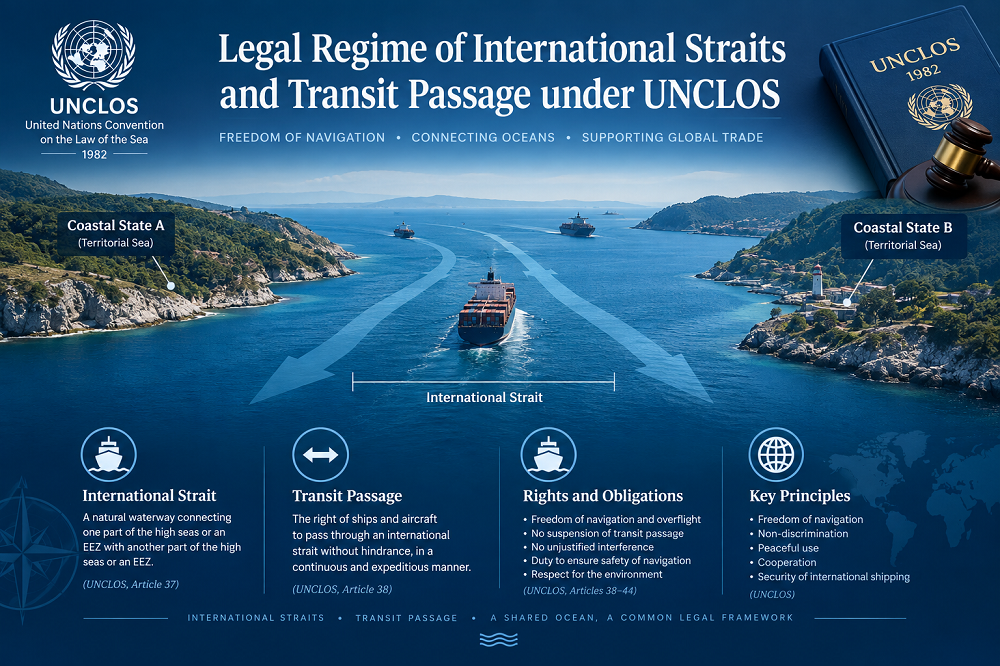
Nearly eighty percent of global trade by volume moves across the oceans, navigating through narrow geographical chokepoints that connect the world's seas and oceans. These corridors, known legally as international straits, serve as vital arteries for commercial shipping, energy transport, and naval deployment. Because international straits naturally overlap with the territorial waters of coastal states, they have historically been a source of intense geopolitical tension between maritime nations seeking unimpeded movement and coastal states seeking security, sovereignty, and environmental protection.
To resolve these competing interests, the third United Nations Conference on the Law of the Sea produced a comprehensive legal framework codified in the 1982 United Nations Convention on the Law of the Sea (UNCLOS). Part III of this treaty established the regime of transit passage, a delicate legal compromise that guarantees the freedom of navigation and overflight through international straits while preserving essential regulatory authorities for strait-bordering states. Understanding this regime requires examining its origin, operational mechanics, key exemptions, and application across critical global waterways.
Historical Evolution and the UNCLOS III Compromise
Prior to the adoption of UNCLOS in 1982, traditional customary maritime law recognized a maximum territorial sea width of three nautical miles. Under this three-mile rule, broad international straits contained ribbons of high seas running down their centers, allowing foreign commercial and military vessels to navigate freely without entering the sovereign domain of bordering nations.
During the negotiations for UNCLOS between 1973 and 1982, states agreed to extend the maximum permissible width of territorial seas from three to twelve nautical miles. While this expansion granted coastal nations greater territorial control over offshore waters, it created a severe strategic crisis. Extending territorial seas to twelve nautical miles instantly enclosed more than one hundred international straits within coastal state territorial waters. Crucial waterways such as the Strait of Gibraltar, the Strait of Malacca, the Strait of Hormuz, and Bab el-Mandeb were suddenly legally overlapped by coastal territorial seas.
Had traditional rules of innocent passage applied to these enclosed straits, naval forces and air mobility would have been drastically constrained. Innocent passage allows coastal states to suspend transit under specific security conditions, forbids aircraft overflight without explicit permission, and requires submarines to navigate on the surface while flying their national flags. Maritime powers insisted that such limitations in international straits were unacceptable for global security and commerce. Conversely, coastal states feared that unrestricted high-seas freedom through their narrow territorial waters would jeopardize their national security and marine environment. The compromise reached in Part III of UNCLOS established the regime of transit passage specifically tailored for straits used for international navigation.
What is transit passage in international law?
Defined principally under Articles 37 and 38 of UNCLOS, transit passage applies to straits which are used for international navigation between one part of the high seas or an exclusive economic zone (EEZ) and another part of the high seas or an exclusive economic zone. Transit passage is defined as the exercise of freedom of navigation and overflight solely for the purpose of continuous and expeditious transit through the strait.
The legal scope of transit passage provides significantly broader freedoms than traditional innocent passage. Crucially, transit passage includes three core elements that preserve the operational mobility of international trade and defense forces:
- Freedom of Navigation and Overflight: Unlike innocent passage, which applies only to surface ships, transit passage explicitly includes civil and military aircraft, guaranteeing the right to fly through air corridors above the strait without seeking advance permission from coastal states.
- Submerged Transit for Submarines: Transit passage permits submarines and other underwater vehicles to navigate in their normal mode during transit. This allows naval submarines to pass through international straits while submerged, provided they adhere to safety standards and proceed without delay.
- Non-Suspendable Right: According to Article 44 of UNCLOS, strait-bordering states may not suspend, hamper, or impair transit passage under any circumstances, even during periods of military tension or emergency, short of an active armed conflict governed by the separate law of naval warfare.
How does transit passage differ from innocent passage?
The distinction between transit passage and innocent passage is fundamental to public international maritime law. While both legal regimes permit foreign vessels to enter coastal waters, their operational rules, rights of coastal states, and scope of military mobility diverge significantly.
| Legal Dimension | Innocent Passage (Part II) | Transit Passage (Part III) |
|---|---|---|
| Submarine Navigation | Must navigate on the surface and display flag | May navigate submerged in normal operational mode |
| Aerial Transit | No right of overflight without coastal state consent | Includes right of overflight for military and civil aircraft |
| Suspension Rights | Coastal state may temporarily suspend in specific areas for security | Non-suspendable under any circumstances |
| Scope of Regulations | Broader coastal state oversight over security and passage conditions | Strictly limited to international safety and anti-pollution standards |
| Geographic Scope | General territorial seas and internal archipelagic waters | International straits connecting high seas or EEZs |
Under innocent passage, a vessel's passage must not be prejudicial to the peace, good order, or security of the coastal state. If a ship engages in activities deemed non-innocent, such as weapons practice, research, or intelligence gathering, the coastal state may take necessary steps to prevent passage. Under transit passage, the focus shifts to whether the movement is continuous and expeditious. Even if a vessel commits a violation of coastal regulations during transit passage, such as an environmental spill, the coastal state cannot block the vessel's movement through the strait, though it may pursue administrative remedies or legal claims through standard enforcement mechanisms.
What rights do coastal states have in international straits?
While transit passage severely limits the ability of coastal states to stop or inspect passing ships, UNCLOS guarantees bordering states essential rights to protect their maritime safety, infrastructure, and marine environment. Articles 41, 42, and 43 delineate the regulatory sovereignty belonging to strait states.
Coastal states bordering international straits hold the following specific rights and regulatory powers:
- Sea Lanes and Traffic Separation Schemes: Strait states may designate sea lanes and prescribe traffic separation schemes to regulate ship routing and prevent maritime collisions. However, these regulations must be submitted to and approved by the competent international organization, which is the International Maritime Organization (IMO), prior to implementation.
- Environmental and Anti-Pollution Rules: Coastal states may enact laws giving effect to applicable international regulations regarding the discharge of oil, oily wastes, and other toxic substances in the strait.
- Customs, Fiscal, Immigration, and Sanitary Laws: Strait states retain authority to enforce regulations governing the prevention of infringement on their legal frameworks regarding customs, revenue, immigration, and quarantine procedures.
- Prevention of Illegal Fishing: Coastal nations can enact laws preventing foreign fishing vessels from engaging in unauthorized fishing activities while in transit through the strait.
Despite these regulatory authorities, Article 42 establishes that coastal laws must not discriminate in form or in fact against foreign ships, nor can their practical application have the effect of denying, hampering, or impairing the right of transit passage.
Duties of Ships and Aircraft During Transit Passage
Rights granted to flag states under the transit passage regime carry strict legal responsibilities set out in Article 39 of UNCLOS. Ships and aircraft exercising transit passage must observe clear operational limits to maintain the security and safety of the strait state.
Vessels and aircraft in transit must proceed without delay through or over the strait and refrain from any threat or use of force against the sovereignty, territorial integrity, or political independence of bordering states. Ships must refrain from any activities other than those incident to their normal modes of continuous and expeditious transit, unless rendered necessary by force majeure or distress.
Regarding maritime safety and environmental protection, ships in transit must comply with standard international regulations, procedures, and practices for safety at sea, including the International Regulations for Preventing Collisions at Sea (COLREGs) and conventions like SOLAS and MARPOL. Aircraft exercising overflight rights must observe the Rules of the Air established by the International Civil Aviation Organization (ICAO) and continuously monitor the radio frequency assigned by designated air traffic control authorities.
Which straits are exempt from the UNCLOS transit passage regime?
The general regime of transit passage does not apply uniformly to every narrow body of water across the globe. UNCLOS Part III explicitly categorizes several legal exceptions where alternative regimes apply based on historical treaties, geographical configurations, or destination points.
Long-Standing International Legal Conventions
Article 35(c) of UNCLOS excludes from the transit passage regime straits in which passage is regulated in whole or in part by long-standing international conventions in force specifically relating to such straits. Prominent examples include:
- The Turkish Straits: The Bosphorus and the Dardanelles connect the Black Sea to the Aegean Sea. Passage through these straits is governed by the 1936 Montreux Convention, which establishes specific rules regarding vessel tonnage, notification requirements, and strict military vessel restrictions for non-Black Sea powers.
- The Danish Straits: The Great Belt, Little Belt, and the Sound connect the North Sea to the Baltic Sea. Their navigation rights are regulated under the 1857 Treaty of Copenhagen and established customary rules.
The Island-Mainland Exception
Under Article 38(1), transit passage does not apply if the strait is formed by an island of a state bordering the strait and its mainland, and there exists seaward of the island a route through the high seas or an exclusive economic zone of similar convenience with respect to navigational and hydrographic characteristics. A classic example is the Strait of Messina between mainland Italy and the island of Sicily. In such waterways, the regime of innocent passage applies, provided an equally convenient high-seas or EEZ route exists outside the island.
Dead-End Straits and Non-Suspendable Innocent Passage
Under Article 45(1)(b), straits that connect an area of the high seas or an exclusive economic zone with the territorial sea of a foreign state are governed by the regime of innocent passage rather than transit passage. An example of this dead-end configuration is the Strait of Tiran, which connects the Red Sea to the Gulf of Aqaba, bordering the territorial waters of Jordan and Israel. Crucially, Article 45 specifies that innocent passage through such straits cannot be suspended by coastal states, guaranteeing access to landlocked or gulf-dependent nations.
Strategic Bottlenecks and Global Case Studies
The practical application of the transit passage regime is evident in several key geographic chokepoints that handle vast proportions of international trade and energy commerce.
The Strait of Malacca and Singapore Strait
Connecting the Indian Ocean with the South China Sea, the Strait of Malacca and the Singapore Strait handle over ninety thousand commercial vessels annually, including a major share of global oil shipments. Bordered by Indonesia, Malaysia, and Singapore, these straits are governed by transit passage. To ensure navigational safety through these congested, shallow waters, the three littoral states worked alongside the International Maritime Organization to establish mandatory traffic separation schemes, under-keel clearance requirements, and cooperative anti-piracy patrols while maintaining the passage rights of foreign vessels.
The Strait of Hormuz
The Strait of Hormuz connects the Persian Gulf to the Gulf of Oman and serves as the primary export route for Middle Eastern oil. Bordered by Iran and Oman, the strait consists entirely of overlapping territorial seas. While Oman is a state party to UNCLOS, Iran has signed but not ratified the treaty. Iran has historically argued that transit passage rights apply only to states that are party to UNCLOS, maintaining that non-signatory vessels are entitled only to innocent passage. Conversely, major maritime nations contend that transit passage represents established customary international law binding on all states regardless of formal ratification.
The Strait of Gibraltar
Connecting the Atlantic Ocean to the Mediterranean Sea, the Strait of Gibraltar is bordered by Spain, Morocco, and the British Overseas Territory of Gibraltar. Measuring approximately eight nautical miles wide at its narrowest point, the strait is fully covered by territorial seas. Transit passage guarantees unimpeded transit for commercial shipping and naval forces, including submerged submarine movement and military aircraft overflight, supporting seamless integration between Atlantic and Mediterranean security sectors.
Modern Security Threats and Emerging Maritime Challenges
The legal framework governing international straits faces evolving pressures from contemporary security threats, technological advances, and geopolitical shifts.
Asymmetric threats, such as non-state actor attacks, anti-ship missile strikes, and maritime drone warfare in strategic straits like Bab el-Mandeb, have raised complex legal questions regarding coastal state defense and flag state enforcement. While UNCLOS establishes navigation rules, armed conflicts and gray-zone aggression test the boundaries between maritime law and international humanitarian law. When hostile forces disrupt navigation in an international strait, naval forces from transiting states often invoke the inherent right of self-defense under Article 51 of the United Nations Charter to protect commercial shipping corridors.
Environmental concerns and the emergence of Maritime Autonomous Surface Ships (MASS) also present regulatory hurdles. Coastal states increasingly seek stricter environmental controls to protect marine ecosystems from acoustic pollution, invasive species in ballast water, and oil spills. Integrating autonomous, crewless commercial ships into traffic separation schemes will require the International Maritime Organization and strait states to adapt international safety standards while respecting the foundational rights of transit passage.
Additionally, climate change and Arctic ice melt are opening new northern trade corridors, such as the Northwest Passage and the Northern Sea Route. These developments have reignited debates over whether these northern waterways meet the criteria for international straits subject to transit passage or constitute internal waters subject to absolute coastal state sovereignty.
Conclusion
The legal regime of international straits and transit passage established under UNCLOS Part III remains one of the greatest accomplishments of modern international law. By carefully balancing the sovereignty and security needs of coastal states with the global necessity for free, unimpeded maritime trade and military mobility, the transit passage compromise maintains global economic stability and strategic peace. As maritime technology advances and geopolitical challenges emerge in critical bottlenecks worldwide, adherence to this balanced legal framework continues to serve as the bedrock of global ocean governance.
Comments
No comments yet.