The Spatial Reach of Sovereignty: Coastal State Jurisdiction and Regulatory Authority Under the Law of the Sea
An exhaustive scholarly inquiry into the jurisdictional boundaries, enforcement powers, and jurisprudence shaping coastal state regulation across maritime zones.
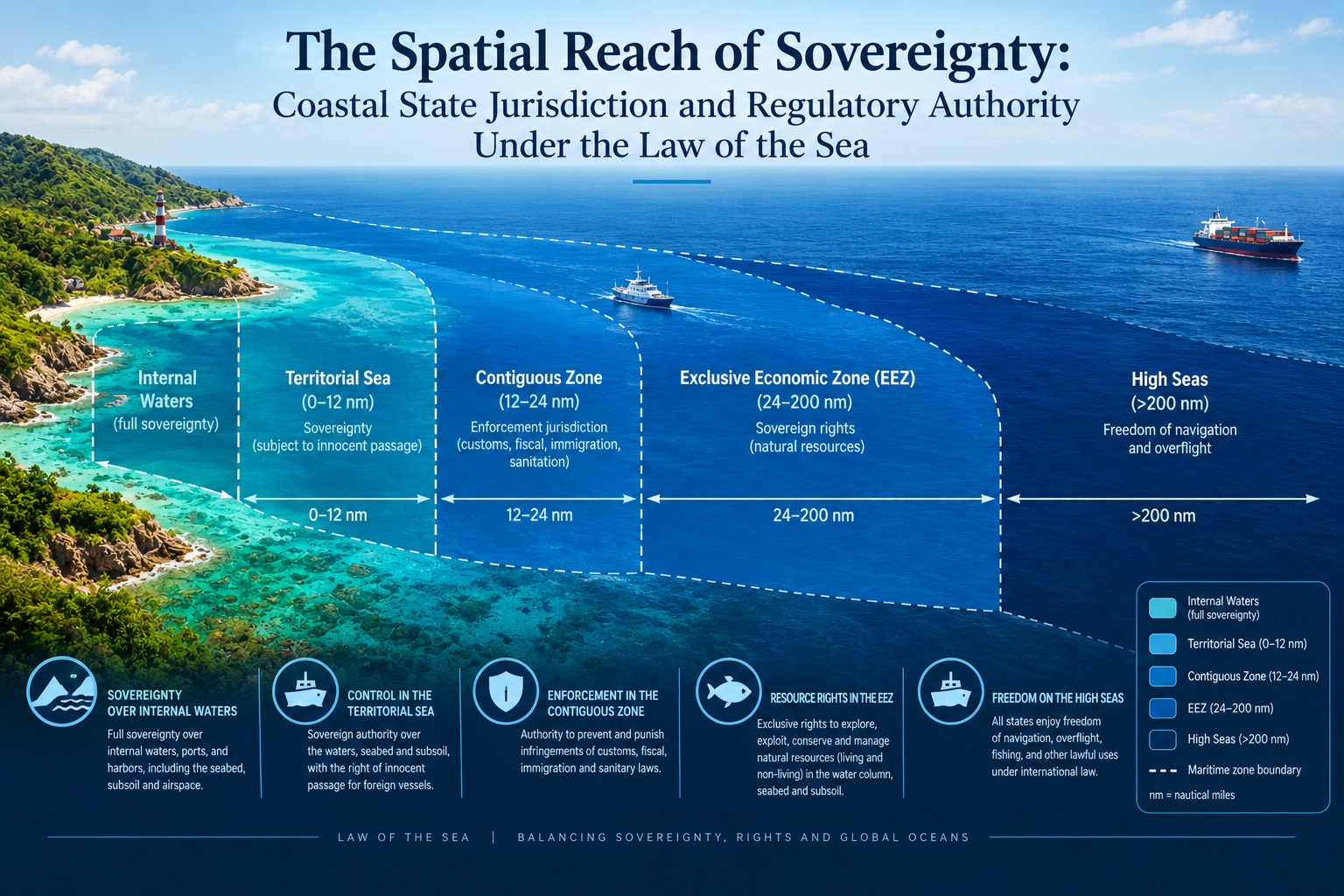
The codification of modern maritime order in the 1982 United Nations Convention on the Law of the Sea (UNCLOS) represents a delicate compromise between two historically antagonistic doctrines: mare liberum, the Grotius-inspired principle safeguarding the freedom of navigation and high-seas access, and mare clausum, John Selden’s thesis asserting the sovereign enclosure of ocean spaces. This structural compromise manifests as a graduated zonal regime. As an observer moves outward from internal waters through the territorial sea, the contiguous zone, the exclusive economic zone, and onto the high seas, coastal state sovereign authority diminishes from plenary territorial jurisdiction to functional, resource-delimited competence, ultimately yielding to flag state primacy. Yet the practical administration of this spatial architecture is fraught with jurisdictional frictions. Coastal states routinely seek to stretch regulatory prerogatives over foreign vessels to protect marine ecosystems, secure economic reserves, and safeguard national security. Conversely, maritime nations invoke high-seas freedoms to prevent creeping coastal jurisdiction. Analyzing the contemporary scope of coastal state authority requires parsing treaty texts alongside the jurisprudence of the International Court of Justice (ICJ), the International Tribunal for the Law of the Sea (ITLOS), and arbitral tribunals convened under Annex VII of UNCLOS.
The Zonal Architecture of UNCLOS and Sovereignty at Sea
The foundational premise of maritime jurisdiction is that the land dominates the sea (la terre domine la mer), an adage affirmed in the North Sea Continental Shelf cases (Federal Republic of Germany/Denmark; Federal Republic of Germany/Netherlands, ICJ 1969) and consistently reaffirmed in international adjudication. Baselines form the spatial origin from which all maritime zones are projected. Under Article 5 of UNCLOS, the normal baseline is the low-water line along the coast as marked on large-scale charts officially recognized by the coastal state. Where the coastline is deeply indented or fringed with islands, Article 7 permits straight baselines, provided they do not depart to any appreciable extent from the general direction of the coast.
Waters on the landward side of the baseline constitute internal waters under Article 8. Within these spaces, the coastal state exercises full territorial sovereignty identical to its authority over its dry landmass. Foreign vessels possess no customary right of innocent passage through internal waters, save for the exceptional carve-out under Article 8(2) where straight baselines enclose waters not previously considered internal. Coastal states may dictate conditions of port access, establish mandatory environmental and technical criteria, and exercise civil and criminal jurisdiction, subject only to jurisdictional immunities afforded to sovereign warships and non-commercial government vessels under customary international law and treaty provisions such as Article 95 and Article 96.
What rights do coastal states have in the territorial sea?
Article 2 of UNCLOS extends a coastal state’s sovereignty beyond its land territory and internal waters to an adjacent belt of sea described as the territorial sea, which may extend up to 12 nautical miles from the baseline pursuant to Article 3. This sovereignty encompasses the water column, the seabed and subsoil, and the superjacent airspace. However, the coastal state’s territorial sovereignty is decisively qualified by the right of innocent passage under Article 17, which guarantees foreign ships the right of continuous and expeditious navigation through the territorial sea without entering internal waters, or proceeding to or from them.
Under Article 19(1), passage is innocent so long as it is not prejudicial to the peace, good order, or security of the coastal state. Rather than leaving the threshold of innocence to unilateral subjective interpretation, Article 19(2) enumerates an exhaustive catalog of non-innocent activities, including weapons practice, intelligence gathering, acts of willful and serious pollution, fishing activities, research or survey activities, and direct interference with coastal communications systems. The legal boundary between innocent and non-innocent passage was examined early in modern maritime jurisprudence. In the Corfu Channel case (United Kingdom v. Albania, ICJ 1949), the ICJ ruled that foreign warships retain the right of innocent passage through straits used for international navigation during peacetime without prior authorization, provided their passage remains strictly operational and non-threatening.
A coastal state may regulate passage under Article 21 by enacting laws concerning the safety of navigation, the protection of navigational aids, the conservation of living resources, and the prevention of marine pollution. Yet these regulatory powers are strictly circumscribed by Article 24, which forbids a coastal state from imposing requirements that have the practical effect of denying or impairing the right of innocent passage, or discriminating in form or in fact against the ships of any state. Furthermore, a coastal state may not levy charges upon foreign vessels solely for passage, but only for specific services rendered to the vessel, as articulated in Article 26.
Criminal and civil jurisdiction over foreign merchant vessels in the territorial sea represents an area of doctrinal compromise. Under Article 27, the coastal state should not exercise criminal jurisdiction on board a foreign ship passing through the territorial sea to arrest any person or conduct an investigation connected with any crime committed on board during that passage, unless:
- The consequences of the crime extend to the coastal state;
- The crime is of a kind to disturb the peace of the country or the good order of the territorial sea;
- The assistance of local authorities has been requested by the master of the ship or by a diplomatic agent or consular officer of the flag state; or
- Such measures are strictly necessary to suppress illicit traffic in narcotic drugs or psychotropic substances.
While the modal verb should indicates an exhortation rather than an absolute prohibition, state practice largely conforms to this limitation, leaving internal disciplinary matters and minor offenses to the exclusive competence of the flag state.
| Maritime Zone | Breadth from Baseline | Legal Character of Coastal State Authority | Countervailing Foreign Navigation Rights |
|---|---|---|---|
| Internal Waters | Landward of baseline | Plenary territorial sovereignty; absolute jurisdiction | No general right of passage; entry subject to consent |
| Territorial Sea | Up to 12 nautical miles | Territorial sovereignty, subject to treaty limits | Right of innocent passage (non-suspensive in international straits) |
| Contiguous Zone | Up to 24 nautical miles | Functional, preventive and punitive enforcement jurisdiction | Freedom of navigation; high-seas-adjacent regime |
| Exclusive Economic Zone | Up to 200 nautical miles | Sovereign rights over resources; functional jurisdiction | Freedom of navigation, overflight, and laying of submarine cables |
| Continental Shelf | Up to 200 nautical miles (or 350 nm max) | Sovereign rights for exploration and exploitation of seabed | Freedom of navigation and cable-laying in superjacent water column |
The Contiguous Zone: Preventive and Punitive Controls
The contiguous zone, codified in Article 33 of UNCLOS, extends up to 24 nautical miles from baselines. Unlike the territorial sea, the contiguous zone is not an area of sovereign domain; it is a zone of special, functionally delimited competence carved out of the high seas or the exclusive economic zone. Coastal state authority within this band is strictly control-oriented, empowering the state to:
- Prevent infringement of its customs, fiscal, immigration, or sanitary laws and regulations within its territory or territorial sea;
- Punish infringement of the above laws and regulations committed within its territory or territorial sea.
The binary formulation of prevent and punish creates an important jurisdictional distinction. For incoming vessels, the coastal state can only take preventive measures to stop a projected violation inside the territorial sea; it cannot penalize acts that have not yet occurred. For outgoing vessels that committed an offense within the territorial sea or land territory, the state may take punitive measures, including arrest and the initiation of hot pursuit.
A recurring controversy concerns whether coastal states may extend security regulations into the contiguous zone. While a minority of states claim security jurisdiction within the 24-mile perimeter, the drafting history of UNCLOS III reveals the deliberate exclusion of security from Article 33. The ITLOS confirmed the narrow scope of Article 33 in the M/V Saiga (No. 2) case (Saint Vincent and the Grenadines v. Guinea, ITLOS 1999). Guinea applied its customs legislation to offshore bunkering inside its exclusive economic zone and contiguous zone, arguing that its public interest justified such enforcement. ITLOS rejected Guinea’s expansive interpretation, holding that a coastal state cannot extend its customs laws beyond the territorial sea by unilaterally deeming activities in the contiguous zone or exclusive economic zone to be offenses under internal law, nor can it assert a generalized police power beyond the precise terms of Article 33.
How can coastal states regulate maritime activities in the EEZ?
The exclusive economic zone (EEZ), governed by Part V of UNCLOS (Articles 55–75), constitutes a sui generis legal regime. Extending up to 200 nautical miles from baselines, the EEZ is neither territorial sea nor high seas. Article 56 establishes that in the EEZ, the coastal state possesses:
- Sovereign rights for the purpose of exploring and exploiting, conserving, and managing the natural resources, whether living or non-living, of the waters superjacent to the seabed and of the seabed and its subsoil, as well as with regard to other activities for economic exploitation (such as the production of energy from water, currents, and winds);
- Jurisdiction as provided for in the relevant provisions of the convention with regard to the establishment and use of artificial islands, installations, and structures; marine scientific research; and the protection and preservation of the marine environment;
- Other rights and duties provided for in the convention.
The allocation of rights in the EEZ is balanced by Article 58, which preserves for all foreign states the freedoms of navigation, overflight, and the laying of submarine cables and pipelines, together with other internationally lawful uses of the sea related to these freedoms. Crucially, Article 56(2) and Article 58(3) establish cross-cutting duties of due regard: the coastal state must exercise its sovereign rights and jurisdiction with due regard to the rights and duties of other states, and foreign states must likewise show due regard for coastal state rights when navigating through the EEZ.
When regulatory conflicts arise that are not expressly allocated by the convention, Article 59 provides that the conflict should be resolved on the basis of equity and in the light of all relevant circumstances, taking into account the respective importance of the interests involved to the parties as well as to the international community as a whole. This equitable balancing mechanism affirms that the EEZ carries no presumption of coastal state territoriality, nor any presumption of absolute high-seas freedom.
The attribution of sovereign rights under Article 56 is functional, not territorial; it confers precisely that measure of authority necessary to conserve, manage, and extract living and non-living resources, while reserving the navigational commons to the international community under the discipline of due regard.
The coastal state’s resource jurisdiction includes extensive fisheries enforcement powers under Article 73. Coastal states may board, inspect, arrest, and initiate judicial proceedings against foreign vessels to ensure compliance with conservation laws. However, this power has strict statutory limits: arrested vessels and their crews must be promptly released upon the posting of a reasonable bond or other security (Article 73(2)), coastal state penalties for fishing violations may not include imprisonment or corporal punishment in the absence of agreements to the contrary (Article 73(3)), and the flag state must be notified immediately of any arrest or detention (Article 73(4)).
In the M/V Virginia G case (Panama/Guinea-Bissau, ITLOS 2014), the tribunal clarified the scope of coastal state authority over bunkering—supplying fuel to fishing vessels—in the EEZ. ITLOS determined that the regulation of bunkering to foreign vessels fishing in the EEZ falls within the coastal state’s sovereign rights under Article 56 when that bunkering directly supports fishing operations. However, the tribunal found that Guinea-Bissau had violated Article 73 by confiscating the vessel without evaluating whether such a severe penalty was proportionate to the administrative infraction committed, emphasizing that enforcement actions must satisfy the requirements of necessity and proportionality.
Can coastal states enforce environmental laws against foreign vessels?
Part XII of UNCLOS establishes a comprehensive framework for the protection and preservation of the marine environment, balancing coastal vulnerability against commercial shipping interests. Article 192 sets forth a general obligation for all states to protect and preserve the marine environment. While flag states retain primary prescriptive and enforcement jurisdiction over their vessels regarding construction, design, equipment, and manning standards (CDEM) under Article 211(2), coastal states possess defined powers to legislate and enforce against ship-source pollution.
Within the territorial sea, Article 211(4) permits coastal states to adopt environmental laws governing foreign ships in innocent passage, provided such laws do not apply to the design, construction, manning, or equipment of foreign ships unless giving effect to generally accepted international rules or standards (GAIRS), notably those formulated within the International Maritime Organization (IMO) under MARPOL 73/78. In the EEZ, coastal state prescriptive authority under Article 211(5) is strictly limited to enacting laws that conform to and give effect to GAIRS.
Enforcement of environmental laws by coastal states is structured under Article 220 through a graduated framework based on the gravity of the violation:
- Where a vessel is voluntarily within a port or offshore terminal of the coastal state, that state may institute proceedings in respect of any violation of its environmental laws committed within its territorial sea or EEZ (Article 220(1));
- Where there are clear grounds for believing that a vessel navigating in the territorial sea violated environmental laws during its passage therein, the coastal state may undertake physical inspection and, where the evidence so warrants, institute proceedings, including detention (Article 220(2));
- Where there are clear grounds for believing that a vessel navigating in the EEZ or territorial sea committed a violation in the EEZ, the coastal state may require the vessel to give information regarding its identity, port of registry, and last and next ports of call (Article 220(3));
- Where a violation in the EEZ has resulted in a substantial discharge causing or threatening significant pollution of the marine environment, and the vessel has refused to provide information or gave manifestly false data, the coastal state may conduct physical inspection of the vessel (Article 220(5));
- Where there is clear objective evidence that a vessel navigating in the EEZ or territorial sea has committed a violation in the EEZ resulting in a discharge causing major damage or threat of major damage to the coastline or related interests of the coastal state, that state may institute proceedings, including detention of the vessel in accordance with its laws (Article 220(6)).
A notable exception to these constraints is Article 234, the ice-covered areas provision. Article 234 grants coastal states non-discriminatory prescriptive and enforcement authority to prevent, reduce, and control marine pollution from vessels in ice-covered areas within the limits of the EEZ, where particularly severe climatic conditions and the presence of ice create obstructions or exceptional hazards to navigation, and pollution could cause major harm to or irreversible disturbance of the ecological balance. This provision gives Arctic littoral states broader legislative and enforcement discretion, enabling them to impose stricter national design, construction, and operational standards than generally accepted international rules.
The Mechanics and Limits of the Right of Hot Pursuit
The doctrine of hot pursuit, codified in Article 111 of UNCLOS, provides an exception to flag state exclusivity on the high seas. It permits a coastal state to extend its domestic enforcement authority onto the high seas if foreign perpetrators attempt to evade justice by crossing jurisdictional boundaries. Because this doctrine infringes upon the freedom of the high seas, its exercise requires strict adherence to procedural conditions established in treaty law and jurisprudence.
Under Article 111(1), hot pursuit can only be initiated if the coastal state's competent authorities have good reason to believe that the ship has violated its laws and regulations. The pursuit must commence when the foreign ship or one of its boats is within the internal waters, archipelagic waters, territorial sea, or contiguous zone of the pursuing state. If initiated within the contiguous zone, pursuit may only be undertaken in respect of violations of the rights for whose protection the zone was established. Under Article 111(2), hot pursuit applies mutatis mutandis to violations in the EEZ or on the continental shelf, including safety zones around continental shelf installations, regarding laws adopted in accordance with UNCLOS.
The procedural mechanics of pursuit are exacting:
- Verification of Location: The pursuing authority must verify that the foreign vessel, or one of its boats, falls within the relevant maritime zone using practical, reliable means, such as radar or optical fixes.
- Auditory or Visual Signal: Pursuit may only begin after a visual or auditory signal to stop has been given at a distance that enables the foreign ship to see or hear it (Article 111(4)). Radio signals alone do not suffice under a strict reading of the text, although modern state practice has generated intense debate over whether electronic communications meet this requirement.
- Uninterrupted Pursuit: The pursuit must be continuous. If the pursuit is broken or interrupted, the coastal state cannot resume it on the high seas.
- Termination of Pursuit: Under Article 111(3), the right of hot pursuit ceases as soon as the ship pursued enters the territorial sea of its own state or of a third state.
In the Arctic Sunrise arbitration (Netherlands v. Russia, PCA 2013/2015), the arbitral tribunal examined Russia's boarding and seizure of a Dutch-flagged vessel on the high seas following a Greenpeace protest at an offshore oil installation in the Russian EEZ. The tribunal held that Russia’s boarding did not satisfy the conditions for hot pursuit under Article 111. The pursuing coast guard vessel had interrupted its pursuit, and the initial protest activities did not constitute violations that justified an extra-zonal boarding on the high seas without the flag state's consent.
Furthermore, when coastal state authorities execute an arrest at sea, the use of force must be kept to a minimum and governed by principles of necessity and proportionality. In The Red Crusader (1962), a commission of inquiry held that Danish naval authorities used excessive force by firing live rounds into a British fishing vessel without adequate warning. This standard was reinforced by ITLOS in the M/V Saiga (No. 2) case, where the tribunal articulated that international law requires warning shots to precede direct gunfire, and that boarding teams must take every precaution to prevent loss of life.
| Case / Precedent | Forum | Primary Legal Question | Doctrinal Principle Established or Reaffirmed |
|---|---|---|---|
| Corfu Channel (1949) | ICJ | Warship passage through straits during peacetime | Innocent passage cannot be prohibited arbitrarily in straits; prior authorization not required under general international law. |
| M/V Saiga (No. 2) (1999) | ITLOS | Customs enforcement in the contiguous zone and EEZ | Coastal states cannot expand customs authority into the EEZ; enforcement must comply strictly with necessity and proportionality. |
| M/V Virginia G (2014) | ITLOS | Regulation of offshore bunkering supporting fishing | Bunkering foreign vessels fishing in the EEZ falls under Article 56 jurisdiction; severe penalties like confiscation must be proportionate. |
| Arctic Sunrise (2015) | PCA (Annex VII) | Legality of hot pursuit after EEZ protests | Article 111 requires uninterrupted pursuit; coastal state cannot execute high-seas boarding without strict compliance with procedural criteria. |
| South China Sea (2016) | PCA (Annex VII) | Status of features, historic rights, and environmental duties | Historic rights claims incompatible with UNCLOS EEZ regime; coastal states have affirmative duties under Part XII to protect marine environments. |
Reconciling Sovereign Resource Prerogatives with Freedom of Navigation
The operational tension between coastal state economic prerogatives and foreign navigation rights is acute in disputed maritime domains, semi-enclosed seas, and areas subjected to extensive unilateral claims. The South China Sea Arbitration (Philippines v. China, PCA 2016) provided an authoritative treatment of these boundaries. The tribunal concluded that claims to historic rights or sovereign authority within maritime spaces that exceed the specific zonal allocations of UNCLOS are incompatible with the convention. The tribunal underscored that high-tide features capable of sustaining human habitation or economic life of their own generate an EEZ and continental shelf under Article 121, whereas low-tide elevations and rocks cannot generate an EEZ, thereby preventing states from using minor features to curtail navigational rights.
A related controversy involves marine scientific research (MSR). Under Part XIII of UNCLOS (Articles 245–257), coastal states possess the exclusive right to regulate, authorize, and conduct MSR in their territorial sea, and foreign states must obtain consent to conduct research in the EEZ and on the continental shelf under Article 246. While coastal states are expected to grant consent for peaceful research projects in normal circumstances, they may withhold consent in the EEZ if the project is of direct significance for the exploration and exploitation of natural resources, involves drilling or explosives, or includes the construction of artificial islands. The ambiguity lies in distinguishing non-commercial MSR from hydrographic surveying and military intelligence operations. Maritime powers contend that hydrographic surveys and military data collection are freedoms of navigation protected under Article 58, whereas many coastal states insist that any data gathering in their EEZ constitutes MSR requiring coastal state consent.
Similarly, the installation of military surveillance arrays and the conduct of foreign naval exercises in the EEZ divide international opinion. Coastal states argue that unconsented foreign military maneuvers affect their national security and disrupt resource exploitation, violating the due regard requirement under Article 58(3). Major maritime powers counter that UNCLOS does not empower coastal states to regulate military activities in the EEZ, as military operations do not target resource extraction and fall within the general high-seas freedoms preserved by Article 58(1).
The Future of Coastal State Jurisdiction
The legal architecture governing coastal state regulation faces new challenges from technological innovation and ecological disruption. Maritime autonomous surface ships (MASS) complicate traditional regulatory models. UNCLOS provisions, such as those in Part II and Part VII, assume the presence of a master and crew on board (for example, Article 94 regarding flag state duties, and Article 27 concerning crimes committed on board). As autonomous and remote-controlled vessels enter commercial use, coastal states must clarify their authority to require technical notifications, enforce navigational safety routing, and verify emergency communication protocols during innocent passage and EEZ transit.
Concurrently, climate change and anthropogenic sea-level rise undermine the baseline stability that anchors the entire zonal framework. Under conventional readings of Article 5, low-water baselines are ambulatory; as sea levels rise and coastlines recede, the spatial limits of the territorial sea, contiguous zone, and EEZ would retreat landward, potentially destabilizing maritime boundaries and shrinking coastal state jurisdiction. In response, small island developing states and international bodies have advocated for the legal freezing of baselines. The International Law Commission (ILC) and regional declarations, such as the 2021 Pacific Islands Forum Declaration on Preserving Maritime Zones in the Face of Climate Change-Related Sea-Level Rise, affirm that maritime zones established under UNCLOS should remain fixed and legally binding regardless of physical changes to the coastline.
Coastal state regulatory competence under the modern law of the sea is neither an absolute sovereign domain nor a secondary exception to the freedom of the high seas. It is a functional legal framework where authority is matched to specific purposes across distinct zones. As states navigate maritime challenges—from autonomous shipping and deep-seabed resource extraction to rising sea levels—preserving order will require fidelity to the balance struck within UNCLOS, disciplined by the jurisprudence of international tribunals and the duty of due regard.
Comments
No comments yet.