Fluctuating Littorals: The Juridical Impact of Sea Level Rise on Baselines and Maritime Entitlements
This article examines the legal tension between ambulatory baselines and the emerging state practice of freezing maritime zones amidst global sea-level rise.
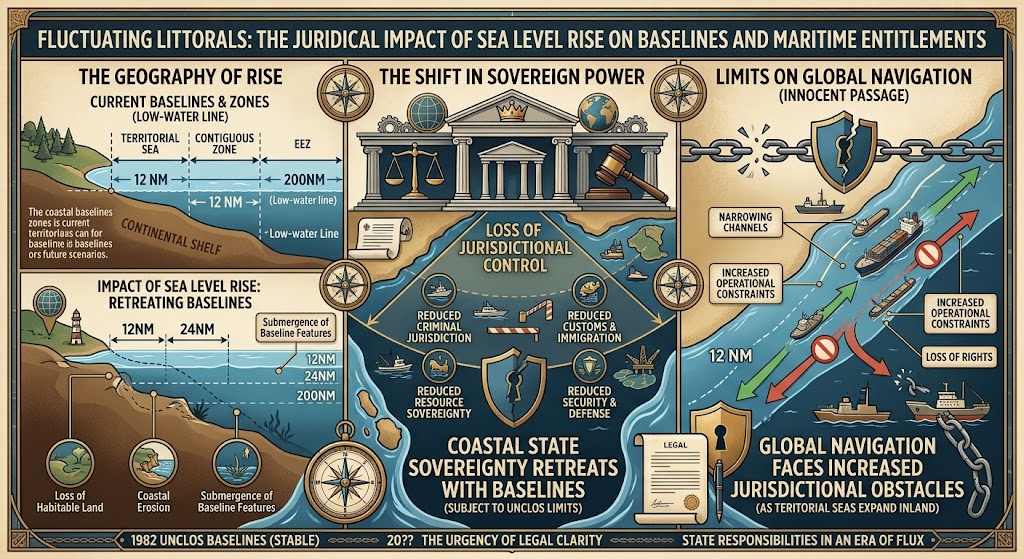
The contemporary international legal order, particularly the framework established under the 1982 United Nations Convention on the Law of the Sea (UNCLOS), is predicated upon a fundamental assumption of geological stability. The legal architecture of maritime zones—the territorial sea, the contiguous zone, the exclusive economic zone (EEZ), and the continental shelf—relies on the 'normal baseline' as its primary point of reference. Article 5 of UNCLOS defines this as the low-water line along the coast as marked on large-scale charts officially recognized by the coastal State. However, as anthropogenic climate change accelerates sea-level rise, this physical low-water line is no longer a static marker but a migrating boundary. The resulting discrepancy between the physical reality of receding coastlines and the juridical desire for maritime stability presents one of the most significant challenges to the law of the sea in the twenty-first century.
The core of the dilemma lies in the doctrine of 'ambulatory baselines.' Historically, international law has accepted that as the coast changes through accretion or erosion, the baseline and the outer limits of maritime zones move accordingly. This ensures that the sovereign rights of the state remain tethered to the actual physical presence of the land. Yet, for low-lying island nations and states with extensive deltaic regions, this logic leads to a catastrophic legal conclusion: the gradual evaporation of maritime entitlements and, in extreme cases, the total loss of statehood itself. The international community is thus witnessing a doctrinal shift toward the preservation of 'legal certainty' through the stabilization of baselines, even when the underlying geography no longer supports them.
How does sea level rise affect maritime boundaries?
Sea level rise affects maritime boundaries by physically altering the points of departure from which those boundaries are measured. Under Article 5, 7, and 47 of UNCLOS, maritime zones are measured from baselines. If a baseline is ambulatory, any landward recession of the low-water line necessitates a corresponding landward shift of the 12-nautical-mile territorial sea and the 200-nautical-mile EEZ. This creates significant practical and legal difficulties, particularly regarding resource management, law enforcement, and the validity of existing maritime delimitation agreements between neighboring states.
When two states have negotiated a maritime boundary based on equidistant points from their respective coasts, the recession of one coast can arguably disturb the equitable nature of the original delimitation. Jurisprudence from the International Court of Justice (ICJ) has traditionally emphasized the principle that 'the land dominates the sea.' In the North Sea Continental Shelf cases, the Court underscored that maritime rights derive from the coastal state's sovereignty over the land territory. If the land disappears or the coastline recedes, the legal basis for the maritime entitlement is weakened under traditional interpretations. However, recent scholarly discourse and state practice, such as the 2021 Pacific Islands Forum Declaration on Preserving Maritime Zones in the Face of Climate Change-related Sea-Level Rise, suggest that once maritime zones are established and notified to the UN Secretary-General, they should not be subject to challenge or change due to sea-level rise.
The Vulnerability of Low-Tide Elevations
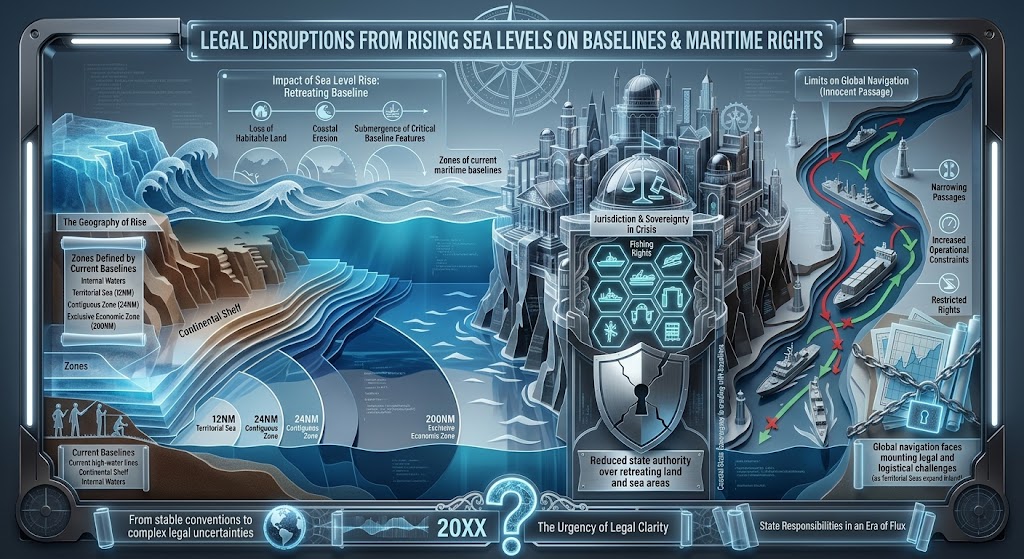
The impact of sea-level rise is most acute concerning low-tide elevations (LTEs). According to Article 13 of UNCLOS, an LTE is a naturally formed area of land which is surrounded by and above water at low tide but submerged at high tide. If an LTE is situated within the territorial sea of the mainland or an island, it may be used as a baseline for measuring the breadth of the territorial sea. As sea levels rise, many LTEs will become permanently submerged, even at low tide. This transformation removes their status as baseline points, potentially leading to a significant reduction in the state’s internal waters and territorial sea. The Sovereignty over Pedra Branca/Pulau Batu Puteh, Middle Rocks and South Ledge (Malaysia/Singapore) case at the ICJ demonstrated the critical role these small features play in determining maritime jurisdiction; their loss to the rising tide represents not just a geographic change, but a loss of sovereign reach.
Can maritime baselines be fixed permanently?
The question of whether maritime baselines can be fixed permanently is currently at the center of a profound legal evolution. UNCLOS does not explicitly prohibit the freezing of baselines, nor does it explicitly require them to be ambulatory. This silence has provided the 'juridical space' for states to argue for the permanence of established limits. The International Law Association (ILA) Committee on International Law and Sea Level Rise has explored the concept of 'fixed' or 'permanent' baselines as a means to ensure maritime stability. The argument is that the objective of UNCLOS was to create a stable legal order for the oceans; allowing sea-level rise to undo maritime entitlements would result in perpetual instability and conflict.
State practice is increasingly leaning toward the permanence of maritime zones. Several Pacific Island states have enacted domestic legislation that defines their maritime zones by coordinates rather than by reference to a fluctuating low-water mark. This approach transforms the maritime boundary from a geographic derivative into a legal fixture. While this may conflict with a strict reading of Article 5, it aligns with the broader object and purpose of the Convention to maintain international peace and security. The following table compares the traditional ambulatory approach with the emerging 'fixed' baseline doctrine:
| Feature | Ambulatory Baseline Doctrine | Fixed Baseline Doctrine |
|---|---|---|
| Legal Basis | Strict interpretation of Article 5 (low-water line). | Teleological interpretation of UNCLOS (Stability). |
| Impact of Erosion | Maritime zones shift landward. | Maritime zones remain unchanged. |
| Entitlement Basis | Physical presence of land ('Land dominates sea'). | Historical entitlement and legal certainty. |
| Resource Security | High risk of losing access to EEZ resources. | Preservation of resource rights (fisheries/minerals). |
The transition toward fixed baselines is bolstered by the South China Sea Arbitration (Philippines v. China), where the Permanent Court of Arbitration (PCA) engaged in a rigorous analysis of what constitutes an 'island' under Article 121(3). While the case did not deal directly with sea-level rise, its findings on the status of maritime features emphasize that legal status is tied to the capacity of a feature to sustain human habitation or economic life in its natural state. As sea-level rise degrades this capacity, the pressure to fix the legal status of these features before they are lost becomes a matter of national survival for many states.
What happens to an EEZ if an island disappears?
If an island disappears or no longer meets the criteria of Article 121(3) of UNCLOS—meaning it can no longer sustain human habitation or economic life of its own—it may be downgraded to a 'rock,' which carries no entitlement to an EEZ or a continental shelf. In the most extreme scenarios of sea-level rise, where an island is entirely submerged, it would technically become a 'seamount' or part of the seabed. Under a traditional interpretation of UNCLOS, the loss of the island would result in the total loss of the 200-nautical-mile EEZ generated by that island.
This outcome is widely viewed as inequitable and potentially destabilizing. Many Small Island Developing States (SIDS) rely almost exclusively on their EEZs for economic survival. The loss of these zones would effectively strip these nations of their primary assets at the same time they are facing the existential threat of losing their land territory. Consequently, there is a growing legal consensus—facilitated by the work of the International Law Commission (ILC)—that maritime entitlements established in good faith should be maintained. The argument is that once a state has established its EEZ based on a legitimate island feature, that right should be 'vested.' The subsequent inundation of the island due to climate change, a phenomenon caused largely by the actions of other states, should not result in the forfeiture of those rights.
"The principle of equity and the need for international stability suggest that maritime zones, once established in accordance with the Convention and deposited with the Secretary-General, should not be subject to subsequent change due to the physical effects of sea-level rise."
This perspective is gainining traction, yet it faces challenges from the principle of nemo dat quod non habet (no one gives what they do not have). If a state no longer possesses the land, how can it possess the sea? This tension between the physical loss of territory and the retention of maritime rights remains one of the most complex puzzles in contemporary international law.
How does UNCLOS address climate change and sea level rise?
UNCLOS does not explicitly mention climate change or sea-level rise, as these issues were not at the forefront of the international agenda during the drafting of the Convention in the 1970s and early 1980s. However, the Convention is often described as a 'living treaty' that must be interpreted in light of contemporary developments. The primary mechanism through which UNCLOS addresses these issues today is through the interpretative work of the International Tribunal for the Law of the Sea (ITLOS) and the evolving state practice of the parties to the Convention.
The 2024 ITLOS Advisory Opinion on Climate Change and International Law marked a watershed moment. The Tribunal was asked to clarify the obligations of states under UNCLOS to protect and preserve the marine environment in the context of climate change. ITLOS affirmed that anthropogenic greenhouse gas emissions constitute 'pollution of the marine environment' under Article 1(1)(4) of UNCLOS. This interpretation links the climate regime directly to the maritime legal framework, obligating states to take all necessary measures to prevent, reduce, and control marine pollution from climate change. While the Advisory Opinion focused heavily on environmental protection, its recognition of climate change as a foundational threat to the oceans supports the broader effort to interpret UNCLOS in a way that protects the territorial integrity and maritime entitlements of vulnerable states.
The Role of the International Law Commission
The International Law Commission (ILC) added the topic of 'Sea-level rise in relation to international law' to its program of work in 2019. The ILC’s Study Group is currently examining three sub-topics: maritime zones, statehood, and the protection of persons affected by sea-level rise. The ILC's preliminary findings suggest a strong preference for maintaining the status quo of maritime boundaries to avoid conflict. The ILC is looking at whether the rules of treaty interpretation (specifically Article 31(3)(b) of the Vienna Convention on the Law of Treaties) allow for the subsequent practice of states in freezing baselines to be considered an authoritative interpretation of UNCLOS. This would effectively bypass the need for a formal amendment to the Convention, which would be a diplomatically arduous task.
Navigating the Ambiguities of Delimitation
The impact of sea-level rise on maritime delimitation—where boundaries are shared between states—is particularly fraught. In cases like Nicaragua v. Colombia or Costa Rica v. Nicaragua, the ICJ has used the three-stage process: drawing a provisional equidistance line, adjusting it for relevant circumstances, and performing a proportionality test. If the basepoints used for the provisional line move due to sea-level rise, does the boundary move? Generally, the law of maritime delimitation favors finality. In the Temple of Preah Vihear case, the ICJ noted that 'stability and finality' are essential in boundary matters. This suggests that once a boundary is settled by treaty or judicial decision, it is 'fixed' and immune to the subsequent physical changes of the coastline. The challenge remains for boundaries that have not yet been delimited; for these, sea-level rise creates a 'moving target' that complicates any future negotiation or adjudication.
Conclusion: Toward a New Lex Specialis
The intersection of sea-level rise and the law of the sea represents a collision between the Newtonian world of fixed lines and the Heraclitean world of constant flux. The traditional reliance on ambulatory baselines, while theoretically sound in an era of geological stability, has become a vehicle for potential injustice in the era of the Anthropocene. The evolution of international law toward the preservation of maritime entitlements, regardless of physical coastal recession, reflects a pragmatic and equitable response to an unprecedented global crisis.
As state practice continues to coalesce around the concept of fixed maritime zones, and as judicial bodies like ITLOS and the ICJ provide increasingly nuanced interpretations of UNCLOS obligations, a new lex specialis regarding climate-related maritime changes is emerging. This regime prioritizes the stability of the international legal order and the economic security of coastal states over the strict adherence to fluctuating physical geography. While the principle that 'the land dominates the sea' remains a cornerstone of maritime entitlement, its application is being tempered by the necessity of 'legal permanence.' The future of the law of the sea will depend on its ability to adapt to a changing planet without sacrificing the predictability and peace that UNCLOS was designed to ensure. The freezing of baselines is not merely a technical adjustment; it is a necessary act of legal preservation in a world where the very ground of sovereignty is shifting.
Comments
No comments yet.