The San Remo Manual and the Juridical Architecture of Modern Naval Warfare
A rigorous examination of the San Remo Manual, exploring its role as the definitive restatement of international law governing armed conflicts at sea and its interplay with UNCLOS.
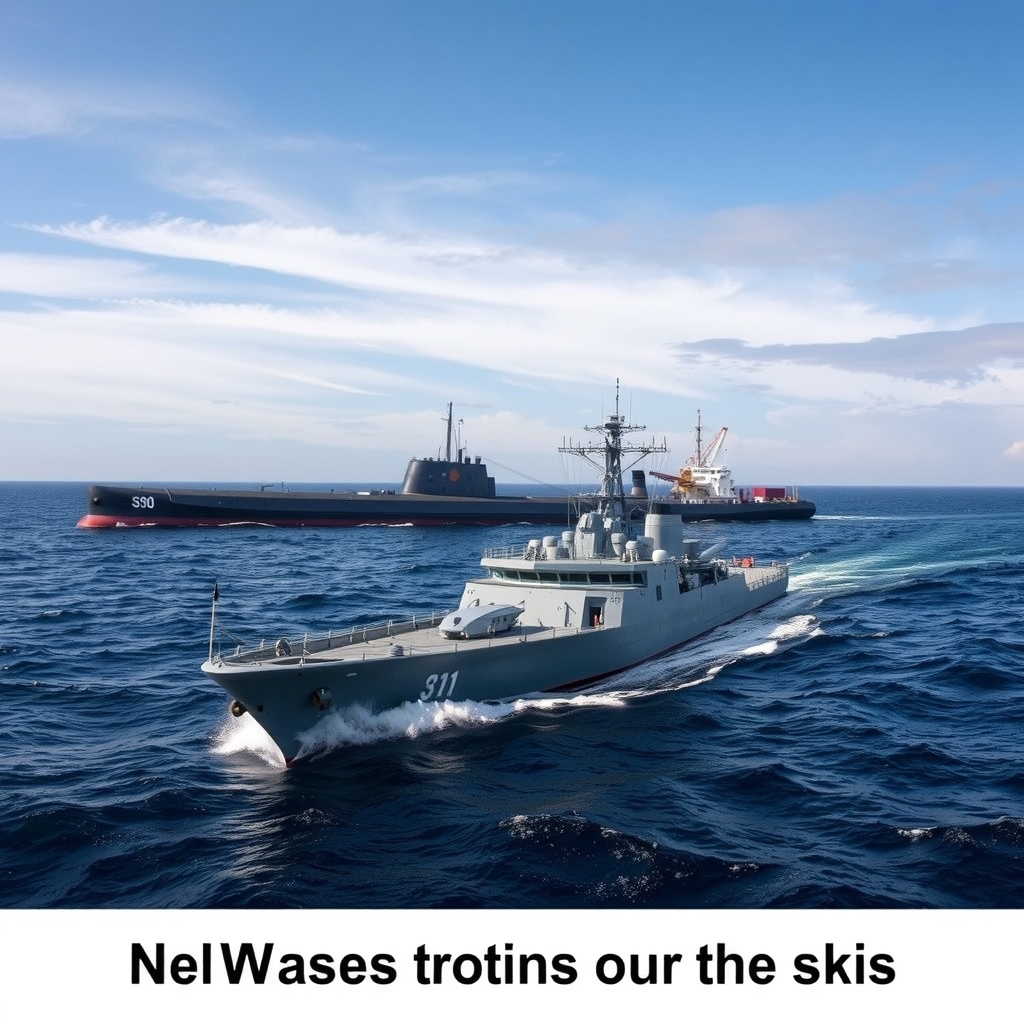
The codification of the law of naval warfare remained largely stagnant for the better part of the twentieth century, anchored to the 1907 Hague Conventions which, while foundational, failed to account for the seismic shifts in maritime technology and the emergence of the United Nations Convention on the Law of the Sea (UNCLOS). The San Remo Manual on International Law Applicable to Armed Conflicts at Sea, adopted in 1994, emerged as a critical remedial instrument. Though technically a restatement of existing law—a product of the International Institute of Humanitarian Law—its influence has permeated military manuals and judicial reasoning, effectively bridging the gap between historical custom and contemporary operational realities.
Unlike its land-based counterparts, naval warfare occurs in a medium that is shared, largely international, and vital for global commerce. The legal complexity of maritime conflict arises from the necessity of balancing belligerent rights with the rights of neutral states and the preservation of the marine environment. This tension is at the heart of the San Remo Manual, which seeks to reconcile the 1982 UNCLOS framework—designed for peacetime governance—with the laws of armed conflict (LOAC). This scholarly inquiry evaluates the manual's role in modern jurisprudence, its treatment of targeting, blockades, and neutrality, and its enduring relevance in an era of autonomous systems and cyber capabilities.
The Dual Framework: Harmonizing UNCLOS and LOAC
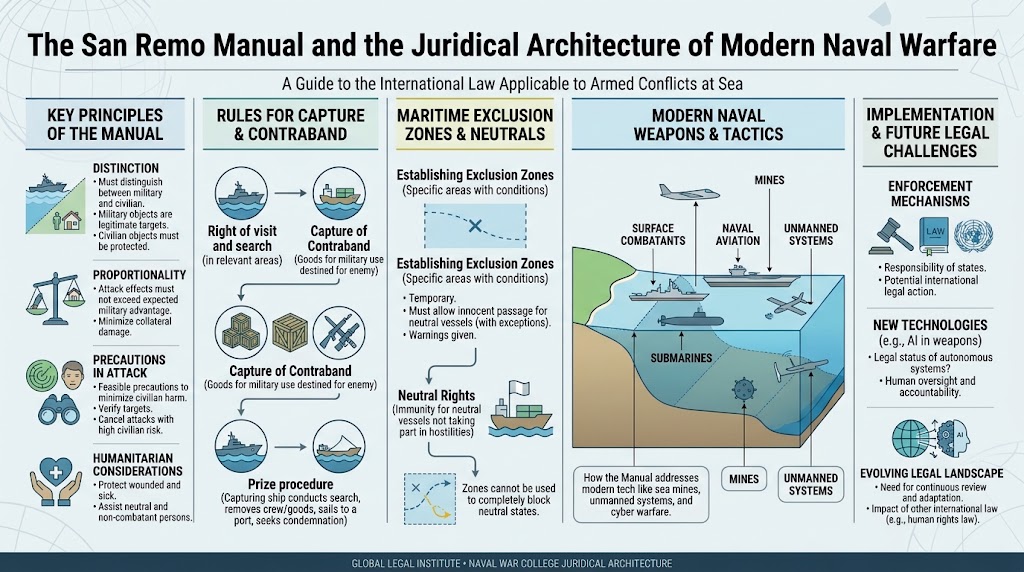
One of the primary challenges addressed by the San Remo Manual is the applicability of UNCLOS during periods of armed conflict. While UNCLOS provides a comprehensive framework for maritime sovereignty and jurisdiction, its silence on the law of war created a normative vacuum. The Manual clarifies that the legal status of maritime zones—territorial seas, contiguous zones, and exclusive economic zones (EEZ)—persists during conflict, but is overlaid by the rights and duties of belligerents and neutrals.
Specifically, the Manual reinforces the principle that while belligerents may engage in hostilities on the high seas and in the EEZ of neutral states (subject to specific constraints), they must not conduct operations within the neutral territorial sea. This distinction is vital for maintaining the stability of international commerce. The Manual effectively imports the concepts of necessity and proportionality from general international law, as articulated by the International Court of Justice (ICJ) in the Nicaragua v. United States (1986) case, and applies them to the unique tactical environment of the ocean.
How does the San Remo Manual define military objectives at sea?
The principle of distinction is the cornerstone of international humanitarian law, yet its application at sea presents unique hurdles. Under Rule 40 of the San Remo Manual, military objectives are defined as those objects which by their nature, location, purpose, or use make an effective contribution to military action and whose total or partial destruction, capture, or neutralization offers a definite military advantage. This definition mirrors Article 52 of Additional Protocol I to the Geneva Conventions but is tailored for the maritime domain.
Vessels are categorized based on their function and ownership. Enemy warships are always legitimate targets, regardless of their immediate activity. However, the status of merchant vessels is more nuanced. Rule 60 identifies conditions under which enemy merchant vessels lose their protection, including engaging in belligerent acts, acting as an auxiliary to an enemy\'s armed forces, or refusing an order to stop. More controversially, Rule 67 addresses the targeting of neutral merchant vessels, a provision heavily influenced by the Tanker War of the 1980s. A neutral vessel only becomes a military objective if it makes an effective contribution to the enemy\'s military action, such as carrying contraband or breaching a blockade, and after a clear warning has been ignored.
| Vessel Type | Legal Status | Conditions for Lawful Attack |
|---|---|---|
| Enemy Warship | Military Objective | Always targetable under LOAC. |
| Enemy Merchant Vessel | Protected (General) | Loss of protection if integrated into military effort or resisting search. |
| Neutral Merchant Vessel | Protected (Strict) | Targetable only if making direct military contribution or breaching blockade. |
| Hospital Ships | Exempt | Inviolable under Geneva Convention II; must be clearly marked. |
What are the legal requirements for a naval blockade under international law?
The blockade remains one of the most potent and legally complex tools of naval warfare. The San Remo Manual modernizes the requirements first established in the 1856 Declaration of Paris and the 1909 Declaration of London. Under Rules 93 through 104, a blockade must be declared, notified to all states, and—crucially—be effective. The requirement of effectiveness means the blockade must be maintained by a force sufficient to render ingress and egress dangerous. Paper blockades, which exist only in decree without physical presence, are prohibited.
Modern jurisprudence, particularly the 2011 Palmer Report (Secretary-General\'s Panel of Inquiry on the 31 May 2010 Flotilla Incident), reaffirmed the Manual\'s stance on the legality of blockades. The Manual introduces humanitarian safeguards that were absent in older customary law. Rule 102 prohibits the declaration of a blockade if its sole purpose is to starve the civilian population or if the suffering of the civilian population is disproportionate to the military advantage. This reflects the evolution of human rights law and its influence on naval strategy. Furthermore, if the civilian population is inadequately provided with food and essential medical supplies, the blockading power must provide for free passage of such relief, subject to technical arrangements including search.
Submarine Warfare and the Legacy of the London Protocol
The Manual addresses the controversial history of submarine warfare, which was a flashpoint of legal debate following both World Wars. Rules 72 through 77 integrate the 1936 London Submarine Protocol into modern practice. Submarines are bound by the same rules of naval warfare as surface ships. Specifically, a submarine may not sink a merchant vessel without first having placed passengers, crew, and ship\'s papers in a place of safety, unless the vessel persistently refuses to stop or offers active resistance. The Manual acknowledges the technological reality of stealth but refuses to grant submarines a legal exception to the humanitarian requirements of capture and destruction.
The Protection of the Marine Environment
Unlike earlier instruments, the San Remo Manual explicitly considers the environmental consequences of naval operations. Rule 44 mandates that belligerents shall take care to protect the natural environment against widespread, long-term, and severe damage. This phrasing is borrowed from Article 35(3) of Additional Protocol I. In the context of maritime conflict, this includes avoiding the destruction of oil tankers or offshore platforms unless strictly necessary, as seen in the environmental disasters resulting from the targeting of oil infrastructure in past conflicts. The ICJ\'s Advisory Opinion on the Legality of the Threat or Use of Nuclear Weapons (1996) underscored that while environmental treaties might not be suspended during war, the requirements of necessity and proportionality include environmental considerations.
Neutrality and the Contested Space of the EEZ
The concept of neutrality is perhaps the most strained by the advent of UNCLOS. Under the 1907 Hague Convention XIII, neutral waters were limited to the territorial sea. However, with the creation of the 200-nautical-mile EEZ, a significant portion of the ocean became a zone of functional neutral rights. The San Remo Manual clarifies that while the EEZ is not "neutral water" in the same sense as the territorial sea, belligerents must have "due regard" for the rights of the neutral coastal state. This includes avoiding damage to underwater pipelines, cables, and artificial islands.
The San Remo Manual represents a pragmatic synthesis of traditional naval custom and the humanitarian imperatives of the late 20th century. It does not seek to abolish naval warfare but to subject it to the rule of law in an increasingly crowded and interconnected maritime domain.
The status of submarine cables, which carry over 95% of global data, is addressed in Rule 37. Belligerents are cautioned against interfering with cables connecting neutral states or those connecting a neutral state to a belligerent state, unless such interference is a matter of urgent military necessity. This rule is increasingly relevant as cyber operations and physical cable security become central to modern conflict.
The Jurisprudential Weight of the Manual
While the San Remo Manual is not a treaty, its provisions have been cited by international tribunals and incorporated into the naval manuals of the United States, United Kingdom, Germany, and Australia. Its role in identifying opinio juris is significant. For instance, in the M/V Saiga (No. 2) Case (Saint Vincent and the Grenadines v. Guinea) before the International Tribunal for the Law of the Sea (ITLOS), the court dealt with the use of force in maritime law enforcement. Although it was a peacetime case, the court\'s emphasis on the necessity and proportionality of force echoed the normative standards codified in San Remo.
Furthermore, the Manual\'s provisions on the capture of prizes and the adjudication of prize courts remain the standard reference for states exercising the right of visit and search. The procedural requirements for prize law, though rarely used in the 21st century, remain an essential check on the arbitrary seizure of private property at sea.
Future Challenges: AI, Drones, and Cyber Warfare
As we look toward the future, the San Remo Manual faces challenges from emerging technologies that its drafters could not fully anticipate. The rise of Unmanned Maritime Systems (UMS), including autonomous underwater vehicles (AUVs) and surface drones, raises questions about the definition of a "ship" and a "warship." Can an autonomous vessel exercise the right of visit and search? How do the rules of precautions in attack apply to AI-driven targeting systems?
Moreover, the integration of cyber operations into naval strategy complicates the Manual\'s rules on blockades and exclusion zones. A "cyber blockade" that disrupts a port\'s digital infrastructure without a physical presence might achieve the same effect as a traditional blockade but currently falls outside the manual\'s explicit definitions. Scholars are increasingly calling for a "San Remo 2.0" or a similar update to address these technological leaps while preserving the core humanitarian and neutral protections established in 1994.
Conclusion
The San Remo Manual on International Law Applicable to Armed Conflicts at Sea remains the most authoritative expression of the laws of naval warfare. By reconciling the 1907 Hague traditions with the 1982 UNCLOS framework and the 1977 Additional Protocols, it provides a stable legal architecture for naval commanders and international jurists alike. While the nature of maritime platforms may change—from ironclads to autonomous drones—the fundamental requirements of distinction, proportionality, and the protection of neutral rights remain constant. The Manual serves as a vital safeguard against the lawless escalation of maritime conflict, ensuring that even in the heat of battle, the sea remains a space governed by international law.
Comments
No comments yet.