Digital Tempests: The Juridical Framework of Cyber Threats to Maritime Infrastructure and Vessels
An interrogation of international law, state responsibility, and the evolving jurisprudence governing maritime cyber security in the age of automated shipping.
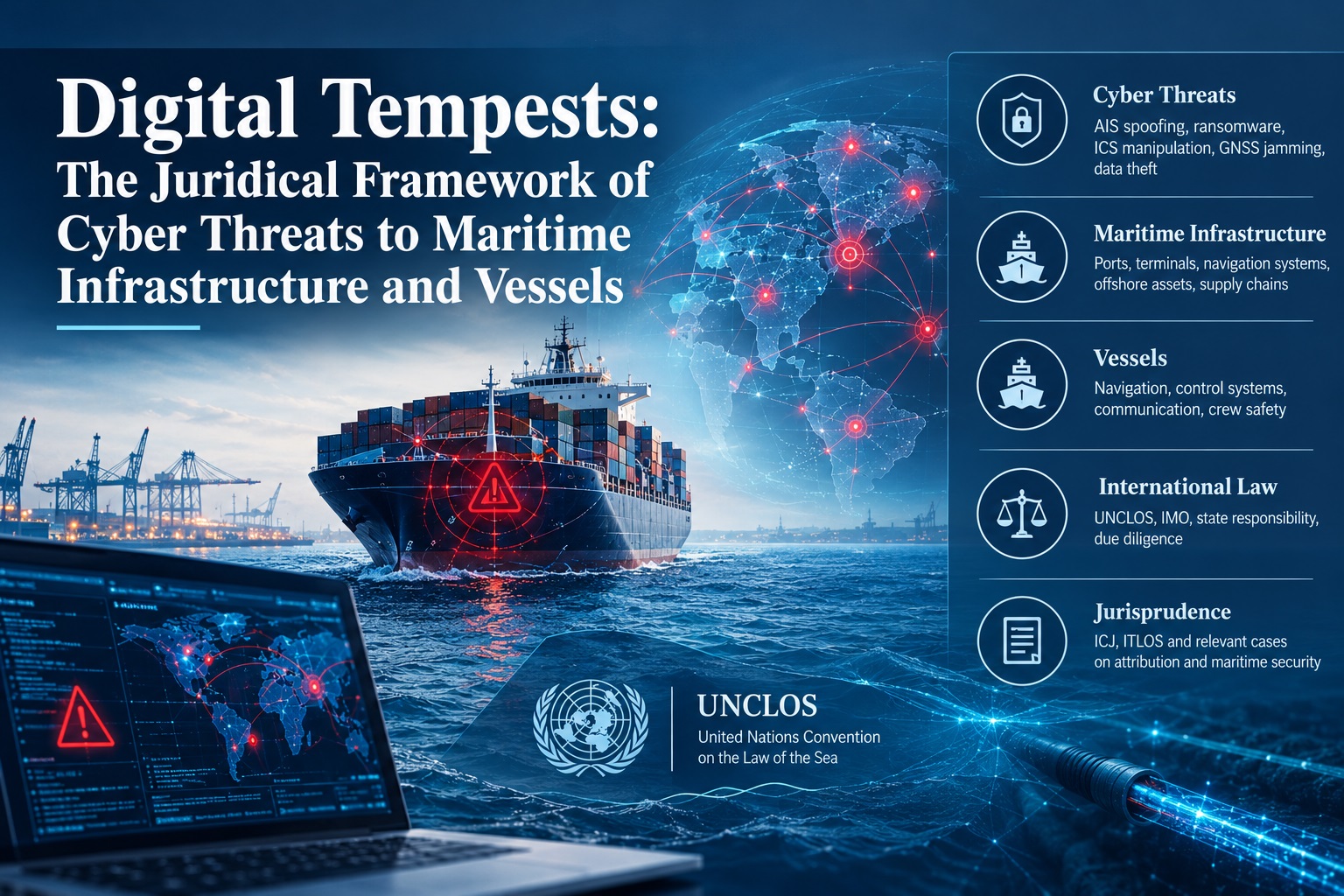
The contemporary maritime landscape is undergoing a systemic transition from mechanical reliance to digital integration. As vessels become sophisticated cyber-physical systems and port infrastructures evolve into interconnected nodes of a global logistical web, the traditional parameters of maritime security are being recalibrated. The emergence of cyber-related interference—ranging from the spoofing of Automatic Identification System (AIS) data to the remote manipulation of Industrial Control Systems (ICS) aboard Ultra Large Container Vessels (ULCVs)—presents a profound challenge to the established *lex maritima*. This analysis seeks to evaluate the adequacy of the United Nations Convention on the Law of the Sea (UNCLOS) and associated international jurisprudence in addressing the intangible yet existential threats posed by cyber-adversaries.
The Regulatory Architecture and IMO Mandates
The International Maritime Organization (IMO) has recognized that the safety of life at sea (SOLAS) is now inextricably linked to cyber resilience. Through Resolution MSC.428(98), the IMO mandated that cyber risk management be integrated into existing Safety Management Systems (SMS) as defined by the International Safety Management (ISM) Code. However, from a juridical perspective, these administrative mandates often lack the enforcement vigor found in treaty-based obligations. The legal community continues to grapple with whether a failure to maintain robust cyber defenses constitutes a breach of the seaworthiness warranty—a cornerstone of maritime law that has, for centuries, focused on the physical integrity of the hull and the competence of the crew.
What is the legal responsibility for maritime cyber attacks?
The determination of legal responsibility for a maritime cyber attack necessitates an inquiry into the Draft Articles on Responsibility of States for Internationally Wrongful Acts (ARSIWA). Under Article 4, the conduct of any State organ is attributable to the State. However, cyber operations often occupy a grey zone where non-State actors, potentially sponsored or tolerated by a sovereign, execute disruptions against commercial shipping. The landmark judgment of the International Court of Justice (ICJ) in Nicaragua v. United States established the effective control test, which sets a high threshold for attributing the acts of private individuals to a State. In the context of a cyber attack on a port’s terminal operating system, proving that a State exercised effective control over the specific digital packets sent by a hacker group remains a formidable evidentiary hurdle.
Furthermore, the principle of due diligence, as articulated in the Corfu Channel case (United Kingdom v. Albania), suggests that every State has an obligation not to allow knowingly its territory to be used for acts contrary to the rights of other States. If a coastal State is aware that its digital infrastructure is being leveraged to jam Global Navigation Satellite System (GNSS) signals within its Exclusive Economic Zone (EEZ), yet fails to intervene, it may incur international responsibility regardless of whether it directed the attack. The difficulty lies in the temporal aspect of cyber warfare; unlike the naval mines in the Corfu Channel, digital intrusions occur at the speed of light, often rendering the requirement of knowledge functionally obsolete before a remedy can be sought.
How does UNCLOS address cyber threats to vessel navigation?
UNCLOS, often referred to as the constitution of the oceans, was drafted in an era of analog navigation. Consequently, it does not explicitly mention cyber activities. Nevertheless, the convention’s provisions on innocent passage (Article 19) and the duties of the flag State (Article 94) provide a foundational, albeit strained, framework. Under Article 19(2), passage is considered prejudicial to the peace, good order, or security of the coastal State if the vessel engages in any act of willful and serious pollution, any act aimed at interfering with any systems of communication, or any other activity not having a direct bearing on passage.
While Article 19 is primarily designed to regulate the conduct of the vessel itself, a burgeoning jurisprudential debate concerns whether a vessel that has had its navigation systems compromised by a third party can still be considered in innocent passage. If a vessel’s AIS is spoofed to display a false position, thereby creating a risk of collision in a busy strait, does the vessel lose its right of innocent passage? The prevailing view suggests that innocence is determined by the vessel's intent and conduct, not its technical malfunctions. However, if the flag State fails to exercise its jurisdiction and control in administrative, technical, and social matters over the ship (as required by Article 94), the coastal State may argue that the vessel’s presence constitutes a threat to maritime safety, justifying intervention.
Comparison of Jurisprudential Applications to Maritime Threats
| Threat Category | Traditional Legal Instrument | Cyber Application / Ambiguity | Precedent/Source |
|---|---|---|---|
| Interference with Navigation | UNCLOS Art. 21 (Safety of Navigation) | GNSS/GPS Jamming and Spoofing | The Enrica Lexie (Jurisdiction) |
| Armed Attack / Force | UN Charter Art. 2(4) | Cyber-induced physical destruction (e.g., boiler explosion) | Nicaragua v. USA (Threshold of Force) |
| Piracy | UNCLOS Art. 101 | Digital Hijacking for Ransom (Ransomware) | The Achille Lauro (Private Ends) |
| Due Diligence | Customary International Law | Failure to secure port data systems | Corfu Channel (ICJ) |
Can a cyber attack be considered an act of piracy under international law?
The definition of piracy under Article 101 of UNCLOS requires three strict elements: an illegal act of violence, detention, or depredation; committed for private ends; by the crew or passengers of a private ship or aircraft; on the high seas. The application of this article to cyber-attacks is problematic. Most cyber-intrusions lack the physical violence traditionally associated with the hostis humani generis. If a hacker in a land-based apartment remotely encrypts a ship’s propulsion software and demands a bitcoin ransom, the two-ship requirement (the attack must be launched from one ship against another) is not met.
The Achille Lauro incident and subsequent interpretations by the Permanent Court of Arbitration (PCA) suggest that the law of piracy is resistant to expansion. While some scholars argue for a functional interpretation—where digital force is equated to physical force—the consensus remains that cyber-ransomware attacks against vessels are better categorized as maritime terrorism or transnational organized crime, falling under the Convention for the Suppression of Unlawful Acts against the Safety of Maritime Navigation (SUA Convention). The SUA Convention’s focus on acts likely to endanger the safe navigation of a ship provides a more flexible platform for prosecuting cyber-offenders, as it does not require the presence of a second pirate vessel.
Who is liable for damages caused by a cyber-hijacked vessel?
In the event of a collision resulting from a cyber-attack—such as the manipulation of an Electronic Chart Display and Information System (ECDIS)—the question of liability shifts to the private law domain, specifically the lex mercatoria and the Hague-Visby Rules. Article III(1) of the Hague-Visby Rules mandates that the carrier must exercise due diligence to make the ship seaworthy. If a shipowner fails to update critical security patches or allows the use of unauthorized USB drives in the bridge systems, the ship may be deemed unseaworthy from the commencement of the voyage.
However, the 1910 Collision Convention and the principle of fault-based liability complicate the recovery process. If a vessel is remotely hijacked, can the owner claim the defense of compulsory pilotage or force majeure? Jurisprudence from the Oil Platforms case (Iran v. United States) suggests that the necessity of a causal link between the act and the damage is paramount. If the shipowner can demonstrate that the cyber-attack was of such sophistication that no reasonable standard of care could have prevented it, liability may be mitigated. This creates a shifting standard of care that evolves with the technological state-of-the-art, placing a continuous burden on maritime operators to remain ahead of the digital threat curve.
"The digital vulnerability of a ship is no longer a peripheral technical concern but a core element of the vessel's juridical status. A ship that cannot defend its digital perimeter is a ship that may, in law, be considered unseaworthy and a hazard to the international community."
Cyber Operations and the Threshold of the Use of Force
A critical inquiry involves determining when a cyber operation against maritime infrastructure crosses the threshold into an armed attack, triggering the right to self-defense under Article 51 of the UN Charter. The Tallinn Manual 2.0, while non-binding, reflects an emerging consensus that a cyber operation constitutes a use of force if its scale and effects are comparable to a non-cyber operation that would be classified as a use of force. For instance, if a cyber-attack on a port’s automated crane system causes them to collapse, resulting in significant loss of life and physical destruction, the legal distinction between a missile and a line of code becomes immaterial. However, the majority of maritime cyber incidents—such as data breaches or temporary service disruptions—fall below this threshold, leaving a significant gap in the legal framework for escalation and deterrence.
Conclusion
The integration of cyber security into maritime law requires more than the mere adaptation of existing conventions; it demands a fundamental re-evaluation of the relationship between sovereignty, technology, and the high seas. While UNCLOS remains the primary instrument for maritime governance, its silence on digital threats necessitates a proactive interpretative approach by bodies such as the International Tribunal for the Law of the Sea (ITLOS). The evolution of the law must move toward a unified standard of digital due diligence, where flag States and coastal States alike are held to a rigorous standard of cyber-hygiene. As the horizon of the autonomous ship nears, the juridical community must ensure that the rule of law is not submerged by the rising tide of digital insecurity.
Comments
No comments yet.