The Jurisprudential Architecture of ITLOS Advisory Opinions: Judicial Activism and the Evolution of UNCLOS
A rigorous analysis of the advisory jurisdiction of the International Tribunal for the Law of the Sea, exploring the evolution of judicial authority from the Seabed Disputes Chamber to the full

The legal landscape of the oceans has undergone a profound transformation since the entry into force of the United Nations Convention on the Law of the Sea (UNCLOS) in 1994. While the Convention is often lauded as the constitution for the oceans, its implementation relies heavily on the interpretive clarity provided by its judicial organs. Central to this interpretive evolution is the International Tribunal for the Law of the Sea (ITLOS), which, through its advisory function, has transcended its primary role as a forum for contentious dispute settlement. The advisory jurisdiction of ITLOS represents a sophisticated mechanism for clarifying normative ambiguities, particularly in the face of contemporary challenges such as illegal fishing and anthropogenic climate change. This article examines the procedural foundations, the jurisdictional controversies, and the substantive impacts of ITLOS advisory opinions, positioning them within the broader framework of international law.
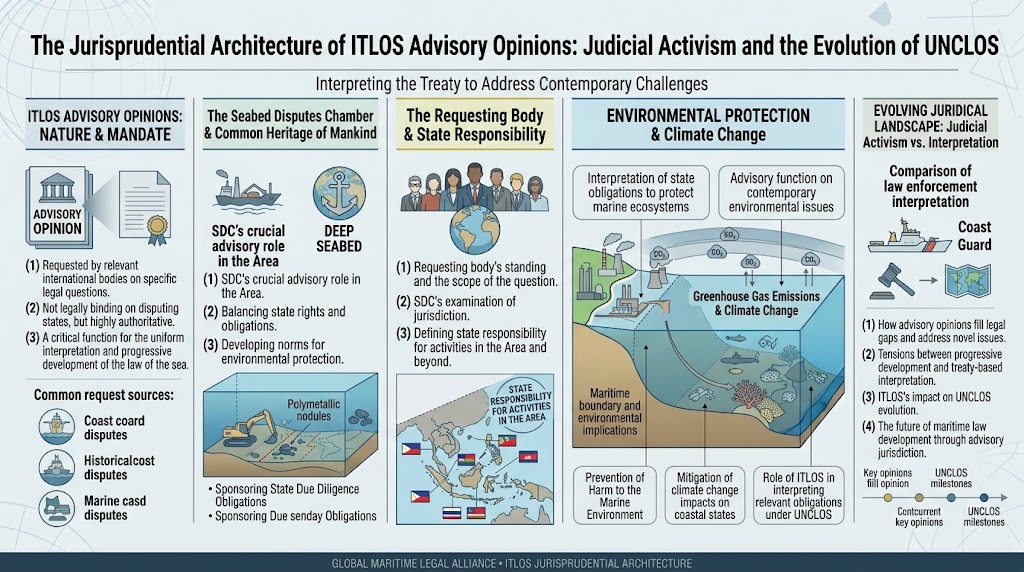
The Dual Track of Advisory Jurisdiction
Unlike the International Court of Justice (ICJ), whose advisory jurisdiction is broadly anchored in Article 96 of the UN Charter, the advisory authority of ITLOS is bifurcated between two distinct legal pathways. The first is explicitly provided for in Article 191 of UNCLOS, which grants the Seabed Disputes Chamber (SDC) the power to give advisory opinions at the request of the Assembly or the Council of the International Seabed Authority (ISA) on legal questions arising within the scope of their activities. This pathway is characterized by its limited geographic and functional scope, focusing strictly on the Area—the seabed and ocean floor beyond the limits of national jurisdiction.
The second pathway, which pertains to the full Tribunal, is more legally complex and has been the subject of significant academic debate. Article 21 of the ITLOS Statute provides that the jurisdiction of the Tribunal comprises all disputes and all applications submitted to it in accordance with UNCLOS and all matters specifically provided for in any other agreement which confers jurisdiction on the Tribunal. Leveraging this provision, the Tribunal adopted Article 138 of its Rules of Procedure, which asserts that the Tribunal may give an advisory opinion on a legal question if an international agreement related to the purposes of the Convention specifically provides for the submission to the Tribunal of a request for such an opinion. This regulatory expansion of jurisdiction has prompted questions regarding the hierarchy of norms and the limits of judicial law-making.
What is the legal basis for ITLOS advisory opinions?
The question of the legal basis for the Tribunal’s advisory function requires a nuanced reading of both the Statute and the Rules. For the Seabed Disputes Chamber, the basis is unequivocally treaty-based (Article 191). However, for the full Tribunal, the basis is derived from a combination of Article 21 of the Statute and Article 138 of the Rules. The legitimacy of this latter basis was tested in Case No. 21, the Request for an Advisory Opinion submitted by the Sub-Regional Fisheries Commission (SRFC). Several states argued that the Tribunal could not grant itself advisory jurisdiction through its own Rules, contending that the silence of UNCLOS on a general advisory function for the full Tribunal was intentional (expressio unius est exclusio alterius).
The Tribunal, however, dismissed these concerns by emphasizing that Article 21 of the Statute allows for jurisdiction to be conferred by other agreements. By reading Article 21 of the Statute in conjunction with the relevant international agreement (in the SRFC case, the 2012 MCA Convention), the Tribunal concluded that it possessed the requisite jurisdiction. This interpretation suggests that the advisory function is not an inherent power but a delegated one, contingent upon the existence of a valid external agreement. The Tribunal thus avoided the charge of ultra vires by anchoring its authority in the consent of the parties to the external agreement, thereby maintaining the consensual nature of international adjudication while expanding its normative reach.
| Jurisdictional Basis | Body Involved | Key Legal Source | Scope of Authority |
|---|---|---|---|
| Article 191 UNCLOS | Seabed Disputes Chamber | The Convention | Limited to the Area and ISA activities. |
| Article 138 Rules | Full Tribunal | Statute Art. 21 + External Agreement | Related to the purposes of UNCLOS. |
The Seabed Disputes Chamber and Due Diligence Obligations
The inaugural exercise of ITLOS's advisory function occurred in 2011 with the SDC's opinion on the Responsibilities and Obligations of States Sponsoring Persons and Entities with Respect to Activities in the Area. This case was pivotal in defining the concept of due diligence in the context of deep-seabed mining. The Chamber was asked to clarify the extent of a sponsoring State's liability for environmental damage caused by a sponsored contractor. The Chamber articulated that the obligation of a sponsoring State is not an obligation of result, but rather an obligation of conduct, specifically the obligation to exercise due diligence.
The SDC defined due diligence as a variable concept that changes over time in light of new scientific knowledge and technological advances. Crucially, it linked this obligation to the precautionary approach, as found in Principle 15 of the Rio Declaration. The Chamber noted that for a State to fulfill its due diligence requirements, it must adopt laws, regulations, and administrative measures within its legal system that are reasonably appropriate for securing compliance by the contractor. This opinion effectively closed a potential legal gap where developing states might have been held to lower standards, asserting that the requirements for the protection of the marine environment must be uniform to prevent the emergence of flags of convenience in the Area.
Can the ITLOS full Tribunal issue advisory opinions?
As established in the SRFC Advisory Opinion, the answer is a qualified yes. The full Tribunal can issue advisory opinions provided three cumulative conditions are met under Article 138 of the Rules: an international agreement related to the purposes of the Convention must provide for the request; the request must be transmitted to the Tribunal by a body authorized by or in accordance with that agreement; and the request must involve a legal question. In Case No. 21, the Tribunal clarified that even if the underlying agreement is not a global treaty, the Tribunal’s jurisdiction is valid as long as the agreement is related to the purposes of UNCLOS.
The Tribunal’s willingness to exercise this power marks a significant shift toward a more proactive judicial role. In the SRFC case, the Tribunal addressed the obligations of flag States regarding illegal, unreported, and unregulated (IUU) fishing. It concluded that flag States have a due diligence obligation to ensure that vessels flying their flag do not engage in IUU fishing within the Exclusive Economic Zones (EEZs) of the SRFC member States. This finding extended the SDC’s reasoning from the Area to the EEZ, reinforcing the notion that due diligence is a cornerstone of modern maritime governance. By doing so, the Tribunal provided the SRFC with a powerful legal tool to hold flag States accountable, even those that are not parties to the regional fisheries agreements.
How do ITLOS advisory opinions influence climate change law?
The most significant and recent development in this field is the 2024 Advisory Opinion on Climate Change and International Law (Case No. 31), requested by the Commission of Small Island States (COSIS). This opinion represents a landmark moment in international environmental law, as it explicitly integrates climate science into the legal framework of UNCLOS. The Tribunal was asked to clarify the specific obligations of States Parties to UNCLOS regarding the prevention, reduction, and control of pollution of the marine environment from anthropogenic greenhouse gas (GHG) emissions.
The Tribunal’s reasoning was transformative. It held that anthropogenic GHG emissions constitute pollution of the marine environment as defined in Article 1, paragraph 1, subparagraph 4 of UNCLOS, primarily because such emissions result in the introduction of substances (carbon dioxide) and energy (heat) into the marine environment, leading to deleterious effects such as ocean acidification and warming. Consequently, the Tribunal ruled that States have a specific obligation under Article 194 to take all measures necessary to prevent, reduce, and control such pollution. Importantly, the Tribunal emphasized that this obligation is independent of the Paris Agreement. While the Paris Agreement sets global temperature targets, UNCLOS imposes a more stringent due diligence requirement to protect the marine environment from the specific impacts of those emissions. This creates a cumulative legal regime where the law of the sea acts as a critical enforcement pillar for climate action.
The obligation of States Parties to take all necessary measures to prevent, reduce and control marine pollution from anthropogenic GHG emissions is an obligation of due diligence. The standard of due diligence must be extremely high, given the scale of the threat to the marine environment and the scientific certainty of its impacts.
What is the difference between ITLOS and ICJ advisory functions?
While both ITLOS and the ICJ provide advisory opinions that are technically non-binding but carry significant legal weight, their jurisdictional foundations and operational modalities differ. The ICJ's advisory jurisdiction is universal in scope, limited only by the requirement that the question be a legal one and requested by authorized UN organs or specialized agencies. In contrast, ITLOS’s advisory jurisdiction is more fragmented and functionally specialized. The SDC’s jurisdiction is treaty-based and restricted to the Area, while the full Tribunal’s jurisdiction is based on external agreements and must be related to the purposes of UNCLOS.
Another key distinction lies in the discretionary nature of the power. Both courts maintain that they have the discretion to decline a request for an advisory opinion if there are compelling reasons to do so. However, the ICJ has never refused a request from a UN organ, asserting that its role as the principal judicial organ of the UN makes it duty-bound to cooperate. ITLOS, while mirroring this sentiment in its rhetoric, operates in a more specialized regime. The criteria for discretionary refusal at ITLOS include whether the request is actually a contentious dispute in disguise (the Monetary Gold principle) or whether the legal question is sufficiently clear. In the COSIS case, ITLOS demonstrated a high degree of judicial confidence, moving beyond the traditional constraints of the ICJ to address the urgent legal implications of the climate crisis on the ocean's chemical and thermal integrity.
The Normative Weight and Legal Effect of Advisory Opinions
The debate surrounding the non-binding nature of advisory opinions often misses their actual impact on State behavior and international jurisprudence. Although an advisory opinion does not have the res judicata effect of a judgment in a contentious case, it provides an authoritative statement of the law. This is particularly relevant in the context of UNCLOS, where many provisions are intentionally broad to allow for consensus. Advisory opinions fill these lacunae, providing a roadmap for domestic legislation and international negotiations.
For instance, the SDC’s 2011 opinion has been extensively cited in the drafting of national seabed mining regulations. Similarly, the SRFC opinion has influenced how regional fisheries management organizations (RFMOs) approach flag State responsibility. The COSIS opinion is expected to serve as a cornerstone for future climate litigation in domestic courts and other international fora, such as the ICJ and the Inter-American Court of Human Rights. By clarifying the due diligence standard, ITLOS has moved the discourse from abstract environmental principles to concrete legal obligations that can be monitored and, in some cases, enforced through the Convention’s compulsory dispute settlement mechanisms under Part XV.
Comparison of Major Advisory Opinions
| Case Name | Key Issue | Core Finding | Legal Impact |
|---|---|---|---|
| Case No. 17 (SDC) | Sponsoring State Liability | Due diligence is a variable and stringent conduct obligation. | Uniform environmental standards for the Area. |
| Case No. 21 (SRFC) | IUU Fishing / Flag State Responsibility | Flag States must take enforcement measures against IUU vessels. | Strengthened regional fisheries governance. |
| Case No. 31 (COSIS) | GHG Emissions as Marine Pollution | GHGs fall under UNCLOS Art 1.1.4; Art 194 is a mandatory duty. | Integrates climate obligations into the law of the sea. |
Critical Perspectives and the Risk of Fragmentation
Despite the utility of advisory opinions, critics argue that the Tribunal’s expansive interpretation of Article 138 of the Rules risks judicial overreach. Some scholars suggest that if any group of States can confer advisory jurisdiction on ITLOS via a side agreement, the Tribunal might be used to bypass the limitations of the Convention’s dispute settlement system. There is also the concern of fragmented jurisprudence. If ITLOS and the ICJ reach different conclusions on similar legal questions—such as the relationship between the law of the sea and general international law on climate change—it could lead to legal uncertainty.
However, the Tribunal has been careful to anchor its findings in established principles of treaty interpretation as found in the Vienna Convention on the Law of Treaties (VCLT). By utilizing Article 31(3)(c) of the VCLT, which requires taking into account any relevant rules of international law applicable in the relations between the parties, ITLOS has ensured that its opinions are not in a vacuum but are part of a systemic integration of international law. This approach mitigates the risk of fragmentation and instead promotes a cross-pollination of legal norms across different specialized regimes.
Conclusion
The advisory opinions of ITLOS have emerged as an indispensable instrument for the progressive development of the law of the sea. From the depths of the Area to the atmospheric interactions of the high seas, the Tribunal has demonstrated a remarkable capacity to interpret UNCLOS as a living treaty, capable of addressing the existential threats of the 21st century. While the jurisdictional basis for the full Tribunal's advisory function may continue to be a point of academic contention, the substantive impact of its opinions on State responsibility, due diligence, and climate change is undeniable. As the international community seeks to balance the exploitation of ocean resources with the imperative of environmental protection, the advisory function of ITLOS provides the necessary normative guidance to ensure that the rule of law prevails in the global maritime commons. The future of ocean governance will likely see a continued reliance on this judicial mechanism as a means of resolving systemic legal questions that transcend bilateral disputes, ultimately contributing to the stability and integrity of the international legal order.
Comments
No comments yet.