The Legal Anatomy of the Exclusive Economic Zone: Sovereign Rights, Jurisdictional Limits, and Freedom of the Seas
An in-depth analysis of the Exclusive Economic Zone (EEZ) under UNCLOS, balancing coastal state resource rights with international freedoms of navigation and transit.
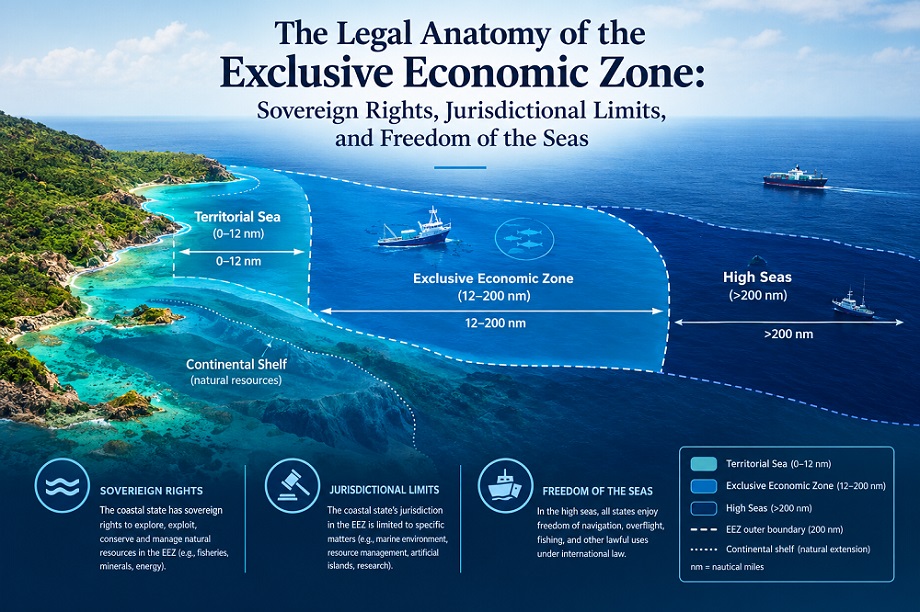
The establishment of the Exclusive Economic Zone (EEZ) stands as one of the most revolutionary achievements in the history of international maritime law. Codified under Part V of the United Nations Convention on the Law of the Sea (UNCLOS) in 1982, the EEZ represents a delicate, highly negotiated compromise between coastal States seeking to protect their offshore resources and maritime nations determined to preserve the traditional freedoms of the high seas. Spanning up to 200 nautical miles from a coastal State’s baselines, the EEZ is neither a zone of territorial sovereignty nor a part of the high seas. Instead, it is a sui generis legal regime—a unique legal space where rights, jurisdictions, and duties are meticulously apportioned to balance national economic interests with global maritime freedom.
The Genesis of the Exclusive Economic Zone
To understand the legal architecture of the EEZ, one must examine the geopolitical forces that shaped its creation during the Third United Nations Conference on the Law of the Sea (UNCLOS III). For centuries, international maritime law was dominated by a simple binary framework: a narrow band of territorial sea (historically three nautical miles, based on the "cannon-shot rule") over which the coastal State exercised full sovereignty, and the vast high seas, governed by the principle of mare liberum (freedom of the seas).
However, the mid-20th century witnessed a rapid evolution in maritime technology. Distant-water fishing fleets grew highly industrialized, depleting fish stocks close to foreign shores. Concurrently, technological breakthroughs made offshore oil and gas extraction viable. These developments prompted a wave of unilateral declarations. The United States pioneered this shift with the Truman Proclamation of 1945, claiming jurisdiction over the natural resources of its subsoil and seabed of the continental shelf. Shortly thereafter, several Latin American nations, including Chile, Ecuador, and Peru, issued the Santiago Declaration of 1952, claiming exclusive sovereignty and jurisdiction over the sea and seabed up to 200 nautical miles from their coasts to safeguard their vital artisanal fisheries.
These unilateral extensions threatened to destabilize global navigation, as naval powers feared a "creeping jurisdiction" that would ultimately close off critical maritime straits and choke points. When UNCLOS III convened in 1973, delegates faced the monumental task of reconciling these competing claims. The solution was the EEZ: a functional zone designed to grant coastal States exclusive control over economic resources while preserving global transit, communication, and scientific exploration.
The Sui Generis Legal Character of the EEZ
The legal status of the EEZ is established in Article 55 of UNCLOS, which defines it as an area beyond and adjacent to the territorial sea, subject to the specific legal regime established in Part V. This designation as a sui generis (of its own kind) regime is critical. It underscores that the EEZ does not constitute an extension of the coastal State's land territory or territorial sea.
Under Article 57, the breadth of the EEZ "shall not extend beyond 200 nautical miles from the baselines from which the breadth of the territorial sea is measured." Because the territorial sea can extend up to 12 nautical miles, the maximum width of the actual EEZ is typically 188 nautical miles. Within this expanse, the legal authority of the coastal State is not absolute; it is functional, specialized, and strictly limited to the purposes enumerated in the Convention.
Distinguishing Sovereignty from Sovereign Rights
A fundamental pillar of maritime law is the distinction between "sovereignty" and "sovereign rights." In its internal waters and territorial sea, a coastal State exercises full sovereignty. This means it has comprehensive legislative and enforcement jurisdiction over almost all activities, foreign vessels, and persons, subject only to specific international law exceptions such as the right of innocent passage.
In contrast, within the EEZ, the coastal State does not possess sovereignty. Instead, it possesses sovereign rights. Sovereign rights are functional and purpose-bound. They do not grant ownership over the maritime space itself, but rather the exclusive right to exploit, manage, and conserve the resources within that space. If a coastal State chooses not to exploit a specific resource, it cannot prevent other States from accessing the zone for purposes unrelated to resource exploitation, provided those activities conform to international law.
Sovereign Rights over Resources: Economic Exploitation and Management
Article 56(1)(a) of UNCLOS delineates the primary sovereign rights of the coastal State. These rights are granted for the purpose of "exploring and exploiting, conserving and managing the natural resources, whether living or non-living, of the waters superjacent to the seabed and of the seabed and its subsoil." This encompasses both the water column (pelagic resources) and the ocean floor (benthic and mineral resources).
Fisheries Management and the Optimum Utilization Principle
Living resources, particularly fisheries, represent the most historically contested aspect of the EEZ. UNCLOS seeks to balance the conservation of marine species with the global demand for food security. Under Article 61, the coastal State is obligated to determine the allowable catch of the living resources in its EEZ. It must ensure, through proper conservation and management measures, that these resources are not endangered by over-exploitation. To achieve this, the coastal State must rely on the best scientific evidence available.
Furthermore, Article 62 introduces the principle of "optimum utilization." The coastal State is required to promote the objective of optimum utilization of the living resources in the EEZ. If the coastal State does not have the capacity to harvest the entire allowable catch, it is legally obligated to give other States access to the surplus of the allowable catch through bilateral or regional agreements. In granting this access, the coastal State must take into account all relevant factors, including:
- The significance of the living resources of the area to the economy of the coastal State concerned and its other national interests.
- The rights of land-locked States (under Article 69) and geographically disadvantaged States (under Article 70) in the region.
- The need to minimize economic dislocation in States whose nationals have habitually fished in the zone or which have made substantial efforts in research and identification of stocks.
Foreign vessels permitted to fish in the EEZ must comply with the laws, regulations, and conservation measures established by the coastal State. These regulations can include licensing, species quotas, seasonal closures, gear restrictions, and the placement of observers on board.
Non-Living Resources and the Interface with the Continental Shelf
The sovereign rights of the coastal State also extend to non-living resources, such as oil, natural gas, and seabed minerals. Legally, the regime governing the seabed and subsoil of the EEZ is integrated with the regime of the Continental Shelf under Part VI of UNCLOS. While the EEZ and the continental shelf frequently overlap geographically up to 200 nautical miles, they are distinct legal concepts. The continental shelf can extend beyond 200 nautical miles under specific geological criteria (up to 350 nautical miles or more), whereas the EEZ is strictly capped at the 200-nautical-mile limit.
Additionally, Article 56 expands the coastal State’s sovereign rights to modern renewable energy production, specifically "the production of energy from the water, currents and winds." This provision has acquired immense contemporary significance with the global expansion of offshore wind farms, wave energy converters, and tidal energy arrays.
Jurisdictional Prerogatives of the Coastal State
In addition to sovereign rights over natural resources, Article 56(1)(b) grants the coastal State specific, limited jurisdiction over three distinct areas within its EEZ:
- The establishment and use of artificial islands, installations, and structures.
- Marine scientific research (MSR).
- The protection and preservation of the marine environment.
Artificial Islands and Marine Installations
Under Article 60, the coastal State has the exclusive right to construct, authorize, and regulate the construction, operation, and use of artificial islands, installations, and structures in its EEZ. This includes oil drilling platforms, offshore wind turbines, and scientific research structures. The coastal State exercises exclusive jurisdiction over these artificial features, including jurisdiction over customs, fiscal, health, safety, and immigration laws.
Importantly, UNCLOS clarifies that artificial islands, installations, and structures do not possess the status of natural islands. They do not have their own territorial sea, and their presence does not affect the delimitation of the territorial sea, the EEZ, or the continental shelf. To ensure maritime safety, the coastal State may establish reasonable safety zones around these structures, which must conform to international standards and generally cannot exceed 500 meters in radius.
Marine Scientific Research (MSR)
The conduct of marine scientific research within the EEZ is governed by a consent-based regime detailed in Article 246. In normal circumstances, coastal States are expected to grant their consent for MSR projects conducted by foreign States or international organizations, provided the research is carried out exclusively for peaceful purposes and to increase scientific knowledge of the marine environment.
However, the coastal State possesses the discretionary right to withhold consent if the proposed research project:
- Is of direct significance for the exploration and exploitation of natural resources, whether living or non-living.
- Involves drilling into the continental shelf, the use of explosives, or the introduction of harmful substances into the marine environment.
- Involves the construction, run, or use of artificial islands, installations, and structures.
- Contains inaccurate information regarding the nature and objectives of the project, or if the researching State has outstanding obligations from a prior research project.
Preservation of the Marine Environment
The coastal State's jurisdiction over environmental protection is vital for safeguarding fragile marine ecosystems from pollution. However, this jurisdiction is circumscribed to prevent coastal States from using environmental regulations as a pretext to restrict lawful navigation.
Under Part XII of UNCLOS, coastal State laws designed to prevent, reduce, and control pollution from foreign vessels in the EEZ must conform to and give effect to "generally accepted international rules and standards" (GAIRAS), primarily established through the International Maritime Organization (IMO). Only in specifically designated, ecologically vulnerable areas of the EEZ can a coastal State implement more stringent environmental rules, and even then, only after consulting with the IMO and obtaining its approval.
The Rights and Freedoms of Third States
While the coastal State enjoys resource-oriented sovereign rights and limited jurisdictions, the EEZ remains an international transit corridor. Article 58 of UNCLOS preserves key high seas freedoms for all other States, whether coastal or land-locked. These include:
- Freedom of Navigation: Foreign vessels of all types (commercial, military, and recreational) enjoy the right to traverse the EEZ without prior notification or authorization from the coastal State. This stands in sharp contrast to the territorial sea, where foreign vessels are limited to the more restrictive regime of innocent passage.
- Freedom of Overflight: Civil and military aircraft of all nations have the unrestricted right to fly through the airspace above the EEZ. No such right exists over the territorial sea or internal waters.
- Freedom to Lay Submarine Cables and Pipelines: All States are entitled to lay submarine cables and pipelines on the seabed of the EEZ. While the routing of pipelines is subject to the consent of the coastal State (which must manage resource exploration on its continental shelf), the laying of fiber-optic communication cables is highly protected and cannot be unreasonably blocked.
The "Due Regard" Standard and Conflict Resolution
The coexistence of coastal State rights and third-State freedoms creates potential for friction. To manage this, UNCLOS implements a mutual "due regard" standard:
"In exercising their rights and performing their duties under this Convention in the exclusive economic zone, coastal States shall have due regard to the rights and duties of other States..." (Article 56(2))
"In exercising their rights and performing their duties under this Convention in the exclusive economic zone, States shall have due regard to the rights and duties of the coastal State and shall comply with the laws and regulations adopted by the coastal State..." (Article 58(3))
If a conflict arises where the Convention does not explicitly attribute rights or jurisdiction to either the coastal State or other States, Article 59 provides a crucial safety valve. It dictates that the conflict must be resolved "on the basis of equity and in the light of all the relevant circumstances, taking into account the respective importance of the interests involved to the parties as well as to the international community as a whole."
The Geopolitical Debate Over Military Activities
One of the most enduring legal controversies regarding the EEZ centers on the scope of foreign military activities. The text of UNCLOS is deliberately ambiguous on this point, leading to divergent interpretations among major maritime nations.
On one side, maritime powers like the United States, the United Kingdom, and various European nations argue that military activities—such as conducting naval maneuvers, intelligence collection, hydrographic surveys, and launching military aircraft—are traditional high seas freedoms protected under Article 58. They contend that as long as these activities are conducted for peaceful purposes (in accordance with Article 301) and with due regard for the coastal State's resource rights, they do not require coastal State consent.
On the other side, a significant group of coastal States, including China, India, Brazil, and Vietnam, maintain that military activities by foreign nations within their EEZ threaten their national security, environmental interests, or resource sovereign rights. These nations assert that hydrographic surveys constitute marine scientific research (which requires consent under Article 246) and that foreign military exercises cannot be conducted in the EEZ without prior authorization or notification.
Comparative Overview of Maritime Zones
To contextualize the EEZ within the broader framework of the Law of the Sea, the following table contrasts the legal status, breadth, and rights associated with different maritime zones established under UNCLOS:
| Maritime Zone | Maximum Breadth | Coastal State Authority | Key Third-State Freedoms |
|---|---|---|---|
| Internal Waters | Landward of the baseline | Absolute sovereignty; equivalent to land territory. | None, subject to specific bilateral agreements or historical rights. |
| Territorial Sea | Up to 12 nautical miles | Full sovereignty over water column, seabed, subsoil, and airspace. | Innocent passage (continuous and expeditious, non-prejudicial transit). No overflight. |
| Contiguous Zone | Up to 24 nautical miles | Limited prevention and enforcement jurisdiction (customs, fiscal, immigration, sanitary laws). | Freedoms of navigation and overflight. |
| Exclusive Economic Zone | Up to 200 nautical miles | Functional sovereign rights over economic resources; jurisdiction over MSR, environment, and installations. | Freedoms of navigation, overflight, and laying of cables and pipelines. |
| High Seas | Beyond national jurisdiction | No state may validly subject any part of them to its sovereignty. | Complete freedoms of navigation, overflight, fishing, scientific research, and cable-laying. |
Enforcement Powers and Human Rights Safeguards
To ensure that the sovereign rights of the coastal State are not mere paper entitlements, UNCLOS equips coastal States with robust enforcement powers under Article 73. When protecting its living resources, the coastal State may take necessary measures, including "boarding, inspection, arrest and judicial proceedings, to ensure compliance with the laws and regulations adopted by it in conformity with this Convention."
However, during the drafting of UNCLOS III, developing nations and distant-water fishing nations recognized that unchecked enforcement powers could lead to the arbitrary detention of vessels and crews, disrupting global commerce. Consequently, Article 73 incorporates vital legal safeguards to balance state enforcement with human rights and maritime trade stability:
- Prompt Release upon Bond: Under Article 73(2), arrested vessels and their crews must be promptly released upon the posting of a "reasonable bond or other financial security." If a coastal State refuses to release a vessel or demands an exorbitant bond, the flag State of the vessel can file an application for prompt release before the International Tribunal for the Law of the Sea (ITLOS).
- Ban on Corporal Punishment and Imprisonment: To prevent cruel treatment of foreign fishers, Article 73(3) prohibits the imposition of imprisonment (in the absence of agreement to the contrary between the States concerned) or any other form of corporal punishment for fisheries violations in the EEZ.
- Notification of Flag State: In cases of arrest or detention of foreign vessels, the coastal State must promptly notify the flag State, through appropriate diplomatic channels, of the action taken and of any penalties subsequently imposed (Article 73(4)).
Conclusion: The Future of the EEZ
The Exclusive Economic Zone remains one of the most successful instruments of international diplomacy, bringing order, predictability, and sustainable management to roughly 36% of the world's oceans. By decoupling resource ownership from territorial sovereignty, UNCLOS created a flexible framework capable of adapting to modern challenges, such as the deployment of offshore green energy technologies, the rise of carbon capture and storage in seabed geology, and the enforcement of international environmental standards.
Nevertheless, the EEZ will continue to be a zone of geopolitical tension. As maritime security threats evolve, competition for dwindling marine resources intensifies, and debates over military operations persist, the precise interpretation of "due regard" will remain at the heart of maritime law. The stability of the global blue economy depends entirely on the continued commitment of all States to respect the delicate balance of sovereign rights and international freedoms enshrined in the UNCLOS framework.
Comments
No comments yet.