Beyond the Coastline: Legal Breadth, Sovereign Power, and Limits in the Territorial Sea
An in-depth analysis of the territorial sea under UNCLOS, examining the 12-nautical-mile limit, the scope of coastal state sovereignty, and the legal balance of innocent passage.
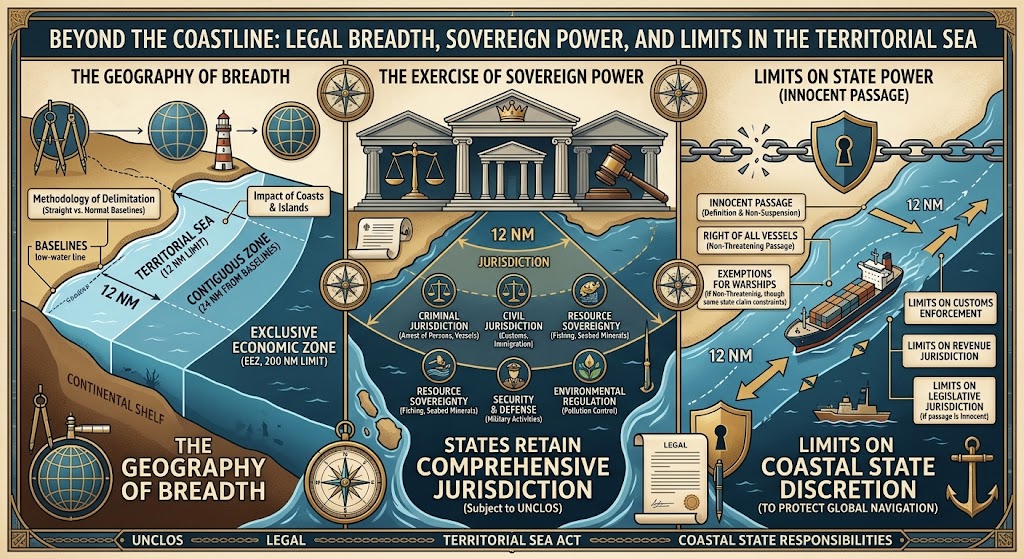
For centuries, the world's oceans were viewed either as common property open to all or as lawless wildernesses beyond national jurisdiction. As maritime commerce expanded, navies grew, and ocean resources became increasingly vital to national economies, the need to establish clear legal boundaries off coastal shores became paramount. At the heart of modern maritime law lies the concept of the territorial sea: a belt of coastal waters where a nation exercises full territorial sovereignty, subject only to specific navigational rights granted to foreign vessels. Codified in the United Nations Convention on the Law of the Sea (UNCLOS), the rules governing the territorial sea strike a precise balance between national security, economic control, and the international freedom of navigation.
The Evolution of Coastal Sovereignty: From Cannon Shots to Codification
The concept of extending state authority into the sea emerged from a pragmatic necessity: self-defense. In the seventeenth and eighteenth centuries, legal scholars proposed that a state's sovereign power should extend off its shores as far as physical force could protect it. This gave rise to the famous cannon-shot rule, articulated by legal theorist Cornelis van Bynkershoek, which posited that control ended where shore-based artillery lost its reach—roughly three nautical miles at the time.
By the nineteenth and early twentieth centuries, the three-nautical-mile limit had become widely accepted by major maritime powers, including Great Britain and the United States. However, as artillery capabilities advanced and modern fishing fleets began exploiting offshore stocks, many coastal nations felt the three-mile limit was insufficient. Unilateral claims expanded rapidly across the globe, ranging from 4 to 6 nautical miles in parts of Europe to 200 nautical miles claimed by several Latin American states in the mid-twentieth century to protect their fisheries.
To prevent chaotic and conflicting claims, international diplomatic conferences sought to establish a single, universal standard. The modern legal consensus was finally reached during the Third United Nations Conference on the Law of the Sea (1973–1982), resulting in the adoption of UNCLOS in 1982. UNCLOS established a clear, unambiguous maximum breadth for the territorial sea, settling centuries of legal debate.
Defining the Breadth: The 12-Nautical-Mile Maximum
Article 3 of UNCLOS sets the foundational rule for maritime sovereignty:
"Every State has the right to establish the breadth of its territorial sea up to a limit not exceeding 12 nautical miles, measured from baselines determined in accordance with this Convention."
A nautical mile, equal to approximately 1.15 statute miles or 1.852 kilometers, is based on the circumference of the Earth. Therefore, a 12-nautical-mile territorial sea extends roughly 22.2 kilometers from a state's baseline.
Understanding the Baseline
The baseline serves as the fundamental starting line for measuring all maritime zones, including the territorial sea, the contiguous zone, the exclusive economic zone (EEZ), and the continental shelf. UNCLOS provides two primary methods for establishing baselines:
- Normal Baselines (Article 5): The low-water line along the coast, as marked on large-scale charts officially recognized by the coastal state. This reflects the natural land-water interface at low tide.
- Straight Baselines (Article 7): Applied in regions where the coastline is deeply indented and cut into, or where there is a fringe of islands along the coast in its immediate vicinity. Straight baselines connect selected geographical points on the coast without departing significantly from the general direction of the shore.
Regardless of whether normal or straight baselines are applied, the outer limit of the territorial sea is defined by Article 4 as the line every point of which is at a distance from the nearest point of the baseline equal to the breadth of the territorial sea.
The Nature and Scope of Coastal State Sovereignty
Under Article 2 of UNCLOS, the sovereignty of a coastal state extends beyond its land territory and internal waters to an adjacent belt of sea described as the territorial sea. This sovereignty is not merely limited to the water column; it applies comprehensively across three distinct domains:
- The Airspace: The coastal state possesses absolute sovereignty over the superjacent airspace above the territorial sea. Foreign aircraft have no general right of transit through a state's territorial airspace without explicit prior consent.
- The Water Column: The coastal state regulates all activities within the water column, including fisheries, navigation, scientific research, and environmental protection.
- The Seabed and Subsoil: Sovereignty extends downward to the ocean floor and the underlying subsoil, granting the coastal state exclusive rights to mine, drill, extract minerals, and manage non-living resources.
To understand how the territorial sea differs from other maritime zones under UNCLOS, consider the comparison outlined in the table below:
| Maritime Zone | Breadth / Distance | Sovereignty Level | Foreign Navigational Rights |
|---|---|---|---|
| Internal Waters | Landward of the baseline | Absolute sovereignty (same as land territory) | No general right of entry without permission |
| Territorial Sea | Up to 12 nautical miles from baseline | Full sovereignty over water, airspace, seabed, and subsoil | Right of Innocent Passage (ships only) |
| Contiguous Zone | Up to 24 nautical miles from baseline | Jurisdictional enforcement (customs, fiscal, immigration, sanitary) | Freedom of navigation and overflight |
| Exclusive Economic Zone (EEZ) | Up to 200 nautical miles from baseline | Sovereign rights over natural resources and economic activities | Freedom of navigation, overflight, and laying of cables |
The Core Limitation on Sovereignty: The Right of Innocent Passage
While the territorial sea is legally an extension of a nation's sovereign territory, that sovereignty is not absolute. To preserve the global economy and international trade, international law balances coastal sovereignty against maritime mobility through the codification of the Right of Innocent Passage.
Under Article 17 of UNCLOS, ships of all states—whether coastal or land-locked, merchant or military—enjoy the right of innocent passage through the territorial sea.
What Constitutes "Passage"?
Article 18 defines passage as navigation through the territorial sea for the purpose of either traversing that sea without entering internal waters or proceeding to or from internal waters or ports. Passage must meet two strict criteria:
- It must be continuous and expeditious.
- Stopping and anchoring are permitted only in so far as they are incidental to ordinary navigation or made necessary by force majeure, distress, or for the purpose of rendering assistance to persons, ships, or aircraft in danger.
Defining "Innocent"
Article 19 provides an objective standard for innocence: passage is innocent so long as it is not prejudicial to the peace, good order, or security of the coastal state. The convention explicitly lists activities that render passage non-innocent, including:
- Any threat or use of force against the sovereignty, territorial integrity, or political independence of the coastal state.
- Any exercise or practice with weapons of any kind.
- Any act aimed at collecting information to the prejudice of the defense or security of the coastal state.
- Any act of propaganda aimed at affecting the defense or security of the coastal state.
- The launching, landing, or taking on board of any aircraft or military device.
- The loading or unloading of any commodity, currency, or person contrary to customs, fiscal, immigration, or sanitary laws.
- Any act of willful and serious pollution contrary to UNCLOS.
- Any fishing activities or carrying out of research or survey activities.
- Any activity not having a direct bearing on passage.
Submarines and other underwater vehicles are required under Article 20 to navigate on the surface and show their flag when traversing the territorial sea.
Rights and Responsibilities of Coastal States
Coastal states are granted clear authority to adopt laws and regulations regarding innocent passage through their territorial seas. Article 21 empowers coastal states to legislate on matters including:
- The safety of navigation and the regulation of maritime traffic.
- The protection of navigational aids, facilities, cables, and pipelines.
- The conservation of living marine resources and the prevention of infringement of fisheries regulations.
- The preservation of the environment and the control of marine pollution.
- The prevention of infringement of customs, fiscal, immigration, or sanitary laws.
Sea Lanes and Traffic Separation Schemes
To ensure maritime safety, particularly in narrow or congested passages, Article 22 allows coastal states to designate designated sea lanes and prescribe traffic separation schemes. Foreign ships, especially tankers, nuclear-powered ships, and vessels carrying dangerous or noxious substances, may be required to confine their passage to these designated corridors.
Duties of the Coastal State
Power is balanced by obligation. Under Article 24, a coastal state must not hamper the innocent passage of foreign ships except in accordance with UNCLOS. Specifically, the coastal state cannot impose requirements on foreign ships that have the practical effect of denying or impairing the right of innocent passage, nor can it discriminate against the ships of any state or against cargoes carried in them. Furthermore, coastal states are legally obligated to give appropriate publicity to any danger to navigation within their territorial sea of which they have knowledge.
Temporary Suspension for Security
Under Article 25(3), a coastal state may, without discrimination among foreign ships, suspend temporarily in specified areas of its territorial sea the innocent passage of foreign ships if such suspension is essential for the protection of its security, including weapons exercises. Such suspension takes effect only after being duly published.
Jurisdictional Limits over Foreign Vessels
A crucial aspect of territorial sea jurisprudence is the allocation of legal jurisdiction when a foreign vessel navigates within a coastal state's 12-nautical-mile zone. UNCLOS draws a sharp distinction between criminal and civil jurisdiction.
Criminal Jurisdiction (Article 27)
As a general principle, a coastal state should not exercise criminal jurisdiction on board a foreign ship passing through the territorial sea to arrest any person or conduct an investigation in connection with a crime committed on board during its passage. However, the coastal state may exercise criminal jurisdiction under four specific exceptions:
- If the consequences of the crime extend to the coastal state.
- If the crime is of a kind to disturb the peace of the country or the good order of the territorial sea.
- If the assistance of the local authorities has been requested by the master of the ship or by a diplomatic agent or consular officer of the flag state.
- If such measures are necessary for the suppression of illicit traffic in narcotic drugs or psychotropic substances.
Civil Jurisdiction (Article 28)
Civil jurisdiction is even more restricted. A coastal state should not stop or divert a foreign ship passing through the territorial sea for the purpose of exercising civil jurisdiction in relation to a person on board. The coastal state may not levy execution against or arrest the ship for the purpose of civil proceedings, except in respect of obligations or liabilities assumed or incurred by the ship itself in the course or for the purpose of its voyage through the waters of the coastal state.
Warships and Sovereign Immunity
Warships and other government ships operated for non-commercial purposes enjoy sovereign immunity. If a warship does not comply with the laws and regulations of the coastal state concerning passage and ignores any request for compliance, Article 30 allows the coastal state to require it to leave the territorial sea immediately. Flag states bear international legal responsibility for any loss or damage caused by a warship's non-compliance with coastal state laws under Article 31.
Delimitation Between Opposite or Adjacent States
In regions where the coastlines of two or more states are opposite or adjacent to each other, their respective 12-nautical-mile claims often overlap. Article 15 of UNCLOS governs the delimitation of the territorial sea between such states:
"Where the coasts of two States are opposite or adjacent to each other, neither of the two States is entitled, failing agreement between them to the contrary, to extend its territorial sea beyond the median line every point of which is equidistant from the nearest points on the baselines..."
This equidistance rule applies universally unless historic title or other special circumstances—such as unusual coastal geography, the presence of small islands, or navigation channels—necessitate delimiting the territorial sea boundaries in a different manner.
Contemporary Maritime Challenges and Future Trends
While the legal framework established by UNCLOS in 1982 has brought stability to international oceans, modern geopolitical and environmental developments present new tests to the regime of the territorial sea.
1. Sea-Level Rise and Baseline Shifts
Climate change and rising sea levels threaten to alter low-water marks, eroding coastal landforms that serve as normal baselines. If physical baselines move landward, questions arise as to whether the outer limit of the 12-nautical-mile territorial sea must also shift, potentially shrinking a state's maritime domain. International legal bodies, including the International Law Commission, are actively studying legal stability mechanisms to allow coastal states to preserve their established maritime zones despite physical coastal changes.
2. Autonomous and Unmanned Vessels
The development of Maritime Autonomous Surface Ships (MASS) introduces complex questions regarding innocent passage. Do unmanned ships qualify as "ships" under UNCLOS? How do autonomous algorithms maintain compliance with local navigational regulations or demonstrate "innocent" intent when no crew is aboard? Regulatory bodies such as the International Maritime Organization (IMO) are reviewing existing maritime treaties to integrate autonomous technologies into the rule of law at sea.
3. Security Concerns and "Gray-Zone" Operations
In contested regions, foreign naval vessels, coast guards, and maritime militias frequently navigate within territorial seas under the assertion of innocent passage while engaging in intelligence collection or psychological operations. Coastal states often argue that such actions violate the security conditions of Article 19, demonstrating the ongoing friction between coastal security interests and foreign navigational freedom.
Conclusion
The establishment of the 12-nautical-mile territorial sea represents one of the greatest achievements of modern international law. By codifying a clear boundary that reconciles state sovereignty with global freedom of navigation, UNCLOS transformed centuries of ocean conflict into a structured legal order. The territorial sea framework preserves a coastal state's complete control over its border security, marine resources, and environmental health, while safeguarding the international transit rights that fuel global trade. As maritime security threats evolve and environmental transformations alter physical shores, the precise legal balance maintained within the territorial sea remains essential to order across the global commons.
Comments
No comments yet.