The Digital Horizon: Maritime Jurisprudence and the Cyber-Security of Global Trade
A rigorous analysis of how digital vulnerabilities redefine maritime liability, seaworthiness, and state responsibility under international conventions and evolving case law.
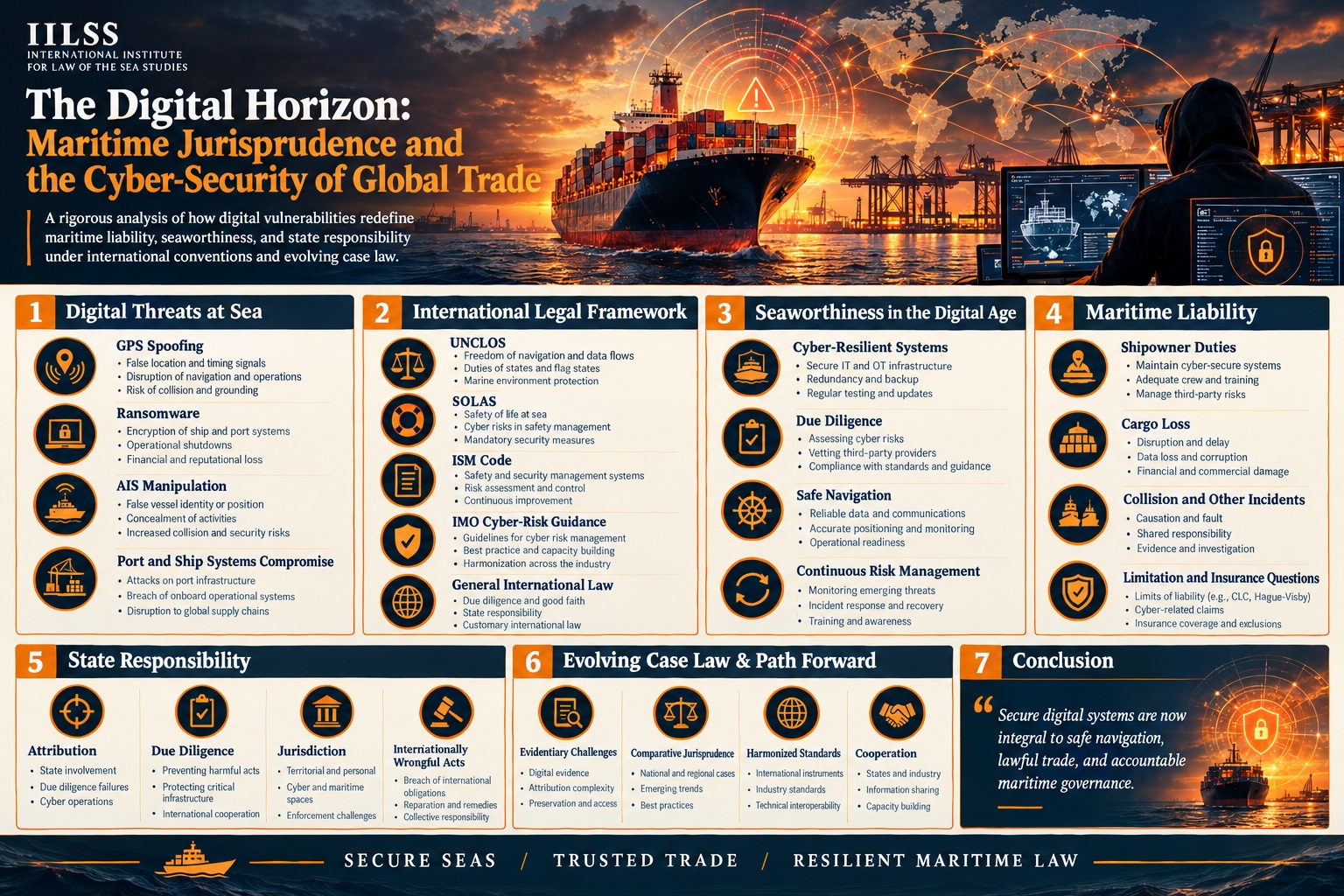
The evolution of the maritime industry from mechanical reliance to digital integration has introduced a profound jurisprudential shift. As vessels metamorphose into floating data centers, the traditional definitions of maritime safety, seaworthiness, and state responsibility are being tested by the ephemeral nature of cyber threats. The historical reliance on physical manifestations of negligence—a rusted hull, an incompetent crew, or a faulty engine—is increasingly insufficient to address the complexities of algorithmic failure or malicious digital intrusion. Consequently, international maritime law must navigate the precarious intersection of the United Nations Convention on the Law of the Sea (UNCLOS), the International Ship and Port Facility Security (ISPS) Code, and the nascent principles of digital sovereignty.
Central to this discourse is the tension between the freedom of navigation and the necessity of digital security. While the high seas remain a domain of shared access, the digital infrastructure that enables modern commerce is often localized or proprietary. This paradox creates significant legal lacunae, particularly when a cyber-event disrupts the safe passage of a vessel or results in catastrophic environmental damage. The challenge for contemporary jurists lies in reconciling the static nature of international conventions with the fluid, borderless reality of cyber warfare and industrial espionage.
The Regulatory Framework and the Duty of Due Diligence
The International Maritime Organization (IMO) has taken significant steps to institutionalize cyber risk management through Resolution MSC.428(98). By integrating cyber risk into the International Safety Management (ISM) Code, the IMO has effectively expanded the scope of a shipowner’s duty of due diligence. Under the ISM Code, companies are required to establish a safety management system (SMS) that addresses all identified risks to its ships, personnel, and the environment. The inclusion of cyber risk suggests that a failure to implement robust digital defenses is no longer merely a technical oversight but a legal breach of the duty to maintain a safe operating environment.
However, the transition from administrative guidelines to enforceable legal standards remains complex. In the event of a maritime casualty caused by a cyber-attack, the burden of proof rests on the claimant to demonstrate that the shipowner failed to exercise due diligence. This necessitates a forensic analysis of digital logs and software architectures, a task that traditional maritime courts are only beginning to grapple with. The jurisprudence surrounding the Hague-Visby Rules, specifically Article III, provides a historical parallel: the carrier must be bound, before and at the beginning of the voyage, to exercise due diligence to make the ship seaworthy. The question now is whether this obligation extends to the integrity of the vessel’s Electronic Chart Display and Information System (ECDIS) or its Global Navigation Satellite System (GNSS) receivers.
Is a ship with outdated software legally unseaworthy?
The concept of seaworthiness is not an absolute standard but a relative one, evolving alongside technological advancements. In the landmark case of The McFadden v. Blue Star Line [1905], the court defined seaworthiness as the ship’s fitness in all respects to encounter the ordinary perils of the sea. In the contemporary context, the ordinary perils of the sea must include the risk of cyber intrusion. If a vessel operates with obsolete software that is susceptible to well-known vulnerabilities, it may be argued that the ship is unseaworthy in the eyes of the law.
This raises the bar for shipowners. It is no longer sufficient to ensure that the physical structure of the vessel is sound. The digital ‘nervous system’ of the ship must also be resilient. A failure to apply critical security patches or the use of default passwords on industrial control systems (ICS) could be construed as a failure to provide a seaworthy vessel. This doctrine of digital seaworthiness has profound implications for insurance subrogation and the limitation of liability. Under the Convention on Limitation of Liability for Maritime Claims (LLMC), a shipowner may lose the right to limit liability if it is proven that the loss resulted from their personal act or omission, committed with the intent to cause such loss, or recklessly and with knowledge that such loss would probably result. Establishing recklessness in the context of cyber-hygiene is a burgeoning area of litigation.
| Legal Instrument | Primary Application | Cyber-Security Implication |
|---|---|---|
| UNCLOS (1982) | Global maritime governance | Defines rights of passage and sovereign immunity; problematic for attribution. |
| ISM Code | Safety Management Systems | Mandates cyber risk management as part of overall safety protocols. |
| ISPS Code | Port and ship security | Focuses on physical security but increasingly covers digital access control. |
| Hague-Visby Rules | Carriage of goods by sea | Establishes the standard for due diligence and seaworthiness. |
Attribution and State Responsibility in International Waters
One of the most vexing challenges in maritime cyber law is the problem of attribution. When a state-sponsored actor compromises a vessel’s automated identification system (AIS) or GPS signal—commonly referred to as ‘spoofing’—the act may constitute a violation of sovereignty or an act of aggression. Yet, the anonymous nature of cyber operations makes it difficult to hold a flag state or a coastal state accountable under the principles of state responsibility articulated by the International Law Commission (ILC).
The International Court of Justice (ICJ), in the Corfu Channel case (United Kingdom v. Albania), established that every state has an obligation not to allow knowingly its territory to be used for acts contrary to the rights of other states. This principle, while formulated in an era of physical mines, is highly relevant to the digital domain. If a state allows cyber-infrastructure within its jurisdiction to be used for a maritime cyber-attack, it may be held liable for the resulting damages. However, the evidentiary threshold for proving ‘knowledge’ or ‘control’ in a decentralized digital network is exceptionally high.
Who is liable for a maritime cyber-attack on a flag-state vessel in international waters?
The determination of liability for a cyber-attack in international waters requires a multi-layered analysis of private maritime law and public international law. From a private law perspective, the shipowner is generally the first point of contact for claims arising from a collision or environmental spill caused by a cyber-incident. If the attack was facilitated by a vulnerability in the ship’s software, the shipowner may seek indemnity from the software provider or the equipment manufacturer under product liability laws or contractual warranties.
However, from a public international law perspective, the question of state liability arises if the attack can be attributed to a sovereign entity. Under the Tallinn Manual 2.0 on the International Law Applicable to Cyber Operations, a state is responsible for cyber operations that are attributable to it and which constitute a breach of its international obligations. If a vessel’s navigation systems are hijacked by a state actor, leading to a grounding in an environmentally sensitive area, the victim state (the flag state or the coastal state) may seek reparations through the Permanent Court of Arbitration (PCA) or the International Tribunal for the Law of the Sea (ITLOS).
The difficulty lies in the fact that many cyber-attacks are carried out by non-state actors or proxy groups. In such cases, the flag state’s duty of ‘due regard’ under UNCLOS becomes the focal point. Does a flag state have an obligation to ensure that the vessels flying its flag maintain a certain level of cyber-readiness? If the flag state fails to enforce IMO regulations regarding cyber risk management, it may be argued that the state itself is in breach of its duties under Article 94 of UNCLOS, which requires flag states to take necessary measures to ensure safety at sea.
Contractual Allocations of Risk: The BIMCO Clauses
In response to the ambiguities of international law, the industry has turned to contractual solutions to allocate cyber risk. The BIMCO Cyber Security Clause is a notable example. This clause requires parties to have in place appropriate plans and procedures to respond to cyber security incidents. It also limits the liability of the parties for cyber-related losses, provided they have met the required standards of care.
While these clauses provide a measure of commercial certainty, they do not insulate parties from third-party claims. For example, if a cyber-attack causes a vessel to collide with a third-party structure or another ship, the contractual limitations between the charterer and the owner will not bind the third-party claimant. In such instances, the courts must revert to the principles of tort and maritime delict, where the concept of the ‘reasonable shipowner’ is increasingly being defined by adherence to industry standards such as the ISO/IEC 27001 or the NIST Cybersecurity Framework.
“The digitalization of the maritime industry is not merely a technological upgrade; it is a fundamental reconfiguration of the legal risks inherent in the carriage of goods by sea. The law must evolve from a reactive posture to a proactive framework that anticipates the systemic risks of interconnectedness.”
The Role of ITLOS and the Evolution of Jurisprudence
The International Tribunal for the Law of the Sea (ITLOS) has yet to adjudicate a case solely focused on a maritime cyber-attack, but its existing jurisprudence on vessel detention and environmental protection offers a glimpse into how it might approach the issue. In the M/V “SAIGA” (No. 2) Case (Saint Vincent and the Grenadines v. Guinea), ITLOS emphasized that the use of force must be avoided as far as possible and, where unavoidable, must not exceed what is reasonable and necessary. This principle of proportionality is vital in the context of cyber-countermeasures. If a coastal state detects a cyber-threat emanating from a vessel in its territorial sea, any digital intervention must be proportional to the threat posed.
Furthermore, the South China Sea Arbitration (Philippines v. China) highlighted the importance of accurate navigational data and the obligations of states to respect international standards for safety at sea. If a state provides fraudulent maritime safety information (MSI) or interferes with the broadcast of navigational warnings via cyber means, it is in direct violation of the Safety of Life at Sea (SOLAS) Convention and UNCLOS. Such actions not only endanger lives but also undermine the entire legal order of the oceans.
| Jurisprudential Concept | Traditional Definition | Digital Interpretation |
|---|---|---|
| Seaworthiness | Physical fitness for the voyage | Resilience of digital navigation and ICS systems |
| Force Majeure | Unforeseeable ‘Acts of God’ | Highly sophisticated, targeted cyber-attacks |
| Due Diligence | Maintenance of hull and machinery | Implementation of firewalls, encryption, and training |
| Innocent Passage | Passage not prejudicial to peace/security | Passage without engaging in cyber-espionage or interference |
Emerging Liability Regimes and the Product Liability Gap
A significant challenge in the current maritime legal landscape is the potential gap in product liability for software vendors. Unlike shipbuilders, who are often held to strict standards regarding the physical integrity of a hull, software developers frequently include broad disclaimers of liability in their end-user license agreements (EULAs). When a software bug or a lack of security by design leads to a maritime disaster, the shipowner may find themselves unable to recover losses from the entity that provided the faulty digital tool.
This ‘accountability gap’ is being scrutinized by maritime legal scholars who argue for a more rigorous application of the ‘implied warranty of fitness for a particular purpose’ in maritime software contracts. Given the critical role of software in the safety of navigation, there is a burgeoning movement to treat maritime software as a ‘component part’ of the vessel, thereby bringing it under the umbrella of traditional maritime lien and liability structures. This would allow claimants to arrest a ship or proceed in rem for damages caused by digital negligence, even if the primary fault lies with a shore-based software provider.
Furthermore, the rise of autonomous and semi-autonomous vessels—as seen in projects like the Yara Birkeland—exacerbates these issues. In a fully autonomous operation, the legal distinction between the ‘master’ of the vessel and the ‘operator’ of the software becomes blurred. If a collision occurs because of a cyber-vulnerability in an autonomous navigation system, the attribution of liability will require a complex unraveling of code, sensor data, and remote-operator intervention. The 1972 COLREGs (International Regulations for Preventing Collisions at Sea) currently assume a human presence on the bridge. The failure of the law to adapt to the reality of the ‘digital master’ represents one of the greatest risks to the stability of the maritime industry.
Conclusion
The intersection of cybersecurity and maritime law is no longer a theoretical concern for the future; it is a present reality that demands a rigorous and unified legal response. As demonstrated, the traditional doctrines of seaworthiness and due diligence are being radically expanded to encompass the digital realm. The IMO’s integration of cyber risk into the ISM Code marks a critical turning point, but it is only the beginning. The global maritime community must move toward a more harmonized framework that addresses the unique challenges of attribution, digital evidence, and the accountability of non-state actors.
Ultimately, the resilience of the global supply chain depends on the integrity of the digital systems that govern the high seas. Jurisprudential standards must continue to evolve, ensuring that the legal ‘safe harbor’ for maritime commerce remains secure against the invisible threats of the cyber age. Whether through the refinement of UNCLOS, the establishment of new international protocols for digital sovereignty, or the evolution of common law principles of negligence, the maritime legal architecture must prove as resilient as the vessels it seeks to regulate. The digital horizon is vast, and the law must be the compass that ensures safe passage through these uncharted digital waters.
Comments
No comments yet.