Legal Status of Disappearing States and Loss of Territory
An examination of international law regarding statehood continuity, territory loss, and sea level rise under treaties and jurisprudence.
Introduction
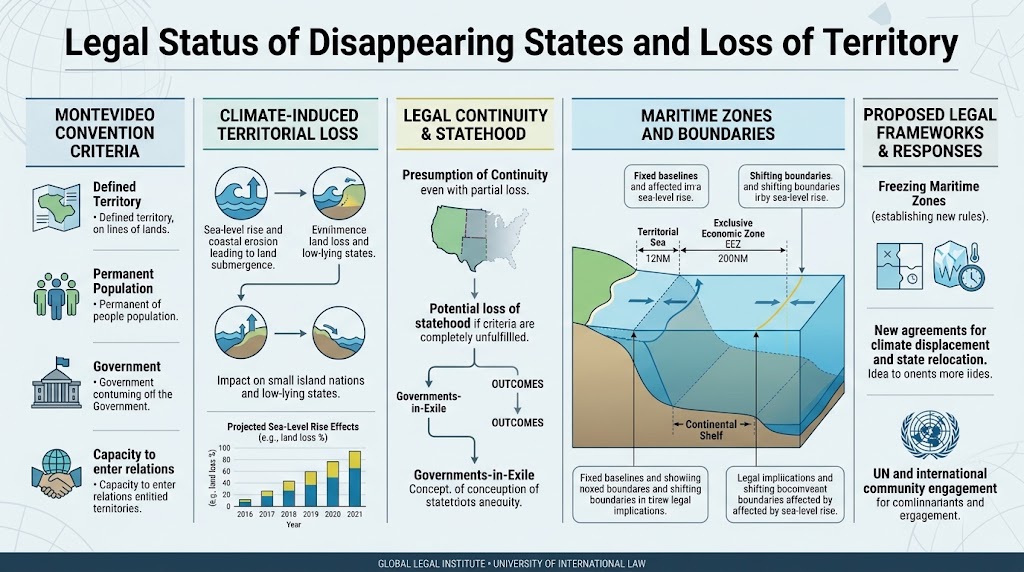
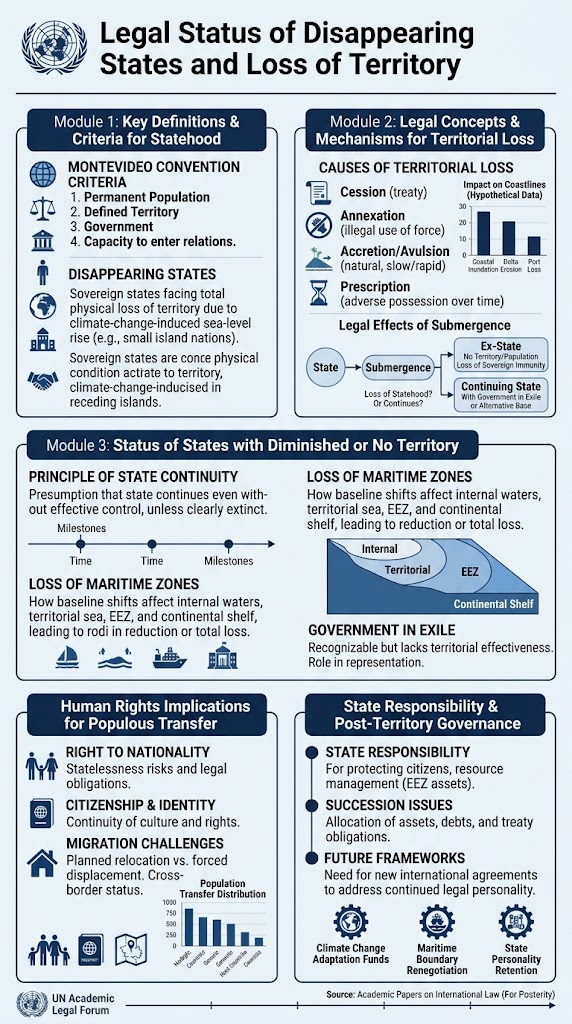
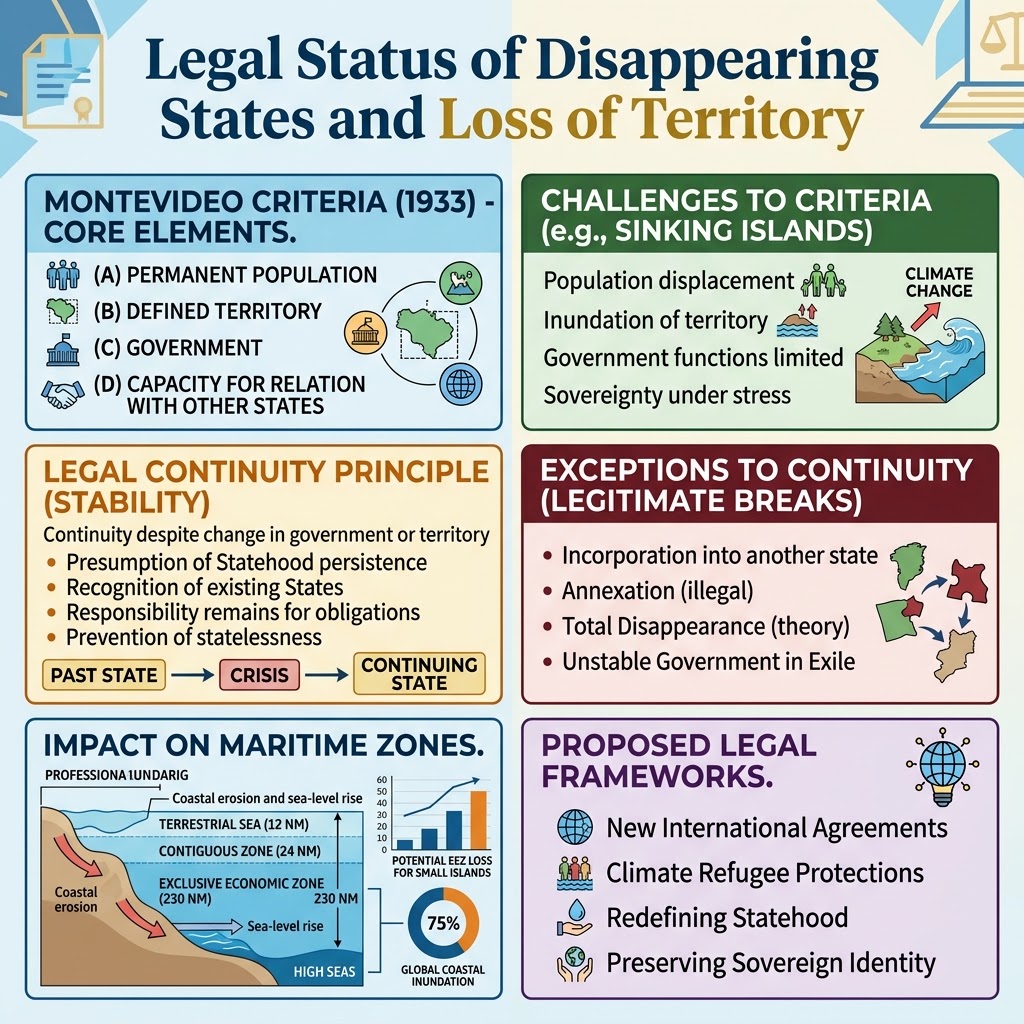
The acceleration of anthropogenic climate change and the consequential rise in global mean sea levels have introduced an unprecedented existential paradox into the corpus of public international law. Traditionally, the Westphalian framework of international relations has been anchored in the physical permanence of sovereign territory. Article 1 of the 1933 Montevideo Convention on Rights and Duties of States prescribes four definitive criteria for statehood: a permanent population, a defined territory, a government, and the capacity to enter into relations with other states. For centuries, these criteria operated as a self-evident triad of people, land, and governance. Today, however, low-lying island nations—most notably atoll states such as Tuvalu, the Marshall Islands, Kiribati, and the Maldives—face the terrifying prospect of total territorial submersion. As maritime boundaries shift and habitable landmasses erode or become entirely uninhabitable, the foundational doctrines of international legal personality are being severely tested.
This scholarly inquiry explores the intricate legal vulnerabilities and doctrinal debates surrounding disappearing states. By examining the structural limits of the Montevideo criteria, the evolutionary role of international jurisprudence, and the operational dilemmas within the United Nations Convention on the Law of the Sea (UNCLOS), this analysis evaluates whether statehood can survive the physical erasure of a state's sovereign soil. Through rigorous engagement with ICJ advisory opinions, arbitral awards, and state practice, we investigate the tension between legal continuity and territorial loss.
Can Statehood Survive the Total Loss of Territory?
The crux of the contemporary debate centers on whether the physical criterion of a defined territory is a mutable precondition or an absolute, permanent requirement for the maintenance of international legal personality. A strict textualist reading of the Montevideo Convention suggests that once a state loses its defined territory, it ceases to meet the objective criteria of statehood. Under this positivist view, statehood is inextricably bound to geographic space; when the land disappears, the sovereign entity dissolves into legal non-existence.
Conversely, a growing body of international legal scholarship champions the doctrine of state continuity. Proponents of this view argue that the criteria enumerated in the Montevideo Convention serve primarily to establish statehood at its inception rather than as ongoing conditions for its survival. Once attained, international legal personality enjoys a strong presumption of continuity, mirroring the well-established principle in state succession and decolonization that states do not easily perish. In the context of climate displacement, the loss of territory is recognized as involuntary, brought about by external wrongful acts or systemic global emissions attributable to the international community at large. To penalize victim states by stripping them of their sovereign status would violate foundational tenets of equity, justice, and the sovereign equality of states enshrined in Article 2(1) of the United Nations Charter.
Landmark jurisprudence from the International Court of Justice (ICJ) and arbitral tribunals provides valuable interpretive guidance regarding the resilience of statehood during extreme crises. While the ICJ has not yet faced a case concerning a completely submerged state, its jurisprudence on uti possidetis juris and territorial integrity emphasizes stability and the presumption against the extinction of states. In the North Sea Continental Shelf cases and various advisory opinions concerning the legality of the threat or use of nuclear weapons, the Court has consistently reinforced the stability of international boundaries and sovereign rights. However, these judicial pronouncements assumed the continued physical presence of the land. Applying them to stateless nations floating on legal fictions requires a bold evolution of doctrine.
To crystallize these competing positions, the following comparative framework outlines the doctrinal divide:
| Doctrinal Approach | Core Legal Premise | Primary Jurisprudential Risk |
|---|---|---|
| Positivist Territorialism | Strict adherence to the Montevideo criteria; territory is a permanent, non-negotiable requirement for statehood. | Results in statelessness for millions, violating principles of equity and sovereign equality. |
| Functional Continuity | Statehood once acquired is presumed permanent; territorial loss through climate change does not extinguish legal personality. | Creates legal fictions that strain enforcement mechanisms and complicate diplomatic representation. |
| Constructive Succession | Migrated populations form governments-in-exile or trust territories recognized by collective international action. | Requires unprecedented multilateral consensus and risks undermining traditional concepts of effective control. |
How Do Maritime Zones Relate to Sinking Baselines?
Beyond the dry landmasses, the physical expansion of oceans due to sea level rise directly threatens the maritime entitlements of coastal and island states under UNCLOS. Under Articles 5, 7, and 16 of UNCLOS, maritime zones—including territorial seas, exclusive economic zones (EEZs), and continental shelves—are measured from baselines drawn along the low-water line along the coast or through straight baselines connecting appropriate points. As coastal erosion eats away at these baselines, the ambulatory nature of baselines threatens to push maritime boundaries inward, drastically shrinking a nation's sovereign resource rights.
This ambulatory baseline dilemma has sparked intense debate among international lawyers. If baselines shift landward as sea levels rise, atoll states stand to lose billions of dollars in fisheries, seabed minerals, and marine scientific jurisdiction. In response, several affected states and regional bodies, including the Pacific Islands Forum via the 2021 Declaration on Preserving Maritime Zones in the Face of Climate Change-Related Sea-Level Rise, have advocated for the freezing of baselines and outer limits of maritime zones. By establishing fixed baselines through domestic legislation and international notification, these nations seek to decouple maritime entitlements from physical geographic changes.
International tribunals and the International Law Commission (ILC), through its Study Group on Sea-Level Rise in Relation to International Law, have begun grappling with these exact mechanics. The ITLOS advisory opinion requested by the Commission of Small Island States on Climate Change and International Law (COSIS) represents a monumental judicial step in clarifying these obligations. While UNCLOS does not explicitly contain a freezing mechanism, teleological and dynamic methods of treaty interpretation support the preservation of established rights to prevent ecological catastrophes from stripping vulnerable states of their economic lifelines.
Consider the structural challenges of maintaining maritime entitlements under UNCLOS:
- Ambulatory Baselines: Traditional interpretations require baselines to follow the receding low-water mark, continuously shrinking maritime zones.
- Fixed Baseline Declarations: Emerging state practice relies on depositing charts with the UN Secretary-General to lock in coordinates permanently.
- Ecosystem Preservation: Artificial reinforcement, seawalls, and dredging are utilized to maintain physical points, though economically unsustainable for many developing island nations.
What Are the Rights of Climate Displaced Populations?
When territory becomes entirely uninhabitable, the human dimension of the disappearing state crisis takes center stage. The legal status of populations displaced by climate change falls into a troubling vacuum within international refugee law. The 1951 Refugee Convention and its 1967 Protocol strictly define a refugee as someone fleeing persecution based on race, religion, nationality, membership of a particular social group, or political opinion. Environmental degradation and sea level rise do not fit neatly into these persecution-based categories, leaving climate refugees without formal institutional protection under traditional asylum frameworks.
Nevertheless, human rights bodies and regional tribunals have increasingly applied international human rights law to bridge this protection gap. The Human Rights Commission, in landmark decisions such as Teitiota v. New Zealand, established that the effects of climate change in countries of origin can trigger non-refoulement obligations under the International Covenant on Civil and Political Rights (ICCPR) if life is placed under imminent threat. Although Mr. Teitiota's specific deportation was upheld due to insufficient evidence of immediate danger, the Human Rights Committee firmly entrenched the principle that environmental degradation can violate the right to life.
State practice is gradually adapting through bilateral labor mobility agreements, regional migration frameworks, and innovative visa categories designed to accommodate displaced islanders. However, these ad hoc measures fall short of providing a comprehensive, binding international regime. Scholars and human rights advocates continue to debate whether a new protocol to the UN Framework Convention on Climate Change (UNFCCC) or a standalone international convention is necessary to guarantee the legal status, cultural preservation, and self-determination of stateless climate populations.
- Exclusion of environmental factors from the 1951 Refugee Convention's definition of persecution.
- Absence of enforceable obligations regarding collective relocation and preservation of national identity.
- Jurisdictional complexities when a population resides permanently within the territory of a host state while maintaining a deterritorialized government.
Conclusion
The legal status of disappearing states and the loss of territory represent one of the most profound stress tests in the history of international jurisprudence. The collision between rigid nineteenth-century positivism and the twenty-first-century reality of climate catastrophe demands creative, principled legal adaptation. Whether through the functional preservation of statehood, the freezing of maritime baselines under UNCLOS, or the expansion of human rights-based protections for climate-displaced persons, the international community must transcend static territorial assumptions. Preserving the legal personality of submerged nations is not merely a technical exercise in doctrinal flexibility; it is an essential moral imperative to uphold the sovereign equality, dignity, and survival of vulnerable peoples in an era of unprecedented planetary change.
Comments
No comments yet.