Comprehensive Legal Analysis and Structural Overview of the United Nations Convention on the Law of the Sea
A rigorous technical and structural examination of the United Nations Convention on the Law of the Sea, detailing its maritime zones, dispute mechanisms, and state obligations.
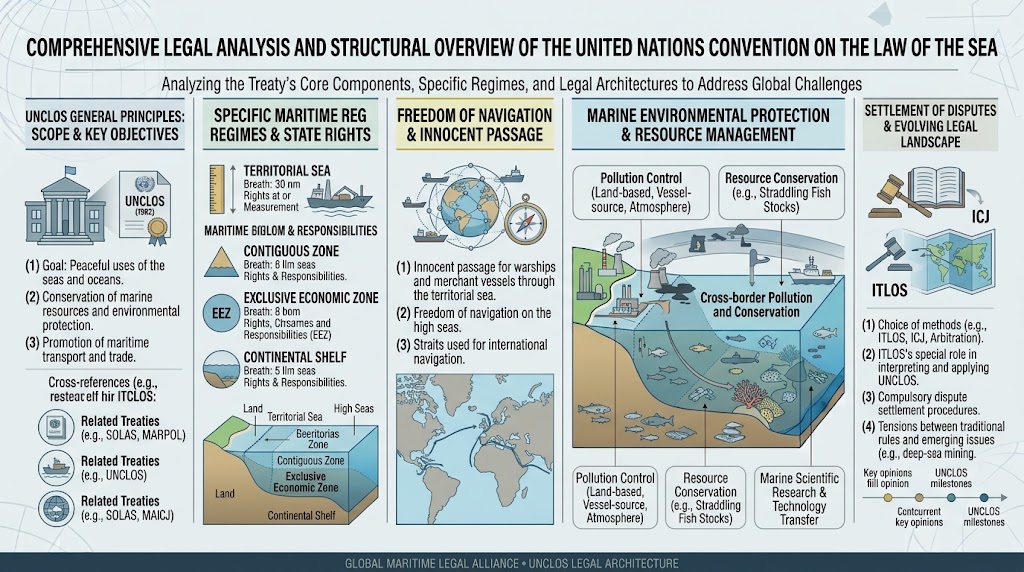
Legal Analysis, Structural Overview, and Key Provisions of the United Nations Convention on the Law of the Sea
Abstract
The United Nations Convention on the Law of the Sea (UNCLOS), adopted on 10 December 1982 and entering into force on 16 November 1994, constitutes the principal international legal framework governing the use, management, and protection of the world's oceans. Often described as the constitution of the oceans, the Convention establishes a comprehensive system of maritime jurisdiction, navigational freedoms, resource management, marine environmental protection, scientific research, and dispute settlement. Its significance lies in its attempt to reconcile the sovereign interests of coastal States with the collective interests of the international community in maintaining the oceans as spaces of communication, economic activity, environmental sustainability, and peaceful cooperation.
This article examines the historical development, legal structure, and fundamental principles of UNCLOS, with particular attention to the different maritime zones established by the Convention, the allocation of rights and obligations between coastal and other States, the legal regime of the continental shelf and the exclusive economic zone, the international seabed Area, and the protection of the marine environment. It also evaluates the Convention's dispute-settlement mechanisms and considers contemporary challenges arising from maritime security, climate change, technological development, submarine infrastructure, and the conservation of marine biodiversity. The analysis demonstrates that UNCLOS remains indispensable to the international maritime legal order, although its practical effectiveness depends on consistent implementation, international cooperation, and the continuing development of complementary legal instruments.
Keywords: United Nations Convention on the Law of the Sea; UNCLOS; maritime jurisdiction; territorial sea; exclusive economic zone; continental shelf; freedom of navigation; marine environmental protection; international dispute settlement.
1. Introduction
The oceans constitute an essential component of the international legal, economic, environmental, and geopolitical order. They facilitate international trade, provide living and non-living natural resources, support complex ecosystems, and connect States through global transportation networks. At the same time, maritime spaces generate persistent legal disputes concerning sovereignty, navigation, fisheries, offshore energy production, marine scientific research, environmental degradation, and the exploitation of seabed resources.
Before the adoption of a comprehensive international convention, the law of the sea developed through a combination of customary international law, bilateral agreements, regional arrangements, and specialized treaties. Although these sources regulated particular aspects of maritime activity, they did not establish a sufficiently uniform framework for the increasingly complex relationship between coastal jurisdiction and international maritime freedoms.
The Third United Nations Conference on the Law of the Sea, convened in 1973, sought to address these deficiencies through comprehensive negotiations. Its work culminated in the adoption of UNCLOS on 10 December 1982. The Convention entered into force on 16 November 1994, following the completion of the required ratification process. Its structure encompasses 320 articles and nine annexes, covering nearly every major aspect of the legal regime of the oceans.[1]
The importance of UNCLOS extends beyond the formal allocation of maritime zones. It establishes a legal framework through which States must exercise their maritime rights consistently with the rights of other States and with applicable international obligations. It also recognizes that the oceans cannot be governed exclusively through unilateral national policies, particularly when activities affect shared resources, international navigation, or the marine environment.
The central objective of this article is to examine UNCLOS as an integrated legal system. Rather than treating its provisions as isolated rules, the analysis considers the relationship between maritime jurisdiction, navigational freedoms, resource sovereignty, environmental obligations, and international dispute settlement. This approach is necessary to understand both the Convention's achievements and the legal difficulties that continue to arise in contemporary maritime affairs.
2. Historical Development and Legal Significance
2.1. The development of the modern law of the sea
Historically, the law of the sea was shaped by the tension between the freedom of the oceans and the territorial ambitions of coastal States. The principle of freedom of the seas, associated with early modern international legal thought, opposed the general appropriation of the oceans by individual States. It supported navigation, trade, and access to maritime spaces beyond national jurisdiction.
Nevertheless, States progressively asserted greater control over waters adjacent to their coastlines. Technological developments, expanding fisheries, offshore petroleum exploration, and growing concerns about national security encouraged the development of more extensive maritime claims. These competing interests created uncertainty concerning the permissible breadth of territorial seas and the extent of coastal jurisdiction over marine resources.
The United Nations Conference on the Law of the Sea held in Geneva in 1958 produced four conventions addressing the territorial sea and contiguous zone, the high seas, fishing and conservation of living resources, and the continental shelf. A further conference in 1960 attempted to resolve the outstanding question of territorial-sea breadth but did not achieve agreement on a comprehensive solution.
Subsequent developments made a broader legal settlement increasingly necessary. States sought recognition of extended resource rights, while maritime powers emphasized the importance of navigation and access to international waters. Developing countries also demanded a more equitable international regime for ocean resources and greater participation in decisions affecting the international seabed.
2.2. The adoption of UNCLOS
The Third United Nations Conference on the Law of the Sea brought these competing interests into a single negotiating process. The resulting Convention represents a carefully negotiated compromise between coastal-State jurisdiction, international freedoms, and common interests in the management of marine resources.
UNCLOS introduced or consolidated several fundamental principles. It recognized the right of coastal States to establish territorial seas extending up to 12 nautical miles and established the exclusive economic zone, which may extend up to 200 nautical miles from the relevant baselines. It also provided a comprehensive framework for continental-shelf rights, international straits, archipelagic States, marine environmental protection, and the international seabed Area.
The Convention's entry into force in 1994 marked a decisive stage in the institutionalization of the modern law of the sea. The 1994 Agreement relating to the Implementation of Part XI subsequently modified the implementation arrangements governing deep-seabed activities. Additional international agreements have further developed particular aspects of the Convention's framework.
2.3. Legal character and relationship with customary international law
UNCLOS is a multilateral treaty. Its provisions bind States Parties in accordance with international treaty law, including the principle that treaties must be performed in good faith.
However, the legal significance of the Convention is not confined to treaty relations. Some of its provisions reflect customary international law and may therefore be relevant to States independently of their status as parties, depending on the particular rule and the evidence of customary law. Other provisions depend more directly on the treaty framework or on subsequent implementing agreements.
Consequently, it is essential to distinguish between the Convention's binding effect as a treaty and the independent applicability of customary international law. A provision should not automatically be assumed to bind every State in precisely the same manner merely because it appears in UNCLOS.
The Convention must also be interpreted in accordance with the general rules of treaty interpretation, particularly the ordinary meaning of its terms in their context and in light of its object and purpose. Relevant subsequent agreements, subsequent practice establishing the parties' agreement, and applicable rules of international law may also inform interpretation.
UNCLOS is therefore best understood as the central component of a broader international legal system governing maritime affairs, rather than as an isolated or entirely self-contained instrument.
3. Structural Overview of the Convention
UNCLOS is organized into seventeen Parts and nine Annexes. Its structure reflects the interdependence of maritime geography, jurisdiction, economic activity, environmental protection, and dispute settlement.[2]
The principal Parts can be summarized as follows:
Part I — Introduction: Defines essential terms and establishes the Convention's scope.
Part II — Territorial Sea and Contiguous Zone: Regulates coastal sovereignty, innocent passage, and limited enforcement powers.
Part III — Straits Used for International Navigation: Establishes the regime of transit passage.
Part IV — Archipelagic States: Governs archipelagic waters and archipelagic sea-lanes passage.
Part V — Exclusive Economic Zone: Allocates resource-related sovereign rights and specified jurisdictional powers.
Part VI — Continental Shelf: Establishes rights over the seabed and subsoil beyond the territorial sea.
Part VII — High Seas: Protects high-seas freedoms and regulates flag-State jurisdiction.
Part VIII — Regime of Islands: Addresses the maritime entitlements of islands and rocks.
Part IX — Enclosed or Semi-Enclosed Seas: Encourages regional cooperation.
Part X — Right of Access of Land-Locked States to and from the Sea: Addresses access and transit arrangements.
Part XI — The Area: Governs the international seabed beyond national jurisdiction.
Part XII — Protection and Preservation of the Marine Environment: Establishes environmental obligations.
Part XIII — Marine Scientific Research: Regulates research activities and coastal-State consent.
Part XIV — Development and Transfer of Marine Technology: Promotes cooperation and capacity development.
Part XV — Settlement of Disputes: Establishes procedures for resolving disputes concerning the Convention.
Part XVI — General Provisions: Contains supplementary rules.
Part XVII — Final Provisions: Addresses matters including signature, ratification, accession, and entry into force.
The nine Annexes provide additional institutional and procedural detail. They address matters such as conciliation, the International Tribunal for the Law of the Sea, arbitration, special arbitration, participation by international organizations, and the procedures of the Commission on the Limits of the Continental Shelf.
This structure demonstrates that UNCLOS is not simply a geographical classification of ocean space. It is an integrated regulatory system combining substantive rights, procedural obligations, institutional arrangements, and mechanisms for international cooperation.
4. Maritime Zones and the Distribution of Jurisdiction
One of UNCLOS's most significant achievements is the establishment of differentiated maritime zones. Each zone has a distinct legal status, and the powers of coastal States vary according to the distance from the relevant baselines and the nature of the activity concerned.
The distinction between sovereignty, sovereign rights, and jurisdiction is fundamental. Sovereignty generally entails comprehensive territorial authority, subject to applicable international law. Sovereign rights are more limited rights, principally associated with the exploration and exploitation of natural resources. Jurisdiction refers to specific regulatory or enforcement competences granted by international law.
These concepts must not be used interchangeably.
4.1. Internal waters
Under Article 8, waters landward of the baseline of the territorial sea generally constitute internal waters. Subject to specific exceptions, coastal-State sovereignty applies to these waters in a manner comparable to its sovereignty over land territory.
Ports, certain bays, and waters enclosed by lawful baselines may fall within this category. Foreign vessels do not generally enjoy a universal right of innocent passage through internal waters equivalent to the right applicable in the territorial sea, although particular legal regimes and historical rights may produce exceptions.
The legal consequences are significant for port regulation, immigration control, customs enforcement, environmental protection, and vessel admission. Nevertheless, coastal-State authority remains subject to applicable treaty obligations and other rules of international law.
4.2. Territorial sea
Article 2 establishes that the sovereignty of a coastal State extends beyond its land territory and internal waters to an adjacent belt of sea known as the territorial sea. This sovereignty also extends to the airspace above the territorial sea and its seabed and subsoil.
Under Article 3, every State has the right to establish a territorial sea extending up to a maximum of 12 nautical miles, measured from baselines determined in accordance with the Convention.[3]
The territorial sea is therefore subject to coastal-State sovereignty, but that sovereignty is not unlimited. The principal qualification is the right of innocent passage enjoyed by foreign ships under Articles 17–19.
Passage must be continuous and expeditious, subject to activities reasonably incidental to ordinary navigation and other circumstances recognized by the Convention. Passage is not innocent if it is prejudicial to the peace, good order, or security of the coastal State under the criteria established by Article 19.
The Convention identifies activities that may render passage non-innocent, including certain threats or uses of force, weapons exercises, intelligence-gathering activities prejudicial to the coastal State's security, serious pollution, fishing, and research or survey activities conducted contrary to the Convention.
Article 21 permits coastal States to adopt laws and regulations concerning specified matters, including navigational safety, protection of navigational facilities, conservation of living resources, environmental protection, and customs and sanitary matters. Such regulation must remain consistent with UNCLOS and other applicable international law.
The legal challenge is to reconcile legitimate coastal-State interests with the practical need for international maritime movement. An interpretation that eliminates innocent passage would undermine the Convention's navigational balance, while an interpretation that disregards lawful coastal regulation would weaken territorial sovereignty.
4.3. Contiguous zone
Article 33 permits a coastal State to establish a contiguous zone extending up to 24 nautical miles from the baselines from which the territorial sea is measured.
Unlike the territorial sea, the contiguous zone does not constitute an additional area of full territorial sovereignty. Instead, it grants limited enforcement powers designed to prevent or punish infringements of the coastal State's customs, fiscal, immigration, or sanitary laws committed within its territory or territorial sea.
This distinction is essential. A State cannot claim general jurisdiction over every activity occurring within the contiguous zone simply because the area falls within the 24-nautical-mile limit.
The contiguous zone illustrates the Convention's broader method: it grants specific powers for defined purposes rather than automatically extending all territorial authority into maritime spaces beyond the territorial sea.
4.4. Exclusive economic zone
Part V establishes the exclusive economic zone (EEZ), a maritime area beyond and adjacent to the territorial sea. Under Article 57, the EEZ may extend up to 200 nautical miles from the baselines used to measure the territorial sea.
Article 56 grants the coastal State sovereign rights for exploring, exploiting, conserving, and managing natural resources, both living and non-living, in the waters superjacent to the seabed and in the seabed and its subsoil. It also recognizes specified jurisdictional powers concerning artificial islands and installations, marine scientific research, and protection and preservation of the marine environment.
The EEZ is not equivalent to territorial waters. Under Article 58, other States retain freedoms of navigation and overflight, as well as the freedom to lay submarine cables and pipelines and other internationally lawful uses of the sea associated with those freedoms, subject to the Convention.
The EEZ consequently establishes a functional allocation of rights. The coastal State exercises defined resource-related rights and jurisdiction, while other States retain significant maritime freedoms.
This arrangement is particularly important for fisheries, offshore oil and gas production, renewable energy installations, marine conservation, and submarine infrastructure.
Article 61 requires coastal States to determine the allowable catch of living resources in their EEZs and to adopt appropriate conservation and management measures. Article 62 addresses the utilization of those resources, including access by other States to any surplus under the conditions specified in the Convention.
These provisions do not permit unlimited exploitation. Coastal-State resource rights must be exercised consistently with applicable conservation obligations and the broader environmental framework of UNCLOS.
4.5. Continental shelf
Part VI regulates the continental shelf, which concerns the seabed and subsoil rather than the water column as such.
Under Article 76, the continental shelf of a coastal State comprises the seabed and subsoil of submarine areas that extend beyond its territorial sea throughout the natural prolongation of its land territory to the outer edge of the continental margin, or to 200 nautical miles from the baselines where the outer edge does not extend that far, subject to the technical criteria and constraints in the Convention.
In qualifying circumstances, a coastal State may establish the outer limits of its continental shelf beyond 200 nautical miles. The applicable rules are technically complex and involve geological, geomorphological, and distance-based criteria.
Article 77 provides that the coastal State exercises sovereign rights over the continental shelf for the purpose of exploring it and exploiting its natural resources. These rights are exclusive: if the coastal State does not explore or exploit the shelf, no other State may undertake those activities without its express consent.
Importantly, continental-shelf rights exist ipso facto and ab initio. They do not depend on occupation, effective control, or an express proclamation.
The continental shelf regime must be distinguished from the EEZ. Although both may extend to 200 nautical miles, they concern different legal interests. The EEZ encompasses rights relating to the water column and the seabed, whereas continental-shelf rights concern the seabed and subsoil. Beyond 200 nautical miles, continental-shelf rights may continue where the conditions of Article 76 are satisfied, even though the waters above the shelf may remain part of the high seas.
The Commission on the Limits of the Continental Shelf examines submissions concerning the establishment of outer limits beyond 200 nautical miles. Its role is scientific and technical; it does not delimit maritime boundaries between States or adjudicate sovereignty disputes.
4.6. High seas
Part VII governs the high seas, which are not included in a State's EEZ, territorial sea, internal waters, or archipelagic waters.
Article 87 recognizes freedoms of the high seas, including navigation, overflight, the laying of submarine cables and pipelines, the construction of installations permitted under international law, fishing subject to applicable obligations, and marine scientific research.
These freedoms are not unlimited. Article 87 requires their exercise with due regard for the interests of other States in their exercise of high-seas freedoms and for rights recognized under the Convention concerning activities in the international seabed Area.
Article 89 prohibits the valid assertion of sovereignty over any part of the high seas. Article 90 recognizes the right of every State, whether coastal or land-locked, to sail ships flying its flag on the high seas, subject to applicable international law.
Article 92 generally requires ships to sail under the flag of one State and, save in exceptional circumstances expressly provided for by international treaties or UNCLOS, to be subject to its exclusive jurisdiction on the high seas.
This flag-State principle is central to the maritime legal order. It establishes the principal jurisdictional link between a vessel and a State, although UNCLOS provides exceptions, including specified cases involving piracy, the slave trade, unauthorized broadcasting, stateless vessels, and other circumstances defined by international law.
4.7. International straits and archipelagic waters
Part III establishes a special regime for straits used for international navigation. Under Articles 37–44, qualifying straits are subject to transit passage, which generally cannot be suspended.
Transit passage protects the continuous and expeditious transit of ships and aircraft through international straits connecting one part of the high seas or an EEZ with another such area. It differs from innocent passage in both its scope and its treatment of aircraft.
Part IV recognizes the particular geographical circumstances of archipelagic States. Under Article 47, qualifying States may draw archipelagic baselines connecting the outermost points of the outermost islands and drying reefs, subject to specified conditions.
The waters enclosed by such baselines constitute archipelagic waters, over which the archipelagic State exercises sovereignty subject to the Convention. Foreign ships and aircraft retain rights of archipelagic sea-lanes passage through qualifying sea lanes under Article 53.
These regimes demonstrate the Convention's effort to reconcile territorial and geographical particularities with the international community's interest in uninterrupted maritime and aerial communication.
5. Islands, Rocks, and Maritime Entitlements
Article 121 establishes the general legal regime of islands. An island is a naturally formed area of land, surrounded by water, which is above water at high tide.
Under Article 121(2), islands generally generate the same maritime zones as other land territory, including a territorial sea, contiguous zone, EEZ, and continental shelf, subject to the Convention.
Article 121(3), however, provides that rocks which cannot sustain human habitation or economic life of their own shall have no EEZ or continental shelf.
The distinction can have substantial consequences in maritime boundary disputes, particularly where small or remote geographical features are situated near competing maritime claims.
Determining whether a feature falls within Article 121(3) requires a careful assessment of the relevant geographical and factual circumstances. Artificial structures cannot, by themselves, create island status, and Article 60(8) expressly provides that artificial islands do not possess the status of islands and have no territorial sea of their own.
Moreover, the existence of maritime entitlements does not automatically determine the outcome of a delimitation dispute. Even where an island is capable of generating an EEZ or continental shelf, its effect on a boundary between neighboring States may be adjusted under the applicable delimitation principles.
6. Maritime Delimitation and Boundary Disputes
UNCLOS provides rules for delimiting maritime boundaries where the entitlements of neighboring States overlap.
Article 15 addresses the delimitation of the territorial sea between States with opposite or adjacent coasts. In the absence of agreement, the median-line principle generally applies, subject to historic title or other special circumstances.
Article 74 governs the delimitation of the EEZ, while Article 83 addresses the continental shelf. Both provisions require delimitation by agreement on the basis of international law, as referred to in Article 38 of the Statute of the International Court of Justice, in order to achieve an equitable solution.
The wording of these provisions reflects the recognition that geographical circumstances vary considerably. A rigid application of equidistance may produce inequitable results in some configurations, particularly where coastal geography is unusual or small islands have a disproportionate effect on the provisional line.
International courts and tribunals have therefore developed a methodology that frequently involves drawing a provisional equidistance line, considering relevant circumstances that may justify adjustment, and examining whether the resulting boundary produces a significant disproportion between relevant coastal lengths and allocated maritime areas.
This methodology is not an inflexible formula applicable identically to every dispute. The precise approach depends on the relevant maritime zone, the geographical circumstances, the parties' submissions, and the applicable law.
Pending final agreement, Articles 74(3) and 83(3) require the States concerned to make every effort to enter into provisional arrangements of a practical nature and not to jeopardize or hamper the reaching of a final agreement. Such arrangements are without prejudice to the final delimitation.
This obligation is particularly important where competing claims overlap and unilateral exploration, drilling, or enforcement activities risk escalating a legal disagreement into a broader political or security crisis.
7. The International Seabed Area and the Common Heritage of Humankind
Part XI establishes the legal regime governing the seabed and ocean floor and their subsoil beyond the limits of national jurisdiction, collectively referred to as the Area.
Article 136 declares that the Area and its resources are the common heritage of humankind. Article 137 prohibits States from claiming or exercising sovereignty or sovereign rights over any part of the Area or its resources.
The International Seabed Authority (ISA), established under the Convention, organizes and controls activities in the Area, particularly with a view to administering mineral-resource activities in accordance with Part XI and the applicable implementing arrangements.
The Authority's responsibilities include developing rules and procedures, supervising activities under its jurisdiction, and promoting the effective protection of the marine environment from harmful effects that may arise from seabed activities.
The 1994 Agreement relating to the Implementation of Part XI forms an essential part of the contemporary legal framework for implementing the deep-seabed regime. It modified the operation of several institutional and economic provisions in response to concerns raised during the negotiations leading to its adoption.
The common-heritage principle is significant because it rejects the assumption that the resources of the international seabed may simply be appropriated by the first State or commercial operator capable of extracting them. It instead requires an internationally regulated approach.
Nevertheless, the implementation of this regime remains legally and politically complex. Questions concerning environmental baselines, precautionary approaches, the distribution of benefits, regulatory standards, liability for environmental harm, and the timing and conditions of commercial exploitation continue to require careful consideration.
The challenge is to reconcile technological development and potential economic benefits with the protection of fragile deep-sea ecosystems and the Convention's commitment to equitable international governance.
8. Protection and Preservation of the Marine Environment
Part XII constitutes one of the Convention's most important contributions to international environmental law.
Article 192 establishes a general obligation that States protect and preserve the marine environment. Article 193 recognizes the sovereign right of States to exploit their natural resources pursuant to their environmental policies, consistently with their duty to protect and preserve the marine environment.
Article 194 requires States to take, individually or jointly as appropriate, all measures consistent with the Convention that are necessary to prevent, reduce, and control pollution of the marine environment from any source. These measures must be pursued using the best practicable means at their disposal and in accordance with their capabilities.
The provisions address pollution from land-based sources, vessels, seabed activities, dumping, and other activities capable of harming marine ecosystems. They also require States to take measures designed to prevent the spread of pollution beyond the areas where they exercise sovereign rights or jurisdiction.
Article 197 emphasizes international and regional cooperation in developing international rules, standards, and recommended practices for marine environmental protection. Article 204 addresses monitoring, while Article 206 requires assessment where States have reasonable grounds for believing that planned activities under their jurisdiction or control may cause substantial pollution or significant and harmful changes to the marine environment.
These obligations are relevant to offshore drilling, shipping emissions, hazardous discharges, marine construction, seabed mining, and the protection of marine biodiversity.
8.1. Due diligence and the prevention of environmental harm
The environmental obligations of UNCLOS cannot be understood solely as a requirement to avoid direct pollution. They also involve positive duties of prevention, regulation, monitoring, and cooperation.
International jurisprudence has emphasized the importance of due diligence in implementing environmental obligations. The precise standard depends on the applicable legal rule and the circumstances, but it generally requires States to adopt appropriate measures, establish regulatory frameworks, and exercise reasonable vigilance over activities under their jurisdiction or control.
A State may therefore face legal questions not only because environmental damage has occurred, but also because it failed to take measures required by its international obligations.
At the same time, the existence of environmental harm does not automatically establish that every potentially connected State has breached international law. Attribution, the applicable obligation, causation where relevant, and the circumstances of the case must be assessed carefully.
8.2. Climate change and ocean protection
Climate change presents increasingly complex challenges for the interpretation and implementation of UNCLOS. Ocean warming, acidification, deoxygenation, sea-level rise, and changes in marine ecosystems affect the conditions under which the Convention's environmental and resource-management provisions operate.
In its 2024 advisory opinion on climate change, the International Tribunal for the Law of the Sea addressed the interpretation of UNCLOS obligations concerning anthropogenic greenhouse-gas emissions and marine pollution. The Tribunal concluded, among other things, that anthropogenic greenhouse-gas emissions into the atmosphere can constitute pollution of the marine environment within the meaning of Article 1(1)(4), and it examined the stringent due-diligence obligations arising under Article 194.
The opinion is important because it clarifies how established treaty obligations may apply to environmental problems that were not the principal focus of the Convention's original negotiations.
Its significance should nevertheless be understood precisely. An advisory opinion is not identical to a contentious judgment between States, and its legal reasoning must be considered within the relevant legal framework. The opinion does not eliminate the need to examine the specific obligations applicable to individual States, their conduct, and the circumstances of particular claims.
9. Marine Scientific Research and Technological Development
Part XIII regulates marine scientific research. The Convention recognizes the importance of scientific investigation while balancing the interests of coastal States and the international community.
Article 238 recognizes the right of all States and competent international organizations to conduct marine scientific research, subject to the rights and duties of other States under UNCLOS.
In the territorial sea, coastal-State consent is required for marine scientific research. In the EEZ and on the continental shelf, Part XIII establishes a more detailed regime under which research is generally subject to coastal-State consent, with particular provisions concerning the circumstances in which consent may be granted or withheld.
Article 246 provides the principal framework for research in the EEZ and on the continental shelf. Article 248 identifies information that researching States and competent international organizations must provide to coastal States, while Article 249 establishes conditions associated with research activities.
The distinction between marine scientific research and other activities, including hydrographic surveys and military-related data collection, may generate interpretive disagreements. The applicable classification depends on the nature and purpose of the activity, the relevant treaty provisions, and the facts of the case.
Part XIV complements this regime by promoting the development and transfer of marine technology. Articles 266–278 address cooperation, the development of scientific capabilities, and related institutional arrangements.
These provisions are particularly relevant to developing States that seek to strengthen their capacity to monitor marine ecosystems, manage fisheries, explore offshore resources, and participate effectively in international maritime governance.
Technological progress, however, creates new legal questions. Autonomous underwater vehicles, advanced seabed sensors, satellite surveillance, artificial intelligence, and sophisticated marine mapping systems may improve environmental monitoring and maritime safety, while also raising concerns about security, access to data, research consent, and the protection of submarine infrastructure.
The Convention's implementation must therefore remain responsive to technological change without disregarding the distinctions between maritime zones, sovereign rights, and international freedoms.
10. Navigation, Maritime Security, and Enforcement
Freedom of navigation is among the foundational principles of the international maritime order. UNCLOS protects this freedom in the EEZ and on the high seas while establishing distinct regimes for passage through territorial seas, international straits, and archipelagic waters.
The Convention also provides a legal basis for particular forms of maritime enforcement. Article 100 requires States to cooperate to the fullest possible extent in the repression of piracy on the high seas or in any other place outside the jurisdiction of any State.
Articles 101–107 define piracy and regulate aspects of the seizure of pirate ships. Piracy must be distinguished from other forms of maritime violence because its legal definition contains specific requirements, including the relevant location and, generally, an unlawful act of violence, detention, or depredation committed for private ends by the crew or passengers of a private ship or aircraft against another ship, aircraft, or persons or property aboard it.
Not every armed robbery at sea constitutes piracy under Article 101. Acts occurring within internal waters, archipelagic waters, or the territorial sea are generally addressed under the applicable coastal-State jurisdiction and other relevant legal rules, although they may fall within broader definitions used in other instruments.
UNCLOS also addresses the right of visit in specified circumstances, hot pursuit under Article 111, and flag-State responsibilities. These powers remain subject to defined legal conditions and cannot be treated as a general authorization for any State to board or detain a foreign vessel on the high seas.
The legal regulation of maritime security is increasingly important in cases involving smuggling, unlawful fishing, trafficking, sabotage of submarine infrastructure, and threats to strategic shipping routes.
In each case, the legality of enforcement depends on the maritime zone, the vessel's status, the relevant jurisdictional basis, and any applicable international agreement.
11. Submarine Cables, Pipelines, and Critical Maritime Infrastructure
Submarine cables and pipelines form a crucial part of global communications, energy transportation, and economic connectivity. Their protection has become increasingly important as States and private operators depend on infrastructure located across extensive maritime areas.
UNCLOS recognizes the freedom to lay submarine cables and pipelines in the EEZ and on the high seas, subject to the applicable provisions of the Convention. Articles 58 and 79 are particularly important, although the legal treatment of cables and pipelines differs in certain respects.
Under Article 79, all States are entitled to lay submarine cables and pipelines on the continental shelf, subject to the conditions established by the Convention. Coastal States may take reasonable measures relating to the exploration of the continental shelf, the exploitation of its natural resources, and the prevention, reduction, and control of pollution from pipelines.
The delineation of the course for laying pipelines on the continental shelf is subject to coastal-State consent under Article 79(3). This provision should not be confused with an unrestricted coastal-State power to prohibit all cable or pipeline projects.
Article 113 addresses the adoption of laws and regulations concerning the breaking or injury of submarine cables and pipelines beneath the high seas where the relevant conduct is willful or culpably negligent and results in interruption or obstruction of telegraphic communications or comparable damage within the provision's scope.
The applicable legal regime does not mean that every incident of damage automatically constitutes an internationally wrongful act attributable to a State. Responsibility depends on the conduct involved, applicable obligations, attribution, and the relevant factual circumstances.
A central contemporary difficulty is the distinction between physical jurisdiction over maritime space and the practical protection of infrastructure crossing multiple jurisdictions. Effective protection may require cooperation among coastal States, flag States, infrastructure operators, and relevant international organizations.
UNCLOS supplies essential jurisdictional principles, but its provisions must be read together with applicable telecommunications rules, environmental obligations, general international law, and any relevant specialized agreements.
12. Settlement of Disputes under Part XV
Part XV establishes a comprehensive framework for resolving disputes concerning the interpretation or application of UNCLOS.
Article 279 requires States Parties to settle such disputes by peaceful means in accordance with the United Nations Charter. Article 280 preserves the freedom of States to agree on peaceful methods of their own choice.
Article 283 requires the parties to proceed expeditiously to an exchange of views regarding the settlement of the dispute by negotiation or other peaceful means.
Where a dispute remains unresolved, Section 2 provides for compulsory procedures entailing binding decisions, subject to the Convention's conditions, limitations, and exceptions.
Under Article 287, States may choose among the following procedures:
The International Tribunal for the Law of the Sea (ITLOS).
The International Court of Justice (ICJ).
An arbitral tribunal constituted under Annex VII.
A special arbitral tribunal constituted under Annex VIII for specified categories of disputes.
Where the parties have not accepted the same procedure, Annex VII arbitration generally applies as provided by Article 287(3), subject to the relevant legal conditions.
12.1. International Tribunal for the Law of the Sea
ITLOS is an independent judicial institution established under UNCLOS and based in Hamburg, Germany.
It has jurisdiction over disputes and applications submitted to it in accordance with the Convention and other agreements conferring jurisdiction. Its functions include deciding certain maritime disputes, prescribing provisional measures in appropriate circumstances, and dealing with applications for the prompt release of vessels and crews under Article 292.
The Tribunal also includes the Seabed Disputes Chamber, which exercises the jurisdiction assigned to it under Part XI concerning activities in the international seabed Area.
ITLOS has played an important role in developing legal reasoning concerning maritime delimitation, fisheries, vessel detention, environmental protection, and provisional measures.
12.2. International Court of Justice and arbitration
The ICJ may hear disputes concerning UNCLOS where it has jurisdiction under the applicable legal framework. It should not be assumed that every dispute concerning the Convention can automatically be brought before the Court; jurisdiction must have a valid legal basis.
Annex VII arbitration offers a separate mechanism for resolving disputes and has been used in significant cases concerning maritime entitlements, navigation, and maritime boundaries.
The choice of procedure can affect institutional arrangements, procedural flexibility, and the way in which particular issues are presented. Nevertheless, all available mechanisms operate within the jurisdictional framework established by the Convention and the applicable rules of international law.
12.3. Limitations and exceptions
Compulsory dispute settlement under UNCLOS is subject to limitations.
Article 297 identifies certain categories of disputes for which the applicability of compulsory procedures is restricted. Article 298 permits States to make declarations excluding specified categories of disputes from certain compulsory procedures, including particular disputes concerning maritime delimitation, historic bays or titles, military activities, and certain law-enforcement activities.
These provisions are essential to understanding the actual scope of compulsory jurisdiction. The Convention does not eliminate all sovereign discretion or guarantee that every maritime dispute will be resolved through binding adjudication.
Under Article 296, decisions rendered by a court or tribunal having jurisdiction under Part XV are final and must be complied with by the parties to the dispute. Their binding force is limited to the parties and the particular dispute, in accordance with the Convention.
The effectiveness of the dispute-settlement system ultimately depends on jurisdiction, the quality of legal reasoning, the parties' compliance, and the broader willingness of States to resolve maritime disagreements through peaceful means.
13. Contemporary Challenges and Emerging Legal Issues
Although UNCLOS provides an extensive legal framework, its application continues to encounter difficult questions arising from environmental change, geopolitical competition, and technological development.
13.1. Climate change and sea-level rise
Sea-level rise creates uncertainty concerning baselines, maritime boundaries, and the continued existence of certain maritime features. These questions are particularly important for low-lying islands and States whose territory and populations are vulnerable to coastal inundation.
The Convention contains rules governing baselines and maritime entitlements, but it does not comprehensively resolve every legal question arising from long-term geographical change.
The International Law Commission has considered legal issues associated with sea-level rise in relation to international law, including questions concerning maritime zones and statehood. State practice and subsequent legal developments remain important in assessing the implications of these changes.
A stable and predictable legal framework is especially valuable for coastal States that need to plan infrastructure, fisheries management, environmental protection, and maritime security policies over long periods.
13.2. Biodiversity beyond national jurisdiction
Marine biodiversity beyond national jurisdiction presents another major challenge. Many marine ecosystems extend across multiple maritime zones or occur in areas beyond the jurisdiction of any individual State.
The 2023 Agreement under UNCLOS on the Conservation and Sustainable Use of Marine Biological Diversity of Areas beyond National Jurisdiction, commonly known as the BBNJ Agreement, was adopted to strengthen international cooperation in this field. It addresses issues including marine genetic resources, area-based management tools, environmental impact assessments, and capacity-building and the transfer of marine technology.
The BBNJ Agreement complements the broader framework of UNCLOS rather than replacing it. Its contribution lies in developing more specific arrangements for the conservation and sustainable use of biodiversity in areas beyond national jurisdiction.
Effective implementation requires coordination among States, international institutions, scientific bodies, and existing sectoral organizations.
13.3. Geopolitical competition and competing interpretations
Maritime disputes often reflect broader strategic competition. States may disagree about the interpretation of navigation rights, the status of geographical features, the scope of coastal enforcement powers, or the legal effects of maritime claims.
The existence of competing national positions does not mean that every interpretation is equally consistent with UNCLOS. Legal assessment must be based on the Convention's text, relevant customary international law, applicable judicial decisions, and the particular facts.
The rule of law at sea requires States to distinguish legitimate jurisdictional claims from excessive assertions of authority and to refrain from using force or coercion inconsistently with the United Nations Charter.
International adjudication can clarify legal principles, but lasting stability also depends on diplomacy, confidence-building measures, regional cooperation, and compliance with binding decisions.
13.4. Marine pollution and offshore industrial activity
Offshore energy development, shipping, land-based pollution, and seabed activities can place substantial pressure on marine ecosystems.
UNCLOS requires States to take appropriate measures to prevent, reduce, and control marine pollution. However, the effectiveness of these obligations depends on implementation through national laws, monitoring systems, international standards, and enforcement mechanisms.
A further challenge concerns the relationship between economic development and environmental protection. Offshore projects may offer important economic benefits, but those benefits must be evaluated alongside the potential for irreversible environmental damage and the costs of inadequate monitoring or emergency preparedness.
A precautionary approach may be relevant where serious environmental risks exist, although its precise legal status and application must be assessed under the particular applicable rules.
13.5. Autonomous vessels and digital maritime systems
The increasing use of autonomous vessels, satellite-based navigation, artificial intelligence, and remotely operated maritime systems raises questions about the application of traditional legal concepts.
UNCLOS contains rules on flag-State responsibilities, navigational safety, jurisdiction, and maritime freedoms, but their application to new technological arrangements may require further interpretation and the development of complementary standards.
Relevant questions include the allocation of responsibility for autonomous navigation, the role of human supervision, compliance with collision-prevention requirements, cybersecurity risks, and the treatment of vessels operating with limited or remote crews.
Digital systems also create new vulnerabilities in ports, offshore installations, and submarine infrastructure. These issues illustrate why effective maritime governance requires cooperation between international legal institutions, technical regulators, and national authorities.
The Convention remains an essential framework, but its practical application must be informed by technological realities and the development of related international rules.
14. Critical Assessment of UNCLOS
UNCLOS has substantially improved the predictability and coherence of international maritime law. Its principal achievement is the establishment of a widely recognized framework that allocates rights and obligations across different maritime zones while preserving essential freedoms of navigation and communication.
First, the Convention provides legal certainty by establishing maximum limits for major maritime zones and defining the legal consequences of coastal jurisdiction. This framework reduces the scope for arbitrary maritime claims, although it does not eliminate disputes arising from overlapping entitlements or competing interpretations.
Second, UNCLOS combines national resource rights with international responsibilities. The EEZ and continental shelf regimes recognize coastal-State interests in natural resources while preserving navigational freedoms and imposing environmental obligations.
Third, the Convention establishes an institutional and procedural framework for dispute settlement. Compulsory procedures, subject to the relevant limitations and exceptions, create opportunities for legal resolution even where diplomatic negotiations have failed.
Fourth, the Convention's environmental provisions recognize that the exploitation of marine resources must be reconciled with the protection and preservation of the marine environment.
Nevertheless, several limitations remain.
The first concerns enforcement. International maritime law frequently depends on national implementation and cooperation among States. Even a detailed treaty cannot guarantee compliance where States lack the necessary institutional capacity or choose not to fulfill their obligations.
The second concerns jurisdictional complexity. The distinction between sovereignty, sovereign rights, and jurisdiction is legally necessary, but it can create practical uncertainty when different activities occur in overlapping or adjacent maritime spaces.
The third concerns the relationship between established treaty rules and emerging challenges. Climate change, autonomous navigation, advanced marine technology, and biodiversity conservation require careful interpretation and, where appropriate, supplementary legal instruments.
The fourth concerns the limits of compulsory dispute settlement. Although UNCLOS provides an important adjudicative framework, jurisdictional exceptions and the need for procedural compliance may constrain the availability of binding decisions in particular cases.
Finally, the Convention's compromises sometimes leave difficult questions open to interpretation. This is not necessarily a defect: comprehensive multilateral agreements must accommodate diverse legal traditions, geographical circumstances, and political interests. However, it means that consistent implementation, judicial clarification, and good-faith cooperation remain indispensable.
The continued relevance of UNCLOS therefore depends not only on the text adopted in 1982 but also on the willingness of States to interpret and apply it in accordance with its object, purpose, and broader international legal context.
15. Conclusion
The United Nations Convention on the Law of the Sea represents the foundational international legal framework governing maritime spaces and activities. By establishing a comprehensive system of maritime zones, allocating jurisdiction between coastal and other States, protecting navigational freedoms, regulating access to marine resources, and creating mechanisms for environmental protection and dispute settlement, UNCLOS has transformed the modern law of the sea into a more coherent and structured legal order.
Its principal achievement lies in balancing competing interests. Coastal States possess sovereignty over their territorial seas and specified sovereign rights in their EEZs and continental shelves, while other States retain important freedoms of navigation, overflight, and communication. The international seabed Area is governed by a distinct regime based on the common-heritage principle, and the marine environmental provisions establish obligations that extend across national and international maritime spaces.
The Convention also provides mechanisms for resolving legal disagreements through negotiation, arbitration, and judicial settlement. Although these procedures are subject to jurisdictional limitations and exceptions, they represent a significant contribution to the peaceful management of maritime disputes.
Contemporary developments demonstrate that the law of the sea remains dynamic. Climate change, biodiversity conservation, submarine infrastructure, offshore industrial activity, and autonomous maritime technologies require continuing legal analysis and international cooperation. The adoption of supplementary agreements and the development of international jurisprudence show how the broader UNCLOS framework can evolve in response to new circumstances.
Ultimately, UNCLOS should be understood not merely as a treaty defining the geographical limits of maritime jurisdiction, but as a comprehensive legal framework for the responsible use of the oceans. Its effectiveness depends on good-faith implementation, respect for international obligations, scientific and technological cooperation, and the willingness of States to resolve disputes peacefully.
In an increasingly interconnected world, preserving the stability of the international maritime order is essential to global trade, environmental sustainability, economic development, and international peace. UNCLOS remains central to that objective, providing both the legal foundation for existing maritime activities and the principles through which emerging challenges must be addressed.
References and Further Reading
United Nations, United Nations Convention on the Law of the Sea, 10 December 1982, 1833 UNTS 3.
United Nations, Division for Ocean Affairs and the Law of the Sea (DOALOS), UNCLOS: Table of Contents and Official Convention Text.
United Nations, Agreement relating to the Implementation of Part XI of the United Nations Convention on the Law of the Sea, 28 July 1994.
International Tribunal for the Law of the Sea, Advisory Opinion on Climate Change and International Law, Case No. 31, 21 May 2024.
United Nations, Agreement under the United Nations Convention on the Law of the Sea on the Conservation and Sustainable Use of Marine Biological Diversity of Areas beyond National Jurisdiction, adopted 19 June 2023.
International Court of Justice, Statute of the International Court of Justice, particularly Article 38 concerning the sources of international law.
United Nations Convention on the Law of the Sea, Part XV, Settlement of Disputes, Articles 279–299.
Official Legal Resources
United Nations, official text of UNCLOS: https://www.un.org/depts/los/convention_agreements/texts/unclos/unclos_e.pdf
United Nations, overview of the Convention: https://www.un.org/Depts/los/convention_agreements/convention_overview_convention.htm
International Tribunal for the Law of the Sea: https://www.itlos.org/
International Court of Justice: https://www.icj-cij.org/
International Seabed Authority: https://www.isa.org.jm/
United Nations Division for Ocean Affairs and the Law of the Sea: https://www.un.org/depts/los/
Editorial note: This article provides a general academic analysis of UNCLOS. The precise legal outcome of a maritime dispute depends on the applicable treaty provisions, customary international law, relevant State practice, jurisdictional requirements, and the specific facts of the case.
Comments
No comments yet.