Thalassocratic Ambiguities: The Juridical Status of Arctic Passages under UNCLOS Article 234
A scholarly examination of the legal tensions between coastal sovereignty and freedom of navigation in the opening Arctic passages within the UNCLOS framework.
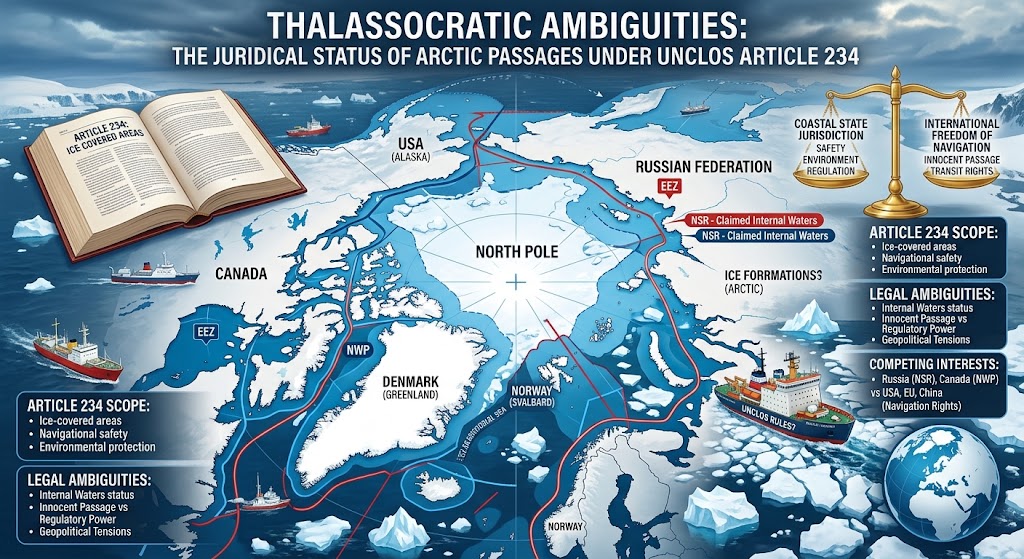
The retreat of the Arctic cryosphere, precipitated by anthropogenic climatic shifts, has transitioned from a geophysical phenomenon into a complex juridical challenge. For centuries, the Northwest Passage (NWP) and the Northern Sea Route (NSR) or Northeast Passage (NEP) were primarily theoretical conduits, locked behind perennial sea ice. Today, the seasonal accessibility of these routes invites a fundamental reassessment of maritime sovereignty, the rights of innocent and transit passage, and the specific regulatory exemptions granted under the United Nations Convention on the Law of the Sea (UNCLOS). The central tension lies between the coastal states—principally Canada and the Russian Federation—which assert that these passages constitute internal waters, and the major maritime powers—led by the United States and the European Union—which maintain that they are international straits subject to the regime of transit passage.
How does UNCLOS Article 234 affect Arctic shipping?
At the heart of the Arctic legal debate is Article 234 of UNCLOS, frequently referred to as the Arctic Exception. This provision was the result of intense negotiations during the Third United Nations Conference on the Law of the Sea (UNCLOS III), primarily driven by Canada’s enactment of the Arctic Waters Pollution Prevention Act (AWPPA) in 1970. Article 234 grants coastal states the right to adopt and enforce non-discriminatory laws and regulations for the prevention, reduction, and control of marine pollution from vessels in ice-covered areas within the limits of the exclusive economic zone (EEZ).
However, the phrasing of Article 234 introduces significant interpretive ambiguity. The provision applies where particularly severe hazards to navigation and pollution of the marine environment could cause major harm to or irreversible disturbance of the ecological balance, and where particularly severe climatic conditions and the presence of ice covering such areas for most of the year create obstructions or exceptional hazards to navigation. The phrase most of the year is increasingly problematic in a warming climate. If ice coverage diminishes to less than six months, a strict textualist interpretation suggests that the exceptional jurisdiction granted by Article 234 might lapse, reverting the legal regime to the standard provisions of Part XII of UNCLOS.
Furthermore, the relationship between Article 234 and the regime of transit passage in straits used for international navigation (Part III) remains a point of contention. Coastal states argue that Article 234 is a lex specialis that overrides the general rights of transit passage, allowing them to impose mandatory ship reporting systems, icebreaker assistance, and hull requirements that exceed international standards set by the International Maritime Organization (IMO). Conversely, flag states argue that even in ice-covered waters, the fundamental right of transit passage cannot be suspended or significantly impeded by coastal state regulations that lack broad international consensus.
What is the legal status of the Northwest Passage?
The Northwest Passage, a labyrinthine series of channels through the Canadian Arctic Archipelago, is the subject of a long-standing dispute between Canada and the United States. Canada’s claim that the NWP constitutes internal waters rests on two primary legal pillars: the doctrine of historic waters and the application of straight baselines. In 1985, following the unauthorized transit of the US Coast Guard icebreaker Polar Sea, Canada drew straight baselines around the entire archipelago, effectively enclosing the passage as internal waters where no right of innocent passage exists without coastal state consent.
The US position, supported by many EU member states, is that the NWP is a strait used for international navigation. To support this, they point to the Corfu Channel case (UK v. Albania, 1949), where the International Court of Justice (ICJ) established a two-pronged test for an international strait: a geographic element (connecting two parts of the high seas or an EEZ) and a functional element (being used for international navigation). Canada argues that the functional test is not met because the NWP has historically been used for local traffic rather than significant international commerce. However, the US maintains that the potential for use, combined with the geographic reality, is sufficient to classify it as a strait subject to transit passage.
| Legal Doctrine | Canadian Assertions (NWP) | US/International Opposition |
|---|---|---|
| Internal Waters | Historic title and straight baselines enclose the archipelago. | Baselines are excessive; doesn't meet 1951 Fisheries Case criteria. |
| Right of Passage | Consent required; no right of innocent passage in internal waters. | Transit passage applies; no coastal state consent required for straits. |
| Article 234 | Primary regulatory authority to protect fragile ecosystem. | Secondary to navigation rights; must be non-discriminatory. |
Is the Northern Sea Route an international strait?
The Northern Sea Route (NSR), spanning the Russian Arctic coast from the Kara Sea to the Bering Strait, presents a parallel yet distinct legal architecture. Russia, following the footsteps of the Soviet Union, maintains rigorous control over the NSR, viewing it as a national transportation route under its full jurisdiction. The Russian Federation has utilized Decree 1102 and Federal Law No. 132-FZ to establish a comprehensive regulatory regime administered by the NSR Administration. This regime includes mandatory prior notification, compulsory icebreaker escort (for a fee), and the requirement of Russian-certified ice pilots.
The legal controversy mirrors that of the NWP but is amplified by Russia’s strategic posture. Russia utilizes straight baselines to enclose several key straits—such as the Vilkitsky, Shokalsky, and Laptev Straits—claiming them as internal waters. The international community, however, views these as straits used for international navigation. The 1951 ICJ Fisheries Case (UK v. Norway) is often cited here; while the court upheld Norway's use of straight baselines in certain rugged coastal areas, it emphasized that such lines must not depart to any appreciable extent from the general direction of the coast. Critics argue that Russia’s lines are overly expansive and aimed at securing thalassocratic control rather than reflecting legitimate geographical necessities.
The Russian government often justifies its position by invoking Article 234 as a source of sui generis authority. They argue that the unique hazards of the NSR necessitate a centralized management system to ensure safety and environmental protection. However, the legal ambiguity arises when Russia applies these regulations to sovereign-immune vessels (warships and government ships), which UNCLOS Article 236 explicitly exempts from the environmental provisions of the Convention. This friction remains a potential flashpoint for maritime escalations.
What are the implications of melting ice for maritime sovereignty?
The transition of the Arctic from an ice-dominated environment to an open-water reality has profound implications for the validity of existing maritime entitlements. Under UNCLOS, maritime zones—territorial seas, contiguous zones, and EEZs—are measured from baselines. As coastal ice shelves and permanent features melt or recede, the ambulatory nature of these baselines may lead to shifts in maritime boundaries. While the Fisheries Case and the later North Sea Continental Shelf cases (FRG v. Denmark/Netherlands, 1969) focused on the physical contours of the land, the Arctic context introduces the variable of changing state-of-matter (ice to water).
Moreover, the eventual disappearance of summer sea ice would render the functional argument of Article 234 moot. If the Arctic becomes a seasonally open sea, the justification for exceptional coastal state jurisdiction based on ice hazards dissolves. In such a scenario, the regime of the high seas or the standard EEZ regulations would prevail. This would weaken the legal standing of Russia and Canada to demand fees or prior authorization for transit. The resulting legal vacuum or shift toward the lex generalis of UNCLOS could lead to increased military presence and resource competition in the Central Arctic Ocean, an area governed by the PCA’s 2016 South China Sea award logic regarding the status of features and entitlements.
The juridical future of the Arctic depends on whether the international community views the region as a 'common heritage of mankind' requiring collective stewardship or as a series of partitioned 'national lakes' governed by 19th-century notions of territoriality.
The Role of the Polar Code and International Standards
Recognizing the limitations of unilateral coastal state regulation, the IMO adopted the International Code for Ships Operating in Polar Waters (Polar Code), which became mandatory in 2017. The Polar Code provides a uniform, international regulatory framework for ship design, construction, equipment, and training. From a jurisprudential perspective, the Polar Code acts as an implementation of UNCLOS Article 211, which concerns pollution from vessels. By establishing international standards, the Polar Code potentially narrows the scope for 'non-discriminatory' unilateral regulations under Article 234, as any national law that deviates significantly from the Polar Code might be challenged as an unjustified barrier to navigation.
Jurisprudential Precedents and Comparative Analysis
In evaluating these disputes, international tribunals often look to the balance between coastal security and maritime mobility. The MOX Plant case (Ireland v. UK) and the Land Reclamation case (Malaysia v. Singapore) before ITLOS highlight the importance of cooperation and environmental impact assessments in disputed maritime spaces. In the Arctic, the lack of a comprehensive regional treaty (unlike the Antarctic Treaty System) means that UNCLOS remains the primary constitution for the oceans. However, as seen in the Arctic Sunrise case (Netherlands v. Russia), Russia has at times challenged the jurisdiction of international bodies over what it considers its internal security matters within its Arctic EEZ.
Conclusion
The legal status of the Northwest Passage and the Northern Sea Route remains one of the most significant unresolved issues in the law of the sea. While Canada and Russia rely on a combination of historic title, straight baselines, and a broad interpretation of Article 234 to maintain control, the international community increasingly pushes for a regime of transit passage as the ice thins. The resolution of these tensions will likely not come through a single landmark judgment from the ICJ or ITLOS, but rather through a gradual evolution of customary law, bilateral agreements (such as the 1988 Arctic Cooperation Agreement between the US and Canada), and the continued refinement of international standards like the Polar Code. As the physical ice melts, the legal ice surrounding these passages is also fracturing, necessitating a new normative framework that balances the legitimate environmental and security concerns of coastal states with the global interest in efficient, open maritime trade routes.
Comments
No comments yet.