Provisional Measures in Maritime Dispute Settlement: Comparing the Jurisprudential Approaches of ITLOS and the ICJ
A rigorous analysis of the jurisdictional thresholds, urgency requirements, and binding authority of provisional measures in maritime disputes before the ICJ and ITLOS.
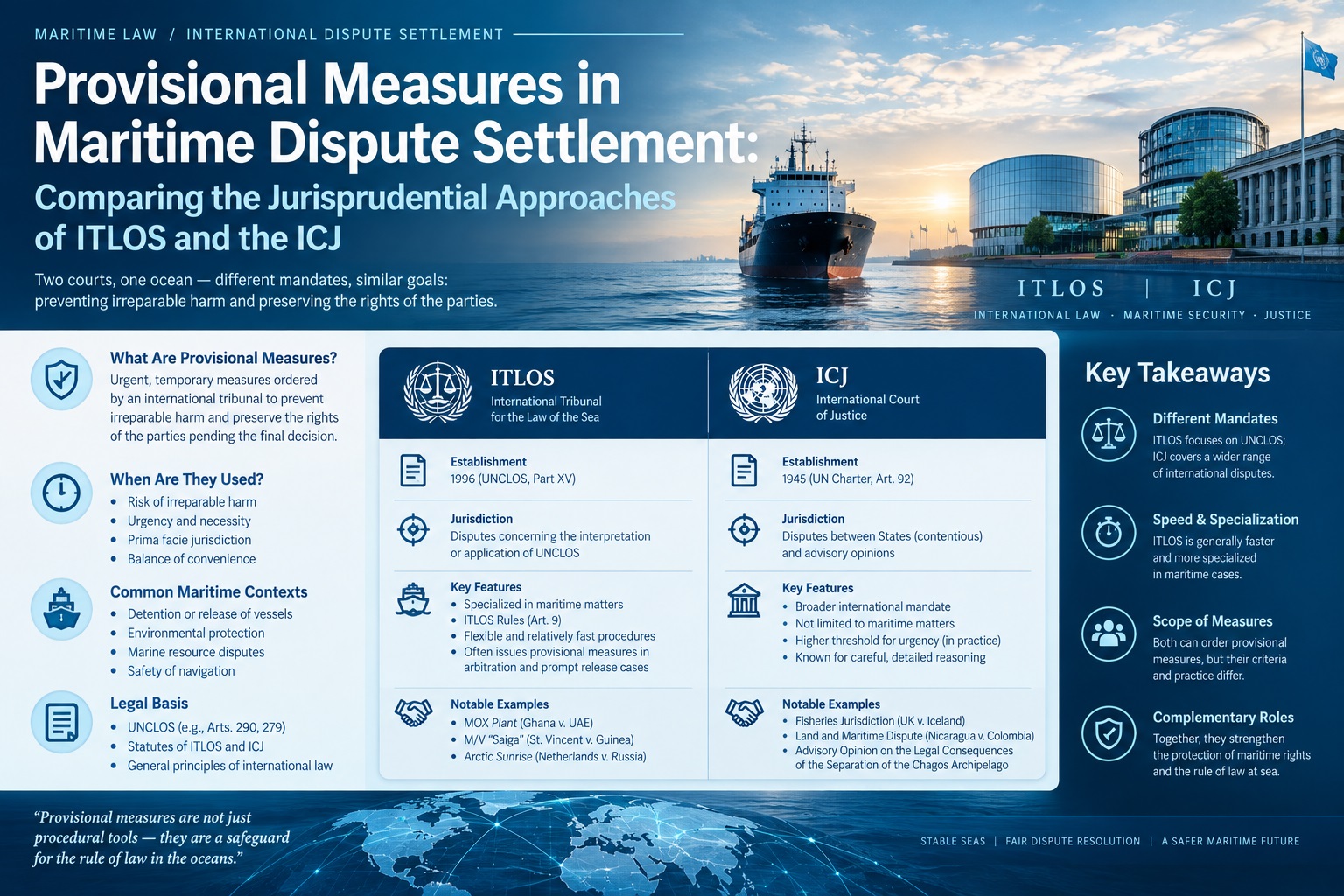
The preservation of sovereign rights and the prevention of irreversible ecological damage during pending litigation are among the most critical functions of international adjudicative bodies. Within the domain of maritime dispute settlement, this protective role is manifested through the prescription or indication of provisional measures. Grounded in the preservation of the parties' respective rights pendente lite, provisional measures serve as an emergency mechanism designed to freeze the status quo before a tribunal can render a final decision on the merits. However, the legal architecture governing these measures is bifurcated between two prominent judicial forums: the International Court of Justice (ICJ) and the International Tribunal for the Law of the Sea (ITLOS).
While both institutions are charged with upholding the rule of law on the oceans, they operate under distinct treaty frameworks and jurisprudential paradigms. The ICJ, operating under the classical framework of Article 41 of its Statute, must reconcile its broad jurisdictional mandate with the specificities of maritime boundary delimitation and sovereign friction. Conversely, ITLOS, established under Part XV of the United Nations Convention on the Law of the Sea (UNCLOS), operates under a specialized, highly integrated compulsory dispute settlement system. Under Article 290 of UNCLOS, ITLOS possesses unique procedural powers, including the explicit mandate to protect the marine environment from serious harm. Analyzing the intersection, overlap, and divergence between these two bodies reveals how international tribunals manage the delicate balance between state sovereignty, environmental protection, and the integrity of the international judicial process.
The Jurisdictional Foundations of Interim Protection: Article 41 of the ICJ Statute vs. Article 290 of UNCLOS
To understand the operational dynamics of provisional measures, one must first examine their constitutional foundations. Under Article 41(1) of the ICJ Statute, the Court has "the power to indicate, if it considers that circumstances so require, any provisional measures which ought to be taken to preserve the respective rights of either party." Historically, the term "indicate" (and its French equivalent, indiquer) sparked intense academic and judicial debate regarding whether these measures possessed a binding character. For decades, some states argued that the phrasing suggested advisory rather than mandatory compliance, a view that persisted until the landmark LaGrand judgment in 2001. In that case, the ICJ definitively resolved the linguistic ambiguity, holding that provisional measures are legally binding, a principle subsequently integrated into its maritime jurisprudence.
In contrast, the drafters of UNCLOS sought to avoid such textual ambiguity. Article 290(1) of the Convention states that a court or tribunal having jurisdiction under Part XV "may prescribe any provisional measures which it considers appropriate under the circumstances to preserve the respective rights of the parties to the dispute or to prevent serious harm to the marine environment." The deliberate choice of the verb "prescribe" (prescrire) represents a major jurisprudential evolution. By opting for "prescribe" rather than "indicate," the drafters of UNCLOS established from the outset that interim orders issued under the Convention carry immediate, legally binding force. This linguistic distinction reflects a broader shift toward compulsory, enforceable mechanisms of global ocean governance.
Furthermore, the jurisdictional reach of ITLOS under Article 290 extends beyond disputes submitted directly to the Tribunal itself. Under Article 290(5) of UNCLOS, ITLOS is empowered to prescribe provisional measures pending the constitution of an Annex VII arbitral tribunal, provided it finds that prima facie the arbitral tribunal to be constituted would have jurisdiction and that the urgency of the situation so requires. This "emergency room" function has no equivalent in the ICJ framework. It positions ITLOS as a central guardian of the Convention's integrity, ensuring that states cannot exploit the delays inherent in establishing ad hoc arbitral tribunals to alter the physical or legal status quo of a disputed maritime space.
How does ITLOS determine prima facie jurisdiction?
The establishment of prima facie jurisdiction is the threshold requirement for any international court or tribunal considering a request for provisional measures. Because interim relief is granted before a full examination of the merits, the applicant is not required to prove definitively that the tribunal possesses jurisdiction. Instead, the tribunal must satisfy itself that the provisions invoked by the applicant appear, at first glance, to afford a reasonable basis upon which the jurisdiction of the court or tribunal might be founded. However, the application of this standard by ITLOS reveals a complex balancing act between judicial caution and the necessity of immediate intervention.
In the Southern Bluefin Tuna cases (New Zealand v. Japan; Australia v. Japan, 1999), ITLOS faced a rigorous challenge to its prima facie jurisdiction. Japan argued that the dispute arose primarily under the 1993 Convention for the Conservation of Southern Bluefin Tuna (CCSBT), which did not provide for compulsory arbitration or adjudication under UNCLOS Part XV. Japan contended that the regional treaty superseded the general provisions of UNCLOS. ITLOS rejected this argument, asserting that the conduct complained of could simultaneously constitute a breach of UNCLOS provisions relating to the conservation of highly migratory species. The Tribunal concluded that the existence of a specialized regional agreement did not preclude the application of the broader dispute settlement procedures of UNCLOS. It found that prima facie jurisdiction existed and prescribed measures limiting Japan's unilateral experimental fishing program. Although the subsequent Annex VII arbitral tribunal ultimately determined that it lacked jurisdiction on the merits, the ITLOS order demonstrated a willingness to assert jurisdiction to prevent irreversible depletion of fish stocks.
The standard of prima facie jurisdiction was further refined in the MOX Plant case (Ireland v. United Kingdom, 2001). Ireland sought provisional measures to suspend the operation of a nuclear mixed oxide fuel recycling facility in the United Kingdom, alleging potential radioactive pollution of the Irish Sea. The UK contested jurisdiction, pointing to regional treaty frameworks such as the OSPAR Convention and the Euratom Treaty, which possessed their own dispute settlement mechanisms. ITLOS, however, maintained that the distinct legal character of UNCLOS obligations regarding the protection of the marine environment allowed it to assert prima facie jurisdiction. The Tribunal noted that the same dispute could be characterized differently under different treaties, and since the rights and duties invoked by Ireland fell squarely within UNCLOS, the jurisdictional threshold for provisional measures was met.
"The dispute settlement procedures under UNCLOS are designed to be comprehensive and integrated. A state cannot escape its environmental obligations under the Convention merely by pointing to overlapping regional regimes."
— MOX Plant Case (Ireland v. United Kingdom), Provisional Measures, Order of 3 December 2001, Separate Opinion of Judge ad hoc Shearer
In the ARA Libertad case (Argentina v. Ghana, 2012), ITLOS demonstrated the rapid deployment of its jurisdictional powers in protection of state sovereignty and sovereign immunity. Ghana had detained an Argentine warship, the frigate ARA Libertad, in the port of Tema, pursuant to an injunction issued by a Ghanaian court in connection with a commercial debt dispute. Argentina immediately applied to ITLOS for provisional measures under Article 290(5). Ghana argued that the dispute was commercial and did not fall under the purview of UNCLOS. ITLOS swiftly bypassed this defense, finding that a warship enjoys sovereign immunity under international law, a principle codified in Articles 32 and 95 of UNCLOS. The Tribunal asserted its prima facie jurisdiction, finding that the detention of a warship threatened the sovereign rights of the flag state and caused a friction that required urgent rectification. It ordered Ghana to release the vessel and its crew immediately, illustrating how ITLOS can utilize the prima facie standard to protect fundamental principles of international maritime law.
The Evolution of Urgency and the Prevention of Ecological Harm
Beyond jurisdiction, the applicant must demonstrate that there is an urgent need for provisional measures to prevent "irreparable prejudice" to the rights in dispute. In the jurisprudence of the ICJ, the requirement of urgency is strictly construed. The Court must determine whether there is a real and imminent risk that irreparable harm will be caused to the rights of a party before the final decision is rendered. This was clearly illustrated in the Passage through the Great Belt case (Finland v. Denmark, 1991). Finland sought provisional measures to halt Denmark's construction of a high-level bridge over the Great Belt, which Finland claimed would permanently block the passage of its deep-sea drilling rigs. The ICJ declined to indicate provisional measures, noting that because the actual blockage of the strait would not occur until several years later (well after the scheduled date for the hearing on the merits), there was no immediate, imminent risk of irreparable harm. The Court relied on Denmark's assurance that construction would not progress to a point of physical obstruction prior to the final judgment.
In maritime boundary disputes, the ICJ has maintained a similarly high bar for irreparable prejudice. In the Aegean Sea Continental Shelf case (Greece v. Turkey, 1976), Greece sought provisional measures to prevent Turkey from conducting seismic exploration in disputed continental shelf areas. The ICJ refused the request, holding that seismic exploration, although provocative, did not cause physical damage to the seabed or its subsoil, nor did it involve the permanent appropriation of natural resources. Because the activities did not establish a prescriptive right that would prejudice the final boundary line, the risk of irreparable harm was not established. This conservative approach contrast sharply with the ecological dimension introduced by UNCLOS.
Under Article 290(1) of UNCLOS, provisional measures may be prescribed not only to preserve the respective rights of the parties but also "to prevent serious harm to the marine environment." This represents a revolutionary departure from classical international litigation. In traditional international law, interim protection is strictly bilateral and reciprocal, designed to safeguard the subjective rights of the litigants. The environmental limb of Article 290, however, introduces an objective element: the protection of the global commons. It reflects a growing recognition that the marine environment is a shared heritage that can suffer irreparable damage independent of any direct infringement on sovereign rights.
This environmental mandate has forced ITLOS to confront the challenges of scientific uncertainty. In the Southern Bluefin Tuna cases, the scientific evidence regarding the state of the tuna stocks was highly contested. Japan argued that its experimental fishing program was safe and scientifically sound, while Australia and New Zealand contended it threatened the collapse of the stock. In prescribing provisional measures, ITLOS effectively applied a precursor to the precautionary principle. The Tribunal emphasized that although there was scientific uncertainty, the parties must act with "prudence and caution" to prevent serious harm to the marine resources. The Order required the parties to limit their catches to their previously agreed national allocations, prioritizing ecological preservation over unilateral economic exploitation.
In the Land Reclamation case (Malaysia v. Singapore, 2003), Malaysia sought to halt Singapore's land reclamation activities in the Straits of Johor, claiming they caused serious damage to the marine environment and coastal ecosystems. While ITLOS did not order a complete halt to the reclamation, it directed the parties to establish an independent group of experts to conduct a joint study and monitor the ecological impact of the works. The Tribunal's order demonstrated a highly cooperative approach, using provisional measures to mandate institutional mechanisms for ecological risk management. This highlights how ITLOS uses its mandate to prevent environmental harm while avoiding unnecessary disruption to state development projects.
Are provisional measures prescribed by ITLOS legally binding?
The question of the binding nature of provisional measures was historically one of the most contentious issues in international adjudication. To fully understand the legal force of these measures, it is necessary to trace the jurisprudential trajectory from the ICJ's initial ambiguity to ITLOS's explicit statutory authority.
For over half a century, the international legal community was divided over the interpretation of Article 41 of the ICJ Statute. The English text used the phrase "indicate... measures which ought to be taken," suggesting a non-binding recommendation. The French text, however, spoke of "indiquer... les mesures conservatoires qui doivent être prises," which carried a much stronger obligatory tone. This linguistic divide allowed states to occasionally disregard ICJ provisional measures with impunity, arguing that they were merely persuasive guidelines. The turning point came in 2001 with the ICJ's judgment in the LaGrand case (Germany v. United States). The Court, applying the rules of treaty interpretation codified in the Vienna Convention on the Law of Treaties, concluded that the object and purpose of the Statute required provisional measures to be binding. The Court reasoned that the judicial function would be fundamentally undermined if a party could frustrate the final judgment by altering the subject matter of the dispute during the proceedings. This landmark ruling brought the ICJ in line with modern expectations of international judicial authority.
For ITLOS, this debate was avoided by the precise drafting of UNCLOS. Under Article 290, the Tribunal "prescribes" provisional measures, and Article 290(6) explicitly states that "the parties to the dispute shall comply promptly with any provisional measures prescribed under this article." The use of the word "prescribe" combined with the mandatory "shall comply" leaves no room for creative interpretation. Legally, any provisional measure issued by ITLOS, or by an Annex VII arbitral tribunal acting under Part XV, is an international legal obligation. Non-compliance with such measures constitutes an independent wrongful act under international law, engaging the state's international responsibility.
However, the binding legal nature of these measures does not automatically translate into effective enforcement. In the international legal order, tribunals lack their own enforcement mechanisms and must rely on the good faith of states or the political pressure of the broader international community. For instance, in the Arctic Sunrise case (Kingdom of the Netherlands v. Russian Federation, 2013), the Netherlands sought provisional measures under Article 290(5) following the boarding and detention of the Greenpeace vessel Arctic Sunrise and its crew by Russian authorities. Russia boycotted the proceedings, claiming that its domestic maritime law enforcement fell outside the Tribunal's jurisdiction. Despite Russia's non-participation, ITLOS prescribed provisional measures ordering the immediate release of the vessel and its crew upon the posting of a bank guarantee. Russia initially ignored the order, but eventually released the crew and the ship. This case demonstrated that even when a powerful state publicly rejects the binding authority of a tribunal, the legal existence of the order creates persistent reputational and diplomatic pressure that often leads to eventual compliance.
A similar dynamic of resistance and eventual resolution occurred in the Enrica Lexie incident (Italy v. India, 2015). The dispute arose from the shooting of two Indian fishermen by Italian marines on board the commercial tanker Enrica Lexie off the coast of India. Italy initiated arbitration under Annex VII and requested provisional measures from ITLOS under Article 290(5) to allow the detained marines to return to Italy. ITLOS prescribed that both Italy and India suspend all domestic court proceedings and refrain from initiating new legal actions that might jeopardize the arbitral tribunal's eventual decision. Both parties complied with this order, freezing their domestic criminal prosecutions until the Annex VII tribunal rendered its final award. This case underscores how provisional measures can act as a valuable cooling-off mechanism, allowing states to de-escalate high-stakes political standoffs under the cover of international legal compliance.
The Intersection of ITLOS and Annex VII Arbitral Tribunals under Article 290(5)
A unique structural feature of the UNCLOS dispute settlement framework is the relationship between ITLOS and the ad hoc arbitral tribunals constituted under Annex VII of the Convention. Under Article 287 of UNCLOS, states can choose from several forums for dispute resolution, including the ICJ, ITLOS, or an Annex VII arbitral tribunal. In practice, because many states make divergent choices or fail to make any declaration, Annex VII arbitration serves as the default forum for compulsory dispute settlement. However, establishing an arbitral tribunal—selecting arbitrators, drafting the rules of procedure, and convening the first meeting—is a time-consuming process that can take several months.
Recognizing this temporal gap, Article 290(5) of UNCLOS designates ITLOS as the default judicial forum empowered to prescribe provisional measures pending the formal constitution of the Annex VII tribunal. This provision acts as a vital safety valve, preventing states from taking unilateral actions to present a fait accompli before the arbitral tribunal can hold its first sitting. To exercise this power, ITLOS must conduct a dual-layered inquiry: first, it must determine whether the future arbitral tribunal would have prima facie jurisdiction over the dispute; second, it must assess whether the urgency of the situation demands immediate intervention.
This procedural mechanism has been deployed in several high-profile disputes, demonstrating both its efficacy and the institutional friction it can generate. In the Enrica Lexie case, the Italian request under Article 290(5) forced ITLOS to evaluate the competing sovereign claims of Italy (which claimed exclusive jurisdiction over its military personnel on the high seas) and India (which asserted criminal jurisdiction over acts committed within its contiguous zone). The Tribunal's order to suspend all domestic legal proceedings effectively preserved the status quo, but it also drew significant criticism from some judges. In his dissenting opinion, Judge ad hoc Robinson argued that ITLOS had overstepped its bounds by encroaching upon the sovereign criminal jurisdiction of India, illustrating the delicate balance tribunals must strike between preserving international rights and respecting domestic judicial processes.
Comparative Matrix of Maritime Interim Protection
The operational and jurisdictional differences between the ICJ and ITLOS in the realm of provisional measures are summarized in the following table:
| Jurisdictional & Procedural Dimension | International Court of Justice (ICJ) | International Tribunal for the Law of the Sea (ITLOS) |
|---|---|---|
| Enabling Treaty Provision | Article 41 of the ICJ Statute | Article 290 of the 1982 UNCLOS |
| Textual Power | Power to "indicate" (indiquer) measures | Power to "prescribe" (prescrire) measures |
| Binding Authority | Established via jurisprudence (LaGrand Case, 2001) | Explicitly established by treaty (Article 290(6) UNCLOS) |
| Environmental Mandate | Implicit; framed through the protection of bilateral state rights | Explicit; mandate to prevent "serious harm to the marine environment" (Article 290(1)) |
| Standard of Urgency | Strict standard of imminent and irreparable prejudice to rights | Pragmatic standard; incorporates "prudence and caution" (precautionary approach) |
| Auxiliary Jurisdiction | None; limited to cases currently pending before the Court | Empowered to act on behalf of future Annex VII arbitral tribunals (Article 290(5)) |
| Default Enforcement & Reporting | Reporting requirements established via Rules of Court (Article 78) | Mandatory reporting on compliance embedded in the text of the order |
Provisional Measures in Disputed Maritime Zones: The Delimitation Context
One of the most legally complex scenarios in maritime dispute resolution occurs when states request provisional measures within disputed maritime spaces prior to boundary delimitation. In these situations, the rights in question are inherently fluid, as the final boundary line has not yet been drawn. Consequently, unilateral resource exploitation—such as offshore oil drilling or seismic mapping—can trigger requests for interim protection. The central legal challenge is determining whether such activities cause "irreparable prejudice" to the rights of the opposing claimant or alter the status quo to a degree that compromises the final boundary line.
The Special Chamber of ITLOS confronted this challenge in the Delimitation of the Maritime Boundary in the Atlantic Ocean case (Ghana/Côte d'Ivoire, 2015). Côte d'Ivoire sought provisional measures under Article 290(1) to halt all ongoing oil exploration and exploitation activities conducted by Ghana in a disputed maritime area. Côte d'Ivoire argued that Ghana's unilateral activities constituted a violation of its sovereign rights and threatened to cause irreparable damage to its marine resources through physical extraction and potential oil spills. Ghana countered that suspending its offshore operations would cause catastrophic economic harm to its domestic industry and violate the terms of contracts concluded with international oil companies.
The Special Chamber adopted a nuanced, balanced approach. It recognized that unilateral drilling in a disputed area could result in the permanent extraction of non-renewable resources, which might prejudice the sovereign rights of the state to which the area is ultimately allocated. However, the Chamber also recognized that a total, immediate shutdown of all active wells would cause immense financial waste and could lead to environmental hazards. Consequently, the Chamber prescribed a bifurcated order: it ordered Ghana to ensure that no new drilling was initiated in the disputed area, while permitting existing, active drilling operations to continue under strict environmental monitoring. Furthermore, it required Ghana to take all necessary steps to prevent the unilateral disclosure of confidential seismic and geological data acquired during the operations.
This decision established a significant precedent for resource management in disputed waters. It demonstrated that provisional measures can be tailored to minimize economic disruption while still protecting the integrity of the final boundary delimitation. By distinguishing between "new" and "ongoing" projects, the Special Chamber balanced the economic interests of the coastal state with the sovereign rights of the neighboring claimant, providing a template for future maritime boundary disputes.
The Procedural Mechanics of Compliance and Modification
The effectiveness of provisional measures depends heavily on the procedural mechanisms used to monitor compliance. Both the ICJ and ITLOS have developed robust reporting requirements to ensure that states take their interim obligations seriously. When prescribing or indicating measures, both forums typically include a clause requiring the parties to submit periodic reports detailing the steps they have taken to comply with the order. These reports are scrutinized by the registry of the respective court or tribunal and can be used as evidence during the subsequent merits phase of the dispute.
Furthermore, because provisional measures are designed to address fluid, rapidly evolving emergency situations, they are not set in stone. Under Article 76 of the Rules of the ICJ and Article 95 of the Rules of ITLOS, either party can request the modification or revocation of an existing provisional measures order if there is a significant change in the factual or legal circumstances. This flexibility allows tribunals to adapt their orders to changing realities on the ground (or at sea).
For instance, if a state complies with a portion of an order or if the threat of environmental harm decreases, a tribunal may scale back the restrictions imposed on the target state. Conversely, if a state acts in bad faith or escalates the dispute, the opposing party can return to the tribunal to request additional, more stringent measures. This dynamic, iterative process ensures that provisional measures remain an active, responsive tool of conflict management throughout the life of the litigation.
Conclusion: Towards a Cohesive Jurisprudence of Interim Ocean Protection
The evolution of provisional measures in the jurisprudence of the ICJ and ITLOS reflects a broader transition in international law away from purely bilateral, voluntaristic dispute resolution toward a more centralized, rule-of-law-based system of global ocean governance. While the ICJ continues to apply a highly disciplined, rights-centric approach to interim protection, its landmark ruling in the LaGrand case established a firm foundation for the binding nature of international judicial orders, ensuring that states cannot disregard the Court's decisions without facing significant legal consequences.
Meanwhile, ITLOS has utilized the specialized framework of UNCLOS to pioneer a more proactive, ecologically sensitive approach to interim protection. Through the dual-layered mechanism of Article 290, ITLOS has expanded the traditional boundaries of provisional measures, integrating the precautionary approach into its jurisprudence and recognizing the protection of the marine environment as an independent, objective value under international law. Whether preventing the depletion of endangered fish stocks, halting unilateral land reclamation, or managing resources in disputed maritime boundaries, ITLOS has demonstrated that provisional measures are a versatile and powerful tool for preserving the delicate balance between state interests and global environmental preservation.
As maritime activities intensify due to deep-sea mining, offshore renewable energy projects, and the shifting geography of climate change, the demand for rapid, effective interim protection will only grow. The jurisprudential dialogue between the ICJ and ITLOS will remain essential to ensuring that these challenges are met with a cohesive, robust body of international law, safeguarding both the sovereign rights of states and the ecological integrity of the global ocean commons.
Comments
No comments yet.