The Fourth Pillar: The Maritime Labour Convention and the Jurisprudence of Seafarers Rights
A comprehensive examination of the Maritime Labour Convention 2006, evaluating its enforcement architecture, ITLOS jurisprudence, and ongoing systemic challenges in seafarer protections.
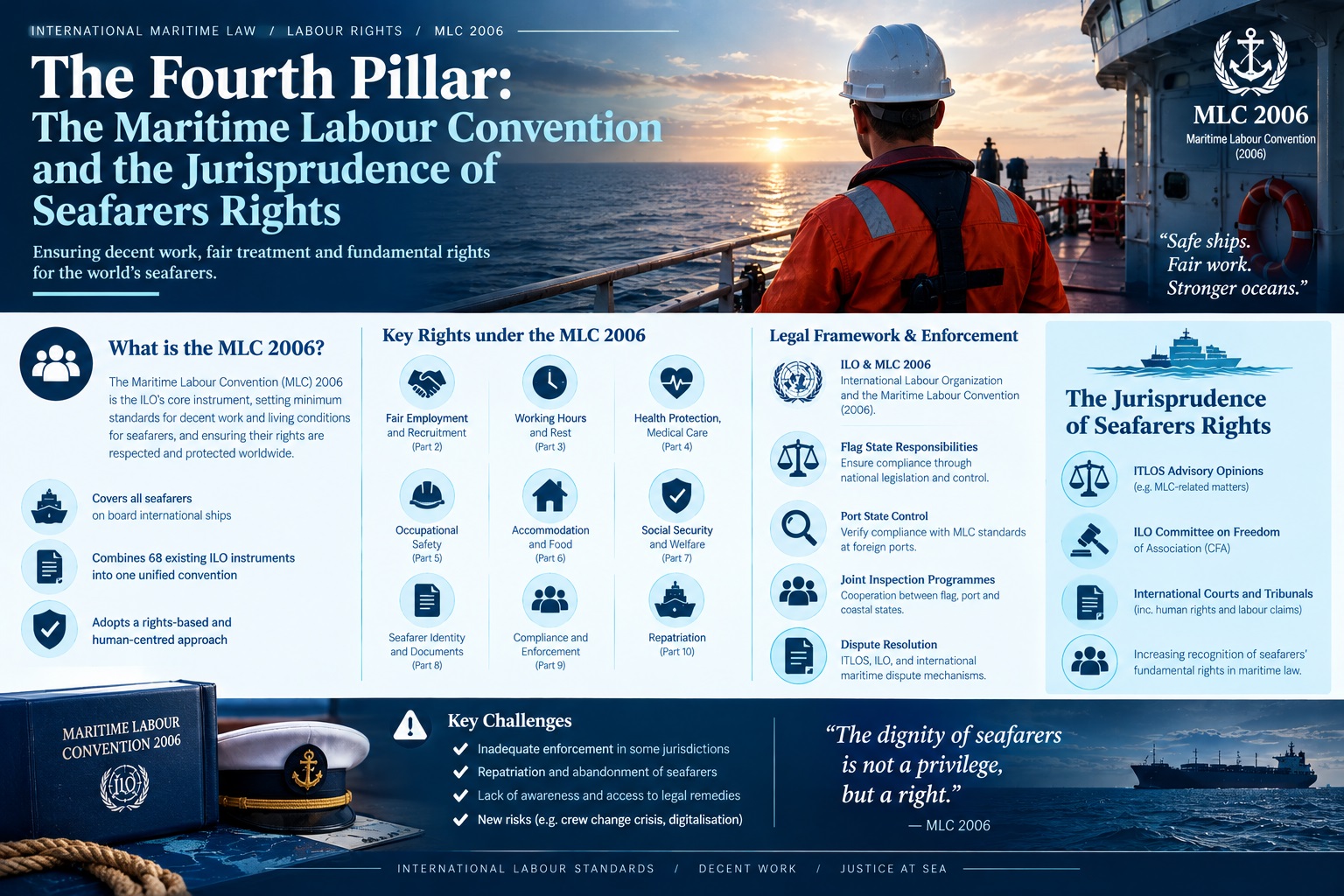
For centuries, the law of the sea developed almost exclusively as a law of spatial sovereignty, resource allocation, and maritime commerce. From Hugo Grotius's defense of open navigation in Mare Liberum to the codification of the United Nations Convention on the Law of the Sea (UNCLOS) in 1982, the legal architecture of ocean governance prioritized the rights of states and the security of commercial ventures over the individuals who sustained them. Seafarers occupied a precarious legal margin: physically removed from terrestrial protections, subordinated to the disciplinary command of the shipmaster, and subjected to the jurisdictional labyrinth of flag states whose genuine links to vessel operations were frequently legal fictions. The entry into force of the Maritime Labour Convention, 2006 (MLC) fundamentally altered this trajectory by establishing what is now recognized across admiralty courts and public international tribunals as the fourth pillar of international maritime governance, sitting alongside the International Convention for the Safety of Life at Sea (SOLAS), the International Convention for the Prevention of Pollution from Ships (MARPOL), and the International Convention on Standards of Training, Certification and Watchkeeping for Seafarers (STCW).
By consolidating, modernizing, and expanding sixty-eight prior maritime instruments generated across eight decades by the International Labour Organization (ILO), the MLC introduced an integrated normative framework designed to operate as a comprehensive international bill of rights for maritime workers. However, the convention's progressive codification does not operate in a vacuum. Its structural effectiveness depends upon complex interactions between international human rights standards, public international law, the jurisprudence of the International Tribunal for the Law of the Sea (ITLOS), and the practical exercise of port state control. The ongoing friction between flag state preeminence under UNCLOS Article 94 and universal minimum standards for labor exposes systemic fractures in international maritime law, particularly where state neglect, flags of convenience, and corporate opacity threaten the basic guarantees of human dignity at sea.
The Normative Architecture of the Maritime Labour Convention, 2006
The institutional architecture of the MLC is distinguished by its departure from traditional treaty drafting. Rather than adopting a monolithic or rigid regulatory style, the drafters employed a vertically integrated, two-tier system consisting of Articles, Regulations, and a two-part Code. The Articles and Regulations set out basic obligations and fundamental rights, while the Code contains the practical means of implementation, split between mandatory Standards (Part A) and non-mandatory Guidelines (Part B). This structural duality was deliberately engineered to resolve a historic conundrum within maritime labor regulation: previous ILO conventions had suffered from notoriously low ratification rates because domestic legislative systems could not reconcile their localized labor codes with inflexible treaty texts.
To preserve uniformity without sacrificing widespread accession, Article VI of the MLC operationalized the doctrine of substantial equivalence. Under this provision, a member state may implement the requirements of Part A through laws or regulations that are not identical in form to the convention's explicit terms, provided that the competent national authority satisfies itself that the measures adopted are conducive to the full achievement of the general object and purpose of the standard. While this flexibility catalyzed global ratification—now encompassing over one hundred states representing more than 95 percent of the world gross tonnage—it introduced substantive interpretive ambiguities. The boundary between legitimate administrative variation and structural dilution remains contentious, especially when domestic courts adjudicate whether national exemptions breach international minimum standards.
The convention's structural core is divided across five substantive Titles: Minimum requirements for seafarers to work on a ship (Title 1); Conditions of employment (Title 2); Accommodation, recreational facilities, food and catering (Title 3); Health protection, medical care, welfare and social security protection (Title 4); and Compliance and enforcement (Title 5). Central to this enforcement apparatus is the no more favorable treatment clause articulated in Article V, paragraph 7. This provision mandates that ratifying states must apply their domestic enforcement measures to all foreign vessels calling at their ports, regardless of whether the flag state has ratified the convention. By neutralizing the competitive commercial advantage historically enjoyed by sub-standard shipowners flying non-ratifying flags of convenience, the no more favorable treatment clause transformed the MLC into a quasi-universal regulatory instrument possessing genuine extraterritorial bite.
How Does the Maritime Labour Convention Protect Seafarers?
The protection afforded to seafarers under the convention operates through both substantive rights guarantees and documentary evidentiary mechanisms. Substantively, Title 2 establishes mandatory minimums that constrain the historical breadth of freedom of contract within maritime employment. Standard A2.1 mandates that every seafarer working on an eligible ship must possess a signed seafarers' employment agreement (SEA) setting out wages, paid annual leave, termination conditions, and health benefits, with adequate opportunities for the worker to review and seek advice on the contract prior to signature. Furthermore, Standard A2.3 codifies rigid parameters for hours of work and hours of rest, establishing that the minimum hours of rest must not be less than ten hours in any 24-hour period, and 77 hours in any seven-day period. These parameters are directly enforceable through shipboard records subject to administrative inspection.
Under Title 4, the convention establishes a robust regime of shipowner liability that operates largely independent of domestic tort doctrines. Standard A4.2 requires shipowners to provide financial coverage for costs associated with sickness, injury, or death occurring between the date of commencement of duty and the date on which the seafarer is deemed duly repatriated. The convention explicitly precludes shipowners from avoiding medical expenses, maintenance, or basic wage coverage during illness, creating an objective strict liability standard. This framework curtails traditional common law defenses such as contributory negligence or assumed maritime risk, which historically left injured crew members without recourse in foreign jurisdictions.
The enforcement engine that translates these substantive guarantees into tangible vessel requirements rests within Title 5. Under Regulation 5.1.3, every ship of 500 gross tonnage or over operating internationally must carry a Maritime Labour Certificate and a Declaration of Maritime Labour Compliance (DMLC). The DMLC consists of two complementary sections:
- DMLC Part I: Drafted by the competent authority of the flag state, identifying the precise national legal provisions that implement the sixteen mandatory inspection areas stipulated by the convention.
- DMLC Part II: Drafted by the shipowner, detailing the practical onboard operational measures, record-keeping procedures, and continuous compliance systems maintained to ensure adherence to those national laws.
The presence of these verified documents creates a rebuttable presumption of compliance. However, when clear grounds exist to believe that the working and living conditions aboard do not conform to the standards, port state control (PSC) officers are empowered under Regulation 5.2.1 to conduct detailed inspections, issue rectifications, and ultimately detain the vessel until deficiencies presenting a significant danger to seafarer safety, health, or security are remedied.
ITLOS Jurisprudence and the Judicial Incorporation of Crew Welfare
While the MLC provides the statutory core of labor rights, international tribunals have increasingly woven seafarers' fundamental rights into the broader tapestry of public international law. The jurisprudence of the International Tribunal for the Law of the Sea has been pivotal in elevating crew welfare from purely private contractual concerns to obligations under general international law and the UNCLOS framework.
The seminal turning point arrived in The M/V "SAIGA" (No. 2) Case (Saint Vincent and the Grenadines v. Guinea), Judgment of 1 July 1999. In evaluating Guinea's use of force during the interception and arrest of an offshore supply vessel, ITLOS articulated a foundational humanitarian standard that transcended the strict text of UNCLOS:
"In considering the force used by Guinea in the arrest of the Saiga, the Tribunal must take into account circumstances of the arrest in the context of the applicable rules of international law... Considerations of humanity must apply in the law of the sea, as they do in other areas of international law."
The Tribunal went further, establishing that the protection of the crew is intimately intertwined with the ship as an integral legal entity. Saint Vincent and the Grenadines was recognized as possessing the standing to assert claims on behalf of all crew members aboard its flagged vessel, regardless of their individual nationalities. This finding bypassed traditional rules of diplomatic protection that require continuous nationality, establishing that the flag state serves as a jurisdictional shield for the multinational crew on board.
This humanitarian imperative was subsequently deepened across a sequence of prompt release proceedings under UNCLOS Article 292. In The "Camouco" Case (Panama v. France) (2000) and The "Monte Confurco" Case (Seychelles v. France) (2000), ITLOS consistently weighed the psychological, physical, and economic conditions of detained crews when evaluating the reasonableness of financial bonds set by coastal states. The Tribunal firmly recognized that indefinite detention of the master and crew pending prolonged domestic forfeiture trials inflicts unacceptable humanitarian burdens.
The clearest synthesis between human rights standards and the law of the sea occurred in The "Juno Trader" Case (Saint Vincent and the Grenadines v. Guinea-Bissau), Judgment of 18 December 2004. Here, the Tribunal took explicit judicial notice of the deteriorating physical condition, medical vulnerability, and social isolation of the crew stranded aboard an arrested vessel in Bissau, declaring:
"The Tribunal is not unmindful of the concerns expressed by Saint Vincent and the Grenadines regarding the treatment of the master and the crew... The Tribunal notes that the prolonged detention of the crew without determination of their individual legal status is inconsistent with the requirement of promptness and fair treatment embodied in the Convention."
Through this progressive lineage—subsequently affirmed in The "Virginia G" Case (Panama/Guinea-Bissau) (2014) and The M/V "Norstar" Case (Panama v. Italy) (2019)—ITLOS bridged the historic divide between maritime jurisdiction and international human rights law. The Tribunal confirmed that UNCLOS Article 94, paragraph 3(b), which mandates that every flag state must exercise effective jurisdiction over labor conditions and social matters, is not a toothless administrative directive. Rather, it must be interpreted harmoniously with evolving international human rights standards and the precise terms of the MLC.
What Happens When Seafarers Are Abandoned at Sea?
Despite the comprehensive codification of labor rights, vessel abandonment represents one of the most severe crises in contemporary maritime transport. Abandonment occurs when a shipowner unilaterally severs financial ties with a vessel, ceasing wage payments, terminating provisioning of food, fuel, and potable water, and refusing to fund repatriation. Historically, when shipping companies descended into cross-border insolvency, seafarers found themselves trapped in foreign anchorages for months or years, serving as de facto custodians of an asset they could neither sail nor legally abandon without sacrificing their accumulated wage claims.
To address this structural failure, the ILO Special Tripartite Committee adopted the landmark 2014 Amendments to the MLC, which entered into force in January 2017. These amendments fundamentally revised Regulation 2.5 (Repatriation) and Standard A2.5.2 by establishing a compulsory financial security system. Under this regime, shipowners must maintain verified financial security—typically arranged through mutual Protection and Indemnity (P&I) Clubs or specialized maritime insurers—to cover abandonment risks. Standard A2.5.2, paragraph 2, establishes an objective tripartite test under which a seafarer is deemed abandoned if the shipowner:
- Fails to cover the cost of the seafarer's repatriation;
- Has left the seafarer without the necessary maintenance and support, including adequate food, drinking water supplies, essential fuel for survival on board, or necessary medical care; or
- Has otherwise unilaterally severed ties with the seafarer, including failure to pay contractual wages for a period of at least two months.
Once abandonment is triggered, the financial security provider must provide direct access to emergency funds without requiring the seafarer to prove owner insolvency through domestic litigation. The security must cover outstanding wages and other contractual entitlements up to a cap of four months, all expenses of repatriation by appropriate and expeditious means, and essential survival needs on board. This direct right of action against the insurer represents a major evolution in maritime insurance, bypassing the strict application of the common law pay-to-be-paid principle that historically insulated marine insurers from direct claims by crew members.
Nevertheless, severe jurisdictional friction persists within admiralty courts when abandoned seafarers assert their historic maritime liens for crew wages. Under traditional maritime law, claims for unpaid wages enjoy top priority among maritime liens, attaching directly to the vessel in rem and surviving changes in ownership. Yet, in real-world abandonment scenarios, the realization of this lien is fraught with peril. If an abandoned ship is arrested in a jurisdiction characterized by a slow judicial auction process, port dues, court marshal costs, and berth charges accumulate rapidly. Because these administrative costs are treated as custodia legis expenses, they take absolute priority over seafarers' wage liens during the distribution of judicial sale proceeds, often exhausting the remaining value of aging tonnage and leaving abandoned mariners with nothing.
Port State Control and the Enforcement Paradigm
The realization of seafarers' rights under the MLC is heavily dependent on port state control, which acts as the critical counterweight to flag state inertia. Maritime history demonstrates that the flag state model, while foundational to UNCLOS Article 92, exhibits deep structural weaknesses when applied to open registries. Many open-registry states lack the technical infrastructure, maritime administration personnel, or political incentive to conduct unannounced onboard audits across thousands of ships scattered throughout international waters.
Under Title 5 of the MLC, port states are invested with autonomous enforcement authority. When a vessel enters the internal waters or port facilities of a state party, it subjects itself to the administrative oversight of that state's maritime administration, executed through regional PSC regimes such as the Paris Memorandum of Understanding (Paris MoU) and the Tokyo MoU. Port state control interventions rely on a calibrated sequence of administrative actions:
- Initial Document Review: Examination of the Maritime Labour Certificate, the DMLC Parts I and II, and relevant crew documentation. If the documentation is valid and no reasonable grounds exist to suspect contravention, the inspection is concluded.
- More Detailed Inspection: Triggered when documentation is missing, invalid, or clear grounds exist to believe the working and living conditions violate the convention. Clear grounds often arise from seafarer complaints, observations of severe material deterioration, or evidence of falsified hours of rest logs.
- Rectification Actions: If deficiencies are discovered, the PSC officer issues an administrative order requiring the master to rectify them within a specified period.
- Vessel Detention: Applied under Standard A5.2.1, paragraph 6, where conditions on board are clearly hazardous to the safety, health, or security of seafarers, or where the deficiency constitutes a serious or repeated breach of the convention's requirements. The detention order remains active until the deficiency is remedied or an acceptable rectification plan is approved.
This operational framework marks a significant redistribution of jurisdictional authority. Historically, coastal and port states refrained from intervening in the internal economy of foreign vessels, adhering to the classical doctrine that the ship is a floating island of flag state sovereignty. By defining labor standards, wage regularity, and crew safety as essential matters of seaworthiness, the MLC firmly establishes that sub-standard social conditions constitute an objective maritime danger authorizing domestic administrative detention.
Comparative Framework: International Instruments and Jurisprudential Sources
To understand the systemic integration of seafarers' rights, it is necessary to examine how specific protections are treated across different regulatory instruments and international judicial forums:
| Protective Domain | UNCLOS 1982 Framework | MLC 2006 Standard | International Jurisprudential Precedent |
|---|---|---|---|
| Humanitarian Treatment and Fundamental Rights | Article 94(3)(b) (general flag state social jurisdiction); Article 292 (prompt release). | Article III (fundamental rights: association, non-discrimination, elimination of forced labor). | M/V "SAIGA" (No. 2) (ITLOS 1999): Considerations of humanity must inform all ocean governance actions. |
| Crew Abandonment and Repatriation | Silent; no specific institutional mechanism for repatriation or commercial failure. | Regulation 2.5; Standard A2.5.2 (2014 Amendments): Mandatory direct-access financial security. | The "Juno Trader" (ITLOS 2004): Stranded crew welfare assessed directly in judicial bond determinations. |
| Enforcement Beyond Flag State Jurisdiction | Article 218 (port state pollution enforcement only; labor matters reserved to flag state). | Title 5; Regulation 5.2.1; Article V(7) (no more favorable treatment doctrine via PSC). | The "Virginia G" (ITLOS 2014): Boundaries of coastal and port state regulation over vessel operations. |
| Protection from Criminalisation and Due Process | Article 97 (penal jurisdiction in collision restricted to flag or nationality state). | Standard A4.3 (health and safety protections; occupational accident reporting). | Enrica Lexie Incident (PCA Award 2020): Immunity and jurisdictional scope over crew in maritime incidents. |
Systemic Fractures: The Genuine Link and Flags of Convenience
Despite the sophisticated machinery of the MLC, the fundamental structural defect of the modern maritime legal order remains: the legal fiction of the genuine link. Article 91, paragraph 1, of UNCLOS explicitly provides that states have the right to grant nationality to ships, but stipulates that there must exist a genuine link between the state and the ship. The International Law Commission originally conceived this requirement as an objective threshold requiring substantial domestic economic ownership, operational oversight, or national crew composition. However, international judicial bodies have largely dismantled this requirement as a barrier to vessel registration.
In The M/V "SAIGA" (No. 2) Case, ITLOS addressed Guinea's argument that Saint Vincent and the Grenadines lacked standing because no genuine link existed between the vessel and the flag state. The Tribunal rejected this position, finding that the purpose of Article 91 is to secure the effective implementation of the duties of the flag state, not to establish a prerequisite for recognizing the nationality of a ship. ITLOS confirmed that once a state issues documentation conferring its nationality, that grant is binding upon other states, irrespective of the underlying economic or corporate reality. This interpretation was reinforced in The "Grand Prince" Case (Belize v. France) (2001), where the Tribunal adhered strictly to administrative registration proofs over substantive beneficial ties.
The consequences for seafarers' rights are severe. Under this open-door regime, beneficial shipowners can incorporate single-purpose brass-plate corporations in offshore jurisdictions, flag their vessels in open registries with nominal regulatory capacities, and employ complex corporate shells to obscure liability. When a crisis emerges—whether catastrophic injury, unpaid wages, or total abandonment—the seafarer faces an asymmetrical battle against corporate veils spanning multiple jurisdictions. The flag state, which possesses primary international responsibility under UNCLOS Article 94, frequently lacks both the administrative apparatus to sanction the vessel owner and the jurisdictional presence to enforce monetary awards against beneficial owners residing in foreign capitals.
Consequently, the MLC does not entirely eliminate the structural exploitation made possible by flags of convenience; rather, it shifts the enforcement burden onto port states. This dynamic produces uneven geographies of legal protection. A seafarer aboard an open-registry vessel calling at major ports in Northern Europe, North America, or Australasia enjoys robust protections through aggressive PSC oversight and active trade union presence. The same seafarer, sailing the identical ship within regional trade routes across underdeveloped port regimes, operates in an environment where the MLC's guarantees remain theoretical, and port inspections are easily evaded.
The Unresolved Challenge of Maritime Criminalisation
A profound gap within the international legal framework governing seafarers is the criminalisation of masters and maritime officers in the wake of marine accidents and pollution incidents. When an environmental disaster occurs, coastal states frequently come under intense domestic political pressure to identify culpable parties. Rather than recognizing commercial seafarers as professionals navigating hazardous industrial environments, national prosecutors often deploy strict-liability criminal statutes, detaining crew members for extended periods without formal charges or denying them access to independent legal counsel.
Prominent international incidents, including the arrest and prosecution of the master and chief officer in the Hebei Spirit casualty in the Republic of Korea, and the decades-long litigation surrounding the Prestige off the coast of Spain, illustrate the acute vulnerability of crews caught between conflicting jurisdictional claims. While UNCLOS Article 97 limits penal jurisdiction in collision cases to the flag state or the state of the individual's nationality, coastal states routinely circumvent this limitation by re-characterizing offenses as environmental crimes or violations of local safety regulations within their territorial sea or exclusive economic zone.
The joint IMO/ILO Guidelines on Fair Treatment of Seafarers in the Event of a Maritime Accident, adopted in 2006, establish valuable soft-law principles designed to guarantee due process, prevent arbitrary detention, and ensure medical access during investigation. However, because these principles remain non-binding, they lack the legal authority necessary to displace domestic criminal procedure. The MLC itself stops short of addressing penal jurisdiction or establishing substantive immunity from summary criminal proceedings, leaving seafarers uniquely exposed to judicial overreach when things go wrong at sea.
Conclusion: Toward an Integrated Lex Maritima Humanitatis
The Maritime Labour Convention, 2006 represents the most ambitious attempt in international legal history to construct a unified, self-enforcing labor regime across an inherently borderless industry. By coupling substantive social minimums with the strategic leverage of port state control and the no more favorable treatment principle, it has succeeded where decades of fragmented ILO conventions failed. It has brought the human element of maritime transport out of the periphery and codified it as an indispensable element of operational seaworthiness.
Yet, the structural integrity of this framework remains permanently tested by the foundational doctrines of international maritime law. The dilution of the genuine link, the corporate strategies of convenience registries, the persistent reality of ship abandonment, and the creeping criminalisation of maritime professionals reflect a legal order that still struggles to reconcile commercial efficiency with universal human dignity. As the international judiciary—led by ITLOS—continues to interpret maritime rights through the lens of fundamental humanitarian considerations, the ongoing development of the law of the sea points toward an emerging lex maritima humanitatis: a legal framework where the sovereignty of the flag and the freedom of the seas are definitively subordinated to the fundamental human rights of those who navigate them.
Comments
No comments yet.