Maritime Data Protection and Privacy: Jurisdictional Friction and Seafarer Rights in Global Shipping
A rigorous jurisprudential examination of maritime data protection, vessel tracking surveillance, seafarer privacy rights, and extraterritorial regulatory reach under UNCLOS.

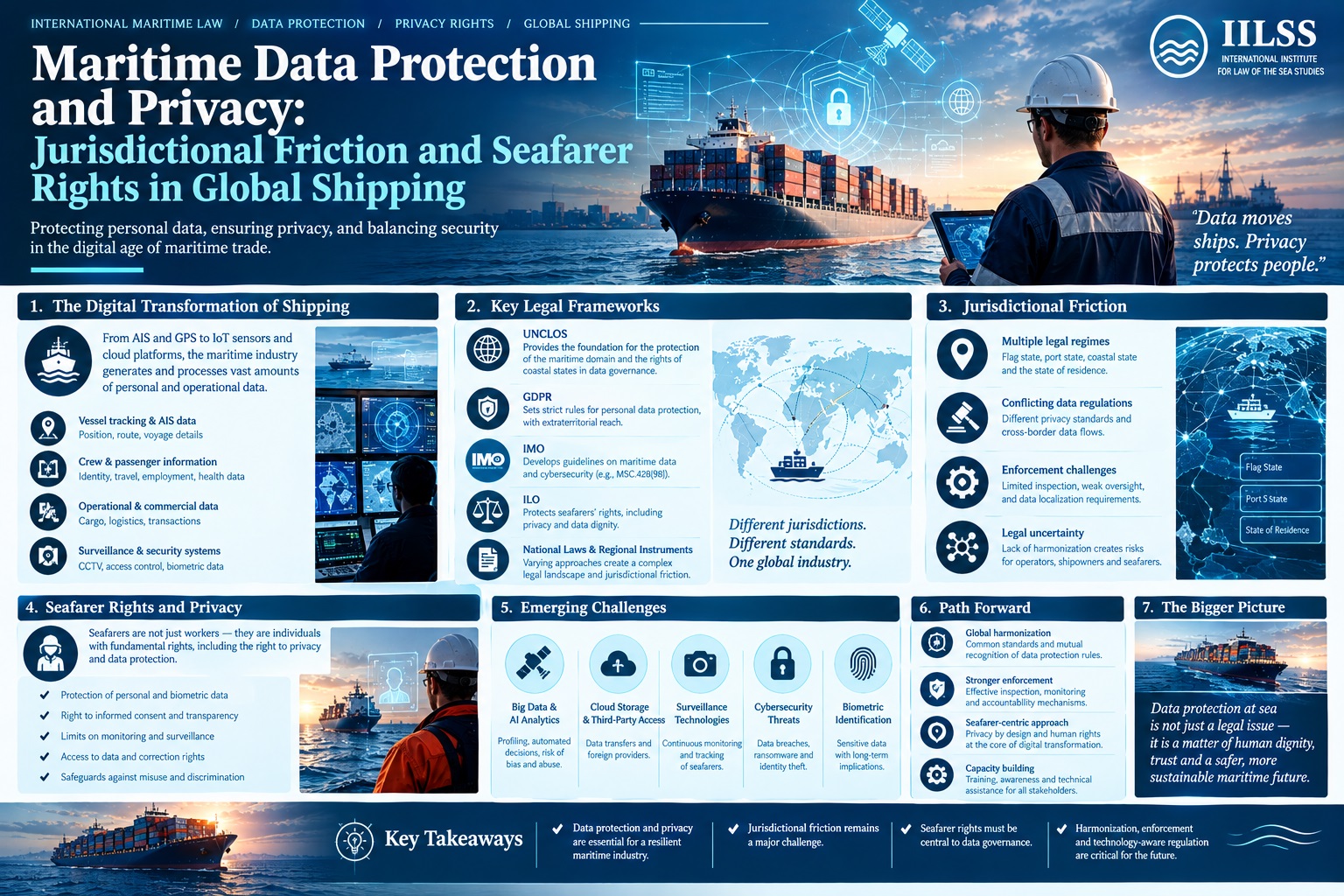
The contemporary ocean space is no longer merely a fluid medium for physical transit; it has evolved into a sensor-saturated digital environment. Modern commercial shipping generates continuous torrents of data, ranging from spatial telemetry and operational diagnostics to personal information gathered from crews and passengers. This digital transformation creates profound legal friction between traditional principles of maritime jurisdiction established under the United Nations Convention on the Law of the Sea (UNCLOS) and modern data privacy regimes designed primarily for terrestrial application. As merchant vessels broadcast real-time location metrics via Automatic Identification Systems, transmit operational telemetry to shore-based management centers, and process crew biometric data, fundamental questions concerning sovereign authority, operational confidentiality, and human rights at sea have become increasingly urgent.
At the center of this legal challenge lies the dual character of maritime data: it serves simultaneously as an indispensable instrument for navigational safety and environmental protection, and as a target for commercial exploitation, state surveillance, and cyber intrusion. The global shipping industry operates across complex jurisdictional boundaries where the sovereignty of coastal states, the authority of flag states, and the administrative oversight of port states frequently overlap. Reconciling these overlapping authorities with strict data protection frameworks requires a careful re-examination of international conventions, judicial decisions, and state practice.
Jurisdictional Foundations and the Spatial Matrix of Maritime Data
The law of the sea divides the ocean into distinct spatial zones, each carrying specific jurisdictional entitlements for flag states, coastal states, and port states. UNCLOS establishes a carefully balanced distribution of sovereign authority that operates along a spatial gradient extending from internal waters to the high seas. Within internal waters and the territorial sea, coastal states exercise sovereign authority subject to the right of innocent passage guaranteed under Article 17 of UNCLOS. However, Article 21 empowers coastal states to adopt laws and regulations regarding innocent passage specifically related to the safety of navigation, the regulation of maritime traffic, and the prevention of infringement of customs, fiscal, immigration, or sanitary laws. This entitlement creates jurisdictional friction when coastal states demand extensive digital reporting, crew biometric profiles, or passenger manifests prior to vessel entry or during transit through territorial waters.
On the high seas, Article 92 of UNCLOS establishes the fundamental doctrine of exclusive flag state jurisdiction. Vessels navigating international waters are subject to the legislative and administrative authority of their registry state, which must effectively exercise its jurisdiction and control over administrative, technical, and social matters under Article 94. The legal complication arises when extraterritorial data protection laws, such as Regulation EU 2016/679, known as the General Data Protection Regulation (GDPR), attempt to regulate data processing activities taking place aboard vessels flying foreign flags in international waters. When a foreign-flagged vessel navigates the Exclusive Economic Zone or high seas, the assertion of regional data protection standards creates a structural tension between flag state exclusivity and extraterritorial statutory enforcement.
How does maritime data protection apply to vessel tracking systems?
The implementation of mandatory vessel tracking systems represents a critical point of friction between maritime safety mandates and data protection regimes. Under Chapter V Regulation 19 of the International Convention for the Safety of Life at Sea (SOLAS), commercial ships of three hundred gross tonnage and upward on international voyages are required to operate Automatic Identification Systems (AIS) continuously. Furthermore, Regulation 19-1 mandates compliance with Long-Range Identification and Tracking (LRIT) systems. These technologies broadcast real-time spatial parameters, including vessel identity, location, course, speed, and navigation status, to enhance navigational safety, search and rescue operations, and marine environmental protection.
However, the open, unencrypted nature of AIS signals enables widespread data scraping by commercial aggregators, private intelligence firms, and non-state actors. This indiscriminate harvesting converts mandatory safety broadcasts into commercially exploited spatial intelligence, exposing operational logistics, trade routes, and vessel vulnerabilities. While SOLAS permits master discretion to deactivate AIS in situations where continuous broadcasting would endanger the safety or security of the vessel, such deactivation routinely triggers suspicion and administrative sanctions from port state control authorities, creating a legal dilemma between physical security and regulatory compliance.
International jurisprudence provides vital guidance regarding state surveillance and information gathering at sea. In the landmark Corfu Channel case (United Kingdom v. Albania, 1949), the International Court of Justice affirmed that coastal states possess a legitimate right to verify the non-prejudicial character of transit through international straits, but emphasized that state measures must not unnecessarily restrict navigational freedoms. Expanding this doctrine to digital surveillance, the Permanent Court of Arbitration in the South China Sea Arbitration (Philippines v. China, 2016) examined state law enforcement and monitoring activities, reinforcing that statutory authority must be exercised in conformity with international law and must not interfere with the lawful rights of other states.
When coastal states or private entities harvest vessel tracking data to conduct coercive surveillance, commercial profiling, or unwarranted interdiction, they test the limits of permissible monitoring under UNCLOS. Tracking data that includes personal details of vessel officers or specific operational parameters falls under data protection principles governing purpose limitation and security of processing. Unrestricted public dissemination of real-time tracking data without safeguards exposes maritime operators to security risks, demonstrating the necessity for regulated access frameworks that balance safety transparency with operational privacy.
What privacy rights do seafarers have under international maritime law?
Seafarers inhabit an environment where professional duties and personal life co-exist within the confined space of a vessel over extended periods. Modern vessels are increasingly equipped with pervasive monitoring infrastructure, including closed-circuit television cameras in work areas and living quarters, continuous internet activity logging, biometric access control, and fatigue-monitoring wearables. While vessel owners justify these technologies on grounds of operational safety, asset protection, and statutory compliance, invasive monitoring raises serious human rights concerns under international law.
The legal protection of seafarers' privacy is anchored in international human rights treaties, notably Article 17 of the International Covenant on Civil and Political Rights (ICCPR) and Article 8 of the European Convention on Human Rights (ECHR), alongside specialized labor instruments. In cases such as Medvedyev v. France (2010) and Rigopoulos v. Spain (1999), the European Court of Human Rights affirmed that human rights protections extend to individuals aboard vessels operating in international waters under the jurisdiction of state parties. The court clarified that state authority and shipboard management measures must adhere strictly to principles of legality, necessity, and proportionality.
Within maritime labor standards, the Maritime Labour Convention 2006 (MLC 2006) mandates decent living and working conditions, while the ILO/IMO Seafarers' Identity Documents Convention (Revised), 2003 (No. 185) governs the processing of biometric data for security verification. Under these frameworks, personal data collected from seafarers must be processed under strict conditions of purpose limitation and data minimization. Collecting biometric indicators or monitoring crew communications must not degrade into arbitrary surveillance. The International Tribunal for the Law of the Sea (ITLOS) emphasized in the M/V Saiga (No. 2) Case (Saint Vincent and the Grenadines v. Guinea, 1999) and the M/V Virginia G Case (Panama/Guinea-Bissau, 2014) that state enforcement actions and administrative regulations applied aboard foreign vessels must respect humanitarian considerations and human rights. Applied to digital data governance, onboard surveillance systems implemented without clear statutory authorization, transparency, or proportionate justification violate fundamental privacy guarantees protected under international law.
Does the GDPR apply to ships operating in international waters?
The territorial scope of regional data privacy regulations presents complex jurisdictional questions when applied to mobile maritime assets. Article 3 of the GDPR outlines a legal applicability framework based on the establishment criterion under Article 3(1) and the targeting criterion under Article 3(2). When a commercial vessel is owned, operated, or managed by a corporate entity established within the European Economic Area, personal data processing aboard that vessel falls under the legal scope of the GDPR, regardless of whether the ship is navigating internal waters, territorial seas, or the high seas.
This extraterritorial application creates severe compliance friction. For instance, when a flag state registry located in a third country requires a vessel to transmit crew manifests or passenger lists containing personal details, and the ship is managed by a European management firm, a cross-border data transfer occurs under Chapter V of the GDPR. Article 44 mandates that any transfer of personal data to a third country or international organization must satisfy strict adequacy decisions under Article 45 or appropriate safeguards, such as Standard Contractual Clauses under Article 46. Where the receiving flag state or port authority lacks an adequacy decision, maritime operators face conflicting legal obligations: compliance with flag state statutory mandates versus adherence to European data transfer restrictions.
Furthermore, satellite communication backhauls transmit vessel data across multiple geographic jurisdictions, cloud servers, and ground stations. This complex network architecture complicates the identification of data controllers and processors, making compliance with data subject rights, breach notification mandates under Article 33, and data protection impact assessments under Article 35 exceptionally difficult during international voyages.
How do flag states enforce data privacy obligations on the high seas?
Under Article 94 of UNCLOS, flag states are obligated to exercise effective administrative, technical, and social jurisdiction over vessels flying their flag. This duty encompasses ensuring that shipboard data processing practices comply with applicable international standards and national legislation. However, the prevalence of open registries, often referred to as flags of convenience, creates significant enforcement disparities. Many open registry states lack comprehensive domestic data protection laws or dedicated regulatory authorities capable of auditing shipboard digital systems.
To enforce data privacy obligations effectively on the high seas, flag states must integrate digital compliance requirements into their statutory survey and certification frameworks. Flag state administrations can mandate that vessel management systems, audited under the International Safety Management (ISM) Code, incorporate robust data protection policies and cybersecurity management procedures. By establishing technical standards for onboard data storage, satellite encryption, and crew data access protocols, flag states can satisfy their jurisdictional duties under UNCLOS Article 94 while ensuring that personal data processed aboard their vessels remains protected against unauthorized access and unlawful processing in international waters.
Who owns the telemetry data generated by modern commercial ships?
Modern commercial vessels are complex industrial platforms that continuously generate non-personal telemetry data, including engine performance metrics, fuel consumption figures, hull stress calculations, emission levels under MARPOL Annex VI, and Voyage Data Recorder (VDR) logs. The legal ownership and regulatory status of machine-generated vessel telemetry remain highly contested in maritime law, situated at the intersection of intellectual property, commercial contract law, and regulatory compliance.
Unlike personal data protected under human rights instruments, industrial telemetry data lacks a unified international treaty framework governing ownership rights. Original equipment manufacturers, vessel owners, charterers, and maritime software providers assert competing claims over operational telemetry. Equipment manufacturers often embed proprietary software licenses claiming ownership over raw diagnostic data transmitted to shore via satellite links. Conversely, shipowners contend that operational telemetry constitutes confidential commercial data generated by their physical assets, essential for voyage optimization and structural maintenance.
In casualty investigations governed by the IMO Casualty Investigation Code and SOLAS Chapter V Regulation 20, VDR data plays a crucial role in determining liability. Legal disputes frequently arise regarding third-party access to VDR audio recordings and navigational inputs. While investigative authorities possess statutory rights to collect evidence under international law, commercial parties litigate whether unredacted VDR logs containing bridge conversations can be compelled in arbitral proceedings without violating officer privacy or proprietary trade secrets. Standard contract clauses developed by industry bodies, such as the BIMCO Cyber Security Clause, attempt to allocate data rights between owners and charterers, but legal ambiguities persist in cross-border discovery proceedings before forums like the London Maritime Arbitrators Association.
Comparative Governance Frameworks in Maritime Data
To evaluate the legal obligations governing maritime data across jurisdictions, the following table compares international conventions, regulatory instruments, and privacy frameworks across key jurisdictional parameters.
| Regulatory Instrument | Jurisdictional Reach | Primary Focus | Data Subject Rights | Surveillance & Tracking Mandate | Dispute Resolution Forum |
|---|---|---|---|---|---|
| UNCLOS (1982) | Global ocean space (zoned) | Sovereign rights and ocean governance | Implicit via human rights standards | Flag state oversight (Art. 94) | ITLOS, ICJ, Annex VII PCA |
| SOLAS Chapter V | Global commercial fleet | Navigational safety and tracking | None specified | Mandatory AIS and LRIT broadcasting | IMO Maritime Safety Committee |
| MLC (2006) / ILO 185 | Flag state merchant ships | Seafarer labor and identity rights | Protection of biometric identity data | Restricted to identity verification | ILO Tripartite Committees |
| EU GDPR (2016/679) | Extraterritorial (Art. 3) | Personal data protection | Comprehensive (Access, Erasure, Portability) | Requires legal basis (Art. 6) | EU National Data Protection Authorities / CJEU |
| MARPOL Annex VI | Global commercial fleet | Environmental emissions telemetry | Not applicable (industrial data) | Mandatory fuel and emissions reporting | IMO Marine Environment Protection Committee |
Enforcement, Judicial Precedent, and Dispute Settlement
The resolution of data-related disputes in international maritime law relies on established international courts and tribunals, including the International Court of Justice, the International Tribunal for the Law of the Sea, and arbitral tribunals constituted under UNCLOS Annex VII. Although these judicial bodies historically focused on territorial delimitation, fisheries enforcement, and vessel detention, contemporary litigation increasingly implicates digital evidence gathering, cyber interference, and operational surveillance.
In the Arctic Sunrise Arbitration (Netherlands v. Russia, 2015), the Permanent Court of Arbitration examined the legal boundaries of state enforcement actions, ship boardings, and electronic evidence seizure within the Exclusive Economic Zone. The tribunal ruled that coastal state enforcement actions resulting in the non-consensual seizure of electronic hardware, communications logs, and personal recordings aboard foreign-flagged vessels must strictly comply with UNCLOS provisions limiting coastal state jurisdiction under Article 73. Seizures conducted outside statutory entitlements violate flag state rights and engage international state responsibility.
Similarly, in the Enrica Lexie Incident (Italy v. India, 2020), the arbitral tribunal under UNCLOS Annex VII addressed the interaction between flag state exclusive jurisdiction, coastal state law enforcement authority, and the collection of digital forensic evidence following an incident in international waters. The tribunal underscored that state authorities collecting forensic data from foreign vessels must observe international jurisdictional limits and avoid actions that infringe upon sovereign immunity or flag state jurisdiction. These precedents confirm that digital evidence collection during maritime law enforcement operations must respect the jurisdictional framework established by UNCLOS.
Future Horizons: Autonomous Shipping and Algorithmic Telemetry
The development of Maritime Autonomous Surface Ships (MASS) presents unprecedented challenges to maritime data protection and privacy regimes. Remote control centers, algorithmic navigation systems, and machine-learning models rely on high-bandwidth satellite data streams transmitting spatial lidar data, continuous video feeds, operator biometric metrics, and operational diagnostics. As autonomy increases, legal liability shifts from traditional mariners to software designers, data aggregators, and remote control operators.
In an autonomous shipping environment, the integrity and confidentiality of maritime telemetry become fundamental to navigational safety. Interception, spoofing, or unauthorized alteration of telemetry streams could lead to catastrophic collisions or environmental disasters. The International Maritime Organization's ongoing work to establish a non-mandatory and eventual mandatory MASS Code must integrate strict data security and privacy standards alongside technical engineering requirements. Future jurisprudence must reconcile mandatory spatial data sharing for collision avoidance under SOLAS with the protection of proprietary navigation algorithms and remote operator privacy.
Conclusion
The digital transformation of commercial shipping has fundamentally altered the legal architecture of ocean governance. The traditional law of the sea, constructed around physical boundaries and spatial zones under UNCLOS, must adapt to an environment where electronic data flows seamlessly across jurisdictional borders. Balancing the legitimate imperatives of maritime safety, environmental protection under MARPOL, and port state security with the privacy rights of seafarers and the operational data rights of vessel operators represents an essential requirement for contemporary international shipping.
As international courts, regulatory authorities, and flag state administrations address these complex issues, the harmonious interpretation of international maritime conventions and data protection standards will determine the stability and resilience of global maritime governance. Harmonizing these legal regimes ensures that technological advancement enhances navigational safety and trade efficiency without compromising fundamental human rights or the sovereign balance established by international law.
Comments
No comments yet.