The Jurisprudential Architecture of Maritime Search and Rescue
An academic examination of the legal duties, international conventions, and jurisdictional tensions governing search and rescue at sea.
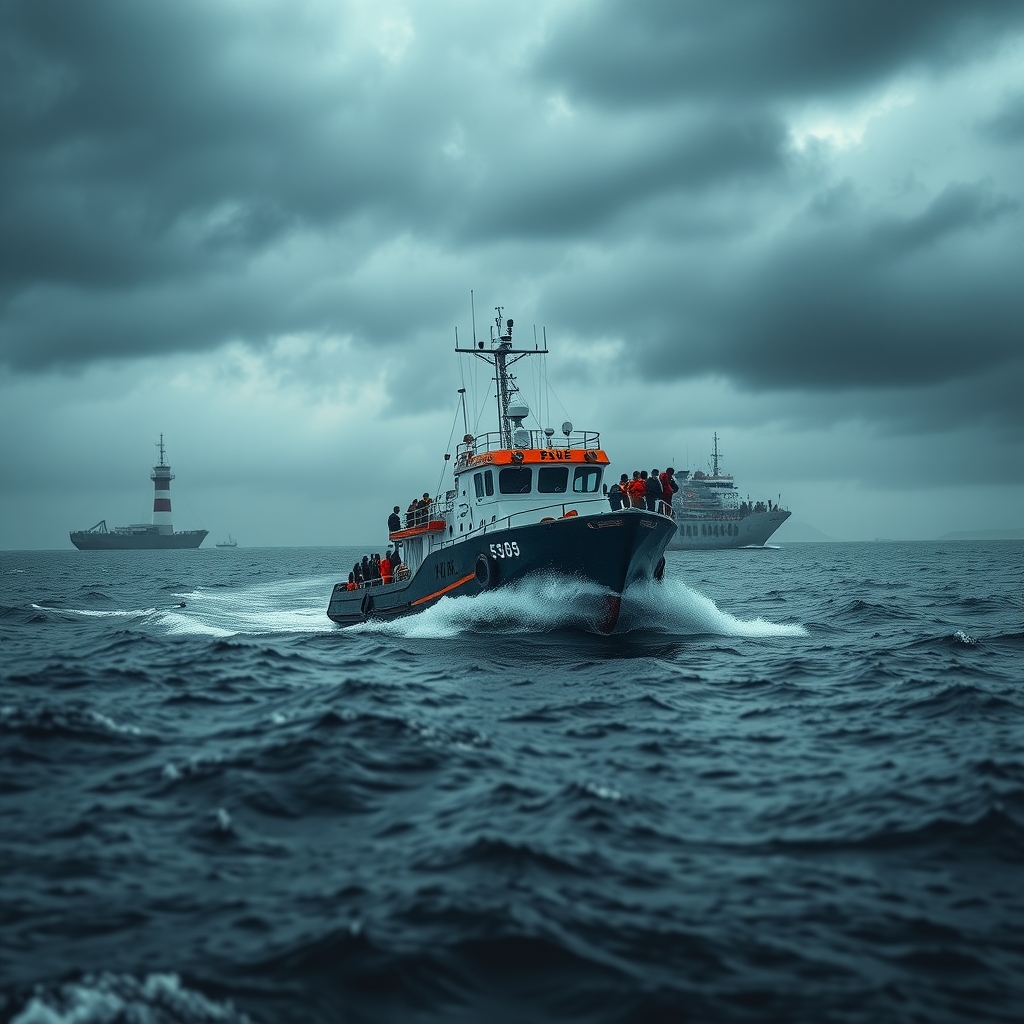
Introduction
The duty to render assistance to persons in distress at sea stands as one of the most venerable pillars of maritime custom. Evolving from unwritten maritime traditions practiced by early Mediterranean and Hanseatic seafarers, this obligation has crystallized into a comprehensive architecture of treaty law and customary international law. At its core, the imperative to rescue balances the absolute necessity of preserving human life against the complex legal frameworks of state sovereignty, flag state jurisdiction, and coastal state administrative authority.
In contemporary maritime governance, however, this humanitarian cornerstone faces unprecedented systemic strains. Large-scale irregular migration across the Mediterranean, the Andaman Sea, and other crucial maritime corridors has exposed profound ambiguities within the foundational conventions governing search and rescue. Legal doctrines that were historically designed to regulate traditional maritime commerce and standard vessel-to-vessel distress incidents now struggle to address situations involving unseaworthy, overloaded craft carrying hundreds of migrants. Consequently, tribunals, international organizations, and scholars are forced to re-examine the intersections of the United Nations Convention on the Law of the Sea, the International Convention for the Safety of Life at Sea, and the International Convention on Maritime Search and Rescue.
What international conventions establish the duty to render assistance at sea?
The primary legal framework governing rescue obligations is anchored in a triad of multilateral instruments negotiated under the auspices of the International Maritime Organization and the United Nations. Foremost among these is the United Nations Convention on the Law of the Sea, adopted in 1982. Article 98 of UNCLOS codifies the customary obligation of every State to require the master of a ship flying its flag to render assistance to any person found at sea in danger of being lost, and to proceed with all possible speed to the rescue of persons in distress if informed of their need of assistance. Furthermore, Article 98 obligates coastal States to promote the establishment and operation of an adequate and effective search and rescue service.
This structural mandate is reinforced by the International Convention for the Safety of Life at Sea, specifically Regulation 33 of Chapter V. SOLAS Regulation 33 explicitly binds contracting governments to ensure that masters of ships bound by the convention take steps to rescue persons in distress, irrespective of the nationality or status of such persons. Crucially, the obligation under SOLAS is independent of the motives or legal status of the individuals requiring rescue, establishing an absolute humanitarian baseline that applies to merchant vessels, passenger ships, and state-owned vessels alike.
The operational mechanisms supporting these overarching duties are detailed in the 1979 International Convention on Maritime Search and Rescue. The SAR Convention divides the global oceans into distinct Search and Rescue regions, assigning coordination responsibilities to specific contracting parties. Under these provisions, Rescue Coordination Centres are designated to receive distress alerts, coordinate operational responses, and ensure that survivors are handed over to a place of safety. The interplay among UNCLOS, SOLAS, and the SAR Convention creates a comprehensive yet intricate web of obligations that continuously tests the boundaries of state responsibility.
To fully appreciate how these treaties operate in tandem, consider the following structural comparison of their core operational provisions:
| Treaty Instrument | Primary Legal Focus | Key Operational Mandate |
|---|---|---|
| UNCLOS (1982) | Global ocean governance and jurisdictional rights | Codifies the flag state duty for vessel masters to rescue and coastal state duty to maintain SAR services. |
| SOLAS (1974/2004 amendments) | Vessel safety standards and operational protocols | Obligates masters to provide assistance and mandates contracting governments to coordinate disembarkation. |
| SAR Convention (1979) | International coordination and regional allocation | Establishes Search and Rescue regions and designates operational Rescue Coordination Centres. |
How do coastal states and flag states share rescue responsibilities?
The division of labor between flag states and coastal states represents a perennial source of jurisdictional friction in maritime jurisprudence. While the flag state exercises exclusive regulatory and administrative jurisdiction over its vessels on the high seas, the coastal state possesses territorial and sovereign rights over its internal waters, territorial sea, and contiguous zone, alongside functional jurisdiction within its exclusive economic zone.
Under the SAR Convention and SOLAS amendments adopted in 2004, the responsibility for coordinating rescue operations within a designated SAR region falls primarily upon the coastal state that accepted responsibility for that zone. However, a persistent legal ambiguity arises when distress events occur outside territorial waters or when a coastal state proves reluctant or unable to coordinate the disembarkation of rescued individuals. The duty of the coastal state to cooperate with neighbouring states and master mariners is explicitly stated in international law, yet enforcement mechanisms remain decentralized.
Flag states, meanwhile, bear the direct responsibility of ensuring that their merchant fleets comply with the mandatory rescue provisions enshrined in SOLAS. When a commercial vessel under a specific flag alters course to rescue stranded individuals, the shipowner and master frequently incur significant commercial losses, operational delays, and logistical burdens. International jurisprudence and subsequent IMO guidelines have emphasized that flag states and coastal states must share the burden of disembarkation, yet customary law lacks a strict mechanism for cost-allocation or mandatory burden-sharing among sovereign nations.
What constitutes a place of safety under maritime law?
A central point of contention in modern search and rescue jurisprudence is the legal definition and operational determination of a "place of safety." Neither UNCLOS nor the original text of SOLAS or the SAR Convention explicitly defined what constitutes a place of safety, leaving a critical vacuum that has been exploited during geopolitical standoffs involving migrant rescue operations.
In response to recurring crises where rescued persons languished aboard merchant vessels for weeks while coastal states disputed jurisdiction, the Maritime Safety Committee of the International Maritime Organization adopted formal guidelines in 2004. These amendments defined a place of safety as a location where rescue operations are considered to be terminated; where the safety of survivors or their lives is no longer threatened; where basic human needs—such as food, lodging, and medical treatment—can be met; and from which transportation arrangements can be made for the survivors' next destination or repatriation.
Despite these normative guidelines, judicial bodies and administrative authorities frequently grapple with competing interpretations. Landmark rulings and advisory opinions from regional human rights courts—most notably the European Court of Human Rights in cases such as *Hirsi Jamaa and Others v. Italy*—have clarified that returning rescued individuals to territories where they face systemic human rights abuses, torture, or arbitrary detention violates the principle of non-refoulement under international refugee and human rights law. Consequently, a geographic location cannot legally qualify as a place of safety if disembarkation exposes individuals to such systemic risks, effectively overriding a coastal state's domestic preference to summarily push back or reject survivors.
The structural elements that collectively define a lawful place of safety can be categorized across humanitarian, legal, and logistical dimensions:
- Termination of Distress: The immediate physical threat to life, limb, and vessel stability must be fully resolved.
- Satisfaction of Basic Needs: Access to potable water, adequate nourishment, sanitary facilities, and emergency medical care must be guaranteed upon arrival.
- Protection of Fundamental Rights: Survivors must be shielded from inhuman or degrading treatment and afforded access to individual asylum procedures where applicable, upholding the core tenets of non-refoulement.
- Logistical Feasibility: The location must possess the infrastructure necessary to process, shelter, and eventually repatriate or resettle the rescued persons without indefinite administrative limbo.
What liability risks do shipmasters face when conducting rescue operations at sea?
Commercial shipmasters operating under strict charterparty agreements and tight maritime schedules face profound legal and financial vulnerabilities when diverted for rescue operations. While international law unequivocally commands the rescue of persons in distress, domestic criminal laws and aggressive prosecutorial postures in various coastal jurisdictions have occasionally targeted shipmasters and crew members under human smuggling statutes.
This paradoxical legal risk occurs when authorities conflate humanitarian rescue operations with illicit trafficking or unlawful facilitation of irregular migration. Shipmasters who fulfill their statutory duties under SOLAS have, on occasion, found their vessels detained, their cargoes delayed, and their crews subjected to lengthy criminal investigations simply for bringing rescued migrants into port. Such practices create a dangerous chilling effect, where commercial mariners may hesitate to respond to distress signals out of fear of protracted legal liability and financial ruin.
To mitigate these risks, international bodies have consistently reaffirmed that the act of rescuing human life at sea is an absolute legal duty that supersedes commercial contracts and regulatory immigration controls. Nonetheless, the absence of robust indemnification frameworks means that shipowners often absorb the entirety of the financial costs associated with deviations, fuel consumption, damaged equipment, and provisioning. Jurisprudential analysis underscores the urgent need for harmonized domestic legislation that grants absolute legal immunity to shipmasters acting in good faith to preserve human life on the high seas.
Conclusion
The legal architecture governing search and rescue at sea remains an intricate balancing act between humanitarian imperatives, state sovereignty, and international cooperation. While multilateral treaties such as UNCLOS, SOLAS, and the SAR Convention provide a robust normative foundation, systemic challenges in operational coordination, burden-sharing, and the definition of a place of safety continue to expose legal vulnerabilities. As maritime migration and global shipping pressures evolve, the international community must address these jurisprudential ambiguities to ensure that the ancient and sacred duty to rescue remains uncompromised by political expediency or jurisdictional friction.
Comments
No comments yet.