Maritime Terrorism and Vessel Security.
An analysis of international legal architectures addressing maritime terrorism, contrasting UNCLOS piracy provisions with the SUA Convention and vessel security obligations.
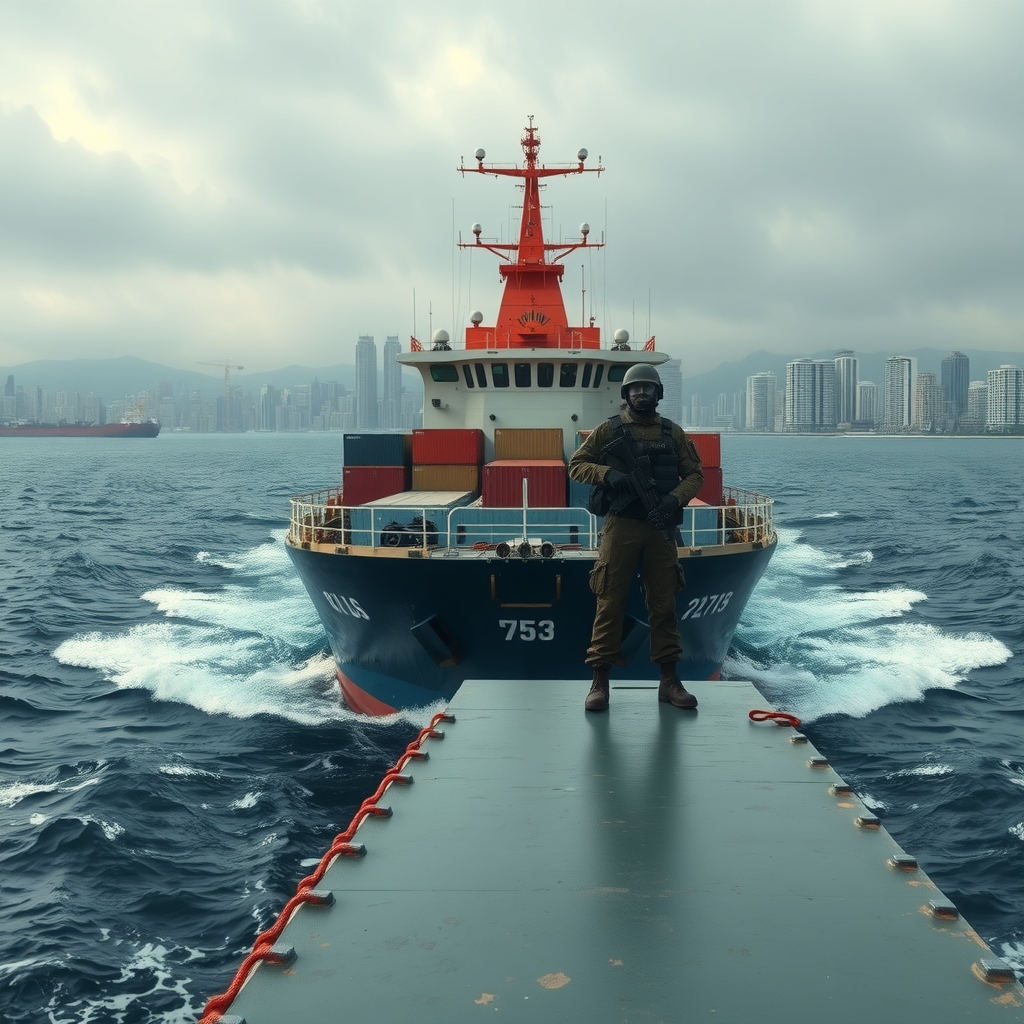
The maritime domain, historically characterized by the principle of mare liberum, has undergone a profound metamorphosis in the twenty-first century. Once primarily concerned with the navigation of merchant fleets and the suppression of opportunistic piracy, the international community now confronts a more insidious threat: maritime terrorism. This phenomenon, characterized by the use of vessels as weapons, the targeting of critical maritime infrastructure, or the seizure of ships to exert political leverage, operates within a legal gray zone that challenges the traditional boundaries of the United Nations Convention on the Law of the Sea (UNCLOS). Unlike piracy, which is governed by a well-established, albeit imperfect, regime of universal jurisdiction, maritime terrorism often lacks a singular, unifying legal definition, creating significant friction between the rights of flag states, coastal states, and the necessity of global security enforcement.
\n\nThe Jurisprudential Divide: How does maritime terrorism differ from piracy under international law?
\n\nTo understand the complexity of maritime security, one must first disentangle the legal identities of piracy and terrorism. Under Article 101 of UNCLOS, piracy is strictly defined as any illegal act of violence, detention, or depredation committed for private ends by the crew or passengers of a private ship on the high seas. This requirement of \\\"private ends\\\" is the fulcrum upon which the entire regime of universal jurisdiction turns. If an act is committed for political, religious, or ideological motivations, it fails the UNCLOS test for piracy, thereby stripping the international community of the automatic right to intervene under the guise of suppressing piracy.
\n\nThis distinction creates a significant enforcement vacuum. While a pirate vessel on the high seas can be seized by any state exercising jurisdiction, a terrorist organization operating a vessel with the intent to cause mass casualty or political upheaval may find itself outside the scope of UNCLOS's anti-piracy provisions. This is where the Convention for the Suppression of Unlawful Acts against the Safety of Maritime Navigation (SUA Convention) becomes critical. The SUA Convention was specifically designed to bridge this gap, criminalizing acts that target the safety of navigation, regardless of whether the motive is private or political.
\n\nThe following table delineates the fundamental legal distinctions between these two categories of maritime crime:
\n\n\n \n \n \n \n \n \n \n \n \n \n \n \n \n \n \n \n \n \n \n \n \\\"High Seas\" or outside state jurisdiction\n \\\"Anywhere\" (Territorial waters and High Seas)\n \n \n \n \n \n \n \n| Feature | Piracy (UNCLOS) | Maritime Terrorism (SUA) |
|---|---|---|
| Primary Motive | Private ends (economic gain) | Political, ideological, or religious ends |
| Jurisdictional Basis | Universal jurisdiction (High Seas) | Treaty-based (Flag, Coastal, or National State) |
| Spatial Limitation | ||
| Legal Framework | UNCLOS Article 101 | SUA Convention and its Protocols |
The ambiguity arises when the motives are hybridized. In contemporary maritime security, the distinction between a sophisticated criminal enterprise and a politically motivated cell is increasingly blurred. If a group seizes a vessel to ransom it for funds to fuel a political movement, does the act fall under the \\\"private ends\\\" of piracy or the \\\"political ends\\\" of terrorism? The lack of a unified international definition allows for judicial inconsistency and complicates the application of aut dedere aut judicare (extradite or prosecute) obligations.
\n\nThe SUA Convention and the Expansion of Criminalized Acts: How does the SUA convention work?
\n\nThe SUA Convention operates as a specialized instrument of international criminal law, designed to complement the broader, more general principles of UNCLOS. Its primary mechanism is the criminalization of specific acts that threaten maritime safety, thereby circumventing the \\\"private ends\\\" requirement of piracy. By focusing on the nature of the act rather than the intent of the actor, the SUA Convention provides a more robust basis for international cooperation.
\n\nThe 1988 Convention originally focused on the seizure of ships and the use of violence against persons on board. However, the 2005 Protocol significantly expanded this scope in response to the post-9/11 security environment. The Protocol addressed the possibility of vessels being used as weapons of mass destruction or tools of large-scale destruction. It criminalized acts such as:
\n\n- \n
- The use of a ship as a weapon to cause death or serious injury to persons. \n
- The placement of devices on a ship that are likely to destroy or damage the vessel. \n
- The seizure of a ship by force that threatens the safety of the vessel or its passengers. \n
- The communication of false information that endangers the safe navigation of a ship. \n
In practice, the SUA Convention works by establishing a framework of mandatory cooperation among signatory states. It requires states to establish jurisdiction over offenses committed on their flagged vessels, by their nationals, or within their territory. More importantly, it facilitates the extradition of suspects by ensuring that the offenses listed are recognized as serious crimes across all signatory jurisdictions. This prevents the emergence of \\\"safe havens\\\" for maritime terrorists who might otherwise exploit the gap between national criminal codes and international maritime law.
\n\nImplementing Security: How is vessel security managed under the ISPS code?
\n\nWhile the SUA Convention provides the legal teeth for prosecution, the International Ship and Port Facility Security (ISPS) Code provides the operational shield for prevention. The ISPS Code, an amendment to the International Convention for the Safety of Life at Sea (SOLAS), represents a paradigm shift from reactive law enforcement to proactive risk management. It moves the burden of security from the state alone to a collaborative model involving shipowners, port authorities, and flag states.
\n\nThe management of vessel security under the ISPS Code is structured around three distinct levels of security, which are triggered based on the current threat assessment:
\n\n- \n
- Security Level 1: The normal operating security level. Minimum protective measures shall be maintained at all times. \n
- Security Level 2: A heightened security level for a period of time, due to a heightened risk of a security incident. Additional protective measures shall be implemented. \n
- Security Level 3: The security threat is imminent or detected. Specific protective measures shall be maintained for a limited period of time as determined by the appropriate security authorities. \n
Under this regime, every vessel is required to carry a Ship Security Plan (SSP), which is tailored to the specific risks of the vessel and its routes. Furthermore, designated personnel—the Ship Security Officer (SSO) and the Company Security Officer (CSO)—are tasked with ensuring that these plans are not merely bureaucratic exercises but are actively integrated into the ship's daily operations. This decentralized approach to security acknowledges that the vastness of the oceans makes constant state surveillance impossible; instead, the vessel itself becomes the first line of defense.
\n\nHowever, the ISPS Code is not without its critics. Legal scholars have pointed out that the code effectively privatizes maritime security, placing significant legal and financial burdens on shipowners. The tension between the commercial necessity of efficient port turnarounds and the security requirement of rigorous inspections creates a persistent friction in global maritime trade. When a port increases its security level, it inevitably increases the cost and time of operations, leading to a debate over who should bear the economic consequences of heightened security mandates.
\n\nSovereignty and Enforcement: Who has jurisdiction over maritime terrorist attacks?
\n\nThe question of jurisdiction in the event of a maritime terrorist attack is one of the most contentious issues in international maritime law. The conflict typically arises between the rights of the flag state and the security imperatives of the coastal state.
\n\nUnder the principle of exclusive flag state jurisdiction, the state in which a vessel is registered has the primary authority to exercise legal control over that vessel on the high seas. This is intended to prevent the chaos of multiple states attempting to enforce their laws on the same vessel. However, when a terrorist attack occurs, a coastal state may feel its national security is directly threatened, particularly if the attack occurs within its Exclusive Economic Zone (EEZ) or involves the targeting of its critical infrastructure (such as offshore oil rigs or subsea cables).
\n\nThe legal justification for coastal state intervention often relies on the concept of \\\"protective jurisdiction\\\" or the \\\"effects doctrine\\\" in international law. This suggests that a state may exercise jurisdiction over acts committed outside its territory if those acts have a direct and substantial effect within its territory. For instance, if a hijacked vessel is used to launch an attack on a coastal city, the coastal state has a compelling legal interest in intervening, even if the vessel is flagged to a distant nation. Yet, such interventions run the risk of violating the sovereignty of the flag state and the freedom of navigation guaranteed by UNCLOS.
\n\n\n\n\n\\\"The tension between the sanctity of flag state jurisdiction and the necessity of coastal state security is the defining jurisdictional friction of the modern maritime era. International law must move toward a doctrine of \\\"coordinated enforcement\\\" rather than \\\"competing sovereignty.\\\"\"\n
The resolution of these conflicts often requires high-level diplomatic coordination or the invocation of multilateral treaties like the SUA Convention, which provides a more standardized legal basis for intervention than the general principles of UNCLOS. The challenge remains that in the heat of a security crisis, the legal ambiguity regarding who has the right to board, search, and arrest can lead to escalatory tensions between maritime powers.
\n\nThe Burden of Protection: What are the legal obligations of a flag state in maritime terrorism?
\n\nA critical and often overlooked dimension of maritime security is the question of flag state responsibility. Under international law, flag states have a duty of due diligence to ensure that vessels flying their flag comply with international regulations, including safety and security standards. This obligation is not merely a formality; it is a substantive duty to prevent the maritime domain from being used as a conduit for criminal or terrorist activity.
\n\nIf a flag state is found to be a \\\"flag of convenience\\\"—a state that provides registration with minimal oversight, low fees, and lax enforcement of international standards—it may be held liable for failing to exercise due diligence. In the context of maritime terrorism, if a terrorist group utilizes a vessel registered in a state that has failed to implement the ISPS Code or the SUA Convention, the question of state responsibility arises. Can a flag state be held internationally responsible for the actions of non-state actors on its vessels?
\n\nThe current legal consensus, leaning on the principles established by the International Court of Justice (ICJ) in cases regarding state responsibility, suggests that a state is not automatically liable for the acts of non-state actors. However, the state is liable if it fails to take reasonable measures to prevent such acts once it has knowledge of the threat, or if it provides the means for such acts through its regulatory negligence. The threshold for \\\"due diligence\\\" is constantly evolving. As maritime technology advances, the expected standard of care for flag states also rises. A state that fails to monitor the compliance of its fleet with modern security protocols may find itself in breach of its international obligations.
\n\nFurthermore, the legal obligation of the flag state extends to the provision of information. In the event of a maritime security incident, flag states are expected to cooperate fully with the investigating states, providing access to ship logs, crew manifests, and electronic data. The failure to do so not only hampers the immediate investigation but also undermines the collective security architecture of the international maritime community.
\n\nConclusion: Towards a Unified Maritime Security Regime
\n\nThe evolution of maritime terrorism from a fringe threat to a central concern of international security has exposed the limitations of the traditional maritime legal order. The gap between the economic-focused definitions of piracy in UNCLOS and the politically-motivated reality of modern terrorism creates a landscape of jurisdictional uncertainty that actors can exploit. While the SUA Convention and the ISPS Code have provided much-needed tools for criminalization and prevention, they remain fragmented components of a larger, more complex whole.
\n\nTo effectively secure the global commons, the international community must move beyond a purely reactive legal framework. This requires a greater degree of integration between different regimes of international law—unifying the principles of the Law of the Sea with the imperatives of international counter-terrorism law. There is also a pressing need to clarify the standards of due diligence for flag states to ensure that the regime of flags of convenience does not become a vulnerability in the global security network. Ultimately, the security of the seas depends not just on the strength of individual vessels or the vigilance of coastal patrols, but on the coherence and universality of the legal architecture that governs the deep blue.
\n\",\n\"seo_title\": \"Maritime Terrorism and Vessel Security: Legal Analysis\",\n\"seo_description\": \"An in-depth analysis of how international law distinguishes piracy from maritime terrorism and the role of the SUA Convention and ISPS Code.\",\n\"seo_keywords\": \"maritime terrorism, vessel security, SUA Convention, ISPS Code, maritime law, what is the difference between piracy and maritime terrorism?, how does the SUA convention work?, what are the legal obligations of a flag state in maritime terrorism?, how is vessel security managed under the ISPS code?, who has jurisdiction over maritime terrorist attacks?\",\n\"slug\": \"maritime-terrorism-vessel-security-law\",\n\"image_prompt\": \"A cinematic, low-angle view of a massive container ship cutting through dark, turbulent ocean waters under a heavy, overcast sky, emphasizing the vulnerability of large vessels.\"\n}"Comments
No comments yet.