Electronic Bills of Lading and the Legal Architecture of International Maritime Transactions
An analysis of electronic bills of lading, examining UNCITRAL MLETR, common law constructive possession, and international legal frameworks governing ocean trade.
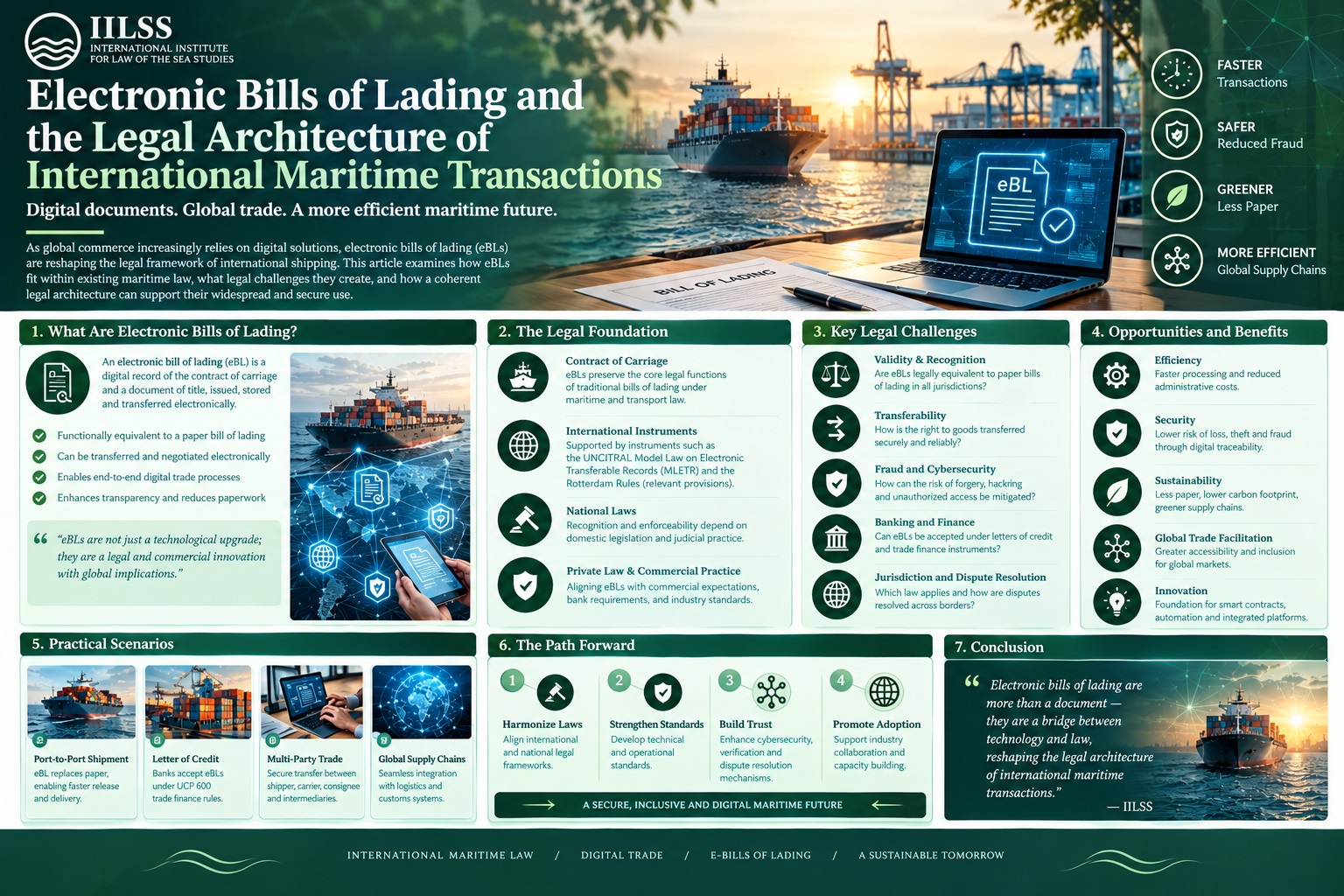
For centuries, international ocean carriage has relied upon physical paper documents to manifest rights, transfer title, and secure financing. The ocean bill of lading, codified through mercantile custom and solidified in decisions such as Lickbarrow v Mason (1794), performs three distinct legal functions: it serves as a receipt for goods received by the carrier, provides evidence of the contract of carriage, and operates as a document of title transferring constructive possession of the cargo. However, the operational reality of modern ocean trade—characterized by high-speed maritime transit, automated logistics networks, and complex commodity trade chains—has rendered the physical handling of paper documents increasingly anomalous. Vessels routinely arrive at ports of discharge well before physical bills of lading arrive via courier, compelling carriers to discharge cargo against letters of indemnity and exposing market participants to systemic fraud, misdelivery claims, and operational delays.
The transition toward dematerialized trade documentation has fundamentally challenged core common law and civil law doctrines concerning property, possession, and bailment. Because traditional jurisprudence grounds the document of title doctrine in physical tangibility, substituting an electronic record for a paper instrument requires overcoming profound statutory and common law obstacles. This paper evaluates the legal evolution of the electronic bill of lading, assessing the structural mechanics of digital transport records, statutory reforms under the UNCITRAL Model Law on Electronic Transferable Records, recent legislative enactments in key trade jurisdictions, and remaining jurisdictional, operational, and cyber vulnerabilities within global supply chains.
The Tripartite Doctrine and the Dematerialization Impediment
To evaluate the legal complexities of digital transition, one must examine the legal nature of the traditional paper bill of lading. Under common law, as articulated in Barclays Bank Ltd v Customs and Excise Commissioners [1963], the bill of lading is unique because its transfer operates as a transfer of constructive possession of the goods themselves. Holder status grants the possessor the legal right to demand delivery from the carrier upon arrival at the destination port. This function is legally distinct from a straight sea waybill or a simple cargo receipt, which merely identify the consignee entitled to take delivery without requiring presentation of an physical document to effectuate release.
The statutory frameworks governing bills of lading in major maritime jurisdictions—such as the United Kingdom Carriage of Goods by Sea Act 1992 (COGSA 1992) and the United States Carriage of Goods by Sea Act 1936 (COGSA 1936)—were drafted around paper mechanics. Section 1(2) of COGSA 1992 specifically defines a bill of lading by reference to a physical document, establishing mechanisms for the transfer of contractual rights upon lawful possession of that document. While Section 1(5) of COGSA 1992 granted the Secretary of State power to make regulations applying the Act to electronic trade systems, this regulatory power remained unexercised for over three decades, creating a enduring legal void that forced the commercial sector to rely on private, contractually closed platform architectures.
The fundamental common law impediment to dematerialization stems from the legal concept of possession. Under traditional doctrine, affirmed in OBG Ltd v Allan [2007] UKHL 21, intangible property cannot be possessed in physical space; it can only be owned or enforced through action. Because the law of conversion and the doctrine of attornment historically required physical bailment and possession of a tangible document, an electronic data string could not constitute a document of title at common law. Without statutory intervention or binding contractual attornment, the holder of a digital record could not establish constructive possession of ocean cargo, rendering the electronic record incapable of transferring legal title or contractual rights under ocean carriage contracts.
how does an electronic bill of lading work?
An electronic bill of lading operates by replicating the functional mechanics of paper documentation through secure digital environments, asymmetric cryptography, and centralized or decentralized database ledgers. Rather than relying on physical ink signatures and paper endorsements, an electronic bill of lading uses cryptographic key pairs, digital signatures, and tokenized control to manage contractual transfers between parties across the maritime supply chain.
In practice, the operational lifecycle of an electronic bill of lading proceeds through several defined stages:
- Issuance: Upon receipt of cargo on board or at the terminal, the carrier or its authorized port agent generates a digital transport record within an approved electronic trade platform. The carrier signs the record using its private cryptographic key, creating a verifiable digital record containing shipment parameters, vessel particulars, routing data, and contractual terms.
- Cryptographic Control and Attornment: The electronic bill of lading is transferred to the shipper by registering the shipper as the exclusive controller of the record within the system. Under contractual closed-loop systems, all platform participants execute a master multilateral agreement agreeing to treat the assignment of control in the platform register as a legal attornment by the carrier to the named holder.
- Transfer and Endorsement: To endorse or transfer the electronic bill of lading to a subsequent holder, endorsee, or financing bank, the current controller initiates a cryptographic transfer transaction. The platform records the relinquishment of control by the transferor and the re-assignment of exclusive control to the transferee, maintaining a continuous, immutable audit trail.
- Presentation and Discharge: Upon arrival at the port of discharge, the final lawful holder presents the electronic bill of lading to the carrier by transmitting a cryptographic presentation signal through the system. Upon verification of the holder's control, the carrier surrenders physical custody of the cargo and the electronic record is permanently accomplished or retired to prevent double-spending or re-circulation.
Modern electronic implementations fall into two distinct structural models: centralized, platform-based closed systems and decentralized, distributed ledger technology (DLT) architectures. Centralized platforms—such as those operated by ICE Digital Trade, Bolero, and WAVE BL—function via central registry databases governed by contractually binding rulebooks. Conversely, decentralized systems utilize blockchain architecture and smart contracts to verify transactions and confirm control without reliance on a single central registry host. In both architectures, the primary objective is to maintain an unbroken chain of custody and guarantee that only one entity holds exclusive control over the actionable electronic record at any given point in time.
is an electronic bill of lading legally binding?
An electronic bill of lading is legally binding when it satisfies statutory requirements of functional equivalence or operates within a valid, contractually binding platform agreement among participating commercial parties. Historically, in the absence of explicit statutory recognition, electronic bills of lading derived their binding force exclusively from private contract law. Platforms created rulebooks that bound all users—carriers, shippers, banks, and consignees—to treat electronic records as functionally equivalent to paper bills of lading and to refrain from challenging their legal validity based on their digital medium.
However, contractual enforcement faced clear limitations under third-party property law. A private rulebook cannot bind external third parties, such as non-member charterers, customs authorities, or judgment creditors seeking pre-judgment attachments against cargo. Furthermore, under international conventions governing carrier liability, legal ambiguities persisted regarding whether electronic transport records fell within mandatory international regimes.
The application of international carriage conventions depends heavily on statutory wording:
- The Hague and Hague-Visby Rules: Article I(b) of the Hague-Visby Rules defines a contract of carriage as applying solely to contracts covered by a bill of lading or any similar document of title. Because the treaty was drafted in 1924 and amended in 1968, courts in non-MLETR jurisdictions have grappled with whether an electronic record can qualify as a bill of lading or similar document of title under the text. Where national legislation enforces Hague-Visby rules strictly by reference to paper instruments, parties using electronic records faced risks that compulsory limits of carrier liability and statutory package limits might not automatically apply.
- The Hamburg Rules (1978): Article 14(3) explicitly accommodated digital signatures, providing that signatures on bills of lading may be made in handwriting, printed, facsimile, perforated, stamped, or by any other mechanical or electronic means, provided this was not inconsistent with the law of the issuing state.
- The Rotterdam Rules (2008): Articles 8 to 10 of the United Nations Convention on Contracts for the International Carriage of Goods Wholly or Partly by Sea (Rotterdam Rules) provided an explicit legal architecture for electronic transport records, establishing functional equivalence and defining rules for control. However, due to lack of ratification by key maritime nations, the Rotterdam Rules have not entered into force internationally.
The landmark English High Court decision in Glencore International AG v MSC Mediterranean Shipping Co SA [2017] EWCA Civ 365 demonstrated the strict approach courts take regarding non-paper release mechanisms. The court held that the release of cargo via an electronic PIN code system did not constitute presentation of a document of title, rendering the carrier liable for misdelivery when unauthorized parties obtained the codes. The ruling highlighted that digital release codes or non-negotiable electronic messaging systems fail to operate as legally binding documents of title at common law unless supported by statutory recognition or complete contractual attornment.
Today, in jurisdictions that have enacted statutory reforms—such as Singapore under its Electronic Transactions (Amendment) Act 2021 and the United Kingdom under the Electronic Trade Documents Act 2023—an electronic bill of lading is statutory recognized as legally binding with full functional equivalence to a physical paper bill of lading, provided it meets statutory criteria regarding control, integrity, and operational reliability.
what is the difference between a paper bill of lading and an electronic bill of lading?
While paper bills of lading and electronic bills of lading perform identical economic and functional roles within ocean trade transactions, they differ fundamentally across legal mechanics, risk allocation profiles, operational workflows, and security architectures.
The core distinction lies in how the law achieves certainty regarding ownership and possession. Paper bills of lading rely on physical tangibility, physical ink signatures, and physical endorsement chains. The physical paper serves as the sole token of title; physical possession of the original document gives rise to constructive possession of the cargo under legal principles established over centuries of commercial adjudication. Conversely, an electronic bill of lading relies on functional equivalence, data integrity, and exclusive digital control secured through cryptographic protocols or centralized ledger management.
| Operational and Legal Dimension | Paper Bill of Lading | Electronic Bill of Lading (eBL) |
|---|---|---|
| Tangibility & Possession | Physical paper document; legal possessory rights tied to physical custody of paper under common law. | Dematerialized data record; legal rights tied to exclusive digital control under MLETR/ETDA frameworks. |
| Transfer Mechanics | Physical endorsement (blank or special) and manual physical delivery of paper. | Cryptographic key transfer, token reassignment, or database registry update within platform. |
| Speed of Transmission | Slow; reliant on international courier services, causing frequent delays at discharge ports. | Instantaneous; real-time global transfer across international trade participants. |
| Misdelivery Avoidance | High risk of port discharge delays; frequent reliance on Letters of Indemnity (LOIs) due to missing paper. | Eliminates need for LOIs; real-time verification allows immediate presentation upon vessel arrival. |
| Fraud and Security Risks | Vulnerable to physical forgery, alteration, duplicate paper issuance, and physical theft. | Vulnerable to cyber incursions, private key theft, system outages, and software security exploits. |
| Third-Party Bindingness | Universal erga omnes effect under established maritime commercial law. | Historically restricted to closed platform rulebooks; expanding to universal effect via statutory reform. |
A profound practical distinction emerges in how the two instruments manage the problem of vessel arrival prior to document presentation. When paper bills of lading are delayed in courier transit, carriers face immense commercial pressure to release cargo against Letters of Indemnity (LOIs). Releasing cargo without production of an original paper bill of lading constitutes a breach of the carriage contract and voids standard protection and indemnity (P&I) insurance coverage for misdelivery claims, as affirmed in Sze Hai Tong Bank Ltd v Rambler Cycle Co Ltd [1959] AC 576. Electronic bills of lading mitigate this exposure by allowing real-time transmission of documents across continents in seconds, ensuring that lawful presentation occurs prior to discharge and avoiding reliance on unbacked indemnities.
how does the uncitral mletr facilitate digital trade?
The UNCITRAL Model Law on Electronic Transferable Records (MLETR), adopted by the United Nations Commission on International Trade Law in 2017, serves as the modern international legislative benchmark for enabling the dematerialization of trade documents. The primary objective of the MLETR is to provide a uniform statutory blueprint for national legislatures to grant full legal functional equivalence to electronic transferable records—including bills of lading, promissory notes, bills of exchange, and warehouse receipts.
The MLETR achieves this functional equivalence through several core legal principles:
1. The Legal Equivalence of Control and Possession
The legal core of the MLETR is established in Article 11, which creates functional equivalence between digital control and physical possession. Article 11 provides that where the law requires the possession of a transferable document, that requirement is satisfied with respect to an electronic transferable record if a reliable method is used to establish exclusive control of that record by a person, and to identify that person as the person in control. By establishing control as the functional surrogate for physical possession, the MLETR overcomes the common law doctrine that intangible records cannot be possessed.
2. The Legal Equivalence of Written and Signed Instruments
Articles 8 and 9 of the MLETR address requirements for writing and signatures. Where domestic law requires information to be in writing, an electronic record meets this standard if the information contained therein is accessible so as to be usable for subsequent reference. Similarly, where domestic law requires a signature, that requirement is met by an electronic record if a reliable method is used to identify the signatory and confirm its intent in relation to the information contained in the record.
3. Requirement of Integrity and Singularity
To prevent double-spending and unauthorized duplication—a central risk when dealing with digital files—Article 10 of the MLETR mandates that an electronic transferable record must retain structural integrity. Integrity is assessed by determining whether the information contained in the record has remained complete and unaltered, apart from additions or changes arising in the normal course of communication, storage, and display. The system must guarantee that a single authoritative record exists that cannot be duplicated into competing valid instruments.
4. Medium Conversion Mechanics
Recognizing that international trade operates across heterogeneous legal jurisdictions with varying degrees of technological adoption, Articles 17 and 18 of the MLETR regulate the conversion of an electronic transferable record into a paper document, and vice versa. Conversion requires that all data, terms, and transfer history be accurately transferred to the new medium, while the pre-existing record is permanently retired to ensure two actionable instruments never exist simultaneously for the same cargo shipment.
The adoption of MLETR principles into national statutory frameworks has expanded rapidly. Jurisdictions including Singapore, the Abu Dhabi Global Market (ADGM), Belize, Kiribati, Papua New Guinea, and the United Kingdom have enacted legislation directly modeled on or harmonized with the MLETR, establishing a cross-border statutory corridor for digital maritime trade.
Statutory Standardization: Comparative Legal Frameworks Across Flag States and Trade Hubs
The legal enforceability of electronic bills of lading remains subject to jurisdictional divergence, creating a bifurcated global trading environment where MLETR-aligned jurisdictions operate alongside states still reliant on traditional paper jurisprudence.
The United Kingdom: Electronic Trade Documents Act 2023
The enactment of the Electronic Trade Documents Act 2023 (ETDA 2023) in the United Kingdom represents a profound statutory modernization within common law jurisprudence. The ETDA 2023 directly addresses the common law prohibition against possessing intangible assets established in OBG v Allan. Under Section 2 of the ETDA 2023, an electronic trade document—including an electronic bill of lading—has the same legal effect as a paper trade document if the underlying electronic system satisfies specific statutory reliability criteria:
- The system must identify the document so that it can be distinguished from copies;
- The system must prevent unauthorized alteration of the document;
- The system must secure exclusive control over the document, ensuring only one party can exercise control at any point in time;
- The system must allow a person in control to demonstrate that exclusive control; and
- The system must enforce transfer mechanics so that transferring control divests the transferor of control simultaneously.
Section 3 of the ETDA 2023 expressly provides that a person has control of an electronic trade document if they exercise exclusive command over the record, and that such control is functionally equivalent to possession of a physical document. Consequently, English law now recognizes that holding an compliant electronic bill of lading confers constructive possession of cargo, transfers contractual rights under COGSA 1992, and supports possessory actions in conversion and bailment.
Singapore: Electronic Transactions (Amendment) Act 2021
Singapore adopted the MLETR framework by amending its Electronic Transactions Act (ETA) in 2021. The amended ETA inserted a new Part 2A, granting explicit legal status to electronic transferable records, including electronic bills of lading. The statutory provisions mirror the MLETR requirements of control, integrity, and singularity. Furthermore, Singapore's Maritime and Port Authority (MPA) has actively integrated ETA-compliant electronic bill of lading platforms into port operations, providing regulatory backing and legal certainty for maritime participants operating within Asia-Pacific trade lanes.
The United States: Uniform Commercial Code Article 7 and Pomerene Act
In the United States, electronic documents of title have been statutorily recognized for two decades under the 2003 revisions to Article 7 of the Uniform Commercial Code (UCC), specifically UCC § 7-106. UCC § 7-106 establishes the rule of control over electronic documents of title, providing that a person has control of an electronic document of title if a system created for establishing control reliably establishes that person as the person to which the document was issued or transferred. However, while domestic commercial transactions under state law fall under UCC Article 7, interstate and international ocean bills of lading are governed federally by the Federal Bill of Lading Act 1916 (Pomerene Act) and US COGSA 1936. The federal legal framework has lacked the explicit MLETR-style statutory updates seen in the UK or Singapore, necessitating careful choice-of-law drafting in international carriage contracts to ensure English or Singaporean governing law applies to the electronic record.
Cryptographic Possession, Attornment, and Exclusive Control
To understand how electronic bills of lading function in high-value maritime disputes, one must examine the legal mechanics of cryptographic possession and attornment. Attornment is the acknowledgement by a bailee (the ocean carrier) that it holds goods on behalf of a designated bailor or third-party transferee. In paper carriage transactions, attornment is embedded in the bill of lading itself: by issuing a negotiable bill of lading, the carrier undertakes to hold the goods at sea for, and deliver them to, whoever lawfully presents the physical paper document.
In dematerialized trade, attornment must occur through cryptographic verification or platform rulebook mechanics. Under public key infrastructure (PKI) cryptosystems, control over an electronic bill of lading is established through possession of a private key corresponding to a public key registered on the ledger. When a transaction occurs, the transferor uses its private key to cryptographically sign a transfer instruction, re-assigning control to the transferee's public key address.
From a evidentiary perspective, courts evaluating whether a digital system achieves statutory control under the MLETR or ETDA 2023 scrutinize the system's operational architecture against specific standards:
- Singularity and Non-Replicability: The architecture must prevent double-spending. If a digital token representing the bill of lading could be duplicated, split, or held simultaneously by two parties, the requirement of exclusive control fails, destroying the record's status as a document of title.
- Authenticity and Non-Repudiation: Cryptographic signatures must establish the identity of the signer and demonstrate that the instruction was authorized, preventing signatories from later disavowing valid transfer commands.
- System Security Assessment: Pursuant to Section 2(3) of the UK ETDA 2023, in determining the reliability of an electronic system, courts consider factors such as security protocols, auditability, hardware reliability, independent security audits, and compliance with recognized international standards (such as ISO/IEC 27001).
Where an electronic bill of lading platform fails to meet statutory standards of reliability, or operates in a jurisdiction that has not adopted MLETR principles, the legal character of the transaction degrades into a non-negotiable electronic record. In such instances, the electronic bill operates merely as a simple receipt and evidence of carriage contract, leaving the holder without constructive possession and unable to assert legal rights in rem against the vessel or protect against competing creditor claims.
Interoperability, Systemic Cyber Risks, and P&I Club Coverage Regimes
Despite significant statutory progress, the widespread adoption of electronic bills of lading faces systemic operational, technological, and insurance challenges.
The Interoperability Deficit
Currently, the market for electronic bills of lading is fragmented across several competing technological vendors. Traditionally, an electronic bill of lading issued on platform A could not be transferred to a recipient operating exclusively on platform B, because each platform relied on its own proprietary rulebook, database architecture, and security protocols. This lack of interoperability required trade participants to onboard onto multiple closed-loop platforms, introducing administrative friction and reducing operational efficiency.
To resolve this fragmentation, industry organizations such as the Digital Container Shipping Association (DCSA) and the International Chamber of Commerce (ICC) Digital Standards Initiative have developed unified data standards and API frameworks for electronic bills of lading. The goal is to establish cross-platform interoperability, enabling an eBL generated on a decentralized blockchain system to seamlessly transfer to a bank operating on a centralized ledger platform without compromising cryptographic integrity or control chains.
P&I Club Approval Regimes
In maritime law, carrier risk allocation is fundamentally shaped by Protection and Indemnity (P&I) Clubs, which insure approximately ninety percent of global ocean shipping tonnage. Historically, standard P&I Club rules excluded liabilities arising from cargo delivery without production of a physical original paper bill of lading, or liabilities arising from the use of electronic trading systems unless specifically approved by the International Group of P&I Clubs (IG P&I).
The IG P&I maintains a strict approval process for electronic bill of lading systems. Approval requires thorough legal and technological scrutiny of the system's rulebook, technical architecture, and risk profile to ensure that liabilities incurred by carriers using the digital platform are equivalent to those incurred under paper bills of lading under standard Hague-Visby conditions. While IG P&I approval provides carrier members with P&I cover for liabilities arising out of the performance of approved electronic systems, it does not cover losses resulting from platform insolvency, cyber-attacks, or hardware failures, which must be separately insured via specialized cyber risk coverage.
Cyber Vulnerabilities and Fraud Liability Allocation
While electronic bills of lading eliminate physical paper forgery, they expose maritime supply chains to digital vulnerabilities:
- Private Key Compromise: If a trader's private cryptographic key is compromised via phishing, malware, or insider theft, unauthorized actors can execute cryptographic transfers, directing cargo to unapproved parties.
- Distributed Denial of Service (DDoS) and System Outages: A major cyber incident disabling a centralized platform registry during vessel discharge could halt port operations, triggering substantial demurrage and detention liabilities.
- Smart Contract and Code Exploits: Decentralized eBL systems relying on automated smart contracts remain vulnerable to software vulnerabilities, where logical flaws in the underlying code can be exploited to re-route cargo rights.
Determining legal liability for loss resulting from cyber incursions requires evaluating the allocation of risk under carriage contracts, platform rulebooks, and statutory frameworks. Under standard Hague-Visby Art. IV(2)(q) defenses, carriers are not liable for loss or damage resulting from any cause arising without the actual fault or privity of the carrier or its agents. However, if a carrier fails to maintain adequate IT security or operates a compromised eBL system, cargo owners may argue that the carrier failed to exercise due diligence to make the vessel seaworthy and fit for cargo handling under Article III Rule 1 and Rule 2 of the Hague-Visby Rules.
Harmonization Horizons and Future Maritime Jurisprudence
The dematerialization of ocean bills of lading represents a structural transition in international commercial law. The historic reliance on physical paper documents—developed during the era of sailing ships—is giving way to a global statutory architecture anchored in functional equivalence, cryptographic security, and statutory control mechanics.
The widespread adoption of the UNCITRAL MLETR, alongside landmark enactments such as the United Kingdom Electronic Trade Documents Act 2023 and Singapore's ETA amendments, has resolved the fundamental common law paradox regarding the possession of intangible data records. By establishing that exclusive digital control is legal functional equivalent to physical possession, these statutory frameworks ensure that electronic bills of lading can perform all three classical functions of the paper bill: serving as cargo receipt, evidence of carriage contract, and negotiable document of title.
However, achieving complete global dematerialization requires addressing persistent international friction points. Courts will increasingly be called upon to resolve cross-border disputes where an electronic bill of lading created in an MLETR jurisdiction is enforced in a port state that has not yet modernized its domestic property laws. Furthermore, legal standards surrounding platform security, private key custodianship, interoperability protocols, and cyber liability allocation must be refined through judicial precedent and standardized arbitral jurisprudence within forums such as the ICC and London Maritime Arbitrators Association (LMAA).
As international trade hubs continue to enact MLETR-aligned legislation and industry standards achieve cross-platform interoperability, the electronic bill of lading will transition from an alternative option to the legal standard for ocean transportation. Maritime legal practitioners, carriers, traders, and financial institutions must navigate this legal evolution, aligning their operational frameworks with new statutory duties, technical requirements, and risk allocation regimes governing digital trade.
Comments
No comments yet.