The Regulatory Calculus of Maritime Safety: Compliance Frameworks and Enforcement Mechanisms
A rigorous analysis of the international legal frameworks, conventions, and enforcement mechanisms that govern vessel safety and maritime compliance.
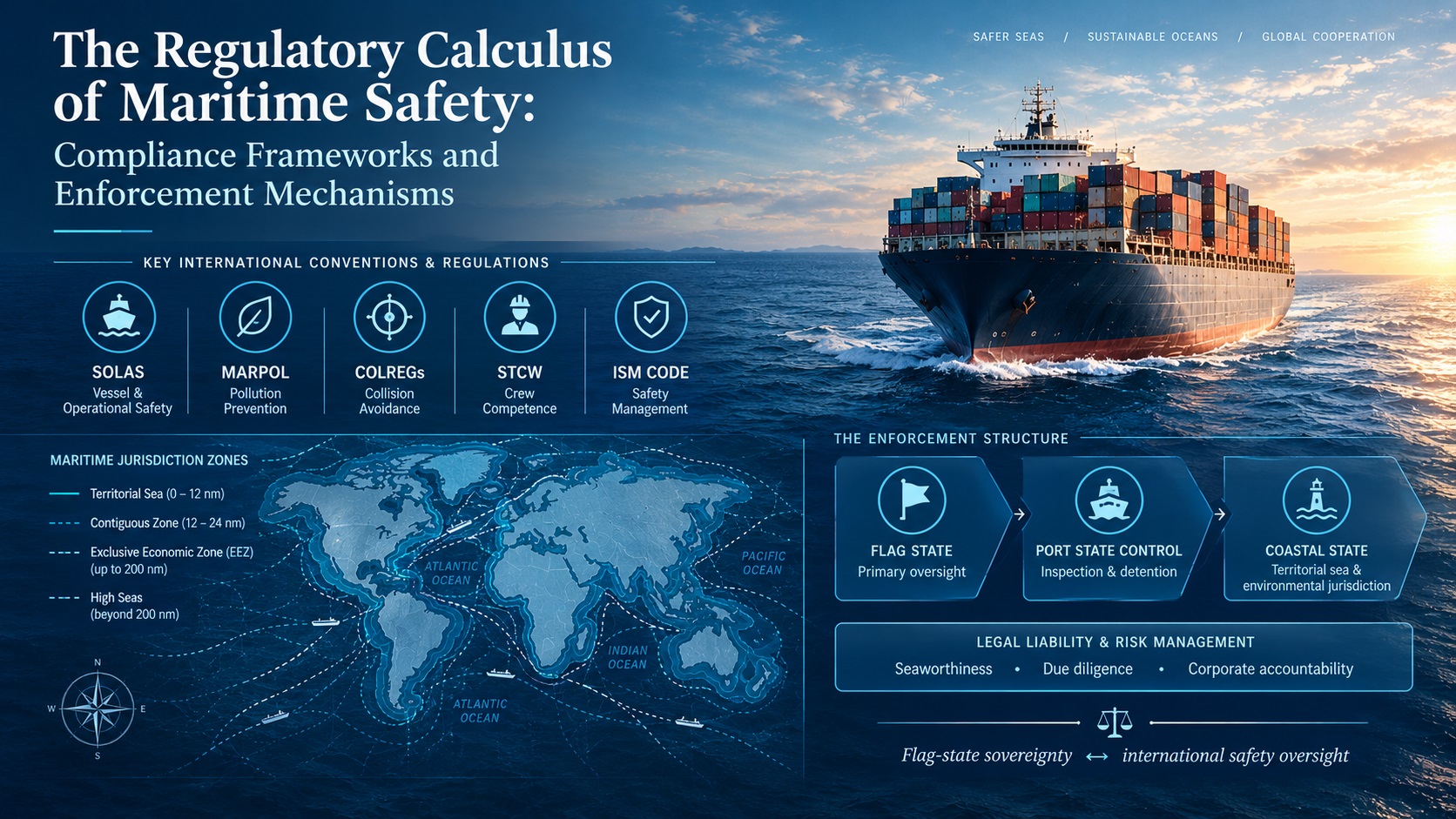
The global maritime industry operates within a complex, multi-layered legal architecture designed to mitigate the inherent risks of transoceanic commerce. At the intersection of sovereign rights, commercial necessity, and the preservation of life and environment lies a sophisticated regime of vessel safety regulations. These regulations do not exist in a vacuum; they are the product of decades of reactive and proactive treaty-making, driven by catastrophic failures and the subsequent evolution of international norms. To understand the contemporary landscape of maritime safety, one must move beyond a mere reading of technical checklists and instead engage with the jurisprudential tensions between flag state sovereignty and the global imperative for standardized safety enforcement.
The governance of the seas is characterized by a fundamental dichotomy: the autonomy of the flag state versus the necessity of international oversight. While the United Nations Convention on the Law of the Sea (UNCLOS) establishes the primacy of the flag state in exercising jurisdiction over its vessels, the practical realities of "flags of convenience" and the potential for regulatory arbitrage have necessitated the rise of robust port state control and international convention-driven standards. This article examines the mechanisms that define this balance, the conventions that underpin safety, and the shifting landscape of liability in an era of increasing technological complexity.
The Foundational Pillars: What are the main international maritime safety conventions?
The bedrock of maritime safety is composed of several key conventions developed under the auspices of the International Maritime Organization (IMO). These instruments collectively form a comprehensive framework intended to address the structural, environmental, and human dimensions of maritime risk.
The International Convention for the Safety of Life at Sea (SOLAS) remains the most critical instrument in the maritime safety hierarchy. Born from the wreckage of the Titanic, SOLAS has evolved from a focus on life-saving appliances to a holistic mandate covering construction, stability, machinery, electrical installations, radio communications, and the management of safe operations. The modern iteration of SOLAS is deeply integrated with the International Safety Management (ISM) Code, which mandates that companies establish a Safety Management System (SMS) to ensure that safety is not merely a technical requirement but a functional component of corporate culture.
The International Convention for the Prevention of Pollution from Ships (MARPOL) serves as the primary regulatory mechanism for environmental safety. By addressing various forms of pollution—ranging from oil and noxious liquid substances to sewage, garbage, and air emissions—MARPOL recognizes that vessel safety is inextricably linked to environmental stewardship. A breach in MARPOL compliance is often viewed through the same lens as a structural safety failure, as the technical integrity of a vessel's containment systems is paramount to preventing ecological catastrophe.
Furthermore, the International Regulations for Preventing Collisions at Sea (COLREGs) provide the "rules of the road," ensuring predictability in vessel movements. These regulations are essential for the prevention of maritime accidents, establishing clear protocols for navigation, lighting, and signaling. When coupled with the International Convention on Standards of Training, Certification and Watchkeeping for Seafarers (STCW), which governs the human element, a tripartite structure emerges: the ship (SOLAS), the environment (MARPOL), and the human navigator (COLREGs and STCW).
| Convention | Primary Focus Area | Key Regulatory Objective |
|---|---|---|
| SOLAS | Structural & Operational Safety | Minimizing loss of life through technical and management standards. |
| MARPOL | Environmental Protection | Preventing pollution from accidental or operational discharges. |
| COLREGs | Navigational Safety | Preventing collisions through standardized maneuvering rules. |
| STCW | Human Competency | Ensuring crew proficiency and standardized training levels. |
| MLC | Seafarer Welfare | Protecting labor rights to ensure a rested and competent crew. |
Jurisdictional Enforcement: How are vessel safety regulations enforced?
The efficacy of maritime safety is entirely dependent on the strength of its enforcement mechanisms. Because the high seas are beyond the direct jurisdiction of any single nation, enforcement relies on a distributed model involving flag states, port states, and coastal states.
The Flag State possesses the primary obligation to ensure that vessels flying its flag comply with international standards. Under UNCLOS, a flag state must exercise effective jurisdiction and control. However, the rise of open registries—where shipowners register vessels in states with minimal regulatory oversight—has created significant challenges. When a flag state fails to fulfill its duties, it creates a "regulatory vacuum" that can lead to systemic safety failures across the global fleet.
To compensate for potential flag state deficiencies, the international community relies heavily on Port State Control (PSC). PSC allows a state to inspect foreign-flagged vessels entering its ports to ensure they comply with international regulations. This "safety net" is organized through regional MoUs, such as the Paris MoU and the Tokyo MoU, which harmonize inspection procedures and share data on vessel deficiencies. A vessel found to be in significant non-compliance may be detained, preventing it from proceeding until repairs are made, thereby exerting powerful economic pressure on owners to maintain standards.
"The principle of flag state jurisdiction is not an absolute shield against the enforcement of international safety norms; rather, it is a responsibility that must be exercised in concert with the oversight capabilities of the port state to ensure the integrity of global maritime commerce."
While the flag state manages the vessel's identity and primary compliance, and the port state manages the entry and safety verification, the Coastal State maintains jurisdiction over its Territorial Sea and Exclusive Economic Zone (EEZ) regarding certain environmental and navigational protections. This tripartite interplay creates a layered defense, though it frequently leads to legal friction regarding the extent of a coastal state's right to intervene in the passage of foreign vessels.
Risk Mitigation and Liability: Why is maritime legal compliance important for shipowners?
For shipowners and operators, maritime legal compliance is not merely a matter of adhering to technical codes; it is a fundamental component of risk management and liability mitigation. The legal consequences of non-compliance can be catastrophic, spanning civil, criminal, and administrative domains.
One of the most significant legal concepts in this context is the doctrine of unseaworthiness. A vessel is considered unseaworthy if it is not reasonably fit to encounter the ordinary perils of the sea. This includes not only physical defects in the hull or machinery but also failures in crew competence, inadequate supplies, or faulty navigational equipment. A breach of seaworthiness can nullify contractual limitations of liability, leaving the shipowner exposed to massive claims in the event of an accident.
In the modern regulatory environment, compliance is often treated as a proxy for due diligence. In litigation following a maritime casualty, courts and tribunals frequently examine whether the owner adhered to the ISM Code and other statutory requirements. A failure to maintain a robust Safety Management System is often interpreted as evidence of systemic negligence. Furthermore, the increasing stringency of environmental regulations means that a MARPOL violation—such as an illegal oil discharge—can trigger criminal prosecution of both the vessel's officers and the corporate entity itself.
The economic implications are equally profound. Compliance affects insurance premiums, access to capital, and the ability to enter certain ports. As ESG (Environmental, Social, and Governance) criteria become more prevalent in maritime finance, the ability to demonstrate rigorous adherence to safety and environmental standards is becoming a prerequisite for commercial viability.
Accountability in the Maritime Domain: Who is responsible for vessel safety at sea?
Determining responsibility in a maritime incident requires a nuanced understanding of the hierarchy of command and the delegation of duties. The question of who is responsible for vessel safety at sea involves several distinct actors, each with varying degrees of legal accountability.
- The Master: The Master holds ultimate authority and responsibility for the vessel, its crew, and its cargo. Under both international law and the ISM Code, the Master is responsible for making immediate decisions to ensure the safety of the ship and the prevention of pollution. While the Master is the operational leader, their decisions are subject to the oversight of the company's management.
- The Shipowner and Operator: While the Master manages the ship, the owner or operator manages the system. Under the principle of vicarious liability, shipowners are often held responsible for the negligence of their employees. More importantly, the ISM Code places a direct obligation on the company to provide the resources and shore-based support necessary for safe operation. A failure at the corporate level to provide training, maintenance, or adequate staffing is a failure of the owner.
- The Flag State: On a macro level, the flag state is responsible for the regulatory oversight of all vessels under its flag. While a flag state is rarely held liable for a specific accident in a civil court, its failure to enforce international standards can lead to international diplomatic pressure and challenges within the IMO.
The evolution of maritime law is increasingly moving toward a systemic view of fault. Rather than searching for a single individual to blame, modern investigations and legal proceedings increasingly look at the "organizational accident"—the confluence of technical failure, human error, and management deficiency. This shift places a higher burden on the corporate structures behind the vessel to ensure that safety is embedded into every layer of the organizational hierarchy.
Conclusion
The landscape of vessel safety regulations is characterized by a continuous struggle to balance the freedoms of the high seas with the necessity of global order. The framework provided by SOLAS, MARPOL, and the various enforcement mechanisms of flag and port states provides a resilient, albeit imperfect, structure for maritime safety. As the industry moves toward increased automation and the integration of digital technologies, the legal frameworks must evolve to address new challenges, such as the accountability of autonomous systems and the cyber-security of navigational tools.
Ultimately, maritime safety and legal compliance are not static destinations but ongoing processes of risk management. For the shipowner, the master, and the regulator, the imperative remains the same: the rigorous application of international standards to mitigate the profound risks inherent in the maritime domain. The future of ocean governance will depend on the ability of these diverse actors to maintain a unified commitment to the principles of safety, environmental protection, and the rule of law.
Comments
No comments yet.