Legal Analysis, Structural Overview, and Key Provisions of the International Convention for the Safety of Life at Sea
An exhaustive academic examination of the SOLAS Convention, detailing its legal framework, technical chapters, enforcement mechanisms, and contemporary maritime developments.
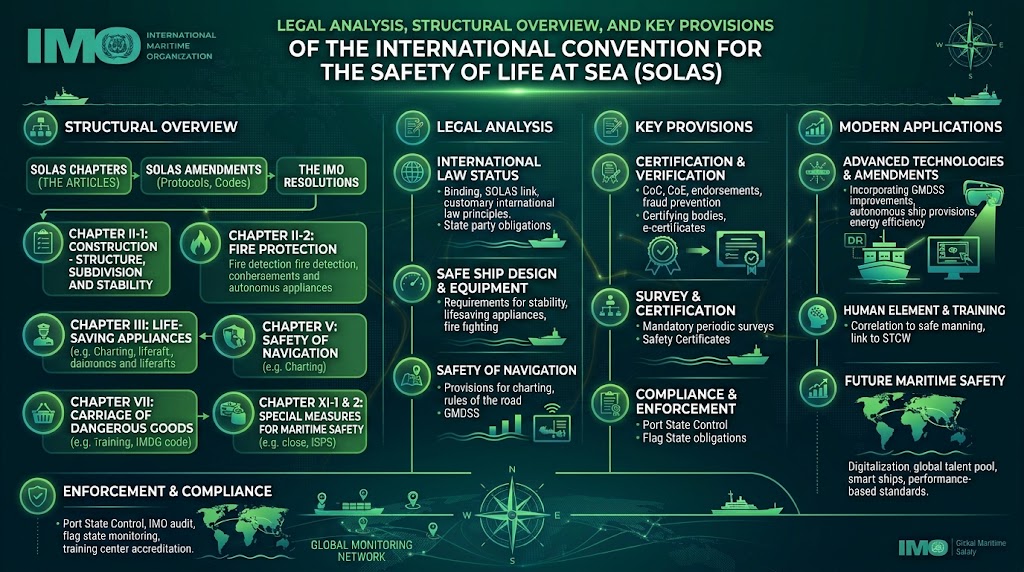
Abstract: The International Convention for the Safety of Life at Sea (SOLAS), 1974, stands as the paramount normative cornerstone of the international maritime safety regime. Evolving in response to catastrophic maritime casualties over more than a century, SOLAS establishes universal minimum standards governing the construction, equipment, and operation of commercial merchant ships. This legal analysis scrutinizes the normative structure, jurisdictional allocation, and institutional dynamics of the Convention. It evaluates the innovative tacit acceptance amendment procedure under Article VIII, the jurisdictional balance between flag State sovereignty and port State intervention under Chapter I, Regulation 19, and Chapter XI-1, and the operationalization of mandatory safety instruments including the International Safety Management (ISM) Code and the International Ship and Port Facility Security (ISPS) Code. The study further examines the jurisdictional interplay between SOLAS and the 1982 United Nations Convention on the Law of the Sea (UNCLOS), reviews international jurisprudence assessing vessel seaworthiness and safety compliance, and investigates contemporary regulatory frontiers, specifically maritime autonomous surface ships (MASS), cyber risk management, and the integration of alternative low-carbon fuels.
Introduction and Jurisprudential Context
The law of maritime safety has historically evolved not through proactive codification, but via post-disaster normative recalibration. The International Convention for the Safety of Life at Sea represents the pinnacle of this reactive yet sophisticated codification process. Embedded within public international law and the institutional architecture of the International Maritime Organization (IMO), SOLAS regulates the material conditions of commercial vessels navigating the high seas and foreign maritime zones, thereby giving substance to the customary duty of flag States to effectively exercise their jurisdiction and control over administrative, technical, and social matters concerning ships flying their flags.
In contemporary maritime doctrine, SOLAS functions as the foundational benchmark for evaluating the seaworthiness of a vessel, the adequacy of flag State regulatory oversight, and the legality of port State interventions. Through dynamic cross-referencing mechanisms in modern treaties, notably the 1982 United Nations Convention on the Law of the Sea (UNCLOS), the technical provisions of SOLAS transcend its immediate contractual parties to constitute generally accepted international rules and standards. Consequently, understanding the legal architecture, systemic limitations, and jurisdictional nuances of SOLAS is indispensable to international maritime law.
Why was the solas convention created?
The genesis of codified international maritime safety law is directly traceable to the sinking of the British passenger liner RMS Titanic on April 15, 1912. The loss of over 1,500 lives precipitated widespread public outrage and exposed critical deficiencies in the fragmented, uncoordinated national safety regulations of maritime nations. Flag States exercised unfettered discretion regarding lifeboat capacity, wireless telegraphy watches, structural subdivision, and ice patrols, producing catastrophic disparities across global fleets.
In response, the United Kingdom convened an international diplomatic conference in London, culminating in the adoption of the first Convention for the Safety of Life at Sea on January 20, 1914. Although this pioneer treaty established early international benchmarks for life-saving appliances, fire detection, and radiotelegraphy, its entry into force was aborted by the outbreak of the First World War. Subsequent revisions were negotiated in 1929 and 1948, progressively expanding requirements for structural fire protection, watertight bulkheads, and electronic navigational aids.
The creation of the Inter-Governmental Maritime Consultative Organization (IMCO, later renamed the IMO) in 1958 established a permanent institutional forum for maritime governance. Under IMCO auspices, the 1960 SOLAS Convention was concluded, representing the first version administered by a specialized United Nations agency. However, the 1960 instrument relied on an amendment mechanism requiring explicit diplomatic ratification by a high threshold of contracting governments. As commercial shipping underwent explosive growth and rapid technological modernization throughout the 1960s and early 1970s—characterized by containerization, the advent of ultra-large crude carriers (ULCCs), and automated propulsion—the traditional amendment procedure proved entirely unworkable. Proposed amendments languished indefinitely without reaching the necessary threshold of affirmative ratifications.
To overcome this regulatory ossification, contracting States convened the 1974 International Conference on Safety of Life at Sea. The resulting treaty, adopted on November 1, 1974, entered into force on May 25, 1980. The 1974 Convention retained and modernized the technical substance of its predecessor while introducing an innovative procedural apparatus designed to ensure perpetual regulatory relevance, cementing SOLAS 1974 as the permanent legal framework for international maritime safety.
Legal Status, Scope, and Structural Architecture
The 1974 Convention comprises thirteen articles that articulate its core institutional and treaty mechanics, supplemented by an extensive, continuously updated Technical Annex. The instrument is further supported by two fundamental amending protocols: the Protocol of 1978, which introduced enhanced requirements for tanker safety and steering gear following major maritime casualties, and the Protocol of 1988, which harmonized survey and certification periods (the Harmonized System of Survey and Certification, or HSSC) with the International Convention on Load Lines, 1966, and the International Convention for the Prevention of Pollution from Ships (MARPOL 73/78).
Scope of Application and Statutory Exemptions
In accordance with Chapter I, Regulation 1, the Convention applies exclusively to ships entitled to fly the flag of States the Governments of which are Contracting Governments. Pursuant to Regulation 3, the material scope of SOLAS is restricted to ships engaged on international voyages, defined under Regulation 2(d) as a voyage from a country to which the present Convention applies to a port outside such country, or conversely.
Significantly, Regulation 3(a) explicitly exempts specific categories of vessels from the general application of the Annex:
- Ships of war and troopships;
- Cargo ships of less than 500 gross tonnage (subject to specific navigational and security carve-outs in later chapters);
- Ships not propelled by mechanical means;
- Wooden ships of primitive build;
- Pleasure yachts not engaged in trade; and
- Fishing vessels (which are separately addressed under the Torremolinos International Convention for the Safety of Fishing Vessels, 1977, and its 2012 Cape Town Agreement).
Furthermore, under Regulation 4, flag State administrations retain discretionary power to grant exemptions to individual ships operating on sheltered or specialized international voyages, provided the safety conditions are, in the opinion of the administration, adequate for the intended voyage. Regulation 5 establishes the doctrine of equivalency: an administration may authorize alternative fittings, appliances, arrangements, or materials if satisfied by trials or evaluative methodologies that such equivalents are at least as effective as those prescribed by the Convention.
What is the tacit acceptance procedure in solas?
The single most revolutionary legal contribution of the 1974 Convention is the tacit acceptance procedure codified in Article VIII(b)(vi)(2). This procedural mechanism solved the historical paradox of maritime regulation: the divergence between rapid technological transformation and the cumbersome inertia of traditional international treaty ratification under public international law.
Under Article VIII, amendments to the technical Annex are formulated, negotiated, and formally adopted within the IMO Maritime Safety Committee (MSC) or at a conference of Contracting Governments. An amendment adopted by a two-thirds majority of Contracting Governments present and voting is deemed to have been accepted at the end of a specified period—typically between one and two years—unless, prior to that date, objections are formally communicated to the Secretary-General by:
- Not less than one-third of Contracting Governments; or
- Contracting Governments whose combined merchant fleets constitute not less than fifty percent of the gross tonnage of the world merchant fleet.
| Procedural Dimension | Explicit Acceptance (Traditional Treaty Law) | Tacit Acceptance (SOLAS Article VIII) |
|---|---|---|
| Default Outcome | Proposed amendment lapses unless affirmatively ratified by domestic legislative/executive acts. | Proposed amendment enters into force automatically on a determined date unless actively blocked. |
| Veto Mechanism | Individual State inaction prevents entry into force for that sovereign State. | Requires concerted objection by one-third of States or fifty percent of world gross tonnage. |
| Legislative Speed | Decades to achieve universal or near-universal coverage. | Typically 18 to 24 months from adoption by the Maritime Safety Committee. |
| Regulatory Impact | Fragmented international maritime regime with tiered legal obligations. | Unified, homogeneous global baseline maintaining pace with maritime technology. |
The legal consequence of this mechanism is profound. Tacit acceptance effectively reverses the presumption of state consent: silent acquiescence is construed as definitive legal consent. This inversion preserves uniform safety standards across the global fleet, precluding the fragmentation of international standards that previously compromised safety at sea. However, this procedural efficiency entails constitutional tensions within certain domestic jurisdictions, where executive assent within international organizations bypasses parliamentary oversight.
What are the main chapters of the solas convention?
The substantive obligations of SOLAS are distributed across a dynamic technical Annex comprising fourteen distinct chapters, which comprehensively regulate every operational, structural, and management facet of international commercial maritime transport.
Chapter I: General Provisions, Surveys, and Certification
Chapter I forms the operational nexus of SOLAS enforcement. It sets out the statutory survey regime governing hull structural integrity, machinery, boilers, life-saving appliances, and radiocommunications equipment. Upon satisfactory completion of mandatory surveys, flag State administrations—or authorized non-governmental technical bodies known as Recognized Organizations (ROs), typically classification societies—issue standardized statutory safety certificates. These include the Passenger Ship Safety Certificate, Cargo Ship Safety Construction Certificate, Cargo Ship Safety Equipment Certificate, and Cargo Ship Safety Radio Certificate. These certificates constitute prima facie evidence that the vessel satisfies the technical requisites of the Convention.
Chapters II-1 and II-2: Construction, Stability, and Fire Protection
Chapter II-1 governs ship structure, subdivision, stability, machinery, and electrical installations. Its legal architecture is premised on probabilistic damage stability requirements, determining the likelihood that a ship will remain afloat and stable following collision or bottom grounding. Chapter II-2 regulates fire safety systems, categorizing obligations across operational principles: separation of accommodation spaces from the remainder of the ship by thermal and structural boundaries, restricted use of combustible materials, detection of fires in their zone of origin, and containment and extinction of onboard conflagrations through fixed firefighting systems.
Chapter III: Life-Saving Appliances and Arrangements
Operationalized in conjunction with the mandatory International Life-Saving Appliance (LSA) Code, Chapter III dictates technical standards for lifeboats, liferafts, rescue boats, personal life-saving equipment, immersion suits, and launching mechanisms. The overarching legal standard requires that all survival craft can be safely boarded and launched under adverse conditions of trim up to 10 degrees and list up to 20 degrees either way.
Chapter IV: Radiocommunications and the GMDSS
Chapter IV codifies the Global Maritime Distress and Safety System (GMDSS), an integrated worldwide satellite and terrestrial communication network. It mandates automated distress alert transmission and receipt capabilities across designated sea areas (A1 through A4), shifting maritime distress communications from manual Morse code telegraphy to automated satellite platforms such as Inmarsat and Cospas-Sarsat, alongside terrestrial VHF, MF, and HF frequencies.
Chapter V: Safety of Navigation
Chapter V occupies a distinct legal category within SOLAS. Unlike the majority of the Annex, which applies strictly to commercial ships exceeding specified tonnage limits on international voyages, Chapter V contains provisions that apply to all vessels on all voyages, including domestic voyages and non-commercial vessels, unless expressly exempted by Regulation 1. Key provisions include:
- Regulation 19: Mandatory carriage requirements for shipborne navigational systems, including Automatic Identification Systems (AIS), Voyage Data Recorders (VDRs), and Electronic Chart Display and Information Systems (ECDIS);
- Regulation 33: The fundamental humanitarian and customary obligation of a shipmaster to render assistance to any person found in distress at sea upon receiving a distress signal; and
- Regulation 34: The doctrine of master's navigational discretion and voyage planning requirements, asserting that the master shall not be constrained by the shipowner, charterer, or any other person from taking decisions necessary for maritime safety.
Chapters VI and VII: Carriage of Cargoes and Dangerous Goods
These chapters establish safety baselines for stowage, securing, and transport of general cargoes, solid bulk cargoes, and dangerous goods. Chapter VII directly incorporates the mandatory provisions of the International Maritime Dangerous Goods (IMDG) Code, the International Code for the Construction and Equipment of Ships Carrying Dangerous Chemicals in Bulk (IBC Code), and the International Code for the Construction and Equipment of Ships Carrying Liquefied Gases in Bulk (IGC Code), transforming specialized technical guidelines into binding international legal mandates.
Chapters VIII, IX, and X: Specialized Fleets and Management Systems
Chapter VIII establishes specialized safety rules for nuclear-powered merchant ships. Chapter IX mandates compliance with the International Safety Management (ISM) Code, an institutional mechanism that bridges the gap between technical vessel hardware and managerial responsibility. Under Chapter IX, shipping companies must implement a structured Safety Management System (SMS), leading to the issuance of a Document of Compliance (DOC) to the company and a Safety Management Certificate (SMC) to each vessel. Chapter X regulates high-speed craft through adherence to the International Code of Safety for High-Speed Craft (HSC Code).
Chapters XI-1 and XI-2: Special Measures for Maritime Safety and Security
Chapter XI-1 strengthens statutory oversight by regulating the authorization of Recognized Organizations and mandating Continuous Synopsis Records (CSR) and unique IMO Ship Identification Numbers. Chapter XI-2, adopted following the geopolitical shocks of September 11, 2001, incorporates the mandatory provisions of the International Ship and Port Facility Security (ISPS) Code, expanding the scope of SOLAS beyond safety hazards to encompass security threats, maritime terrorism, and coordinated security levels across ships and port facilities.
Chapters XII, XIII, and XIV: Modern Structural Enhancements
Chapter XII introduces mandatory structural survival standards for bulk carriers over 150 meters in length. Chapter XIII operationalizes the IMO Member State Audit Scheme (IMSAS), establishing a mandatory institutional framework to assess Contracting States' compliance and enforcement efficacy. Chapter XIV mandates compliance with the International Code for Ships Operating in Polar Waters (Polar Code), addressing the structural, equipment, and navigational hazards unique to Arctic and Antarctic navigation.
How does port state control work under solas?
While the primary obligation to enforce SOLAS standards rests upon the flag State pursuant to public international law, the structural reality of the open-registry system (flags of convenience) has historically resulted in divergent enforcement rigor. To counter this regulatory vulnerability, SOLAS incorporates robust Port State Control (PSC) provisions, establishing a critical secondary line of defense against substandard maritime operations.
The Dual-Pronged Legal Basis: Regulation I/19 and Regulation XI-1/4
The authority of a port State to inspect foreign-flagged vessels is rooted in Article 25 of UNCLOS, which acknowledges the sovereign right of coastal States to establish conditions for entry into their internal waters and ports. Within SOLAS, this authority is operationalized through Chapter I, Regulation 19, and Chapter XI-1, Regulation 4.
Under Regulation I/19, every foreign ship within a port of another Contracting Government is subject to control exercised by officers duly authorized by that Government. The default procedural scope is strictly limited to verifying the validity of the certificates issued under Chapter I. Under normal circumstances, valid statutory certificates must be accepted as conclusive proof that the vessel complies with the requirements of the Convention.
The Doctrine of Clear Grounds
The limitation of PSC inspections to documentary review ceases to apply where there are clear grounds for believing that the condition of the ship or its equipment does not correspond substantially with the particulars of any certificate, or that the ship and its equipment are not compliant with the provisions of Regulation I/11 (maintenance of conditions after survey). Upon the establishment of clear grounds, the authorized officer is legally empowered to conduct a comprehensive structural, physical, and operational inspection.
Clear grounds are typically established through perceptible deficiencies, including:
- Visible structural hull corrosion, buckling, or unapproved temporary structural patches;
- Inoperable oily water separators, fire dampers, emergency generators, or steering gear systems;
- Evidence that crew members are unable to communicate effectively or execute mandatory emergency muster, fire, or abandon-ship drills; and
- Discrepancies in the Safety Management System documentation indicating systemic failure of onboard compliance.
Detention Authority and the Principle of Proportionality
Where deficiencies are identified that are clearly hazardous to safety, health, or the environment, Regulation I/19(c) mandates that the port State officer must ensure the vessel does not sail until the danger is resolved. This enforcement sanction—administrative detention—constitutes a major financial and operational penalty for commercial ship operators.
However, the exercise of PSC authority is circumscribed by the legal requirement of proportionality. Regulation I/19(f) establishes that when exercising port State control, all possible efforts shall be made to avoid a ship being unduly detained or delayed. If a vessel is unduly detained or delayed, it is legally entitled to compensation for any loss or damage suffered. In practice, establishing that an administrative detention was undue requires clearing an exceptionally high evidentiary bar, as port State authorities possess broad administrative discretion to interpret safety threats.
Regional Memoranda of Understanding
To eliminate safe havens for substandard vessels, port States coordinate their inspection regimes through regional multilateral agreements known as Memoranda of Understanding on Port State Control. Key regional bodies include the Paris MoU (covering Europe and the North Atlantic), the Tokyo MoU (covering the Asia-Pacific), and the United States Coast Guard PSC regime. These administrative networks employ harmonized risk-profiling matrices, shared data networks (such as THETIS in the Paris MoU), and targeted inspection campaigns, effectively externalizing and amplifying the domestic regulatory authority of individual port States.
Flag State Obligations, Jurisdiction, and Delegation
Under public international law, the fundamental jurisdictional principle governing the high seas is the exclusive jurisdiction of the flag State, codified in Article 92 of UNCLOS. This jurisdictional exclusivity is balanced by positive duties articulated in UNCLOS Article 94, which explicitly requires flag States to take all necessary measures to ensure safety at sea with regard to the construction, equipment, and seaworthiness of ships, in conformity with generally accepted international regulations. SOLAS constitutes the authoritative codification of these regulations.
Under Article I of SOLAS, Contracting Governments undertake to promulgate all laws, decrees, orders, and regulations and to take all other steps which may be necessary to give the Convention full and complete effect. The flag State is directly responsible for:
- Conducting statutory initial, renewal, intermediate, and annual surveys;
- Issuing the statutory certificates prescribed in Chapter I; and
- Investigating maritime casualties involving ships flying its flag pursuant to Chapter I, Regulation 21, and the mandatory Code of the International Standards and Recommended Practices for a Safety Investigation into a Marine Casualty or Marine Incident (Casualty Investigation Code).
The Legal Conundrum of Recognized Organizations
A persistent operational and legal challenge in the implementation of SOLAS is the pervasive practice of flag States delegating their statutory survey and certification functions to Recognized Organizations under Chapter I, Regulation 6. While classification societies possess unmatched naval architecture expertise and global technical surveyor networks, their dual role as commercial entities hired by shipowners and sovereign agents deputized by flag States creates structural conflicts of interest.
Under the mandatory IMO Code for Recognized Organizations (RO Code), flag States remain legally responsible under international law for the acts and omissions of their appointed ROs. If an RO improperly certifies an unseaworthy vessel that subsequently founders, the underlying flag State bears responsibility on the international plane, while the RO may face private civil liability depending on domestic maritime tort regimes and contractual limitation-of-liability clauses.
Dispute Settlement and International Jurisprudence
Unlike contemporary conventions that incorporate mandatory dispute settlement bodies, the 1974 SOLAS Convention lacks an internal compromissory clause conferring compulsory jurisdiction upon the International Court of Justice (ICJ) or the International Tribunal for the Law of the Sea (ITLOS). Dispute settlement under SOLAS relies primarily on diplomatic consultations and IMO administrative review.
However, this structural limitation is substantively mitigated through the jurisdictional bridge provided by UNCLOS Part XV. Because UNCLOS Articles 94, 211, and 217 mandate compliance with generally accepted international rules and standards, failure by a State to implement or enforce SOLAS standards constitutes a breach of UNCLOS itself. Consequently, Contracting Parties to UNCLOS can invoke the compulsory, binding dispute settlement procedures under Part XV—including proceedings before ITLOS or an Annex VII arbitral tribunal—to litigate breaches of international maritime safety obligations.
Authoritative Judicial Precedents
The substantive requirements of SOLAS have received substantial attention in international and domestic maritime jurisprudence, primarily regarding questions of vessel seaworthiness, limitation of liability, and the standard of care in maritime casualties.
The Erika (Court of Cassation, France, 2012)
In the seminal criminal proceedings arising from the 1999 sinking of the tanker Erika off the coast of Brittany, the French Court of Cassation (Cour de cassation) addressed the legal liabilities of classification societies functioning as Recognized Organizations under SOLAS. The Court affirmed that an RO could be held criminally and civilly liable for negligent structural survey oversight, establishing that statutory certifications cannot shield negligent corporate actors from liability where unseaworthy conditions violate international safety standards.
The Herald of Free Enterprise (UK High Court of Justice, 1987)
Following the capsizing of the roll-on/roll-off passenger ferry Herald of Free Enterprise immediately upon departing Zeebrugge with its bow doors open, the subsequent formal investigation and corporate liability litigation exposed fatal flaws in prevailing management structures. The disaster catalyzed the development and eventual mandatory adoption of the International Safety Management (ISM) Code under SOLAS Chapter IX. The judicial findings established that shoreside managerial failure to institute robust operational safety protocols constituted institutional negligence directly linked to statutory seaworthiness.
The M/V Saiga (No. 2) (ITLOS Case No. 2, 1999)
While primarily an offshore bunkering and freedom of navigation dispute, the International Tribunal for the Law of the Sea confirmed that the genuine link requirement under UNCLOS Article 91 does not operate as a condition precedent that allows non-flag States to challenge the nationality of a properly registered ship. However, ITLOS emphasized that the effective enforcement of safety conventions, including SOLAS, constitutes an inherent component of the flag State's supervisory jurisdiction, validating regional port State control regimes as the appropriate mechanism to police substandard vessels.
Relationships with Other Legal Instruments
The SOLAS Convention does not function in normative isolation; it forms the core of a mutually reinforcing network of multilateral maritime treaties.
| Instrument | Normative Interface with SOLAS | Key Convergence Points |
|---|---|---|
| UNCLOS (1982) | Provides jurisdictional framework (Articles 94, 211, 217); incorporates SOLAS as generally accepted international rules and standards. | Flag State duty of oversight; legal constraints on Port State Control inspections; high-seas jurisdiction. |
| MARPOL 73/78 | Parallels SOLAS technical regimes; coordinated under the Harmonized System of Survey and Certification (HSSC). | IBC/IGC Codes integrate chemical/gas transport safety with marine pollution prevention. |
| STCW (1978/1995/2010) | Human element counterpart to SOLAS hardware; operationalizes Chapter IV and ISM crew competence requirements. | Safe manning levels (SOLAS Chapter V/Reg 14); minimum watchkeeping and operational drill competencies. |
| MLC (2006) | Seafarer labor and living standards directly interfacing with ship construction and operational safety. | Accommodation safety, emergency egress, occupational health and safety systems under the ISM Code. |
The dynamic cross-referencing between UNCLOS and SOLAS is particularly vital. While UNCLOS provides the jurisdictional baseline dividing maritime zones and allocating state competence, it relies intentionally on technical conventions such as SOLAS to supply the substantive content of flag State obligations. Consequently, an evolving technical amendment adopted under the tacit acceptance procedure of SOLAS automatically becomes the enforceable legal standard under UNCLOS, ensuring that the umbrella law of the sea evolves concurrently with technical progress.
How does solas regulate maritime cyber security?
As commercial shipping transitions into an era characterized by integrated automation, shore-based operational support, and interconnected Internet of Things (IoT) bridge environments, the vulnerability of critical shipboard systems to malicious cyber intrusion has emerged as a major safety concern. In response, the IMO opted not to draft an independent convention, choosing instead to integrate cyber risk management directly into the existing normative framework of SOLAS.
IMO Resolution MSC.428(98) and the ISM Code
In June 2017, the Maritime Safety Committee adopted Resolution MSC.428(98), titled Maritime Cyber Risk Management in Safety Management Systems. This regulatory action anchored cyber security within Chapter IX of SOLAS by requiring that an approved Safety Management System (SMS) identify, assess, and manage cyber risks in accordance with the objectives of the ISM Code.
Under this approach, cyber security is legally treated not merely as an IT issue, but as a direct component of operational seaworthiness. Shipping companies must integrate cyber risk controls into their SMS no later than the first annual verification of the company's Document of Compliance following January 1, 2021. The regulatory scope covers five functional elements drawn from the National Institute of Standards and Technology (NIST) framework:
- Identify: Pinpoint critical operational technologies (OT) on board, including ECDIS, propulsion controls, and power management networks;
- Protect: Implement operational procedures, hardware protections, and firewalls to secure networks against unauthorized infiltration;
- Detect: Formulate automated and procedural mechanisms to uncover software corruption, data manipulation, or unauthorized intrusion;
- Respond: Outline rapid mitigation strategies to isolate compromised bridge or engine networks; and
- Recover: Ensure rapid data recovery, backup navigation configurations, and physical restoration of propulsion and navigational capacity.
Failure to satisfy these expectations renders a vessel legally vulnerable under Port State Control. Pursuant to Paris MoU and Tokyo MoU inspection guidelines, an unmanaged cyber risk can lead directly to an ISM Code deficiency, triggering port detention on the grounds that the Safety Management System fails to ensure the safe operation of the vessel.
The Maritime Autonomous Surface Ships (MASS) Regulatory Challenge
A more disruptive challenge to the structure of SOLAS is the emergence of Maritime Autonomous Surface Ships (MASS). SOLAS was drafted under the foundational assumption that physical human crews are present aboard every ship. Critical provisions throughout the Convention mandate human presence and immediate physical agency:
- Chapter V, Regulation 14: Requirement that all ships be sufficiently and efficiently manned;
- Chapter V, Regulation 19: Requirement for lookout and physical sensory monitoring on the navigation bridge;
- Chapter III: Requirements that life-saving appliances be capable of immediate physical deployment by shipboard crew members; and
- Chapter II-2: Fire suppression systems predicated on human search-and-rescue teams and manual activation of firefighting systems.
To accommodate degrees of autonomy ranging from ships with automated processes and decision support to fully autonomous vessels with no personnel on board, the IMO has developed the mandatory MASS Code. In the interim, alternative design and arrangement provisions—such as Chapter II-1, Regulation 55, and Chapter II-2, Regulation 17—serve as the legal bridge, allowing administrations to authorize alternative technological architectures provided an engineering analysis proves the design achieves equivalent safety.
Decarbonization and Alternative Marine Fuels
The push to decarbonize global shipping introduces acute safety challenges under SOLAS Chapters II-1 and II-2. The transition from heavy fuel oil to zero- and low-carbon alternative fuels—specifically liquefied natural gas (LNG), methanol, ammonia, and hydrogen—imposes novel operational risks. Ammonia is highly toxic and corrosive; hydrogen exhibits low volumetric energy density and extreme flammability; and methanol features a low flashpoint.
Because traditional SOLAS fire safety provisions assume high-flashpoint petroleum hydrocarbons (flashpoint above 60°C pursuant to Chapter II-2, Regulation 4), the legal regime must continually adapt through the International Code of Safety for Ships Using Gases or Other Low-Flashpoint Fuels (IGF Code). Developing mandatory safety standards that reconcile industrial decarbonization deadlines with rigorous structural safety represents one of the most critical legal tasks currently facing the Maritime Safety Committee.
Critical Assessment: Strengths, Deficiencies, and Enforcement Realities
Over four decades of continuous refinement, the SOLAS Convention has successfully reduced the rate of total vessel losses across the global merchant fleet. The institutional combination of tacit acceptance, technical codification, and interlocking port State control inspections has established a comprehensive, globally respected safety regime. Nevertheless, critical analysis reveals systemic institutional weaknesses.
Structural Deficiencies and Enforcement Gaps
- The Genuine Link Fiction: The continued prevalence of open registries permits shipowners to incorporate in jurisdictions that possess nominal regulatory resources. Despite the mandatory audit scheme under Chapter XIII, vast disparities in flag State investigative and enforcement capacity persist.
- Over-Delegation to Recognized Organizations: The practical reality that many flag administrations delegate nearly all statutory oversight to private classification societies creates regulatory hazards. Commercial competition among classification societies can undermine rigorous enforcement of SOLAS standards.
- Regional Disparities in Port State Control: Port State Control enforcement varies significantly by region. While the Paris and Tokyo MoU regimes maintain high inspection rates and uniform criteria, port control in developing coastal States is frequently constrained by limited resources, maritime domain awareness, and institutional infrastructure.
- The Human Factor Disconnect: While SOLAS excels at technical, mechanical, and structural engineering prescriptions, human error remains the primary causal factor in over seventy percent of maritime casualties. Despite the incorporation of the ISM Code, SOLAS remains predominantly a hardware convention, periodically struggling to influence corporate safety cultures and seafarer fatigue patterns.
Conclusion
The International Convention for the Safety of Life at Sea, 1974, remains the bedrock of international maritime safety governance. Its enduring relevance is anchored in its structural adaptability: through the tacit acceptance mechanism of Article VIII, it bridges the gap between traditional state consent and the dynamic realities of contemporary maritime technology. The convention operates not as a static historical agreement, but as an evolving regulatory ecosystem that integrates statutory hardware mandates with comprehensive safety management through the ISM Code, port security through the ISPS Code, and polar operations through the Polar Code.
As the international maritime sector enters a period of dual transformation driven by digital autonomy and zero-carbon propulsion, SOLAS faces unprecedented normative challenges. Preserving its historical effectiveness will require continuous codification—integrating cyber risk controls, harmonizing rules for autonomous navigation systems, and establishing structural safety baselines for hazardous alternative fuels—while maintaining the vital institutional balance between flag State sovereignty and port State intervention. The resilience of international maritime transport relies, as it has for more than a century, upon the rigorous, universal, and unwavering enforcement of the SOLAS Convention.
References
- Anderson, P. (2005). The ISM Code: A Practical Guide to the Legal and Operational Implications. Informa Law from Routledge.
- Boisson, P. (1999). Safety at Sea: Policies, Regulations and International Law. Paris: Bureau Veritas.
- Churchill, R. R., Lowe, A. V., & Sander, A. (2022). The Law of the Sea (4th ed.). Manchester University Press.
- International Maritime Organization. (1974). International Convention for the Safety of Life at Sea, 1184 U.N.T.S. 276.
- International Maritime Organization. (2017). Resolution MSC.428(98): Maritime Cyber Risk Management in Safety Management Systems. IMO Doc. MSC 98/23/Add.1.
- International Tribunal for the Law of the Sea. (1999). The M/V "Saiga" (No. 2) Case (Saint Vincent and the Grenadines v. Guinea), Judgment, ITLOS Reports 1999.
- Karim, M. S. (2015). Prevention of Pollution of the Marine Environment from Vessels: The Emerging Regime of Flag State Responsibility. Springer.
- Mukherjee, P. K., & Brownrigg, M. (2013). Farthing on International Shipping (4th ed.). Springer.
- Ölçer, A. I., Ballini, F., & Schönborn, A. (Eds.). (2018). Trends and Challenges in Maritime Energy Management. Springer.
- Tan, A. K.-J. (2006). Vessel-Source Marine Pollution: The Law and Politics of International Regulation. Cambridge University Press.
Comments
No comments yet.