Algorithmic Execution and the Lex Maritima: The Jurisprudential Integration of Smart Contracts
A rigorous examination of the legal challenges and conventions governing the adoption of smart contracts and autonomous execution within international maritime commerce.
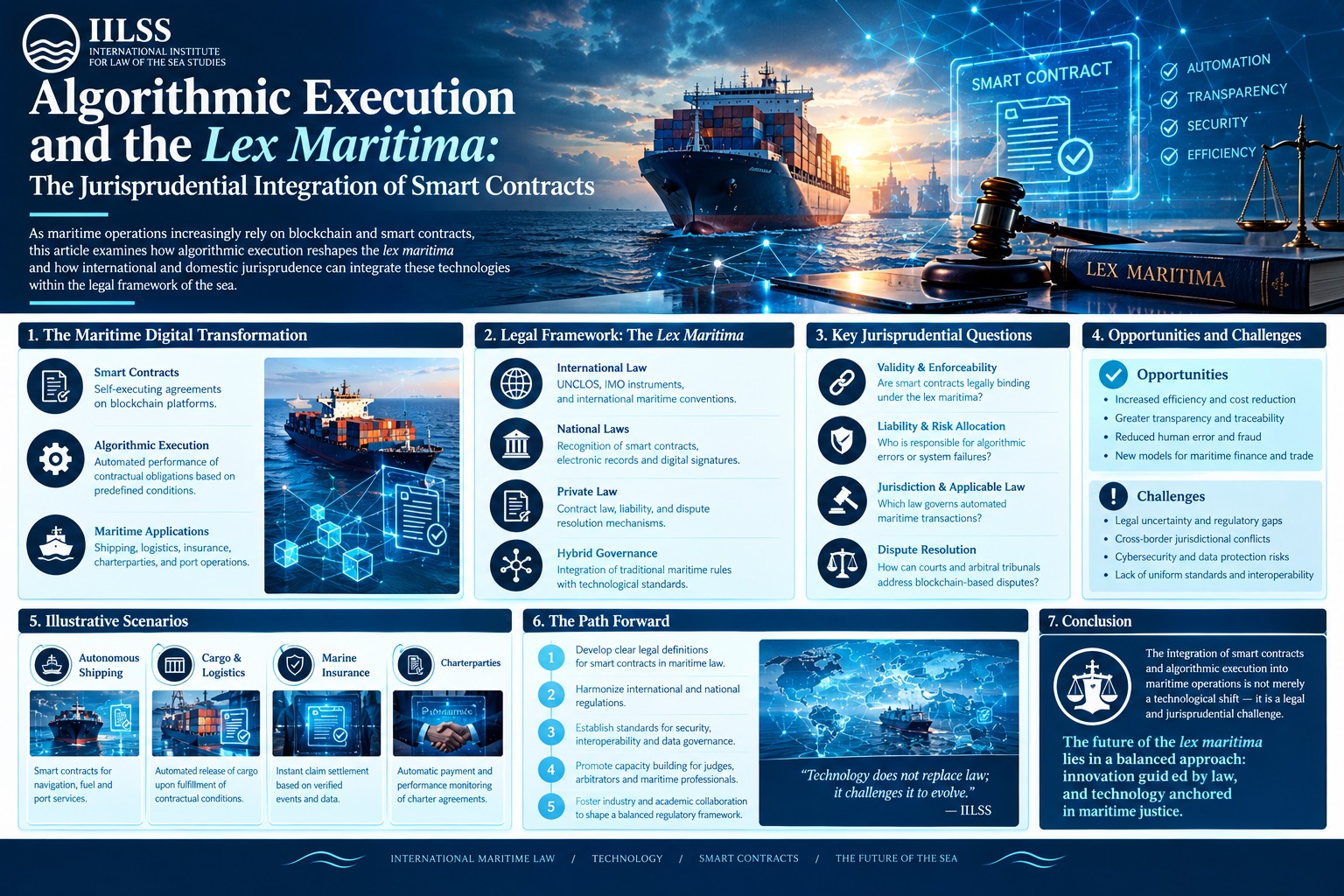
The evolution of international maritime commerce has reached a critical juncture where the ancient principles of the Lex Maritima confront the deterministic rigidity of cryptographic protocols. Historically, the maritime industry has relied upon the fluidity of the Bill of Lading and the interpretative depth of English or Civil law charterparties. However, the emergence of smart contracts—self-executing digital agreements encoded on distributed ledgers—presents a fundamental challenge to established notions of contractual intent, performance, and liability. This analysis seeks to evaluate the legal viability of these instruments under current international conventions, such as the UNCITRAL Model Laws and the Rotterdam Rules, while addressing the ontological friction between immutable code and the inherently unpredictable nature of the sea.
The Functional Equivalence of Digital Assent
Central to the integration of smart contracts is the principle of functional equivalence. This doctrine, championed by the UNCITRAL Model Law on Electronic Commerce (1996), posits that electronic communications should not be denied legal effect solely on the ground that they are in digital form. In the context of maritime commerce, where the transfer of title and the evidence of the contract of carriage are traditionally bound to physical paper, the transition to blockchain-based tokens requires a robust interpretation of what constitutes a document. The UNCITRAL Model Law on Electronic Transferable Records (MLET) further refines this by establishing that a digital record is the functional equivalent of a transferable document if it contains the necessary information and is managed by a system that ensures its singularity and control.
Despite these frameworks, maritime law remains anchored in specific formalities. The Hague-Visby Rules and the subsequent Rotterdam Rules emphasize the evidentiary value of the document. Under Article 1(g) of the Hague-Visby Rules, the contract of carriage applies to contracts covered by a bill of lading or any similar document of title. The question arises whether a smart contract—which might exist as a series of if-then statements rather than a readable document—can be recognized as a bill of lading under these conventions. The legal community is divided. Some argue that as long as the smart contract performs the functions of receipt, evidence of contract, and document of title, the specific medium is irrelevant. Others maintain that the lack of human-readable text during the execution phase complicates the requirement for a record that is accessible so as to be usable for subsequent reference.
How do smart contracts satisfy the written form requirements in maritime law?
The requirement for a contract to be in writing is a cornerstone of maritime stability, particularly regarding arbitration clauses. The New York Convention on the Recognition and Enforcement of Foreign Arbitral Awards (1958) stipulates in Article II(2) that an agreement in writing shall include an arbitral clause in a contract or an arbitration agreement, signed by the parties or contained in an exchange of letters or telegrams. The challenge for maritime smart contracts is that the agreement is often expressed in hexadecimal code or Solidity script rather than natural language. For a smart contract to satisfy the New York Convention, a dual-layered approach is often necessary: a natural language wrapper that incorporates the code by reference, or a judicial recognition that cryptographic signatures constitute a valid signing under the evolving standards of international trade.
Furthermore, the Rotterdam Rules (2008), though not yet globally ratified, provide a more flexible approach to writing. Article 1(17) defines an electronic communication as information generated, sent, received, or stored by electronic, optical, or similar means. This definition is broad enough to encompass smart contract logic. However, the challenge remains one of interpretation. In traditional maritime disputes, courts look to the intentions of the parties (the consensus ad idem). In a smart contract, the intention is fixed at the time of coding. If a vessel is delayed due to force majeure—a concept traditionally subject to equitable interpretation—the smart contract may execute a penalty automatically, potentially bypassing the nuanced defenses provided under the Hague-Visby Rules or the English law doctrine of frustration.
The deterministic nature of blockchain execution ignores the maritime tradition of 'reasonable dispatch' and 'due diligence,' replacing judicial discretion with mathematical certainty. This shift necessitates a re-evaluation of the carrier's defenses under Article IV of the Hague-Visby Rules.
Who is liable for errors in maritime smart contract code?
The shift from human-mediated execution to autonomous code introduces a novel liability vacuum. In a standard charterparty dispute, liability is typically apportioned between the shipowner and the charterer based on breaches of specific warranties or conditions. However, if a smart contract erroneously triggers a payment or a release of cargo due to a bug in the code or a failure in the data feed (the Oracle problem), the traditional maritime liability regimes are ill-equipped to provide a remedy. Is the coder an agent of the shipowner? Or is the smart contract platform a third-party service provider akin to a port authority?
If we apply the principles of the *International Convention on Civil Liability for Oil Pollution Damage* (CLC) or the *HNS Convention* by analogy, liability is often channeled to the registered owner. Yet, in the realm of digital commerce, the fault may lie with the software developer. Maritime jurisprudence generally does not recognize the software architect as a party to the contract of carriage. This creates a risk of non-recourse for the aggrieved party. Furthermore, if the code is decentralized and open-source, identifying a defendant becomes an exercise in jurisdictional futility. The International Chamber of Commerce (ICC) has begun addressing these gaps through the Incoterms 2020 updates and the Digital Standards Initiative, but a definitive liability protocol for algorithmic errors at sea remains elusive.
| Feature | Traditional Maritime Contract | Smart Maritime Contract |
|---|---|---|
| Formation | Subject to negotiation and signatures. | Programmatic; triggered by conditions. |
| Evidence | Physical or PDF Bill of Lading. | Cryptographic hashes and tokens. |
| Modification | Addenda and mutual consent. | Immutable; requires new contract (fork). |
| Dispute Resolution | Court or Arbitration (e.g., LMAA). | On-chain or hybrid arbitration. |
| Performance | Human-led and discretionary. | Autonomous and deterministic. |
The Oracle Problem and the Law of Evidence
Smart contracts rely on Oracles—external data sources that provide real-time information such as GPS coordinates, temperature sensor data for reefer containers, or port congestion metrics. From a jurisprudential perspective, the reliability of an Oracle is a matter of evidentiary weight. Under the rules of the International Tribunal for the Law of the Sea (ITLOS) or the Permanent Court of Arbitration (PCA), digital evidence must be authenticated and shown to be tamper-proof. The deterministic nature of a smart contract means that if the Oracle provides false data (e.g., reporting a vessel has arrived when it has not), the contract will execute regardless of the factual reality.
This creates a conflict with the *parol evidence rule* in common law and similar doctrines in civil law that allow for the correction of manifest errors. If a smart contract is deemed the entire agreement (an entire agreement clause in code), can a court intervene to reverse an execution based on faulty data? The current consensus suggests that unless the parties have specifically included an arbitration bridge—a mechanism that allows a human arbitrator to pause or reverse the code—the court's ability to intervene is limited by the finality of the transaction on the ledger. This highlights the need for specialized maritime arbitration rules, such as those proposed by the Baltic and International Maritime Council (BIMCO), to incorporate digital dispute resolution clauses that account for Oracle failure.
Jurisdictional Ambiguity and the Conflict of Laws
Maritime law is inherently cross-border, yet blockchain nodes are geographically dispersed. When a smart contract is executed, where does the contract take place? Does the lex loci contractus apply to the location of the node that validated the transaction, the headquarters of the shipowner, or the port of discharge? Traditional conflict of law rules, such as those in the Rome I Regulation, rely on the characteristic performance of the contract. In maritime commerce, this usually points to the carrier's place of business. However, if the contract is part of a decentralized autonomous organization (DAO) or a multi-party platform, the traditional nexus of jurisdiction is severed.
The PCA has dealt with boundary and maritime disputes where technology was central, such as in the *South China Sea Arbitration*, emphasizing the importance of objective data. In smart contract disputes, the industry may see a shift toward 'code as law' only within the parameters of a pre-agreed jurisdictional framework. Parties may increasingly opt for a chosen law clause that explicitly states that the digital execution is governed by the laws of a specific maritime hub, such as Singapore or London, regardless of where the blockchain validation occurs. This provides a necessary safety net, ensuring that the algorithmic execution remains subservient to the sovereign legal order.
Conclusion: Towards a Hybrid Lex Cryptographia
The integration of smart contracts into maritime commerce does not signal the end of traditional maritime law, but rather its digital transfiguration. The rigorous standards of the Hague-Visby and Rotterdam Rules must be harmonized with the realities of autonomous execution. While the smart contract offers unprecedented efficiency in freight settlement and cargo release, it lacks the equitable flexibility that has allowed maritime law to survive for centuries. The path forward lies in the development of hybrid instruments—contracts that utilize code for performance and natural language for liability and dispute resolution.
As the industry moves toward greater automation, international bodies must prioritize the creation of a uniform liability framework for digital maritime assets. The potential for 'legal forks'—where the code says one thing and the law says another—remains the greatest risk to global trade. Only through a synthesis of cryptographic precision and jurisprudential wisdom can the maritime world navigate the complexities of the digital horizon. The future of the Lex Maritima will be written not only in ink or on screens, but in the immutable blocks of the ledger, moderated by the enduring principles of equity and international cooperation.
Comments
No comments yet.