Subaquatic Arteries: Protection and Jurisdiction Over Submarine Cables and Pipelines
An examination of the legal frameworks governing submarine cables and pipelines under international law and jurisprudence.
Introduction
Modern global commerce, communications, and energy transmission rely upon a fragile, invisible, and deeply vulnerable subaquatic infrastructure. Submarine fiber-optic cables carry over ninety-five percent of international data traffic, underpinning global financial transactions, governmental communications, and the internet at large. Concurrently, transnational submarine pipelines transport vast quantities of oil and natural gas across maritime boundaries, forming the lifeblood of regional energy security. Despite their critical economic and strategic importance, these linear infrastructure systems traverse complex, overlapping maritime zones where legal authority is fragmented among coastal states, flag states, and international bodies.
The codification of international maritime law, culminating in the 1982 United Nations Convention on the Law of the Sea (UNCLOS), establishes a sophisticated architecture of rights and obligations regarding the laying, maintenance, and protection of submarine cables and pipelines. However, the legal regime governing this subaquatic domain is fraught with ambiguities. Jurisdictional boundaries shift dramatically depending on whether a pipeline or cable is located within internal waters, the territorial sea, the exclusive economic zone, or the continental shelf. Furthermore, contemporary geopolitical tensions, hybrid warfare tactics, and the physical vulnerability of deep-sea cables to anchors, seismic events, and deliberate sabotage have severely tested the resilience of traditional international legal doctrines.
This inquiry provides a rigorous examination of the protection and jurisdiction afforded to submarine cables and pipelines under international law. By evaluating foundational treaties, customary international law, and landmark jurisprudence from international tribunals, this analysis unpacks the doctrinal tensions between coastal state sovereignty and the high seas freedoms of navigation and laying communications infrastructure. Particular attention is directed toward the enforcement gaps in criminal and civil liability, the challenges of maritime delimitation, and the evolving normative standards required to secure transoceanic connectivity in an era of heightened geopolitical competition.
Historical Evolution and Foundational Treaties
The international regulation of subaquatic infrastructure predates the modern law of the sea codification movement, originating in the late nineteenth century with the rapid expansion of telegraphy. The foundational milestone in this domain is the 1884 Convention for the Protection of Submarine Telegraph Cables, negotiated in Paris. Designed to secure transoceanic telegraph links against accidental damage caused by commercial fishing and maritime navigation, the 1884 Convention established a regime of universal penal liability for willful or culpable injury to cables laid on the high seas. Contracting states agreed to enact domestic penal legislation punishing infractions, while granting warships of any party the right to board and inspect suspect vessels flying foreign flags under carefully circumscribed conditions.
While the 1884 Paris Convention established early principles of cooperative enforcement and high seas protection, its scope was strictly limited to telegraph cables and predated the modern conceptualization of maritime zones. As deep-sea technology advanced in the mid-twentieth century, the Geneva Conventions on the Law of the Sea of 1958 synthesized existing state practices regarding submarine pipelines and cables. The 1958 Convention on the High Seas explicitly recognized the freedom to lay submarine cables and pipelines on the bed of the high seas beyond the territorial sea, while obliging states to adopt domestic laws penalizing intentional or negligent breaks or injuries to such installations.
These historical instruments laid the conceptual groundwork for UNCLOS, which integrated and expanded upon nineteenth- and twentieth-century norms. UNCLOS elevated the protection of submarine infrastructure into a comprehensive constitutional framework for the world's oceans. Yet, the transition from bilateral telegraph lines to massive multi-terabit fiber-optic loops and transcontinental energy pipelines has exposed the limitations of these legacy treaties. The legal assumptions underpinning nineteenth-century enforcement mechanisms contrast sharply with modern operational realities, where subsea assets are frequently targeted by sophisticated state-backed actors employing gray-zone tactics that evade traditional thresholds of armed conflict.
What is the jurisdictional framework for submarine cables and pipelines across maritime zones?
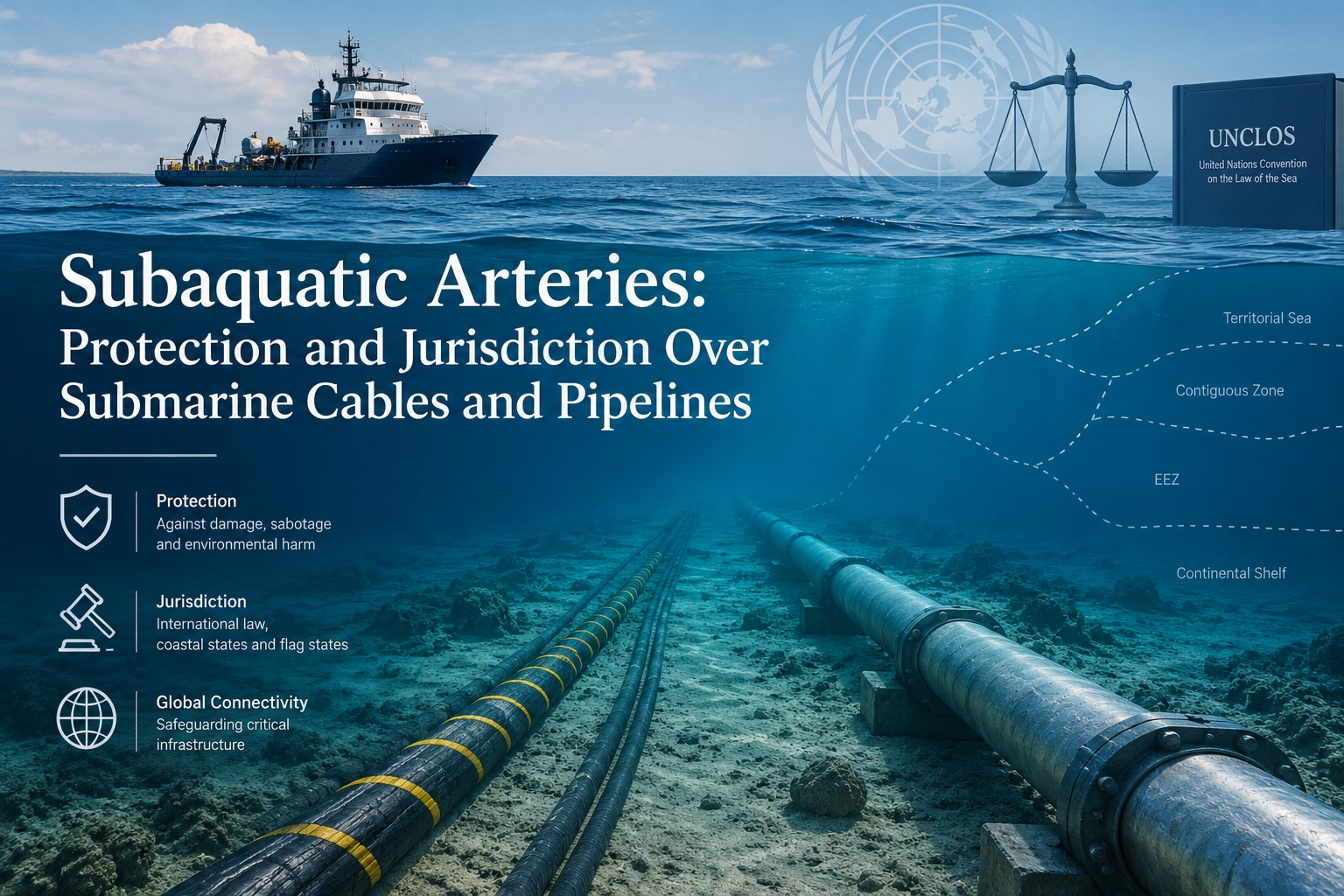
The legal regime governing submarine cables and pipelines is fundamentally zonal, meaning that a coastal state's jurisdiction varies significantly depending on the maritime space in which the infrastructure is situated. Under UNCLOS, maritime zones are categorized into internal waters, territorial seas, contiguous zones, exclusive economic zones (EEZs), continental shelves, and the high seas or the Area. Each zone delineates a distinct equilibrium between the sovereign rights of the coastal state and the navigational and infrastructural freedoms of third-party states.
Within internal waters and the territorial sea, the coastal state exercises full sovereignty. Consequently, the laying of submarine cables and pipelines entering the territorial sea is entirely subject to the consent and regulatory prescription of the coastal state. While UNCLOS Article 79(1) acknowledges the right of all states to lay submarine cables and pipelines on the continental shelf in accordance with the convention's provisions, Article 79(4) explicitly preserves the coastal state's right to establish conditions for cables and pipelines entering its territory or territorial sea, and its jurisdiction over cables and pipelines constructed or used in connection with the exploration of its continental shelf or the exploitation of its resources. Coastal states may thus impose rigorous environmental impact assessments, route approvals, and licensing fees before permitting foreign entities to land cables on their shores.
Beyond the territorial sea, within the EEZ and on the continental shelf, the jurisdictional balance shifts toward accommodation. Pursuant to UNCLOS Article 79(2), the coastal state may not impede the laying or maintenance of such cables and pipelines, subject to its right to take reasonable measures for the exploration of the continental shelf, the exploitation of its resources, and the prevention, reduction, and control of pollution from pipelines. However, the coastal state's authority is not unlimited. When a coastal state designs route approvals or environmental regulations in the EEZ, it must have regard to cables and pipelines already in position. This structural tension between the coastal state's resource management mandate and the flag state's freedom to lay communications infrastructure generates persistent legal ambiguity, particularly regarding pipeline routing conflicts and overlapping continental shelf claims.
| Maritime Zone | Coastal State Sovereignty / Jurisdiction | Applicable UNCLOS Provisions | Key Legal Restrictions |
|---|---|---|---|
| Internal Waters & Territorial Sea | Full sovereignty; absolute regulatory control over entry and landing. | Articles 2, 21, 79(4) | Mandatory state consent, domestic environmental permitting, compulsory landing rights regulation. |
| Exclusive Economic Zone (EEZ) | Sovereign rights for economic exploration and resource exploitation; limited authority over infrastructure. | Articles 56, 58, 79 | Reasonable measures permitted; prohibition on impeding cable laying without justification; due regard standard. |
| Continental Shelf | Sovereign rights over shelf resources; authority over pipelines and cables tied to resource extraction. | Articles 77, 79 | Consent required for pipeline routing; duty to consult on intersecting lines; protection of existing assets. |
| The High Seas & The Area | Freedom of the high seas; international seabed authority oversight for Area-related assets. | Articles 87, 112-115, 141 | Universal duty to avoid interference; penalization of willful or negligent damage; flag state enforcement primacy. |
How do competing legal doctrines and international jurisprudence address subsea infrastructure damage?
When subsea cables or pipelines are damaged—whether by commercial shipping anchors, bottom-trawl fishing, seismic disruption, or intentional sabotage—attributing responsibility and securing legal remedy involves navigating complex evidentiary hurdles and doctrinal conflicts. Under customary international law, codified in UNCLOS Articles 112 through 115, states are obligated to enact domestic legislation making it a punishable offense for a vessel flying their flag or a person subject to their jurisdiction to break or injure a submarine cable or pipeline willfully or through culpable negligence. Furthermore, states must ensure that owners of ships who can prove that they have sacrificed an anchor, a net, or any other fishing gear in order not to injure a submarine cable or pipeline shall be compensated by the owner of the cable or pipeline.
Despite these explicit treaty obligations, international jurisprudence addressing subsea infrastructure disputes is remarkably sparse. Unlike maritime boundary delimitation or fisheries disputes, which frequently occupy the docket of the International Court of Justice (ICJ) and the International Tribunal for the Law of the Sea (ITLOS), subsea cable and pipeline incidents are rarely litigated before international courts. This judicial scarcity stems from several factors: most physical damage is handled through domestic admiralty courts, insurance arbitration, or diplomatic channels; incidents occurring in contested maritime zones often involve sensitive national security considerations that states prefer to manage outside formal judicial forums; and the evidentiary burden of proving intent or culpable negligence in the deep ocean is exceptionally high.
In the rare instances where international tribunals touch upon subsea infrastructure, jurisprudence tends to interpret State obligations through the lens of due diligence. For instance, advisory opinions and judgments from ITLOS and the ICJ concerning environmental protection and resource management emphasize that states must exercise due diligence to prevent activities within their jurisdiction or control from causing transboundary harm. Applied to submarine cables and pipelines, this due diligence standard requires flag states to police their commercial fleets, coastal states to monitor maritime traffic near critical infrastructure bottlenecks, and port states to enforce safety standards. However, the exact threshold of due diligence remains a subject of doctrinal debate, particularly when hybrid warfare actors engage in clandestine operations, such as dragging anchors across cables or detonating explosive charges along energy pipelines, while deliberately obscuring state responsibility.
Enforcement Gaps, Criminal Liability, and Enforcement Limitations
The enforcement architecture governing submarine cables and pipelines suffers from structural vulnerabilities that hinder effective prosecution of wrongful acts. Primary enforcement jurisdiction over vessels on the high seas rests with the flag state. If a foreign commercial vessel severs a telecommunications cable in the middle of an ocean basin, coastal states remote from the incident generally lack jurisdiction to board, inspect, or detain the vessel unless specific treaty exceptions apply or the flag state grants consent. This jurisdictional exclusivity of the flag state creates significant impunity gaps, especially when vessels operate under flags of convenience with lax regulatory oversight or administrative enforcement capacity.
Compounding this enforcement deficit is the inadequacy of criminal sanctions in many domestic legal systems. While UNCLOS mandates that states criminalize intentional and negligently caused damage to submarine cables and pipelines, the severity of penalties varies wildly across jurisdictions, and prosecutions are exceedingly rare. Prosecutors face daunting evidentiary challenges in proving that a vessel master acted with culpable negligence rather than ordinary navigational error when an anchor drags across a mapped cable route. Furthermore, maritime surveillance in the deep ocean is chronically deficient. Detecting subsea sabotage requires advanced hydroacoustic monitoring, fiber-optic distributed acoustic sensing, and naval submarine tracking—capabilities possessed by only a handful of advanced maritime powers.
The rise of hybrid warfare has further exposed the limitations of traditional law enforcement paradigms. When state-sponsored vessels engage in covert operations against subsea pipelines or cables, invoking criminal negligence or tort law becomes entirely inadequate. Traditional maritime law is built upon commercial assumptions of negligence, accident, and economic loss, rather than calculated geopolitical sabotage. Consequently, injured states frequently find themselves in a legal vacuum where the acts committed against their critical infrastructure fall into a gray zone between criminal damage, terrorism, and an armed attack, complicating the invocation of collective self-defense under Article 51 of the United Nations Charter.
Navigational Freedoms Versus Infrastructure Security: Reconciling Conflicting Interests
The legal regime of the oceans is anchored in the foundational doctrine of the freedom of the high seas, which includes the freedom of navigation and the freedom to lay submarine cables and pipelines. However, as maritime space becomes increasingly crowded and congested with offshore wind farms, marine protected areas, aquaculture installations, and strategic transit corridors, these competing freedoms frequently collide. Commercial shipping lanes overlap directly with major telecommunications cable routes, and deep-sea fishing fleets routinely deploy heavy gear in close proximity to vulnerable subsea assets.
Balancing navigational freedoms with infrastructure security requires strict adherence to the due regard principle articulated in UNCLOS Article 87 and Article 79. Flag states navigating vessels through areas dense with submarine cables must ensure that their ships do not conduct operations that unreasonably obstruct cable laying or maintenance. Conversely, cable and pipeline operators must design their routes and burial depths to minimize interference with traditional maritime activities such as anchoring and fishing. Notice requirements, hydrographic charting of cable routes, and the establishment of safety zones around critical subsea nodes are vital operational mechanisms designed to prevent accidental interactions.
Nevertheless, tensions escalate sharply when coastal states attempt to unilaterally restrict navigational rights in the name of critical infrastructure protection. Some jurisdictions have sought to establish expansive prohibited zones or surveillance corridors extending far beyond their territorial seas into the EEZ, restricting foreign navigation and marine scientific research under the guise of national security. Such unilateral measures run counter to the delicate jurisdictional balance struck by UNCLOS, which strictly limits coastal state sovereignty in the EEZ to matters concerning economic exploration, resource exploitation, and environmental protection. Preserving the integrity of subsea infrastructure without eroding the foundational freedoms of navigation remains one of the most pressing doctrinal challenges facing contemporary international maritime law.
Conclusion
The protection of and jurisdiction over submarine cables and pipelines constitute a cornerstone of contemporary global interconnectivity. As demonstrated through the historical evolution of maritime treaties, the zonal architecture of UNCLOS, and the operational realities of modern maritime security, the legal framework governing these subaquatic assets is comprehensive in design yet vulnerable in execution. The primary challenges facing the international community do not stem from a total absence of legal rules, but rather from persistent enforcement deficits, jurisdictional fragmentation across maritime zones, and the emergence of hybrid threats that elude traditional paradigms of commercial negligence and flag state responsibility.
Addressing these legal and operational vulnerabilities requires concerted multilateral cooperation. States must harmonize domestic penal legislation to ensure rigorous accountability for willful and negligent damage to subsea infrastructure, enhance cooperative maritime surveillance mechanisms, and fully leverage the due diligence standard to enforce compliance among commercial operators. Furthermore, maintaining the delicate equilibrium between coastal state security interests and universal navigational freedoms will be essential to preventing jurisdictional creep on the high seas and within exclusive economic zones. Ultimately, safeguarding the fragile arteries of global communication and energy transmission is not merely a technical or commercial imperative, but a fundamental requirement for the maintenance of international peace, economic stability, and global interdependence.
Comments
No comments yet.