Subaquatic Sovereignty: The Juridical Regulation of Naval Mines in International Humanitarian Law
A comprehensive analysis of the legal frameworks, from the 1907 Hague Convention to the San Remo Manual, governing the use of naval mines in modern armed conflict.
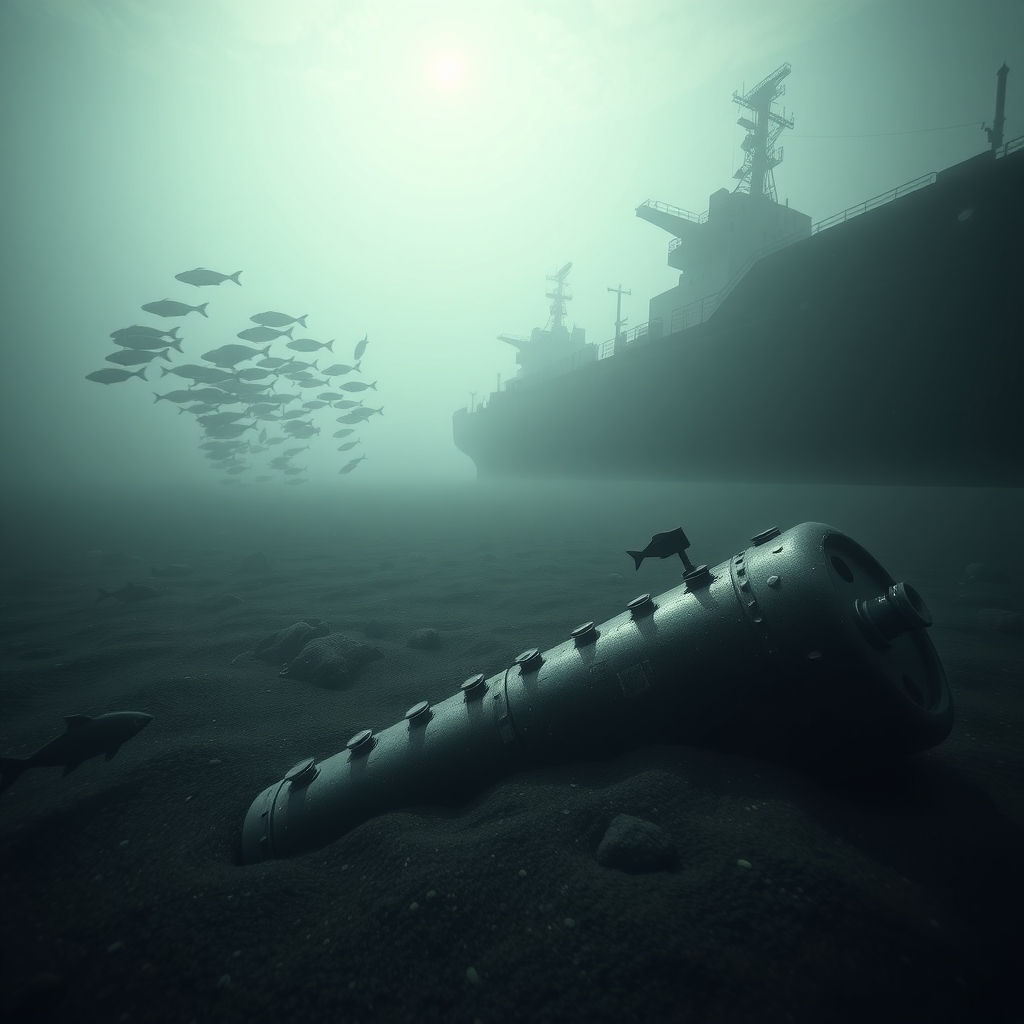
The deployment of naval mines remains one of the most contentious aspects of maritime warfare, sitting at the precarious intersection of military necessity and the protection of peaceful commerce. Unlike precision-guided munitions, the naval mine is inherently an indiscriminate weapon—or at least, its historical legacy is one of blind destruction. As technological advancements transition from the primitive contact mines of the nineteenth century to the sophisticated, sensor-driven influence mines of the twenty-first, the legal framework governing their use must reconcile antiquated treaty law with the evolving standards of International Humanitarian Law (IHL). This inquiry seeks to parse the complex layers of the 1907 Hague Convention (VIII), the customary status of the San Remo Manual, and the foundational jurisprudence of the International Court of Justice (ICJ) to determine the current state of lex lata in subaquatic warfare.
The Historical and Treaty Foundation: Hague Convention VIII
The primary treaty instrument specifically addressing naval mines is the 1907 Hague Convention (VIII) relative to the Laying of Automatic Contact Submarine Mines. Despite its age and the radical shifts in naval technology since its inception, it remains a cornerstone of the legal regime. However, its limitations are profound. At the time of its drafting, the primary concern was the protection of merchant shipping from the drifting mines used during the Russo-Japanese War. Consequently, the treaty focuses almost exclusively on automatic contact mines, leaving a significant juridical vacuum regarding influence mines—those triggered by magnetic, acoustic, or pressure signatures.
Hague VIII establishes several critical obligations. Article 1 prohibits the laying of unmoored automatic contact mines unless they are so constructed as to become harmless at most one hour after the person who laid them ceases to control them. Similarly, moored automatic contact mines must become harmless as soon as they have broken loose from their moorings. These provisions reflect an early attempt to mitigate the long-term environmental and humanitarian risks of "lost" mines. However, the effectiveness of these rules was historically undermined by the lack of technical reliability in the deactivation mechanisms of the early twentieth century.
Article 3 of the Convention mandates that when anchored automatic contact mines are employed, every possible precaution must be taken for the security of peaceful shipping. This includes the requirement that belligerents do their utmost to render these mines harmless within a limited time and, should the mines cease to be under surveillance, notify shipowners of the danger zones as soon as military exigencies permit. This qualification—as soon as military exigencies permit—has been the subject of intense debate, as it grants commanders significant discretion in timing the disclosure of minefields, potentially at the expense of neutral shipping.
What are the legal requirements for laying naval mines?
The legal requirements for laying naval mines are governed by a synthesis of Hague Convention VIII and modern customary international law, as articulated in the San Remo Manual on International Law Applicable to Armed Conflicts at Sea. The fundamental requirement is the principle of distinction. Under IHL, mines must be directed against military objectives. Because mines are stationary and do not possess the ability to distinguish between a warship and a hospital ship at the moment of contact, the legality of their use depends entirely on the procedures surrounding their placement and the mechanisms for their neutralization.
First, there is a strict prohibition against the use of mines to prevent the passage of neutral shipping or to cut off all access to the coast of a neutral state. Second, the laying of mines in the internal waters, territorial sea, or archipelagic waters of a neutral state is a per se violation of international law. Third, the party laying the mines must maintain an accurate record of the location and characteristics of the minefield. This requirement is not merely for operational efficiency but is a legal prerequisite to fulfill the post-conflict duty of removal and the ongoing duty to provide warnings to non-combatants.
The requirement of notification is perhaps the most critical legal safeguard. As established in the 1949 Corfu Channel case (United Kingdom v. Albania), the ICJ affirmed that a state has a duty to warn of known dangers in its territorial waters. The Court famously grounded this duty in "elementary considerations of humanity," which are even more exacting in peace than in war. In the context of active hostilities, while the exact location of a minefield may be kept secret for tactical reasons (the element of surprise), the general area of danger must be publicized to allow neutral shipping to divert its course. Furthermore, modern influence mines must be equipped with self-neutralization or remote-deactivation capabilities to satisfy the requirement that the weapon remains under the control of the belligerent and does not become an enduring hazard after the cessation of hostilities.
| Feature | Hague Convention VIII (1907) | San Remo Manual (1994) |
|---|---|---|
| Scope of Mines | Limited to automatic contact mines. | Includes influence mines and all naval mines. |
| Neutral Shipping | Weak protections; vague "military exigencies." | Explicit protections; mandatory safe passage routes. |
| Post-Conflict Duty | General obligation to remove/render harmless. | Detailed duties for recording and clearing. |
| Technological Standards | Manual deactivation/mechanical failure. | Self-neutralization and remote control required. |
How does the San Remo Manual regulate maritime mine warfare?
The San Remo Manual (SRM), though not a treaty, is widely recognized as a restatement of the customary international law applicable to naval warfare. It bridges the gap between the outdated 1907 rules and the requirements of modern naval operations. The SRM provides a more granular framework for the deployment of mines, particularly in relation to the different maritime zones defined by the United Nations Convention on the Law of the Sea (UNCLOS).
According to the SRM (Rules 80-92), mines may only be used for legitimate military purposes. Rule 82 explicitly prohibits the use of free-floating mines unless they are directed at a specific military objective and become harmless within an hour. This essentially reaffirms Hague VIII but applies it to the modern context of all mine types. Rule 83 addresses the crucial issue of neutral waters, stating that belligerents may not lay mines in the neutral waters of a state that is not a party to the conflict. This is a vital protection for the sovereignty of neutral coastal states.
The SRM also introduces the concept of providing safe alternative routes for neutral shipping when a minefield is laid in international waters or the Exclusive Economic Zone (EEZ). Rule 84 states that if a belligerent lays mines in its own territorial sea, it must provide for the safety of neutral shipping by ensuring there is a safe passage available, or by providing notification. If the mines are laid in the high seas, Rule 80 requires that the area of the minefield be notified, and the mines themselves must be such that they do not remain active indefinitely.
Furthermore, the SRM addresses the legality of influence mines. Because these mines can be programmed to ignore certain acoustic or magnetic signatures, they offer a theoretical possibility of increased distinction. However, the SRM cautions that if an influence mine cannot distinguish between a military and civilian vessel with reasonable certainty, its use may constitute an indiscriminate attack, which is prohibited under the broader principles of IHL. The manual thus places the burden of technological reliability squarely on the belligerent state.
The Jurisprudential Pillars: Corfu Channel and Nicaragua
The judicial interpretation of mine-laying has been significantly shaped by two landmark ICJ cases. In the Corfu Channel case, the Court dealt with the explosion of mines in Albanian territorial waters that damaged British destroyers. The Court found Albania liable not because it necessarily laid the mines itself, but because it had knowledge of their presence and failed to warn other states. This established the principle that territorial sovereignty carries with it the responsibility to protect the rights of other states, including the freedom of navigation. The "elementary considerations of humanity" cited by the Court have since become a foundational concept in the law of armed conflict at sea.
In the 1986 case of Military and Paramilitary Activities in and against Nicaragua (Nicaragua v. United States), the ICJ addressed the legality of the United States laying mines in Nicaraguan ports and territorial waters. The Court ruled that the laying of mines in the waters of another state without legal justification (such as self-defense or authorization by the UN Security Council) constitutes a violation of the principle of non-intervention and a breach of the prohibition on the use of force. More importantly for IHL, the Court held that the US had failed to issue any public and official warning to international shipping, thereby violating its obligations under Hague Convention VIII and customary law. The Nicaragua judgment underscored that the duty to notify is not a mere procedural formality but a substantive legal requirement intended to prevent the indiscriminate loss of life at sea.
Legal Status of Mine Placement by Maritime Zone
The legality of laying mines is highly dependent on the maritime zone in which the activity occurs. The interplay between UNCLOS (which governs the law of the sea in peacetime) and IHL (which governs in times of conflict) creates a complex jurisdictional map. While UNCLOS generally guarantees the right of innocent passage in territorial seas and freedom of navigation on the high seas, these rights are modified by the laws of war during a state of armed conflict.
| Maritime Zone | Legality for Belligerents | Constraints / Requirements |
|---|---|---|
| Internal Waters of Belligerent | Permitted | Must not impede access to neutral ports. |
| Territorial Sea of Belligerent | Permitted | Notification required; safe passage for neutrals. |
| Territorial Sea of Neutral State | Prohibited | Violation of neutral sovereignty. |
| International Straits | Highly Restricted | Must not effectively close the strait to neutral traffic. |
| Exclusive Economic Zone (EEZ) | Permitted | Must have due regard for neutral economic rights. |
| High Seas | Permitted | Notification of danger zone is mandatory. |
Are naval mines legal under international law?
The short answer is yes, naval mines are legal weapons under international law, provided their use adheres to the strictures of IHL. They are not categorized as prohibited weapons, such as chemical or biological agents. However, their legality is conditional rather than absolute. For a mine-laying operation to be lawful, it must satisfy four core principles: military necessity, distinction, proportionality, and humanity. If a minefield is laid for the sole purpose of terrorizing civilian populations or destroying civilian merchant vessels without a concrete military advantage, it is an illegal act and potentially a war crime.
The legal debate often centers on whether certain types of mines are inherently indiscriminate. Critics argue that once a mine is laid, the user loses control over who or what it strikes. However, the prevailing legal view is that the "weapon" is not just the mine itself, but the entire system of deployment, including the marking, notification, and eventual removal. If a state lays mines but provides clear warnings and ensures the mines will self-destruct after a certain period, the requirement of distinction is deemed satisfied. The mine is effectively a "stationary sentry" rather than an indiscriminate projectile.
Moreover, the legality of mines is increasingly viewed through the lens of the 1980 Convention on Certain Conventional Weapons (CCW). Although the CCW’s Protocol II primarily addresses landmines, its principles of restricting the use of weapons that cause unnecessary suffering or have indiscriminate effects inform the interpretation of naval mine legality. The evolution of international law is trending toward a requirement for all mines to be capable of being remotely neutralized, effectively bringing them closer to the legal status of controlled munitions.
How does the Corfu Channel case influence maritime law?
The Corfu Channel case (1949) remains the single most important judicial precedent for maritime security law. Beyond its immediate ruling on Albania's liability, it established the principle of "innocent passage" for warships through international straits, even in times of tension. For mine warfare, its influence is two-fold. First, it articulated the "duty to warn" as a general principle of international law, moving it beyond the narrow confines of Hague VIII. This means even states that have not ratified Hague VIII are bound by the obligation to notify others of known hazards in their waters.
Second, the case established a high standard for state responsibility. The ICJ held that it was not necessary for the United Kingdom to prove that Albania itself laid the mines; it was sufficient to prove that the mines could not have been laid without Albania's knowledge. This "knowledge" standard is crucial in modern asymmetric conflicts where mines might be laid by non-state actors or through clandestine operations. If a coastal state knows or has reason to know that its waters have been mined, it has a legal obligation to inform the international community. Failure to do so makes the state complicit in any subsequent damage or loss of life.
Who is responsible for removing naval mines after a war?
Under both Hague Convention VIII and the San Remo Manual, the responsibility for post-conflict mine clearance rests primarily with the party that laid the mines. Article 5 of Hague VIII stipulates that at the close of the war, the contracting powers undertake to do their utmost to remove the mines which they had laid, each power removing its own mines. If a state has laid mines off the coast of another state, it must notify the other party of their location and assist in their removal.
In practice, this is often complicated by the realities of post-war transitions. The San Remo Manual expands on this by requiring states to maintain detailed records of all mine-laying operations specifically to facilitate post-conflict clearance. Furthermore, the duty to remove mines is often reinforced by bilateral peace treaties or UN Security Council resolutions. For example, after the 1991 Gulf War, the international community collaborated on a massive demining effort in the Persian Gulf, guided by the principle that the presence of residual mines constitutes an ongoing threat to international peace and security.
Failure to assist in the removal of mines or to provide accurate records can lead to legal claims for reparations. In the context of contemporary international law, the persistence of "ghost mines" (unexploded ordnance) is increasingly treated as an environmental hazard as well as a humanitarian one, potentially triggering state responsibility under international environmental law for the degradation of the marine environment.
The Future of Lex Maritima: Autonomous Underwater Vehicles as Mines
The emergence of Autonomous Underwater Vehicles (AUVs) and "loitering" torpedoes presents a significant challenge to the traditional definitions of naval mines. If a device can navigate to a location, wait for a target, and then move to intercept it, is it still a "mine" or has it become an "autonomous weapon system"? The juridical significance of this distinction lies in the applicable rules. Traditional mines are subject to the specific restrictions of Hague VIII, while autonomous weapons are governed by the more general (and often more permissive) rules of IHL relating to the conduct of hostilities.
The consensus among legal scholars is that the functional nature of the weapon should dictate its legal regime. If the primary mode of operation is to remain stationary and wait for a target to trigger it, it should be treated as a mine, regardless of how it reached its position. This means that AUV-deployed mines must still comply with notification and self-neutralization requirements. However, the ability of these devices to "wake up" and relocate makes the duty of notification significantly harder to fulfill. How can a state provide a danger zone notification for a minefield that is constantly shifting its geography?
This technological shift suggests the need for a new international instrument—a "Hague IX" for the twenty-first century—that addresses the nuances of digital and autonomous maritime warfare. Until such a treaty is realized, the international community must rely on the "Martens Clause," which provides that in cases not covered by specific treaties, civilians and combatants remain under the protection of the principles of humanity and the dictates of the public conscience. In the realm of subaquatic warfare, this requires a conservative interpretation of the law, prioritizing the safety of non-combatants over the tactical advantages of autonomous, undetectable weaponry.
Conclusion
The juridical framework governing naval mines is an intricate blend of century-old treaty obligations and dynamic customary principles. While Hague Convention VIII provides a foundational structure, it is the San Remo Manual and the jurisprudence of the ICJ that have modernized the law to address the realities of contemporary maritime conflict. The core of this legal regime is the tension between the strategic utility of the mine as a force multiplier and its inherent risk as an indiscriminate hazard. As we move into an era of autonomous maritime systems, the fundamental principles of distinction, notification, and state responsibility remains the only safeguard against the "blind" lethality of the deep. The duty of states is not merely to win the subaquatic war, but to ensure that the peace which follows is not permanently haunted by the remnants of hidden hostility.
Comments
No comments yet.