The Juridical Parameters of Maritime Exclusion: Assessing the Legality of Modern Naval Blockades
An exhaustive analysis of the legal criteria for naval blockades under international law, examining the San Remo Manual, UNCLOS tensions, and humanitarian obligations.
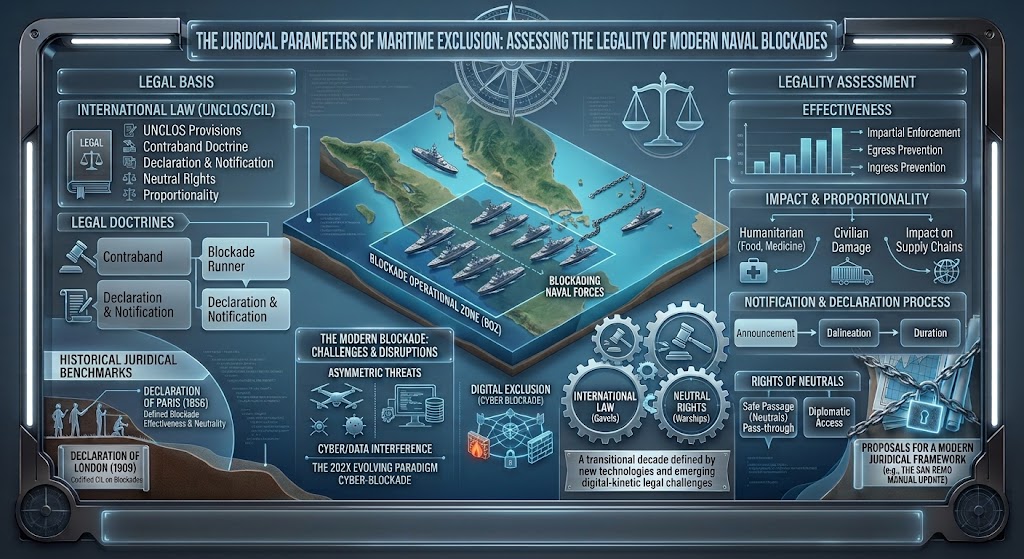
The naval blockade remains one of the most potent yet controversial instruments of maritime power. Historically defined as the blocking of the coast or ports of an enemy by a belligerent's warships to prevent all ingress and egress, the blockade has evolved from the blunt-force sieges of the 19th century into a sophisticated legal construct. In the contemporary era, the legality of a blockade is not merely a matter of naval supremacy but is governed by a complex intersection of customary international law, the Law of Armed Conflict (LOAC), and the burgeoning influence of international human rights law. The transition from the 1856 Declaration of Paris and the 1909 London Declaration to the 1994 San Remo Manual on International Law Applicable to Armed Conflicts at Sea marks a critical trajectory in codifying the rights of belligerents against the protections afforded to neutral commerce and civilian populations.
Unlike other forms of maritime interdiction, such as contraband control or the establishment of maritime exclusion zones, a blockade is an act of war that creates a total legal regime over a specific geographic area. The rigor of its legal requirements is intended to prevent the arbitrary interference with neutral shipping, which remains a cornerstone of the freedom of the high seas. However, as naval technology incorporates long-range sensors, autonomous systems, and standoff weaponry, the traditional requirement of physical presence near the enemy coastline has faced significant jurisprudential scrutiny. This inquiry seeks to dissect the current state of the law, evaluating how ancient principles of effectiveness and notification reconcile with modern military necessity.
What are the fundamental legal requirements for a naval blockade?
Under customary international law, as reflected in the San Remo Manual, the validity of a blockade rests upon four foundational pillars: declaration, notification, effectiveness, and non-discrimination. Failure to satisfy any of these criteria renders the blockade illegal under jus in bello, potentially exposing the enacting state to international litigation or justifying the intervention of neutral powers. These requirements serve as a safeguard against paper blockades—situations where a state claims a blockade exists without having the means to enforce it, thereby creating legal uncertainty for global shipping.
The Declaration must specify the commencement date, the geographical limits of the blockaded area, and the period during which neutral vessels may leave the blockaded ports. This is not a mere formality; it is a jurisdictional boundary that defines where the right of visit, search, and potential seizure begins. Following the declaration, Notification is required. This involves formal communication to all neutral states and the authorities of the blockaded coast. In the absence of such notification, a neutral vessel cannot be seized for breach of blockade unless it can be proven that the master of the vessel had actual or constructive knowledge of the blockade's existence.
The principle of Effectiveness remains the most physically demanding criterion. A blockade must be maintained by a force sufficient to render ingress and egress hazardous. While the 1909 London Declaration implied a close-in cordoning of the coast, modern jurisprudence—informed by the 2011 Palmer Commission report regarding the Mavi Marmara incident—suggests that effectiveness is a question of fact rather than distance. If the blockading power can effectively monitor and intercept vessels through a combination of surface ships, aerial surveillance, and subsurface assets, the legal threshold for effectiveness is likely met. Finally, Non-discrimination dictates that a blockade must be applied impartially to the vessels of all nations. A state cannot permit its own vessels or those of a favored ally to bypass the blockade while seizing others; such selective enforcement invalidates the blockade entirely.
| Legal Criterion | Traditional Interpretation (1909) | Modern Interpretation (San Remo Manual) |
|---|---|---|
| Effectiveness | Physical presence of ships at the harbor mouth. | Capability to prevent access via any naval/aerial means. |
| Geographic Scope | Limited to the immediate enemy coastline. | Can extend to international waters if proportionate. |
| Humanitarian Aid | No specific provisions for neutral aid. | Mandatory passage for essential medical/food supplies. |
| Notification | Formal diplomatic notes to every neutral capital. | Diplomatic notes combined with NOTAMs and NAVAREAs. |
Does a naval blockade violate the United Nations Convention on the Law of the Sea?
The relationship between naval blockades and the United Nations Convention on the Law of the Sea (UNCLOS) is characterized by a significant legal dichotomy. UNCLOS is primarily a lex generalis governing the use of the oceans during peacetime, emphasizing the freedom of navigation (Article 87) and the right of innocent passage (Article 17). Conversely, the law of blockade is part of the lex specialis of armed conflict. The tension arises when a state invokes its rights under the Law of Armed Conflict to override the peacetime guarantees of UNCLOS.
Proponents of the restrictive view argue that UNCLOS Article 301, which requires states to refrain from the threat or use of force against the territorial integrity or political independence of any state, limits the circumstances under which a blockade can be established. However, the prevailing jurisprudential consensus, supported by the International Court of Justice (ICJ) in cases like Nicaragua v. United States and the Oil Platforms case, is that UNCLOS does not supersede the inherent right of self-defense under Article 51 of the UN Charter, nor does it displace the law of naval warfare. While Article 88 of UNCLOS reserves the high seas for peaceful purposes, this is generally interpreted as prohibiting unauthorized military aggression, not as a ban on the recognized methods of naval warfare during a state of armed conflict.
The ambiguity persists regarding the enforcement of blockades in Exclusive Economic Zones (EEZ). Since UNCLOS grants coastal states sovereign rights over economic resources in the EEZ but maintains high-seas freedoms for navigation, a blockading power must ensure that its operations do not unnecessarily interfere with the economic rights of neutral third-party states. The International Tribunal for the Law of the Sea (ITLOS) has yet to rule directly on a blockade's validity, but its jurisprudence on provisional measures often emphasizes the need for states to exercise restraint and respect the safety of life at sea, which acts as a normative check on how a blockade is physically conducted.
Can a blockade be used to starve a civilian population?
One of the most critical evolutions in maritime law is the prohibition of starvation as a method of warfare. Historically, the purpose of a blockade was often to bring a population to its knees by cutting off all supplies. Modern international law, specifically the 1977 Additional Protocol I to the Geneva Conventions and Section 102 of the San Remo Manual, explicitly prohibits blockades if their sole purpose is to starve the civilian population or to deny them objects essential for their survival. If the suffering of the civilian population is disproportionate to the military advantage sought, the blockade is deemed illegal.
This requirement introduces the principle of proportionality into maritime interdiction. A blockading power has an affirmative obligation to provide for the passage of medical supplies and food for the civilian population. While the blockading state has the right to search these shipments and even prescribe technical arrangements (such as specific routes or ports of entry) to ensure that the aid is not diverted for military use, it cannot block them entirely. The Mavi Marmara incident highlighted this friction; the UN-appointed Palmer Commission concluded that while the blockade of Gaza was a legal security measure to prevent weapons smuggling, it had to be balanced against the humanitarian needs of the population. The dissenting voices in that commission, however, argued that the cumulative effect of the restrictions amounted to collective punishment, illustrating the deep ideological divide in how humanitarian thresholds are calculated.
The declaration of a blockade must not be an instrument of indiscriminate suffering. The military necessity of isolating an adversary must always be weighed against the fundamental human rights of the non-combatant population, ensuring that the maritime environment does not become a vacuum of legal accountability.
How is a naval blockade notified to neutral states?
Notification is the mechanism by which the de facto state of naval operations becomes a de jure reality for the international community. For a blockade to be enforceable against neutral vessels, the blockading power must provide clear and timely notice. This is traditionally achieved through diplomatic channels, where the state establishing the blockade sends a formal declaration to the governments of all neutral states. This declaration must define the exact coordinates of the blockade, the time of its commencement, and the grace period granted to neutral ships currently in the blockaded ports to depart.
In the digital age, the methods of notification have expanded to include Notice to Mariners (NOTAMs) and electronic broadcasts via the Global Maritime Distress and Safety System (GMDSS). However, these technical alerts do not replace the formal diplomatic requirement. The importance of notification was underscored in early maritime jurisprudence, such as the 1898 case of The Adula, which established that while knowledge of a blockade could sometimes be presumed, the burden of proof rests heavily on the captor. In modern practice, if a vessel is intercepted and claims ignorance of the blockade, the blockading force must officially notify the master of the vessel and record this notification in the ship’s log before any seizure for breach of blockade can occur. Only a subsequent attempt to cross the line after this direct notification justifies the condemnation of the vessel and its cargo.
The Concept of Neutrality and Breach of Blockade
Neutral states occupy a precarious position during a naval blockade. Under the 13th Hague Convention of 1907, neutral states are not required to prevent their citizens from attempting to trade with a blockaded port, but they must accept the legal consequences if those citizens are caught. A vessel is considered in "breach of blockade" the moment it leaves a neutral port with the manifest intent to enter the blockaded area. This allows the blockading power to intercept the vessel on the high seas, far from the actual blockade line. This doctrine of "continuous voyage" or "intended breach" is controversial, as it extends the reach of the belligerent deep into international waters, often clashing with the high-seas freedoms protected by UNCLOS.
Seizure and condemnation are the legal penalties for breaching a blockade. Once a vessel is seized, it should be brought before a prize court—a domestic tribunal of the captor state that applies international law to determine if the seizure was lawful. While the practice of prize courts has dwindled in the 21st century, the underlying legal principles remain relevant for determining state liability and insurance claims. The Permanent Court of Arbitration (PCA) and other international fora may eventually be called upon to adjudicate these disputes if the domestic prize court process is seen as biased or lacking in due process.
Synthesis and Future Directions
The legal architecture of the naval blockade is undergoing a period of significant stress and adaptation. The rigid requirements of the 19th century are being recalibrated to fit a world of asymmetrical warfare, non-state actors, and integrated global supply chains. As we look forward, several challenges emerge that will likely shape the next generation of maritime jurisprudence. First is the role of autonomous maritime vehicles. Can a blockade be considered "effective" if it is enforced entirely by a swarm of autonomous drones and smart mines without a manned hull in sight? Current law, which emphasizes "hazardous" entry, suggests yes, but the lack of human judgment in the intercept phase raises profound questions about the safety of neutral crews and the risk of accidental escalation.
Second, the intersection of cyber warfare and physical blockades is an unexplored frontier. If a state uses cyber means to disable a port’s infrastructure, does this constitute a "cyber blockade," and must it follow the same rules of declaration and notification? The Tallinn Manual on the International Law Applicable to Cyber Warfare has begun to address these issues, but state practice remains opaque. Finally, the increasing influence of the International Criminal Court (ICC) over the crime of starvation as a war crime (Rome Statute Article 8(2)(b)(xxv)) adds a layer of individual criminal liability to naval commanders and political leaders who order a blockade without adequate humanitarian safeguards.
In conclusion, the naval blockade is not a lawless zone of military convenience but a strictly regulated legal regime. Its legitimacy depends on a delicate balance between the belligerent’s right to cut off the enemy’s resources and the international community’s right to the freedom of navigation and the protection of human life. As maritime technology advances, the international community must remain vigilant in ensuring that the lex specialis of the blockade does not erode the foundational principles of jus cogens and the humanitarian progress of the last century.
Comments
No comments yet.