Legal Analysis, Structural Overview, and Key Provisions of the SUA Convention
A comprehensive examination of the Convention for the Suppression of Unlawful Acts against the Safety of Maritime Navigation and its 2005 Protocols.
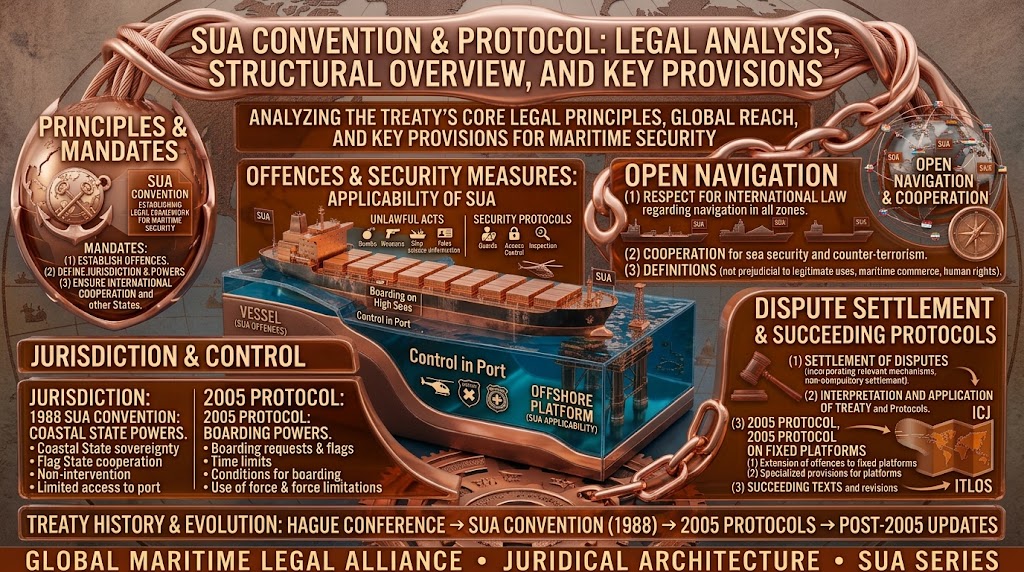
The Convention for the Suppression of Unlawful Acts against the Safety of Maritime Navigation (SUA), adopted in 1988 and significantly expanded by the 2005 Protocols, represents the cornerstone of the international legal framework governing maritime security. Unlike traditional piracy laws, which are historically rooted in the concept of hostis humani generis (enemies of mankind) acting for private ends, the SUA regime was specifically designed to address the rise of maritime terrorism and politically motivated violence at sea. This article provides a rigorous legal analysis of the convention's structural components, jurisdictional nuances, and the evolutionary shift necessitated by the post-9/11 security environment.
Abstract
This legal analysis explores the 1988 SUA Convention and its 2005 Protocols as instruments of international criminal law and maritime security. It examines the treaty's origins following the Achille Lauro hijacking, the definition of offenses, and the innovative aut dedere aut judicare (extradite or prosecute) principle. Furthermore, the article scrutinizes the 2005 expansion, which introduced provisions regarding weapons of mass destruction (WMD) and maritime boarding procedures. By distinguishing SUA from the United Nations Convention on the Law of the Sea (UNCLOS) provisions on piracy, the study highlights the convention's role in filling jurisdictional gaps in the high seas and territorial waters.
Historical Background: The Catalyst of the Achille Lauro
The necessity for a dedicated legal instrument to address non-piratical unlawful acts at sea became tragically apparent in October 1985. Members of the Palestine Liberation Front hijacked the Italian-flagged cruise ship Achille Lauro in the Mediterranean. The incident resulted in the murder of Leon Klinghoffer, an elderly American passenger. When the hijackers were eventually apprehended, the international community faced a significant legal vacuum. Because the hijackers acted for political motives rather than animus furandi (intent to steal for private gain), and because the incident did not involve a two-ship confrontation required by the UNCLOS definition of piracy, many jurisdictions struggled to classify the crime under existing international maritime law.
In response, the International Maritime Organization (IMO) Assembly, spurred by a proposal from Austria, Egypt, and Italy, initiated the drafting of a convention that would criminalize acts threatening the safety of maritime navigation regardless of the perpetrator's motive. The result was the 1988 Convention for the Suppression of Unlawful Acts against the Safety of Maritime Navigation, accompanied by a Protocol for the Suppression of Unlawful Acts against the Safety of Fixed Platforms Located on the Continental Shelf.
What is the convention for the suppression of unlawful acts?
The SUA Convention is an international treaty aimed at ensuring that appropriate action is taken against persons committing unlawful acts against ships. These acts include the seizure of ships by force, acts of violence against persons on board ships, and the placing of devices on board a ship which are likely to destroy or damage it. The primary objective of the convention is to deny safe haven to individuals who commit such acts by requiring State Parties to either prosecute the offenders themselves or extradite them to a state that will.
In its original 1988 form, the convention focused primarily on the safety of the ship and the persons on board. However, the 2005 Protocols radically expanded this scope. The modern SUA regime now encompasses the use of a ship as a weapon, the transport of dual-use materials for weapons of mass destruction, and the transport of fugitives. This evolution transformed the convention from a localized response to terrorism into a global tool for non-proliferation and counter-terrorism enforcement.
Legal Status and Character
The SUA Convention is characterized as a suppression convention. It does not create an international court; instead, it utilizes the domestic legal systems of State Parties to enforce international standards. It operates on the principle of universal jurisdiction's cousin: mandatory treaty-based jurisdiction. Under Article 6, State Parties are obligated to establish jurisdiction over the offenses listed in Article 3 when the offense is committed against or on board a ship flying their flag, in their territory (including territorial sea), or by one of their nationals.
Detailed Analysis of Principal Provisions
Offenses under Article 3
Article 3 of the 1988 Convention defines the prohibited acts. A person commits an offense if that person unlawfully and intentionally:
- Seizes or exercises control over a ship by force or threat thereof;
- Performs an act of violence against a person on board a ship if that act is likely to endanger the safe navigation of that ship;
- Destroys a ship or causes damage to a ship or to its cargo which is likely to endanger the safe navigation of that ship;
- Places or causes to be placed on a ship, by any means whatsoever, a device or substance which is likely to destroy that ship, or cause damage to that ship or its cargo which endangers or is likely to endanger the safe navigation of that ship;
- Destroys or seriously damages maritime navigation facilities or seriously interferes with their operation, if any such act is likely to endanger the safe navigation of a ship;
- Communicates information which he knows to be false, thereby endangering the safe navigation of a ship.
It is important to note the qualifying phrase likely to endanger the safe navigation of that ship. This threshold ensures that the convention is reserved for serious maritime threats rather than minor criminal activities that do not jeopardize the vessel's operational safety.
The Aut Dedere Aut Judicare Principle
The legal crux of the SUA Convention is found in Article 10. It stipulates that the State Party in whose territory the offender or the alleged offender is found shall, if it does not extradite him, be obliged, without exception whatsoever and whether or not the offense was committed in its territory, to submit the case without delay to its competent authorities for the purpose of prosecution. This ensures that perpetrators cannot find legal immunity by simply moving across borders.
How does the SUA Convention differ from piracy laws?
A common point of confusion in maritime law is the distinction between piracy and the acts covered by the SUA Convention. While both involve unlawful violence at sea, their legal definitions and jurisdictional requirements differ significantly under international law, specifically when comparing UNCLOS (Article 101) to the SUA Convention.
First, the definition of piracy under UNCLOS requires that the act be committed for private ends. This excludes most acts of terrorism, which are typically politically motivated. SUA does not require a private ends motive, making it the appropriate instrument for maritime terrorism. Second, the two-ship requirement in UNCLOS means piracy generally involves one ship attacking another. SUA applies to internal takeovers (like the Achille Lauro), where the perpetrators are already on board as passengers or crew. Third, geographical scope is a major differentiator. Piracy is strictly a high seas crime (or in a place outside the jurisdiction of any State). SUA applies if the ship is navigating or scheduled to navigate into, through, or from waters beyond the outer limit of the territorial sea of a single State.
| Feature | Piracy (UNCLOS) | SUA Convention |
|---|---|---|
| Motive | Private ends | Irrelevant (includes political) |
| Location | High seas / Terra nullius | Broad (including territorial waters if international voyage) |
| Vessels Involved | Two ships (attacker and victim) | One ship (internal or external attack) |
| Jurisdiction | Universal | Treaty-based (Mandatory for parties) |
Who has jurisdiction over maritime terrorism?
Jurisdiction under the SUA Convention is multi-layered, established under Article 6 to ensure that at least one State is always empowered and obligated to act. There are three mandatory grounds for jurisdiction and several optional grounds.
Mandatory Jurisdiction: A State Party must establish jurisdiction when the offense is committed:
- Against or on board a ship flying its flag at the time the offense is committed;
- In its territory, which includes its territorial sea;
- By a national of that State.
Optional Jurisdiction: A State Party may also establish jurisdiction if the offense is committed:
- By a stateless person whose habitual residence is in that State;
- During which a national of that State is seized, threatened, abused, or killed;
- In an attempt to compel that State to do or abstain from doing any act.
This comprehensive jurisdictional web is designed to prevent legal loopholes. If an offender is found in the territory of a State Party that does not have a direct link to the crime (e.g., neither the flag state nor the state of nationality), that State is still required by the aut dedere aut judicare rule to establish jurisdiction for the purpose of prosecution if it chooses not to extradite the suspect to a State that does have a link.
The 2005 Protocols: A Post-9/11 Paradigm Shift
The terrorist attacks of September 11, 2001, prompted a fundamental re-evaluation of maritime security. The concern shifted from simple hijacking to the possibility of ships being used as delivery systems for weapons of mass destruction (WMD) or as weapons themselves (e.g., crashing a tanker into a port). The 2005 Protocol to the SUA Convention significantly expanded the list of offenses to meet these modern threats.
New Offenses under the 2005 Protocol
The 2005 Protocol introduced Article 3bis, which criminalizes the use of a ship as a weapon or the use of a ship to transport WMDs. Specifically, it prohibits the discharge of biological, chemical, or nuclear (BCN) weapons from a ship in a manner that causes or is likely to cause death or serious injury or damage. It also criminalizes the transport of any BCN weapon or related material, knowing that it is intended to be used in a terrorist act.
Furthermore, Article 3ter criminalizes the transportation of persons who have committed an offense under the SUA Convention or other UN-defined terrorist treaties, effectively targeting the logistical support networks of international terrorism.
What are the maritime boarding provisions under SUA 2005?
Perhaps the most controversial and legally complex addition in the 2005 Protocol is Article 8bis, which provides a framework for boarding ships on the high seas. Under UNCLOS, the principle of exclusive flag state jurisdiction is paramount; a ship on the high seas is generally subject only to the authority of the state whose flag it flies.
Article 8bis of the 2005 SUA Protocol creates a structured exception to this rule. If a State Party has reasonable grounds to suspect that a ship flying the flag of another State Party is involved in an offense defined by the Convention, it may request the flag State's authorization to board and search the vessel. The protocol offers several options for streamlining this process:
- Explicit Authorization: The flag State may authorize the requesting State to board and take appropriate measures.
- Tacit Authorization (The 4-hour rule): A State may notify the IMO that if it does not respond to a boarding request within four hours, the requesting State is authorized to proceed.
- Prior Authorization: A State may grant standing permission for other States to board its vessels under specific circumstances.
These provisions are balanced by rigorous safeguards in Article 8bis, paragraph 10, which require the boarding State to ensure the safety and humane treatment of persons on board, to avoid unnecessary delay, and to compensate for any damage or loss if the suspicions prove unfounded. This represents a significant evolution in maritime enforcement, balancing the traditional sanctity of the flag state with the urgent need for collective security.
Institutional Mechanisms and Enforcement
The IMO serves as the depositary and the primary institutional body for the SUA Convention. States are required to report to the IMO Secretary-General as soon as possible regarding the circumstances of an offense and the measures taken, particularly regarding the custody and prosecution of offenders. This reporting mechanism ensures a degree of international transparency and accountability.
Enforcement remains the responsibility of individual States. However, the convention facilitates this through mutual legal assistance. Article 12 obligates State Parties to afford one another the greatest measure of assistance in connection with criminal proceedings brought in respect of the offenses, including assistance in obtaining evidence at their disposal necessary for the proceedings.
Dispute Settlement and International Jurisprudence
Article 16 of the Convention addresses the settlement of disputes between State Parties concerning the interpretation or application of the treaty. If a dispute cannot be settled through negotiation within a reasonable time, it may be submitted to arbitration at the request of one of the parties. If the parties are unable to agree on the organization of the arbitration within six months, any party may refer the dispute to the International Court of Justice (ICJ).
While there have been few high-profile ICJ cases specifically centered on the SUA Convention, its provisions are frequently cited in domestic courts during extradition and maritime criminal proceedings. The Enrica Lexie incident (Italy v. India), though primarily argued under UNCLOS regarding sovereign immunity and jurisdictional zones, touched upon the broader principles of maritime criminal jurisdiction that SUA seeks to codify.
Critical Assessment and Contemporary Challenges
Despite its comprehensive nature, the SUA regime faces several challenges in the 21st century. One primary concern is the universal adoption of the 2005 Protocols. While the 1988 Convention has near-universal ratification, the 2005 update—with its invasive boarding provisions—has seen slower uptake. This creates a fragmented legal landscape where different rules apply depending on the treaty version ratified by the flag State and the coastal State.
Another challenge is the definition of terrorism. Because the international community has struggled to agree on a single, comprehensive definition of terrorism, the SUA Convention relies on specific acts (hijacking, violence, WMD transport). This "piecemeal" approach is effective for criminalizing behavior but can lead to interpretative difficulties when an act does not perfectly fit the listed categories but is clearly intended to cause terror.
Finally, there is the tension between maritime security and human rights. The boarding provisions, while necessary for security, raise questions about the rights of the crew, the potential for profiling, and the use of force during maritime interdictions. The safeguards in Article 8bis are intended to mitigate these risks, but their practical application in the isolation of the high seas remains a point of legal scrutiny.
Conclusion
The Convention for the Suppression of Unlawful Acts against the Safety of Maritime Navigation stands as a vital instrument in the architecture of global maritime security. By creating a robust framework for criminalizing maritime violence and mandating the prosecution or extradition of offenders, it addresses the unique challenges posed by non-piratical threats at sea. The 2005 Protocols further modernized this framework, aligning it with contemporary concerns regarding WMD proliferation and the use of vessels as terrorist tools. While challenges regarding ratification and the balance of rights persist, the SUA Convention remains the primary legal vehicle for ensuring that the world's oceans do not become a sanctuary for lawlessness and terror. As maritime threats continue to evolve with technological advancements and geopolitical shifts, the SUA regime will undoubtedly remain at the center of international legal discourse regarding the safety and security of global navigation.
References
- International Maritime Organization (IMO). Convention for the Suppression of Unlawful Acts against the Safety of Maritime Navigation (SUA), 1988.
- IMO. Protocol of 2005 to the Convention for the Suppression of Unlawful Acts against the Safety of Maritime Navigation.
- United Nations. United Nations Convention on the Law of the Sea (UNCLOS), 1982.
- Beckman, R. C. (2002). "Combating Piracy and Armed Robbery Against Ships: Charting a Course for Reforming the International Legal Framework." Ocean Development & International Law.
- Halberstam, M. (1988). "Terrorism on the High Seas: The Achille Lauro, Piracy and the IMO Convention on Maritime Safety." American Journal of International Law.
- Klein, N. (2011). Maritime Security and the Law of the Sea. Oxford University Press.
- Tuerk, H. (2012). Reflections on the Contemporary Law of the Sea. Martinus Nijhoff Publishers.
Comments
No comments yet.