Legal Analysis, Structural Overview, and Key Provisions of the Convention on the International Regulations for Preventing Collisions at Sea, 1972
A comprehensive academic analysis of the COLREG 1972 convention, examining its steering rules, judicial interpretation, autonomy challenges, and liability frameworks.
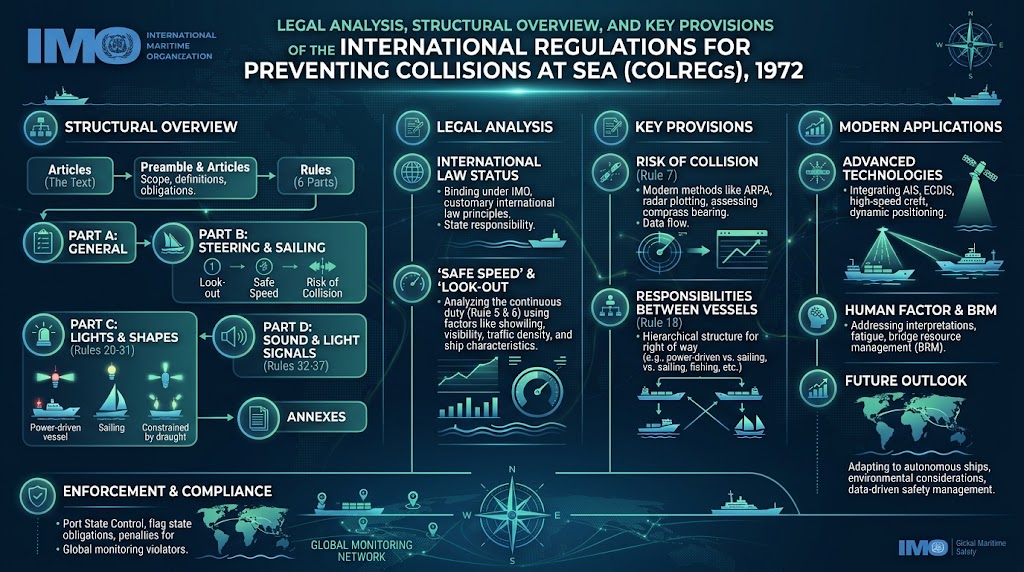
Abstract: The Convention on the International Regulations for Preventing Collisions at Sea, 1972 (COLREGs) constitutes the foundational multilateral framework governing maritime navigation, traffic separation, and collision avoidance on the high seas and connected navigable waters. Established under the auspices of the International Maritime Organization (IMO), the regime transformed customary navigation conventions into a codified, legally binding instrument. This treatise provides an exhaustive academic analysis of the normative structure, institutional mechanics, and jurisdictional architecture of the COLREGs. It scrutinizes the operational dialectic between objective mechanical mandates and subjective standards of ordinary seamanship, analyzes leading Admiralty jurisprudence spanning landmark English, American, and international judgments, examines systemic interactions with the United Nations Convention on the Law of the Sea (UNCLOS), and assesses the profound normative disruptions introduced by Maritime Autonomous Surface Ships (MASS) and electronic navigational integration.
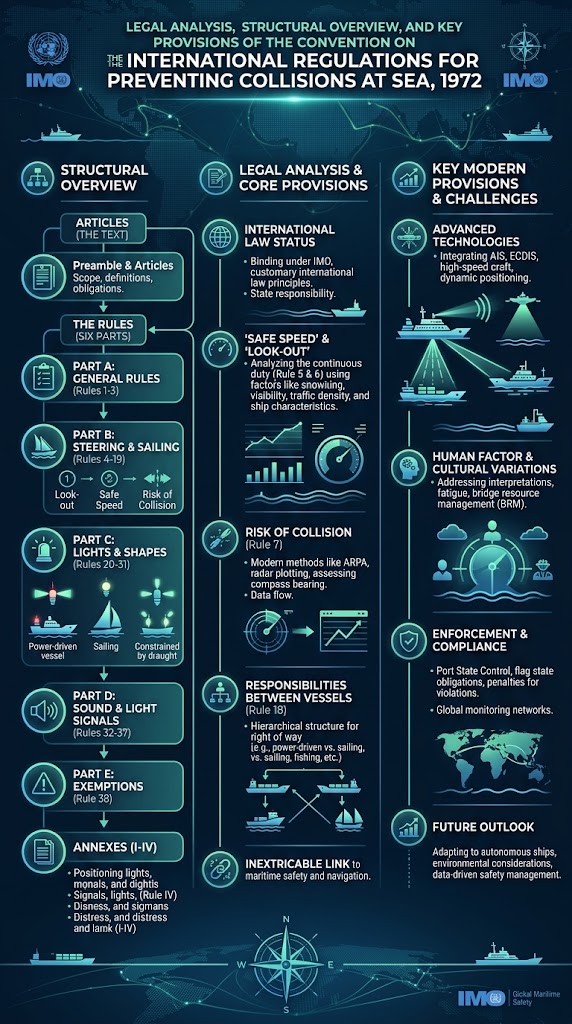
Historical Evolution and Codification of International Navigation Rules
The codification of collision prevention standards reflects centuries of progressive harmonization, transmuting unwritten mariners customary practices into positive international law. Prior to the mid-nineteenth century, collision adjudication relied primarily upon the maritime customary lex maritima and domestic maritime precedents, such as the decisions rendered by the High Court of Admiralty in England and the Maritime Courts of the Mediterranean and Hanseatic trading leagues. In 1840, the Corporation of Trinity House promulgated a set of authoritative recommendations addressing steam navigation and the port-helm rule, which subsequently obtained statutory entrenchment in the United Kingdom through the Steam Navigation Act 1846 and the Merchant Shipping Act 1854.
The transatlantic expansion of industrial steam shipping necessitated an internationalized normative consensus. In 1863, the British Board of Trade, in formal concert with the French imperial government, established a bilateral regulatory code of navigational lights and steering protocols. Within two years, more than thirty maritime sovereign states acceded to these bilateral regulations, effectively crystallizing the earliest multilateral customary standard for navigational conduct. Further systemic refinements were enacted at the International Marine Conference held in Washington, D.C., in 1889, culminating in the 1897 International Regulations for Preventing Collisions at Sea, which formally introduced acoustic maneuvering signals, comprehensive fog operational protocols, and refined the obligations of the stand-on vessel.
The institutional inception of the Inter-Governmental Maritime Consultative Organization (IMCO, later the IMO) in 1948 ushered in modern institutional codification. Although the 1948 and 1960 International Conferences on Safety of Life at Sea (SOLAS) revised collision standards as annexures to the primary safety conventions, rapid technological advances—notably commercial marine radar, ultra-large crude carriers (ULCCs), and dense traffic choke-points such as the Dover Strait—rendered these iterations inadequate. The catastrophic sinking of the Torrey Canyon in 1967 catalyzed the imperative for compulsory routing and modernized procedural mandates. In response, IMCO convened the International Conference on Revision of the International Regulations for Preventing Collisions at Sea in London, leading to the formal adoption of the Convention on the International Regulations for Preventing Collisions at Sea on 20 October 1972, which entered into force internationally on 15 July 1977.
Legal Status, Scope, and Systemic Architecture
The 1972 instrument departed structurally from its antecedents by adopting the form of a distinct, freestanding multilateral convention rather than an annexure to SOLAS. Operating under the depositary authority of the IMO Secretary-General, the Convention commands virtually universal ratification, encompassing over 160 contracting parties representing more than 98 percent of world merchant shipping tonnage. This universal penetration elevates its regulatory rules to the threshold of general international maritime custom, binding upon sovereign vessels as customary international law irrespective of formal accession in common navigational scenarios.
The formal treaty instrument consists of nine substantive articles establishing treaty mechanisms, coupled with the constitutive Regulations divided into Parts A through F, supplemented by four technical annexes. Article I imposes an explicit obligation upon contracting parties to give full and complete effect to the annexed Regulations. Article II governs entry into force mechanics, while Article VI institutes a streamlined tacit acceptance procedure for amendments to the technical regulations, whereby proposed modifications adopted by a two-thirds majority in the IMO Maritime Safety Committee automatically enter into force on a stipulated date unless objected to by more than one-third of the contracting parties.
The Jurisdictional Scope of Rule 1 and Domestic Harmonization
Rule 1 delineates the territorial and operational parameters of the Regulations, establishing that the rules apply to all vessels upon the high seas and in all waters connected therewith navigable by seagoing vessels. This establishes a presumption of international regulatory competence over internal and territorial waters provided those waters are accessible to seagoing shipping. However, Rule 1(b) contains a critical reservation of sovereignty, preserving the legislative prerogative of coastal states to enact special local rules for roadsteads, harbors, rivers, lakes, or inland waterways. Where local rules diverge from the international standard, domestic legislation governs within internal confines, provided that such local provisions conform as closely as possible to the general international rules.
This dynamic was addressed in landmark common law and civil law jurisprudence, including the English Admiralty Court decision in The Cito (1881) and subsequent interpretations such as The Beaverford, demonstrating that vessels navigating inland waters connected to the sea must comply simultaneously with local bylaws and international rules, with local regulations operating as lex specialis only to the extent of direct inconsistency. Rule 1(c) preserves sovereign state authority to introduce special rules with respect to additional station or signal lights, shapes, or whistle signals for ships of war and vessels proceeding under convoy, preserving naval operational latitude under strict sovereign immunity guarantees codified in international law.
Normative Character: The General Prudential Rule and Ordinary Seamanship
A distinctive jurisprudence governs the interpretation of Part A, defined principally by Rule 2, which embodies the General Prudential Rule and the duty of ordinary seamanship. Rule 2(a) operates as an overarching exculpatory limitation and negligence standard, declaring that nothing in the Regulations shall exonerate any vessel, or the owner, master, or crew thereof, from the consequences of any neglect to comply with these Rules or of the neglect of any precaution which may be required by the ordinary practice of seamen, or by the special circumstances of the case.
In legal terms, Rule 2 codifies a fault-based standard of professional tort liability. Judicial tribunals, including the House of Lords in The Macgregor [1942] AC 197 and the United States Supreme Court in The Oregon, 158 U.S. 186 (1895), have recognized that the COLREGs do not constitute an exhaustive, self-contained mechanical code operating in isolation from general maritime tort principles. Rather, the rules operate as minimum statutory duties layered upon the common law maritime duty of care. Rule 2(b) establishes an affirmative legal defense and reciprocal duty of departure, providing that in construing and complying with the Rules, due regard shall be had to all dangers of navigation and collision and to any special circumstances, including the limitations of the vessels involved, which may make a departure from these Rules necessary to avoid immediate danger.
This departure provision does not grant unbridled navigational discretion. Judicial analysis consistently limits the invocation of Rule 2(b) to situations of extreme urgency where literal adherence to a specific steering mandate would inevitably cause the casualty it was designed to avert. As held by Lord Merriman in The Queen Mary (1949) 82 Ll.L.Rep. 303, the party invoking the right or duty to depart from a statutory rule carries a rigorous evidential burden to prove not merely that adherence was perilous, but that the departure adopted was necessary, reasonable, and effective in mitigating immediate peril.
Analysis of Principal Steering and Sailing Rules: Part B
Part B forms the prescriptive nucleus of collision prevention, establishing an objective procedural calculus for navigational interaction. Structurally divided into three sections, its operational hierarchy depends upon whether vessels navigate under any condition of visibility (Rules 4-10), are in sight of one another (Rules 11-18), or navigate in restricted visibility without visual confirmation (Rule 19).
Watchkeeping and Risk Assessment (Rules 5, 6, 7, and 8)
Rule 5 imposes an affirmative, non-delegable duty upon every vessel to maintain at all times a proper look-out by sight and hearing as well as by all available means appropriate in the prevailing circumstances and conditions so as to make a full appraisal of the situation and of the risk of collision. In contemporary maritime litigation, such as The Roseline (1981) 2 Lloyd's Rep 410, courts have held that the phrase all available means obligates the operational integration of automatic radar plotting aids (ARPA), Electronic Chart Display and Information Systems (ECDIS), and Automatic Identification Systems (AIS), alongside physical optical lookouts. The failure to deploy radar efficiently in conditions of darkness or deteriorating visibility constitutes a per se violation of Rule 5.
Rule 6 mandates the maintenance of a safe speed at all times, providing a non-exhaustive catalog of assessment factors, including visibility, traffic density, vessel maneuverability, stopping distance, draught relative to depth, and technical radar characteristics. In The Samco Europe and MSC Prestige [2011] EWHC 1580 (Admlty), the Admiralty Court reaffirmed that safe speed is an absolute, continuous obligation relative to environmental context rather than an immutable mathematical ceiling; what constitutes a safe speed in open oceanic waters becomes an actionable breach within congested convergence zones.
Rule 7 codifies the methodology of assessing risk of collision, establishing a statutory presumption: risk shall be deemed to exist if the compass bearing of an approaching vessel does not appreciably change. Rule 7(c) expressly proscribes assumptions based on scanty information, especially scanty radar information. Rule 8 dictates the parameters of collision-avoidance maneuvers, requiring that any action to avoid collision shall be positive, made in ample time, and with due regard to the observance of good seamanship. Alterations of course and speed must be large enough to be readily apparent to another vessel observing visually or by radar; a succession of small, incremental adjustments is explicitly condemned as contrary to sound legal and nautical practice.
Narrow Channels and Traffic Separation Schemes (Rules 9 and 10)
Rule 9 regulates navigation within narrow channels and fairways, enshrining the starboard-hand obligation: a vessel proceeding along the course of a narrow channel or fairway shall keep as near to the outer limit of the channel or fairway which lies on her starboard side as is safe and practicable. Rule 9 prohibits crossing vessels from impeding the passage of a vessel which can safely navigate only within such channel, creating a structural priority favoring constrained through-traffic.
Rule 10 regulates Traffic Separation Schemes (TSS) adopted by the IMO pursuant to its institutional competence. It requires vessels utilizing a TSS to proceed in the appropriate traffic lane in the general direction of traffic flow, keep clear of traffic separation lines or zones, and enter or terminate lanes at the endpoints at the smallest possible angle. The crossing of lanes is forbidden unless unavoidable, in which event vessels must cross on a heading as nearly as practicable at right angles to the general direction of traffic flow. This deliberate orthogonal requirement minimizes the spatial and temporal exposure of the crossing ship to traffic moving along the designated lane.
How do the crossing rules apply when ships approach a narrow channel?
The operational and jurisdictional intersection between Rule 9 (narrow channels) and the open-water steering rules—specifically Rule 15 (crossing situations)—has generated significant doctrinal debate in Admiralty law. Rule 15 mandates that when two power-driven vessels are crossing so as to involve risk of collision, the vessel which has the other on her own starboard side shall keep out of the way and shall, if the circumstances of the case admit, avoid crossing ahead of the other. The reciprocal Rule 17 obligates the other vessel to keep her course and speed.
The definitive common law jurisprudence resolving this conflict was delivered by the United Kingdom Supreme Court in Evergreen Marine (UK) Ltd v Nautical Challenge Ltd (The Ever Smart and Alexandra 1) [2021] UKSC 6. This litigation arose from a catastrophic collision at the entrance to the narrow approach channel of the port of Jebel Ali, United Arab Emirates. The container vessel Ever Smart was proceeding outbound down the deep-water channel, while the tanker Alexandra 1 was navigating outside the channel, preparing to enter the channel to embark a pilot.
The judicial controversy centered on whether the crossing rules applied in circumstances where one vessel was navigating within a narrow channel and the other was approaching the channel from open waters with the intention of entering it. The lower courts had held that the crossing rules were inapplicable or displaced because the Alexandra 1 was not operating on a sufficiently steady heading to engage Rule 15, and that Rule 9 dominated the spatial encounter. Overturning the Court of Appeal, the Supreme Court unanimously restored the primacy of the crossing rules, establishing three essential legal propositions:
- The crossing rules apply to vessels approaching the mouth of a narrow channel from different directions, provided they are crossing so as to involve a risk of collision, unless the approaching vessel is already committed to navigating on her own starboard side of the channel entrance.
- A vessel approaching a narrow channel entrance is not exempt from the crossing rules merely because she has not yet established a settled course, so long as her intended navigational trajectory is reasonably ascertainable by the other vessel.
- The crossing rules are not automatically displaced by the presence of a narrow channel. Where Rule 9 and Rule 15 can be applied harmoniously, their obligations must be integrated sequentially rather than treating Rule 9 as an absolute exclusion of Rule 15.
The Ever Smart ruling restored predictability to maritime law by discouraging localized judicial exceptions to the objective mechanics of Rules 15, 16, and 17. The stand-on vessel's duty to maintain course and speed under Rule 17 must be preserved until such time as it becomes evident that the give-way vessel is not taking appropriate action in compliance with the Rules.
The Tripartite Interaction: Rules 15, 16, and 17
The steering mechanics between vessels in visual sight of one another are governed by an intricate interdependent triadic dynamic:
| Instrument Provision | Target Classification | Primary Statutory Mandate | Jurisprudential Scope & Limitations |
|---|---|---|---|
| Rule 15 | Give-Way Vessel (Crossing) | Keep out of the way; avoid crossing ahead of the other vessel. | Mandatory duty to execute early, substantial positive action to achieve a safe passing distance. |
| Rule 16 | Give-Way Vessel (General) | Take early and substantial action to keep well clear. | Prohibits delayed maneuvers; strictly proscribes late, minor course alterations. |
| Rule 17(a)(i) | Stand-On Vessel | Maintain course and speed. | Absolute statutory duty designed to provide a predictable frame of reference for the give-way vessel. |
| Rule 17(a)(ii) | Stand-On Vessel | Permissive maneuver: action may be taken as soon as it becomes apparent the give-way ship is not complying. | Discretionary threshold granting autonomy when coordinated compliance breaks down; course alterations to port are discouraged. |
| Rule 17(b) | Stand-On Vessel | Mandatory maneuver: action shall be taken to avert collision when collision cannot be avoided by give-way vessel alone. | Emergency statutory threshold converting permissive navigational judgment into a strict legal obligation to maneuver. |
This dynamic illustrates that the stand-on vessel is not a passive spectator. Under Rule 17(a)(i), maintaining course and speed is a strict affirmative duty. The House of Lords held in The Olympic and H.M.S. Hawke [1913] P 214 that maintaining course and speed does not mandate an invariable heading or throttle setting, but rather the continuation of an established nautical maneuver (such as altering course to follow a sinuous river bend or dropping pilotage speed). Once the threshold of Rule 17(b) is crossed, the stand-on vessel breaches international regulations if it remains passive, incurring proximate liability for the resulting casualty.
Navigation in Restricted Visibility: Rule 19 Jurisprudence
Rule 19 establishes an autonomous legal regime governing vessels not in sight of one another when navigating in or near an area of restricted visibility. The traditional reciprocal relationship between the give-way and stand-on vessel ceases to exist under Rule 19. Instead, every vessel must proceed at a safe speed adapted to the prevailing circumstances and conditions of restricted visibility, with power-driven vessels maintaining their engines ready for immediate maneuver.
Crucially, Rule 19(d) mandates that a vessel which detects by radar alone the presence of another vessel shall determine if a close-quarters situation is developing or risk of collision exists. If so, she shall take avoiding action in ample time. When such action consists of an alteration of course, Rule 19(d) prescribes specific negative criteria:
- An alteration of course to port for a vessel forward of the beam, other than for a vessel being overtaken; and
- An alteration of course towards a vessel abeam or abaft the beam.
In The E.R. Wallonia [1987] 2 Lloyd's Rep 485, the Admiralty Court held that alterations of course to port in restricted visibility forward of the beam represent gross breaches of navigational discipline that invariably attract high percentages of fault apportionment. When fog acoustic signals are heard apparently forward of the beam under Rule 19(e), a master is legally bound to reduce speed to the bare minimum at which the vessel can be kept on her course, or take all way off entirely, navigating with extreme caution until the danger of collision is over.
Parts C, D, E, and F: Technical Harmonization and Verification
Part C (Rules 20-31) and Annex I prescribe the physical, optical, and positional specifications for navigation lights and geometric day shapes. Compliance with Part C is mandatory from sunset to sunrise and in periods of restricted visibility during daylight hours. The judicial construction of Rule 20 emphasizes that proper lights provide essential visual indicators of an approaching vessel's aspect, vector, and special operational limitations (e.g., vessels not under command, restricted in their ability to maneuver, or constrained by their draught).
Part D (Rules 32-37) establishes standardized acoustic and light signaling protocols, delineating between maneuvering signals (Rule 34), warning signals, and sound signals in restricted visibility (Rule 35). The five-short-and-rapid whistle blast sequence of Rule 34(d) constitutes a mandatory communication duty whenever a vessel in sight of another fails to understand the intentions or actions of the other, or doubts whether sufficient action is being taken to avert casualty.
Part E (Rule 38) governs grandfathering exemptions for vessels constructed prior to the entry into force of the 1972 convention. Part F, incorporating Rules 39, 40, and 41 (adopted via MSC.391(95) in 2015), formalized the IMO Instruments Implementation Code (III Code), establishing mandatory audit mechanisms for contracting governments to verify flag state enforcement and domestic institutional compliance with the Convention.
Who is liable for a ship collision under COLREGs?
A fundamental doctrinal tenet of international maritime law is that the COLREGs do not themselves contain substantive civil liability provisions. The convention defines statutory standards of conduct, whereas civil liability and damages apportionment are governed by domestic admiralty law, maritime tort statutes, and the International Convention for the Unification of Certain Rules of Law with respect to Collisions between Vessels (1910 Collision Convention).
Historically, early English admiralty law applied a statutory presumption of fault: under Section 419(4) of the Merchant Shipping Act 1894, any breach of collision regulations rendered the infringing ship liable for the collision without requiring direct proof that the breach caused the accident. This rigid rule of strict statutory culpability was abolished internationally by Article 2 and Article 3 of the 1910 Collision Convention, which instituted the rule of proportional fault: liability attaches strictly in proportion to the degree in which each vessel was at fault. If fault cannot be established, or if the fault appears equal, liability is apportioned equally.
The contemporary legal inquiry into liability for a maritime collision involves a two-stage analysis applied by admiralty courts worldwide:
- The Inculpatory Element (Breach of Duty): Did the vessel breach an applicable rule of the COLREGs, failing to exercise the standard of care expected of a reasonably prudent mariner?
- The Causative Element (Causation): Was that regulatory breach an effective, proximate cause of the collision, or merely a collateral condition?
In The British Aviator [1965] 1 Lloyd's Rep 271 and affirmed in modern decisions such as The Miraflores and The Abadesa [1967] 1 AC 825, appellate courts established that liability does not automatically follow a technical infringement of the COLREGs. A breach of Rule 5 (lookout) or Rule 10 (traffic separation) will not result in financial damages unless it is proved that the violation contributed causatively to the incident. Once causative fault is established on the part of multiple vessels, the court determines the comparative blameworthiness and causative potency of each ship's navigational errors to allocate liability on a percentage basis (e.g., 60/40, 75/25, or 80/20).
In the United States, admiralty jurisprudence long applied the doctrine derived from The Pennsylvania, 86 U.S. 125 (1873). The Pennsylvania Rule established a powerful procedural presumption: if a vessel violates a statutory safety rule intended to prevent collisions (such as the COLREGs), the burden rests upon that vessel to prove not merely that her fault might not have been one of the causes, or that it probably was not, but that it could not have been. Although the US Supreme Court subsequently discarded the ancient divided damages rule in favor of comparative fault in United States v. Reliable Transfer Co., 421 U.S. 397 (1975), the Pennsylvania burden of proof continues to apply to the preliminary assessment of proximate causation in American federal admiralty proceedings.
Jurisdiction, Institutional Mechanisms, and Enforcement
The operational efficacy of the COLREGs depends upon an international matrix of jurisdictional competencies distributed among flag states, coastal states, and port states.
Flag State Jurisdiction (UNCLOS Article 94)
Under general international law, codified in Article 94 of the United Nations Convention on the Law of the Sea (UNCLOS), every state must effectively exercise its jurisdiction and control in administrative, technical, and social matters over ships flying its flag. Specifically, Article 94(3)(c) and 94(4)(c) mandate that flag states must ensure their vessels conform to generally accepted international regulations, procedures, and practices concerning the prevention of collisions. The COLREGs represent the unambiguous international baseline for these generally accepted international rules and standards (GAIRS).
Flag states enforce compliance by incorporating the Regulations into domestic maritime penal and administrative codes. Flag administrations conduct routine flag state inspections, require compliance for the issuance of Safety Construction and Equipment Certificates, and institute disciplinary proceedings—including license revocation—against masters and navigating officers guilty of reckless breaches of the COLREGs.
Port State Control (PSC)
While the COLREGs do not contain an autonomous inspection regime comparable to Chapter XI-1 of SOLAS, port states exercise regulatory oversight over collision compliance via Port State Control regimes, such as those structured under the Paris Memorandum of Understanding (Paris MoU) and the Tokyo Memorandum of Understanding (Tokyo MoU). When foreign vessels enter a party's internal waters and commercial ports, port state control officers (PSCOs) inspect physical compliance with Part C (navigation lights, day shapes, and sound signal appliances) and review navigational bridge logs to assess adherence to Part B. Rectification of defects, or formal detention of the vessel, can be imposed where non-compliance poses an immediate navigational hazard.
Coastal State Jurisdiction and Electronic VTS
Within territorial waters, coastal states retain sovereign authority to police and prosecute navigational violations. Under UNCLOS Article 21(1)(a), coastal states may enact legislation concerning innocent passage with respect to the safety of navigation and the regulation of maritime traffic. Coastal state Vessel Traffic Services (VTS), established in compliance with SOLAS Chapter V, monitor dense straits using shore-based radar, AIS transponders, and optical surveillance. Coastal authorities routinely issue punitive administrative fines and initiate penal prosecutions against offending masters and shipowners who contravene IMO-adopted traffic separation lanes governed by Rule 10.
Contemporary Legal Challenges: Autonomous Ships and Modern Technology
The rapid emergence of Maritime Autonomous Surface Ships (MASS) and artificial intelligence navigation platforms introduces unprecedented normative and structural challenges to the COLREGs architecture.
Maritime Autonomous Surface Ships (MASS)
The International Maritime Organization has completed a comprehensive regulatory scoping exercise on MASS across primary maritime safety conventions, analyzing vessels classified across four progressive degrees of autonomy:
- Degree 1: Ships with automated processes and decision support, where seafarers are on board to operate and control shipboard systems.
- Degree 2: Remotely controlled ships with seafarers on board.
- Degree 3: Remotely controlled ships without seafarers on board.
- Degree 4: Fully autonomous ships whose operating system calculates decisions and determines actions independently.
The integration of Degrees 3 and 4 exposes critical statutory tensions within the COLREGs. Rule 5 imposes the requirement for a proper look-out by sight and hearing as well as by all available means. Doctrinal legal scholars and maritime legal committees debate whether algorithmic computer-vision processing, multi-spectral thermal sensors, and LiDAR arrays fulfill the legal requirement of sight and hearing, which historically presupposed human biological sensory perception. While modern tele-operators located in a remote operating center (ROC) might arguably project visual scrutiny remotely, fully autonomous vessels (Degree 4) lack human perceptual agency.
Furthermore, Rule 2(a)'s reliance on the ordinary practice of seamen presents a significant doctrinal dilemma. This standard embodies an adaptable, anthropomorphic concept of professional prudence, requiring subjective intuition and qualitative situational judgment in non-linear maritime dilemmas. Translating the open-textured negligence standard of ordinary seamanship into deterministic, machine-readable boolean logic algorithms challenges modern software developers. If an autonomous vessel adheres mechanically to the objective rules of Part B while failing to anticipate the irregular, non-compliant maneuvers of an errant fishing vessel, liability may arise from the AI system's inability to deploy human-like common sense under Rule 2(b).
Algorithmic Interventions, ECDIS, and Sensor Fragility
Contemporary navigation relies on integrated bridge systems combining ECDIS, ARPA radar, AIS, and Global Navigation Satellite Systems (GNSS). However, over-reliance on digital systems has fostered an acute operational pathology known as automated complacency. In collisions like that of the bulk carrier Huayang Endeavour and the container vessel Sea Falcon, investigative agencies identified improper ECDIS safety contours and alarm deactivations as material causes.
Moreover, the vulnerability of GNSS to electronic spoofing, cyber jamming, and systemic satellite outages complicates the legal calculus under Rule 6 (safe speed) and Rule 7 (risk of collision). When automated systems fail or present corrupted spatial data, navigating officers must immediately revert to foundational visual, celestial, and acoustic methods, exposing deficiencies in manual seamanship skills.
Offshore Renewable Energy Infrastructure and Spatial Density
The large-scale deployment of offshore wind farms across continental shelf zones has constrained traditional shipping routes in the North Sea, the English Channel, and the South China Sea. The introduction of fixed offshore renewable infrastructure adjacent to TSS lanes compresses navigable fairways, transforming open waters into narrow channels governed by Rule 9. This increases the potential for vessel interactions and limits the sea-room available for give-way vessels executing large, early maneuvers under Rule 8 and Rule 16.
Critical Assessment and Jurisprudential Recommendations
The Convention on the International Regulations for Preventing Collisions at Sea, 1972 has proved resilient, facilitating global trade growth while reducing collision rates. Nevertheless, its legal framework reveals structural vulnerabilities that necessitate deliberate normative revision by the international community.
First, the subjective flexibility of the Regulations—represented by ambiguous phrases such as safe speed, ample time, and small bearing change—creates an epistemic divide between mariners and judicial tribunals analyzing decisions in hindsight. What a master perceives as a safe speed in moderate coastal traffic can be recharacterized post-casualty by an admiralty judge as an egregious breach of Rule 6 based on retrospective simulations.
Second, the interaction between technological development and prescriptive mandates requires institutional clarification. The ongoing development of a non-mandatory and ultimately mandatory MASS Code within the IMO must reconcile the wording of Rule 5 and Rule 8 with algorithmic navigation. Rather than adopting localized exemptions, the IMO should draft a targeted protocol or amendment to the COLREGs that formally defines the parameters of synthetic lookout capabilities, recognizes certified AI algorithms as legally valid components of seamanship, and standardizes collision-avoidance behavior between autonomous and conventionally manned vessels.
Conclusion
The COLREG 1972 convention remains an indispensable pillar of international maritime law. Balancing rigid behavioral mandates (such as the crossing obligations of Rules 15 and 16 and the TSS rules of Rule 10) with situational flexibility (embodied in Rules 2, 6, and 17), the regime creates a predictable, structured environment for navigation. However, the advent of algorithmic decision-making, autonomous shipping, and congested waterways demonstrates that statutory clarity is vital. Preserving the historical integrity of the convention while modernizing its provisions to accommodate emerging maritime technologies is essential to sustaining global navigational safety and maritime legal order.
References and Authoritative Authorities
- Convention on the International Regulations for Preventing Collisions at Sea, 1972, opened for signature 20 October 1972, 1050 UNTS 16 (entered into force 15 July 1977).
- United Nations Convention on the Law of the Sea, opened for signature 10 December 1982, 1833 UNTS 397 (entered into force 16 November 1994).
- International Convention for the Safety of Life at Sea, opened for signature 1 November 1974, 1184 UNTS 2 (entered into force 25 May 1980).
- International Convention for the Unification of Certain Rules of Law with respect to Collisions between Vessels, signed 23 September 1910, UKTS 4 (1913) Cd. 6677.
- Evergreen Marine (UK) Ltd v Nautical Challenge Ltd (The Ever Smart and Alexandra 1) [2021] UKSC 6; [2021] 1 Lloyd's Rep 299.
- The Samco Europe and MSC Prestige [2011] EWHC 1580 (Admlty); [2011] 2 Lloyd's Rep 579.
- The Roseline (1981) 2 Lloyd's Rep 410.
- The E.R. Wallonia [1987] 2 Lloyd's Rep 485.
- The Macgregor [1942] AC 197 (House of Lords).
- The Miraflores and The Abadesa [1967] 1 AC 825 (House of Lords).
- The Pennsylvania, 86 U.S. 125 (1873) (US Supreme Court).
- United States v. Reliable Transfer Co., 421 U.S. 397 (1975) (US Supreme Court).
- Cockcroft, A.N. and Lameijer, J.N.F., A Guide to the Collision Avoidance Rules (7th edn, Elsevier Butterworth-Heinemann 2012).
- Marsden, R.G., Marsden and Gault on Collisions at Sea (15th edn, Sweet & Maxwell 2021).
- International Maritime Organization, Outcome of the Regulatory Scoping Exercise for the use of Maritime Autonomous Surface Ships (MASS), MSC.1/Circ.1638, 3 June 2021.
Comments
No comments yet.