Legal Analysis, Structural Overview, and Key Provisions of the STCW Convention
A comprehensive legal examination of the International Convention on Standards of Training, Certification and Watchkeeping for Seafarers and its role in maritime safety.
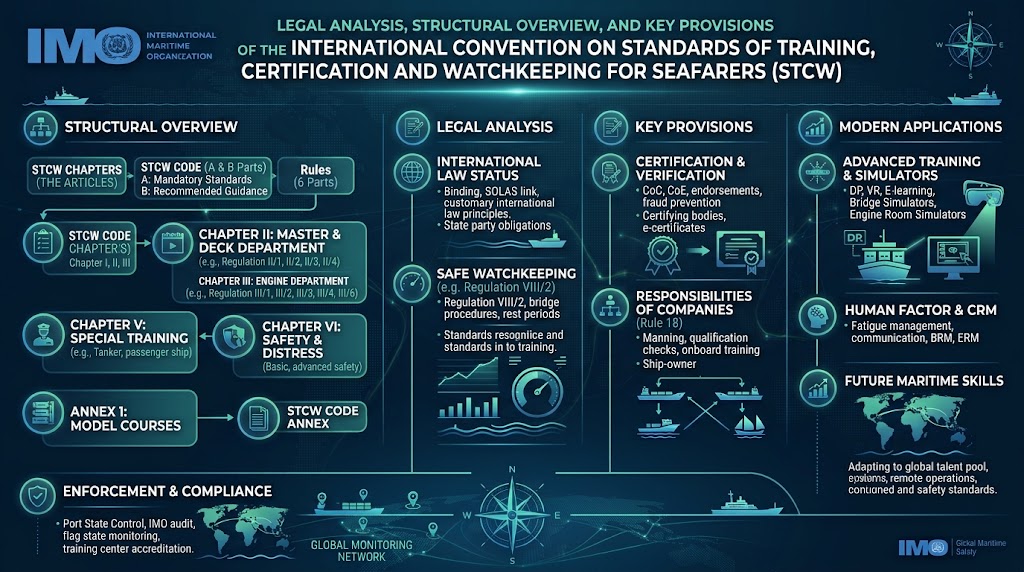
The International Convention on Standards of Training, Certification and Watchkeeping for Seafarers (STCW), 1978, as amended, represents one of the four essential pillars of the international maritime regulatory regime, alongside the International Convention for the Safety of Life at Sea (SOLAS), the International Convention for the Prevention of Pollution from Ships (MARPOL), and the Maritime Labour Convention (MLC). While other instruments focus primarily on the technical specifications of vessels or environmental protection, the STCW Convention addresses the most critical component of maritime safety: the human element. This article provides an exhaustive legal analysis of the STCW framework, its structural evolution, and the complex jurisdictional interactions that define its enforcement.
Abstract
This legal analysis explores the normative framework established by the STCW Convention. It examines the shift from discretionary national standards to uniform international benchmarks, the legal mechanisms of the 1995 and 2010 amendments, and the unique role of the International Maritime Organization (IMO) in auditing sovereign compliance. By assessing the interplay between Flag State obligations and Port State Control (PSC), the article elucidates the enforcement challenges inherent in a globalized labor market. Key focus areas include the STCW Code, the concept of the White List, and the legal implications of technological advancements on seafarer competency.
Keywords
STCW Convention, Maritime Safety, IMO, Manila Amendments, Seafarer Certification, Watchkeeping Standards, Port State Control, Flag State Implementation, Maritime Law, STCW Code.
Historical Background and Legal Evolution
Prior to 1978, the standards for training and certification of seafarers were determined primarily by individual national governments, leading to significant disparities in competency and safety. The 1978 Convention was the first to establish basic requirements on training, certification, and watchkeeping at an international level. However, the original text was frequently criticized for its vague language, which allowed for broad interpretations (e.g., standards to the satisfaction of the Administration). This lack of precision undermined the objective of global uniformity.
The 1995 amendments marked a paradigm shift. They introduced the STCW Code, divided into mandatory standards (Part A) and recommended guidance (Part B). More importantly, they granted the IMO a degree of oversight over national maritime administrations, requiring them to submit evidence of compliance to the IMO Maritime Safety Committee (MSC). This led to the creation of the so-called White List of compliant nations.
The 2010 Manila Amendments further refined the convention to address modern maritime challenges, including security threats, technological shifts (such as Electronic Chart Display and Information Systems - ECDIS), and a heightened focus on seafarer welfare and fatigue management. These amendments represent the current operational standard for the global maritime industry.
What are the Manila amendments to STCW?
The 2010 Manila Amendments introduced several critical updates to ensure the STCW Convention remained relevant in a rapidly evolving technological and regulatory landscape. Legally, these amendments were adopted through the tacit acceptance procedure, ensuring a streamlined entry into force across all contracting parties. The primary revisions included:
- Fatigue Prevention: Revised requirements for hours of work and rest were implemented to align with the Maritime Labour Convention (MLC). Specifically, the amendments mandated a minimum of 10 hours of rest in any 24-hour period and 77 hours in any 7-day period.
- Training for New Technologies: Mandatory training was established for ECDIS, which replaced traditional paper charts on most commercial vessels.
- Security Training: In response to rising piracy and maritime security threats, specific training requirements for all seafarers (Security Awareness) and those with designated security duties were introduced.
- Medical Standards: The amendments harmonized medical fitness standards, ensuring that seafarers are physically capable of performing their duties without risking themselves or the vessel.
- Environmental Awareness: Increased focus was placed on marine environmental awareness training to ensure compliance with MARPOL requirements.
- Alcohol Limits: A mandatory limit of not greater than 0.05% blood alcohol level (BAC) or 0.25 mg/l alcohol in the breath was established for seafarers performing safety, security, and marine environmental duties.
Legal Character and Treaty Structure
The STCW Convention is a multilateral treaty that operates under the auspices of the IMO. Its legal character is defined by its ability to impose mandatory standards on sovereign states through its Annexes and the STCW Code. The structure of the instrument is tripartite:
- The Articles: These contain the legal framework, including definitions, general obligations, amendment procedures, and jurisdictional boundaries.
- The Annex: Contains technical regulations regarding training, certification, and watchkeeping.
- The STCW Code: Divided into Part A (Mandatory) and Part B (Recommended). Part A contains the precise technical details that must be met for a certificate to be valid under the Convention.
Article I of the Convention obligates Parties to give full and complete effect to its provisions to ensure that seafarers on board ships are qualified and fit for their duties. This obligation is absolute; a state cannot claim its domestic law as a defense for failing to meet the minimum international standard.
How does the STCW Code regulate watchkeeping?
Chapter VIII of the STCW Code, titled Standards regarding watchkeeping, provides the legal basis for the safe conduct of a vessel's voyage. The regulations are designed to prevent maritime casualties caused by human error, which is estimated to be a factor in over 80% of accidents. The Code mandates that all officers in charge of a watch must ensure that the ship is safely navigated and that a proper lookout is maintained at all times in accordance with Rule 5 of COLREGs.
Legal responsibility for watchkeeping is shared between the Master, the Chief Engineer, and the watchkeeping officers. The Code specifies that watchkeepers must not be assigned duties that interfere with the safety of the vessel. Furthermore, the mandatory rest periods mentioned in the Manila Amendments are integrated into Chapter VIII to ensure that watchkeepers are not impaired by fatigue. The Principles to be observed in keeping a safe watch are non-negotiable and must be incorporated into the Standing Orders of every vessel. Failure to comply with these watchkeeping standards often serves as a primary ground for establishing negligence in maritime litigation.
Analysis of Principal Provisions and Obligations
Certification and Competency
Regulation I/2 requires that every certificate of competency (CoC) issued to a seafarer must be in a format approved by the IMO. The administration of the Flag State is responsible for verifying the authenticity of certificates. This creates a chain of accountability where the issuing state guarantees the competency of the individual to the international community.
The Concept of the White List
Under Regulation I/7, Parties must provide information to the IMO regarding their compliance with the Convention. If the Maritime Safety Committee is satisfied that the Party has given full and complete effect to the Convention, the Party is placed on the so-called White List. From a legal perspective, being on the White List is a prerequisite for the international recognition of a state's certificates. Ships flying the flag of a non-White List state, or employing seafarers with certificates from such a state, face significantly higher scrutiny and potential detention by Port State Control.
What is the STCW white list?
The STCW White List is not a formal term used within the text of the Convention but is the industry-standard term for the list of countries that the IMO Maritime Safety Committee has confirmed to be in full compliance with the STCW 95/2010 requirements. Legally, this list is maintained under the authority of Regulation I/7 and I/8.
The significance of the White List lies in the principle of mutual recognition. When a country is on the White List, other Member States can have confidence that the certificates issued by that country meet the minimum international standards. If a country is not on the list, other states may refuse to recognize its certificates for service on their vessels. This creates a powerful economic and legal incentive for states to modernize their maritime education and training systems and to permit IMO-appointed experts to audit their internal processes.
Jurisdiction and Enforcement Mechanisms
The STCW Convention employs a dual-enforcement mechanism involving Flag State jurisdiction and Port State Control (PSC). Under Article VI, the Flag State has the primary responsibility for issuing certificates and ensuring its ships are manned according to the Convention. However, Article X grants Port States the authority to verify compliance when a foreign ship is in its port.
Port State Control (Regulation I/4)
Regulation I/4 permits PSC officers to verify that all seafarers on board possess the required certificates. If there are clear grounds for believing that the standards are not being met, the PSC officer may conduct a more detailed inspection. These clear grounds include:
- The ship has been involved in a collision or grounding.
- The ship has discharged substances in violation of international conventions.
- The ship has been maneuvered in an erratic or unsafe manner.
- The certificates of competency are missing, expired, or clearly fraudulent.
How does port state control enforce STCW standards?
The enforcement of STCW by Port State Control is one of the most effective tools for maintaining global maritime standards. When a PSC officer boards a vessel, they perform a document check under Regulation I/4. If deficiencies are found, such as expired endorsements or lack of specialized training for tanker operations, the Port State has the legal authority to detain the vessel. Detention is a severe administrative measure that prevents the vessel from sailing until the deficiency is rectified—usually by replacing the unqualified crew member.
Furthermore, under the No More Favorable Treatment clause (Article X, paragraph 5), Port States must apply the STCW standards to all ships, regardless of whether the ship's Flag State is a party to the Convention. This ensures that non-party ships cannot gain a competitive advantage by employing sub-standard crew, effectively making the STCW standards universal even for non-signatories.
Who is liable for a ship collision under STCW?
While the STCW Convention itself is an administrative and regulatory treaty rather than a liability convention, it plays a pivotal role in determining liability in civil and criminal litigation following a collision. In most jurisdictions, a breach of the STCW watchkeeping standards (Chapter VIII) creates a presumption of negligence.
If a collision occurs and it is discovered that the officer of the watch was unqualified, was working beyond the permitted hours (fatigued), or was not properly certified for the specific equipment (e.g., ECDIS), the shipowner or operator may be held liable under the principle of respondeat superior. Furthermore, such breaches may jeopardize the shipowner's ability to limit liability under the Convention on Limitation of Liability for Maritime Claims (LLMC), as the failure to ensure proper manning can be construed as an act or omission committed with the intent to cause such loss, or recklessly and with knowledge that such loss would probably result.
What are the minimum safe manning requirements?
Minimum safe manning is the legal requirement that a ship must carry a sufficient number of qualified personnel to ensure the safety and security of the ship, its crew, passengers, cargo, and the marine environment. While STCW provides the standards for the competency of individuals, the number of people required is governed by Regulation V/14 of SOLAS and IMO Resolution A.1047(27).
The STCW Convention supports this by requiring each ship to carry a Minimum Safe Manning Document (MSMD) issued by the Flag State. This document specifies the minimum number and grades of personnel required. During a PSC inspection, the officer will compare the actual crew on board against the MSMD. If the ship is unmanned relative to its certificate, it is considered unseaworthy and will be detained. The legal nexus between STCW (quality) and SOLAS (quantity) ensures a comprehensive approach to human-resource-based safety.
Contemporary Legal Challenges and Technological Disruptions
The STCW framework faces significant challenges from the rapid digitalization of the maritime industry. One of the primary issues is the rise of fraudulent certificates. In an era of sophisticated digital editing, the verification of seafarer credentials has become increasingly difficult. To combat this, the IMO is promoting the use of e-certificates and centralized digital databases for real-time verification.
Another challenge is the emergence of Maritime Autonomous Surface Ships (MASS). The current STCW Convention is built on the assumption of a human crew being physically present on a vessel. The legal definitions of Master, officer, and watchkeeper may need to be fundamentally revised to encompass remote operators located in shore-based control centers. This raises complex questions regarding jurisdiction: if a remote operator in country A navigates a ship in country B's waters, which state's training standards apply?
Mental Health and Human Element
Recent legal discourse has emphasized that competency under STCW must include psychological fitness. The isolation and stress of long-term seafaring, exacerbated by the COVID-19 pandemic crew change crisis, have highlighted gaps in the Convention's approach to mental health. Legal scholars argue for more robust mandatory standards regarding onboard welfare and psychological support systems within the STCW Code.
Critical Assessment and Jurisprudence
The STCW Convention has undoubtedly raised the floor for global maritime training. However, its effectiveness is often limited by the uneven quality of training institutions in different countries. While the White List provides some assurance, the IMO lacks a permanent enforcement arm to conduct unannounced inspections of training facilities, relying instead on periodic reports from member states.
In the case of The Star Maria [2003], the court examined the relationship between certification and seaworthiness. The court held that the mere possession of an STCW-compliant certificate does not automatically prove competency if the individual's actual performance demonstrates a fundamental lack of skill. This reinforces the principle that while STCW provides the legal framework for presumed competency, the ultimate responsibility for ensuring a seaworthy crew remains with the shipowner.
Conclusion
The International Convention on Standards of Training, Certification and Watchkeeping for Seafarers remains the cornerstone of the human element in maritime law. Through its sophisticated structure of Articles, Annexes, and the STCW Code, it has successfully transitioned the industry from a patchwork of national rules to a unified global standard. The 2010 Manila Amendments demonstrated the Convention's capacity for evolution, addressing fatigue, technology, and security.
However, as the maritime industry moves toward decarbonization and automation, the STCW framework must undergo further radical transformation. The legal community must focus on harmonizing digital certification, defining the competency of remote operators, and strengthening the enforcement powers of the IMO. Only through rigorous adherence to these standards can the international community hope to reduce maritime accidents and protect the lives of those who serve at sea.
References
- International Maritime Organization. (2011). STCW: Including 2010 Manila Amendments: STCW Convention and STCW Code. London: IMO Publishing.
- Baughen, S. (2019). Shipping Law. Routledge.
- Chircop, A., Lindén, O., & Mukherjee, P. K. (2006). The STCW Convention: A Review of the 1995 Reform. Journal of Maritime Law and Commerce.
- United Nations Convention on the Law of the Sea (UNCLOS), 1982.
- IMO Resolution A.1047(27) on Principles of Safe Manning.
- International Convention for the Safety of Life at Sea (SOLAS), 1974.
Comments
No comments yet.