Legal Analysis, Structural Overview, and Key Provisions of the SAR Convention
A comprehensive academic legal analysis of the International Convention on Maritime Search and Rescue (SAR), its structural framework, and core obligations.
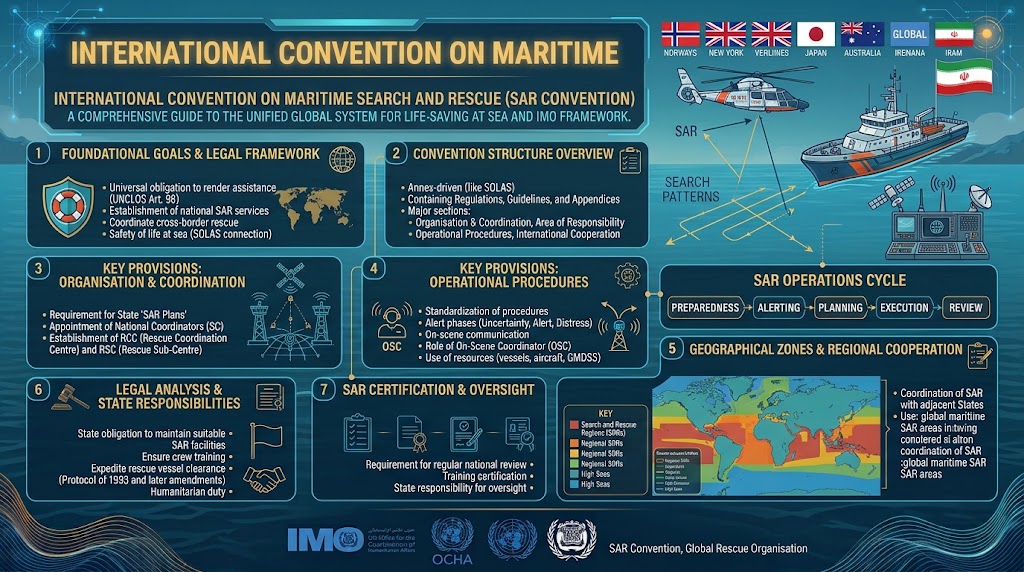
Abstract
This academic legal analysis examines the International Convention on Maritime Search and Rescue (SAR), 1979, evaluating its structural framework, principal provisions, international legal character, and the complex interplay between state sovereignty and humanitarian obligations at sea. The article explores the historical imperatives leading to the treaty's adoption, its jurisdictional reach under the United Nations Convention on the Law of the Sea (UNCLOS), institutional mechanisms governed by the International Maritime Organization (IMO), and contemporary enforcement challenges. Special attention is devoted to interpretive controversies surrounding places of safety, extraterritorial application, and the reconciliation of rescue obligations with migration control frameworks.
Keywords
Maritime Search and Rescue, SAR Convention, IMO, Law of the Sea, State Obligations, Place of Safety, Distress Jurisprudence
Introduction and Historical Background
The safety of navigation and the preservation of human life in the marine environment have long formed foundational tenets of customary international law. Historically, the duty to render assistance to persons in distress at sea was primarily enforced through moral imperatives, maritime tradition, and decentralized bilateral arrangements. However, the exponential growth of international maritime commerce, commercial aviation, and offshore industrial exploration following the Second World War exposed severe structural deficiencies in global coordination mechanisms for maritime emergencies. Catastrophic maritime casualties demonstrated that fragmented, ad hoc rescue efforts frequently resulted in fatal delays, uncoordinated multi-agency responses, and jurisdictional disputes regarding operational command and control.
Recognizing the urgent need for a unified global regime, the International Maritime Organization (IMO), then operating as the Inter-Governmental Maritime Consultative Organization (IMCO), spearheaded diplomatic efforts that culminated in the adoption of the International Convention on Maritime Search and Rescue (SAR) on April 27, 1979. The 1979 SAR Convention was expressly designed to develop an international search and rescue plan ensuring that, no matter where an accident occurs, the rescue of persons in distress at sea is coordinated by a search and rescue organization or, when necessary, by cooperation with neighboring search and rescue services. The treaty entered into force on June 22, 1985, following the fulfillment of requisite ratification thresholds.
Despite its ambitious inception, the original 1979 text encountered substantial implementation hurdles. Many developing maritime nations lacked the financial resources, technical infrastructure, and institutional capacity required to establish and maintain dedicated national rescue coordination centers (RCCs) and regional operational sub-centers. Consequently, large expanses of the global ocean remained devoid of effective search and rescue coverage. This operational deficit prompted a comprehensive revision of the Convention initiated by the IMO Maritime Safety Committee in the late 1990s. The revised SAR Convention, adopted by Conference resolution in May 1998, entered into force on January 1, 2000. This overhaul streamlined operational standards, clarified state responsibilities regarding Search and Rescue Regions (SRRs), and integrated modern communication architectures such as the Global Maritime Distress and Safety System (GMDSS).
What is the legal character and international status of the SAR Convention?
The International Convention on Maritime Search and Rescue occupies a specialized niche within the corpus of public international law and international law of the sea. Structurally, it functions as a multilateral treaty establishing uniform technical standards, operational obligations, and cooperative frameworks among state parties. Its legal character cannot be divorced from its symbiotic relationship with other foundational instruments, most notably the 1982 United Nations Convention on the Law of the Sea (UNCLOS) and the 1974 International Convention for the Safety of Life at Sea (SOLAS).
Under Article 98 of UNCLOS, state parties are mandated to require the master of a ship flying its flag, insofar as he can do so without serious danger to the ship, the crew, or the passengers, to render assistance to any person found at sea in danger of being lost, and to proceed with all possible speed to the rescue of persons in distress. Furthermore, coastal states are obligated to promote the establishment, operation, and maintenance of an adequate and effective search and rescue service regarding safety on and over the sea and, where circumstances so require, by way of mutual regional arrangements cooperate with neighboring states for this purpose. The SAR Convention operationalizes these broad UNCLOS mandates by providing the detailed technical blueprint and administrative machinery required to execute these duties.
From a formalistic perspective, the SAR Convention employs a framework-convention model supplemented by technical Annexes. While the main body of the treaty establishes overarching state obligations, entry-into-force mechanics, amendment procedures, and dispute resolution pathways, the substantive operational requirements are contained within the Annex. This bifurcation facilitates dynamic regulatory adaptation. Through the tacit acceptance procedure codified in Article XVI of the SAR Convention, technical amendments to the Annex adopted by the IMO Maritime Safety Committee enter into force for all contracting governments unless a specified proportion of parties register objections. This mechanism ensures that search and rescue standards evolve synchronously with technological advancements in satellite tracking, telecommunications, and maritime aviation.
Structural Overview and Treaty Architecture
The architecture of the 1979 SAR Convention, as amended, is deliberately designed to balance sovereign rights over maritime zones with collective international responsibility for human life. The treaty comprises a preamble, 19 substantive articles, and an Annex divided into five distinct chapters. Each chapter targets a specific operational dimension of maritime search and rescue coordination.
- Chapter 1: Terms and Definitions: Establishes authoritative legal and operational terminology, defining concepts such as Rescue Coordination Centre (RCC), Rescue Sub-Centre (RSC), Search and Rescue Region (SRR), Alert phase, Distress phase, and Emergency phase.
- Chapter 2: Organization: Mandates state parties to establish basic elements of a search and rescue service, including legal frameworks, designated rescue authorities, communication infrastructure, and coordination facilities.
- Chapter 3: Co-operation between States: Regulates international cooperation, obligating parties to coordinate search and rescue operations, establish joint rescue regions, and permit rescue units of other parties to enter their territorial sea or territory to render assistance.
- Chapter 4: Operating Procedures: Details operational protocols for initiating emergency phases, assisting vessels in distress, handling distress communications, and terminating search and rescue operations.
- Chapter 5: Ship Reporting Systems: Establishes standards for voluntary and mandatory ship reporting systems utilized to facilitate search and rescue planning, reduce search intervals, and track maritime traffic.
Analysis of Principal Provisions and State Obligations
The substantive obligations imposed upon contracting governments by the SAR Convention are rigorous and multifaceted, requiring both domestic administrative implementation and active international collaboration. A critical examination of these provisions reveals a dual legal nature: obligations directed toward internal infrastructural readiness and obligations governing external interstate coordination.
Article 2 of the Convention sets forth the fundamental obligation of contracting governments to adopt all legislative, administrative, and other measures necessary to give full effect to the Convention and its Annex. This requires states to designate responsible authorities—typically national coast guards, naval commands, or specialized civil aviation and maritime transport agencies—entrusted with the day-to-day oversight of search and rescue operations.
A core obligation under Chapter 2 of the Annex is the establishment of Rescue Coordination Centres (RCCs). Contracting governments are required to ensure that such centers are staffed 24 hours a day with trained personnel proficient in English and equipped with rapid, reliable means of communication with participating rescue units, coastal radio stations, and adjacent RCCs. Where national resources are insufficient to maintain a dedicated RCC for a designated zone, states must enter into cooperative arrangements with neighboring administrations to pool resources and eliminate jurisdictional gaps.
Furthermore, Chapter 3 mandates that state parties shall delineate Search and Rescue Regions (SRRs) within each ocean basin or coastal zone. Crucially, the establishment of SRRs does not prejudice or affect in any way the legal regime of the waters over which they are designated, nor does it alter maritime boundaries delimited under international law. The delineation of an SRR is an operational, functional allocation of responsibility rather than an assertion of territorial sovereignty or sovereign rights under the law of the sea.
How are Search and Rescue Regions and jurisdictional competencies delineated?
The legal demarcation of Search and Rescue Regions constitutes one of the most operationally significant elements of the SAR Convention regime. An SRR is defined as an area of defined dimensions, associated with a rescue coordination centre, within which search and rescue services are provided. The delimitation of these regions is achieved through regional agreements or bilateral negotiations facilitated under the auspices of the IMO.
When the SAR Convention was originally adopted, many coastal states were hesitant to delineate SRRs due to perceived risks of compromising sovereign maritime claims or assuming exorbitant financial liabilities for vast oceanic expanses. To resolve this, the IMO instituted regional conferences aimed at rationalizing global search and rescue coverage. Under the revised 1998 framework, the world's oceans are divided into distinct search and rescue areas, each assigned to a primary coordinating state.
However, jurisdictional complexities frequently arise at the margins of overlapping SRRs or in areas beyond national jurisdiction (ABNJ), commonly referred to as the high seas. While coastal states have primary responsibility for SRRs adjacent to their coasts, incidents occurring on the high seas require cooperative frameworks where multiple nations may possess proximate rescue assets. Article 3 of the SAR Convention emphasizes that parties shall coordinate their search and rescue organizations and, whenever necessary, cooperate with neighboring states in search and rescue operations involving joint or adjacent regions.
A profound legal tension exists between search and rescue jurisdictional competencies and territorial sovereignty. When a vessel in distress is located within the territorial sea or internal waters of a coastal state, the coastal state exercises full territorial sovereignty over entry, boarding, and rescue execution. Conversely, on the high seas, the principle of exclusive flag state jurisdiction governs vessels navigating outside territorial waters, yet search and rescue intervention by third-party states is authorized under customary international law and treaty provisions to save human life, overriding traditional jurisdictional barriers.
Rights, Exceptions, and Interpretive Controversies
The application of the SAR Convention is subject to specific legal exceptions and has generated significant interpretive controversies in contemporary maritime practice. Chief among these controversies is the legal regime governing the designation of a 'place of safety' for persons rescued at sea, and the intersection of maritime rescue law with international refugee and immigration law.
Under amendments to the SAR Convention and the SOLAS Convention adopted in 2004, contracting governments are obligated to coordinate and cooperate to ensure that masters of ships rendering assistance are released from their obligations with minimum additional delay, and that survivors are delivered to a place of safety. However, neither the SAR Convention nor SOLAS explicitly defines what constitutes a 'place of safety,' nor do they explicitly designate which state bears the ultimate legal obligation to disembark rescued persons when rescue operations take place on the high seas or within the SRR of a state reluctant to admit them.
This ambiguity has precipitated intense diplomatic friction and legal disputes. States adjacent to primary migration routes in the Mediterranean Sea and other maritime flashpoints have frequently invoked sovereignty and border control prerogatives to deny entry to commercial or humanitarian vessels carrying rescued migrants. Conversely, flag states and shipmasters argue that detaining rescued individuals on board vessels indefinitely breaches international maritime safety norms, human rights standards, and the fundamental humanitarian ethos of the SAR regime.
International bodies, including the IMO Legal Committee and the United High Commissioner for Refugees (UNHCR), have issued numerous guidelines emphasizing that a place of safety is not merely a location where life is no longer threatened, but a place where survivors' basic human needs—such as food, shelter, and medical care—can be met, and where their legal status can be assessed in accordance with international refugee law, including the principle of *non-refoulement*. Despite these normative clarifications, binding treaty obligations regarding the mandatory assignment of a disembarkation port remain a persistent gap in the international legal architecture.
Institutional Mechanisms and Enforcement Regimes
The enforcement of the SAR Convention relies primarily on a system of indirect international oversight, flag state responsibility, and port state cooperation, rather than centralized judicial penalization. The principal institutional mechanism charged with administering and monitoring the implementation of the Convention is the International Maritime Organization, acting through the Maritime Safety Committee (MSC) and the Sub-Committee on Navigation, Communications and Search and Rescue (NCSR).
Unlike environmental treaties or human rights conventions equipped with dedicated judicial tribunals, the SAR Convention does not feature an independent enforcement court. Instead, compliance is monitored through the IMO Member State Audit Scheme (IMSAS), which became mandatory under resolution MSC.366(93). IMSAS subjects contracting governments to periodic, systematic audits to evaluate their adherence to mandatory IMO instruments, including the SAR and SOLAS Conventions. These audits assess legal infrastructures, technical capabilities, training protocols, and operational readiness.
Furthermore, port state control (PSC) mechanisms—while traditionally focused on vessel seaworthiness, safety equipment, and pollution prevention under SOLAS and MARPOL—indirectly interface with the SAR regime. When port state inspectors verify compliance with safety management systems (such as the ISM Code), they examine whether commercial vessels carry appropriate publications, distress signaling equipment, and operational instructions governing search and rescue interactions. Nevertheless, direct enforcement of search and rescue coordination duties remains predominantly tied to state self-reporting and diplomatic peer review within IMO forums.
Dispute Settlement and International Jurisprudence
Disputes arising concerning the interpretation or application of the SAR Convention are primarily addressed through diplomatic channels, negotiation, and mediation. Article XVII of the SAR Convention outlines the formal dispute settlement mechanism, providing that any dispute between two or more contracting governments concerning the interpretation or application of the Convention which cannot be settled by negotiation shall, upon request of one of them, be submitted to arbitration. If the parties are unable to agree on the organization of the arbitration within six months from the date of the request, any of the parties may refer the dispute to the International Court of Justice (ICJ).
In practice, direct recourse to ICJ litigation or formal binding arbitration under the SAR Convention is exceptionally rare. More frequently, legal controversies concerning maritime rescue, state jurisdiction, and state responsibility are adjudicated before broader international tribunals exercising jurisdiction under UNCLOS, such as the International Tribunal for the Law of the Sea (ITLOS) or Annex VII arbitral tribunals.
While jurisprudence specifically interpreting the SAR Convention text in isolation is limited, international courts and tribunals have increasingly addressed the legal implications of maritime search and rescue within advisory opinions and contentious cases. For instance, in maritime delimitation cases and disputes concerning sovereign rights in exclusive economic zones, tribunals have reaffirmed that the exercise of search and rescue duties is an inherent attribute of coastal state governance that must be executed without discrimination and in strict accordance with international human rights standards. The evolving jurisprudence emphasizes that humanitarian rescue obligations under UNCLOS Article 98 and the SAR Convention possess an erga omnes character, binding upon all states regardless of specific treaty ratification status.
Relationships with Other International Legal Instruments
The SAR Convention does not operate in a legal vacuum; it is deeply embedded within a dense network of international treaties governing the maritime domain, civil aviation, and human rights. Understanding the normative weight of the SAR Convention requires analyzing its structural linkages with several core instruments:
- UNCLOS (1982): Provides the overarching constitutional framework for the law of the sea, anchoring the general duty to render assistance (Article 98) and establishing the sovereign rights and jurisdictional limits within which SAR operations are conducted.
- SOLAS Convention (1974): Establishes detailed structural and equipment standards for commercial vessels, including mandatory carriage requirements for two-way VHF radiotelephone apparatuses, satellite emergency position-indicating radio beacons (EPIRBs), and radar transponders (SARTs). Chapter V of SOLAS contains complementary provisions obligating masters to proceed to the rescue of persons in distress.
- Chicago Convention (1944): The foundational treaty of international civil aviation, administered by the International Civil Aviation Organization (ICAO), contains Annex 12 (Search and Rescue), which parallels and coordinates with the IMO SAR Convention to ensure seamless integration between maritime and aeronautical rescue services.
- International Human Rights Covenants: The International Covenant on Civil and Political Rights (ICCPR) and regional human rights instruments impose positive obligations on states to protect the right to life, which domestic and international courts have interpreted as extending to individuals in distress within zones subject to a state's effective control or operational jurisdiction.
Contemporary Legal Challenges and Practical Implications
As maritime navigation undergoes profound technological and geopolitical transformations, the SAR Convention faces severe contemporary legal challenges that test its structural resilience. Chief among these are the complex legal dynamics surrounding mixed migration flows across maritime borders, the proliferation of private humanitarian search and rescue vessels, and the advent of autonomous maritime surface ships (MASS).
The criminalization or administrative restriction of non-governmental organizations (NGOs) operating search and rescue vessels has generated intense legal debate. Several coastal states have enacted domestic legislation or administrative decrees penalizing humanitarian rescue vessels for allegedly facilitating unlawful immigration or failing to coordinate strictly with designated national RCCs. Legal scholars and human rights advocates argue that such measures contravene the mandatory duty to render assistance and undermine the foundational architecture of the SAR regime.
Additionally, the rapid development of maritime autonomous surface ships introduces profound liability and operational dilemmas. When an unmanned or autonomously navigated vessel detects persons in distress at sea, questions of legal responsibility—ranging from the duty of the remote operator to program autonomous collision-avoidance and rescue routines—remain inadequately addressed by the existing text of the SAR Convention. The IMO’s ongoing regulatory scoping exercise aims to bridge these gaps, but formal treaty amendments will be required to establish clear legal standards for autonomous rescue interactions.
Critical Assessment of Structural Strengths and Weaknesses
A rigorous critical appraisal of the International Convention on Maritime Search and Rescue reveals a treaty characterized by significant structural achievements tempered by profound operational and legal vulnerabilities.
Among its principal strengths, the SAR Convention successfully established a universal, standardized vocabulary and institutional framework for global emergency coordination. By dividing the world's oceans into distinct Search and Rescue Regions and mandating continuous 24-hour monitoring through Rescue Coordination Centres, the treaty drastically reduced emergency response times and fostered unprecedented institutional cooperation between disparate national coast guards and naval forces.
However, the Convention suffers from notable structural weaknesses. The most glaring deficiency is the absence of binding enforcement mechanisms and explicit legal obligations regarding the mandatory disembarkation of rescued persons. Because the treaty relies heavily on state goodwill, voluntary compliance, and decentralized bilateral negotiations, it frequently breaks down during geopolitical crises involving irregular maritime migration. When coastal states refuse to designate a place of safety, the entire rescue chain fractures, leaving shipmasters, commercial operators, and shipwreck survivors trapped in legal limbo.
Furthermore, financial and technical disparities between developed maritime nations and developing coastal states continue to impede uniform global implementation. While international technical assistance programs administered by the IMO endeavor to bridge these gaps, vast maritime zones in developing regions remain severely under-resourced in terms of radar coverage, helicopter rescue capacity, and rapid-response vessels.
Conclusion
The International Convention on Maritime Search and Rescue, 1979, stands as an indispensable pillar of international maritime law, operationalizing the timeless humanitarian duty to preserve human life at sea. Through its comprehensive framework of Rescue Coordination Centres, Search and Rescue Regions, and cooperative operational procedures, the treaty has saved countless lives and provided much-needed structure to global emergency response coordination. Nevertheless, contemporary legal challenges—particularly those arising from mixed migration flows, jurisdictional disputes over places of safety, and the emergence of autonomous shipping—expose significant normative gaps that require urgent multilateral attention. Strengthening the SAR Convention through explicit disembarkation protocols, enhanced enforcement mechanisms, and equitable technical resource sharing will be essential to ensuring that the treaty remains robust, effective, and fully responsive to the humanitarian demands of the twenty-first century.
References
- International Maritime Organization (IMO). International Convention on Maritime Search and Rescue (SAR), 1979, as amended. London: IMO Publishing.
- United Nations. United Nations Convention on the Law of the Sea (UNCLOS), 1982. New York: United Nations.
- International Convention for the Safety of Life at Sea (SOLAS), 1974, as amended. London: IMO Publishing.
- Churchill, R.R., and A.V. Lowe. The Law of the Sea. 3rd ed. Manchester: Manchester University Press, 1999.
- Molenaar, Erik Jaap. "The Concept of 'Place of Safety' and the International Law of the Sea." Marine Policy 32, no. 4 (2008): 636–648.
- Guilfoyle, Douglas. Shipping Interdiction and the Law of the Sea. Cambridge: Cambridge University Press, 2009.
- United Nations High Commissioner for Refugees (UNHCR). Rescue at Sea: A Guide to Principles and Practice as Applied to Migrants and Refugees. Geneva: UNHCR, 2006.
Comments
No comments yet.