Legal Analysis, Structural Overview, and Key Provisions of the Load Lines Convention
An in-depth academic legal analysis of the International Convention on Load Lines, 1966, examining its statutory framework, structural design, and enforcement mechanisms.
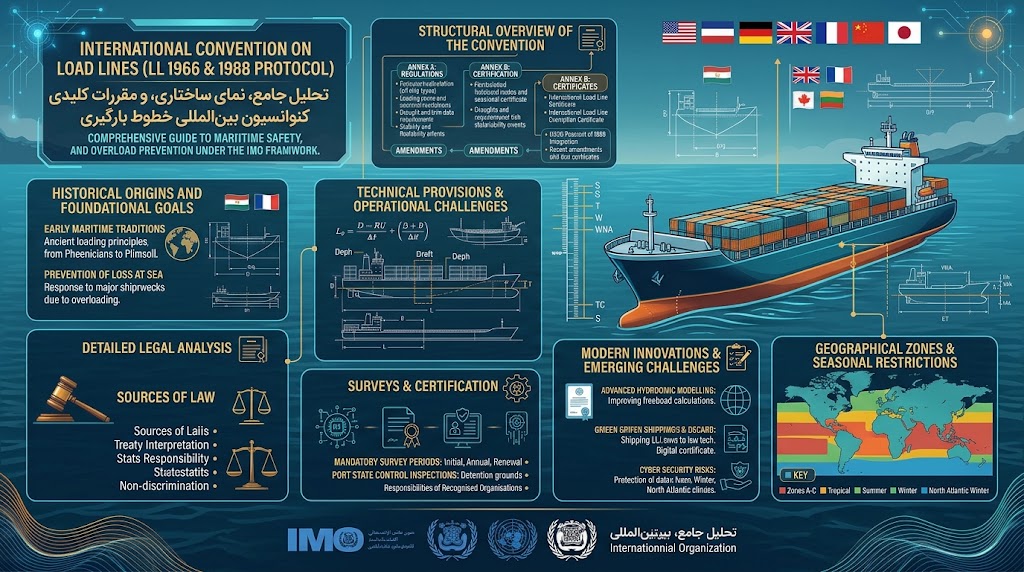
Maritime safety has historically depended on the establishment of rigorous technical standards designed to mitigate the inherent perils of the sea. Among the foundational instruments of international maritime law, the International Convention on Load Lines, 1966 (LL 1966), alongside its 1988 Protocol, occupies a central role. By establishing uniform principles and rules with respect to the limits to which ships may be loaded, the Convention seeks to safeguard human life and property at sea. This article provides a comprehensive legal analysis of the Convention, dissecting its historical evolution, structural architecture, substantive obligations, jurisdictional enforcement mechanisms, and contemporary legal challenges within the modern global maritime regime.
Historical Background and Evolution of Load Line Regulation
The genesis of load line regulation lies in the nineteenth-century merchant shipping crises, characterized by the catastrophic loss of vessels laden beyond structural capacities—often colloquially termed 'coffin ships.' In the United Kingdom, public agitation spearheaded by figures such as Samuel Plimsoll culminated in the Merchant Shipping Act 1876, which introduced a compulsory statutory mark on British vessels to indicate the maximum legal immersion point. This mark, universally known as the Plimsoll line, established the rudimentary domestic foundation for modern international freeboard regulation.
As international maritime trade expanded, unilateral state standards proved inadequate, necessitating multilateral harmonization. The first international efforts materialized through piecemeal bilateral agreements and culminated in the landmark International Load Line Conventions of 1930. The 1930 Convention successfully established international formulas for freeboard calculation based on vessel geometry and environmental zones. However, post-war advances in naval architecture, rapid changes in ship design—such as the emergence of bulk carriers and container ships—and evolving safety data rendered the 1930 regime obsolete. This necessitated the diplomatic conference convened by the Inter-Governmental Maritime Consultative Organization (IMCO, now the International Maritime Organization) that adopted the International Convention on Load Lines on April 5, 1966, entering into force on July 21, 1968.
Legal Status, Scope, and Objectives
The International Convention on Load Lines, 1966, operates as a specialized technical treaty within the overarching framework of public international maritime law. It functions alongside other primary instruments developed under the auspices of the IMO, most notably the International Convention for the Safety of Life at Sea (SOLAS), 1974, and the International Convention for the Prevention of Pollution from Ships (MARPOL), 1973/78. The primary objective of LL 1966 is to prevent overloading by prescribing minimum freeboards for different types of vessels engaged in international voyages, thereby ensuring adequate reserve buoyancy and structural integrity under adverse meteorological conditions.
Pursuant to Article 4, the Convention applies to ships engaged on international voyages flying the flag of a Contracting Government, subject to specific exemptions and exclusions detailed in Article 5. Specifically, warships, ships of less than 24 meters in length, pleasure yachts not engaged in trade, and fishing vessels are excluded from its mandatory scope. The temporal and spatial reach of the treaty is defined by its application to international voyages between ports in Contracting States or between a port in a Contracting State and a port outside it, ensuring broad jurisdictional coverage across global shipping lanes.
What is the structural architecture of the Load Lines Convention?
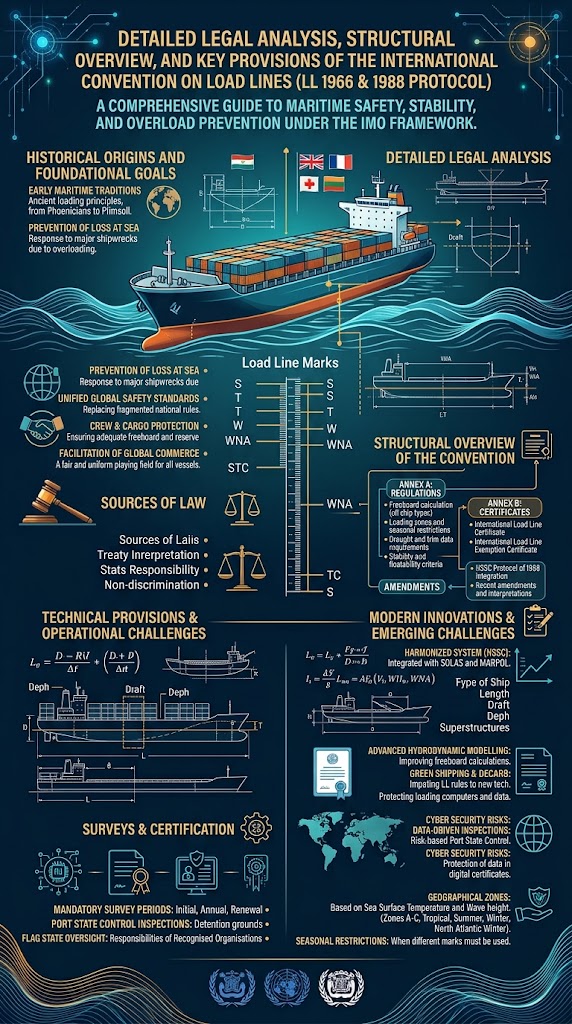
The structural architecture of the 1966 Convention reflects a classic two-tier treaty design: an operational body of substantive legal articles followed by highly detailed technical annexes. This bifurcation ensures that while the legal obligations and treaty amendment procedures remain stable, the technical regulations governing structural safety can be adapted dynamically to technological innovations without requiring formal, cumbersome diplomatic revisions.
The Convention comprises 34 Articles addressing state obligations, certification, inspection, survey, enforcement, and amendment procedures, supplemented by three Annexes and two Protocols. Annex I contains the core technical regulations divided into four chapters: Chapter I defines general provisions and calculation principles; Chapter II sets forth conditions of assignment of freeboard; Chapter III details special requirements for ships assigned timber freeboards; and Chapter IV outlines the specific freeboard tables and corrections. Annex II establishes zones, areas, and seasonal periods, dictating the environmental parameters under which varied freeboards apply. Annex III provides mandatory forms of certificates, notably the International Load Line Certificate (1966). Furthermore, the 1988 Protocol relating to the Convention introduced harmonized systems of survey and certification (HSSC), aligning LL 1966 survey cycles with SOLAS and MARPOL regimes.
Principal Provisions, Rights, and Obligations
The core legal mechanism of the Convention centers upon the calculation and assignment of freeboard. Article 12 establishes the foundational obligation that no ship shall proceed to sea on an international voyage unless it has been surveyed, marked, and provided with an International Load Line Certificate. The substantive obligations are distributed between Contracting Governments, shipowners, and masters. Flag States are bound to ensure that ships flying their flag comply fully with the structural conditions of assignment outlined in Annex I, which mandate standards for hatch covers, doorways, cargo ports, ventilators, and air pipes designed to prevent the ingress of water into hull spaces.
The assignment of freeboard is intrinsically linked to the concept of reserve buoyancy—the volume of the watertight hull above the waterline. By setting a minimum freeboard, the Convention guarantees that a vessel retains sufficient buoyancy to withstand flooding and pitching moments. The technical rules dictate specific corrections based on ship length, depth, sheer, camber, and block coefficient. Furthermore, Annex II categorizes global oceanic areas into Tropical, Summer, Winter, and Winter North Atlantic zones, reflecting seasonal wave heights and meteorological severity. Masters are legally prohibited from submerging the applicable load line corresponding to the operational zone and season, as codified in Article 14.
How does port state control enforce load line compliance?
Enforcement of the Load Lines Convention relies on a dual-jurisdictional mechanism combining flag state responsibility with robust port state control (PSC) powers. Traditionally, international maritime law vested exclusive regulatory authority in the flag state. However, recognizing the practical limitations of flag state implementation—particularly within open-registry or 'flag of convenience' frameworks—modern maritime conventions empower port states to intervene to protect marine safety and environmental integrity.
Article 21 of LL 1966 governs the control of ships in port by Contracting Governments. Officers duly authorized by the port state possess the authority to inspect foreign-flagged vessels to verify the validity of the International Load Line Certificate and ensure that the ship's condition corresponds substantially with the particulars of the certificate. Furthermore, inspectors must verify that no overloading has occurred and that the structural conditions of assignment (such as closing appliances and freeing ports) are maintained in an effective state.
If clear grounds exist—such as structural defects, expired certificates, or manifest overloading—port state authorities possess the legal right to detain the vessel. Article 21(3) mandates that the port state shall take immediate steps to ensure the ship does not sail until it can proceed to sea without danger to human life or the vessel's structural integrity. This detention power is reinforced by regional Memoranda of Understanding (MoUs) on Port State Control, such as the Paris MoU and Tokyo MoU, which coordinate targeted inspections and share compliance data globally.
Jurisdiction, Institutional Mechanisms, and Dispute Settlement
The jurisdictional framework of the Convention operates upon the foundational principles of the law of the sea, balancing territorial sovereignty with freedom of navigation. While coastal and port states exercise enforcement jurisdiction within internal waters and territorial seas, flag states maintain primary administrative and penal jurisdiction over their registered vessels on the high seas.
Institutional oversight is primarily vested in the International Maritime Organization (IMO) and its subsidiary bodies, notably the Maritime Safety Committee (MSC) and the Sub-Committee on Ship Design and Construction (SDC). The IMO serves as the depositary and forum for continuous legal and technical updates. Amendments to the Convention are governed by Article 29, which provides for explicit acceptance procedures. Technical amendments to the Annexes may be adopted by the MSC and enter into force under tacit acceptance procedures unless a specified proportion of Contracting Governments object.
Regarding dispute settlement, Article 30 provides that any dispute between two or more Contracting Governments concerning the interpretation or application of the Convention which cannot be settled by negotiation shall, upon the request of one of them, be submitted to arbitration. If the disputing parties fail to agree on the organization of the arbitration within three months, any of the parties may refer the dispute to the International Court of Justice (ICJ). While direct resort to formal litigation under Article 30 is relatively rare—with most disputes resolved through diplomatic channels or IMO mediation—the provision establishes a binding legal backstop.
Relationships with Other International Legal Instruments
The International Convention on Load Lines does not operate in a legal vacuum; it forms an integral pillar of the tripartite safety regime established under IMO auspices, alongside SOLAS and STCW. The technical standards of LL 1966 directly interact with SOLAS structural and subdivision requirements. For instance, stability requirements under SOLAS Chapter II-1 complement the reserve buoyancy mandates of LL 1966, ensuring that a vessel maintains both stability and buoyancy across varying operational drafts.
Furthermore, the 1988 Load Line Protocol modernized the legal framework by integrating the Harmonized System of Survey and Certification (HSSC). This integration resolves potential administrative friction and scheduling conflicts between LL 1966 surveys and those required under SOLAS and MARPOL. In the event of normative conflicts between LL 1966 and subsequent environmental instruments—such as MARPOL Annex I regarding oil tanker structural designs (e.g., double hull requirements)—constructive interpretation ensures that stricter safety and environmental standards prevail without compromising hull structural integrity.
Contemporary Legal Challenges and Interpretive Controversies
Modern maritime commerce presents novel legal and technical challenges that test the elasticity of the 1966 Convention. The evolution of mega-container ships, ultra-large crude carriers (ULCCs), and non-conventional offshore structures has created interpretive ambiguities concerning the application of traditional freeboard formulas.
One prominent contemporary challenge involves the legal characterization and safety regulation of Floating Production, Storage and Offloading (FPSO) units and Floating Storage Units (FSUs). While these units operate as stationary or semi-permanent production facilities, they often retain ship-shaped hulls and fall under the formal definitions of the Convention when moving between locations. Applying static freeboard rules designed for trans-oceanic merchant vessels to industrial offshore installations requires complex legal and technical accommodations, often managed through equivalences and exemptions granted under Article 6 of the Convention.
Another interpretive controversy centers on the legal implications of technological innovation in load monitoring. The advent of real-time hull stress monitoring systems, electronic draft sensors, and automated ballasting systems challenges traditional prescriptive rules. While LL 1966 relies on fixed marks and physical inspections, modern operators increasingly advocate for goal-based standards and performance-based compliance frameworks. Reconciling rigid statutory freeboard lines with dynamic, sensor-driven operational loading profiles remains a pressing challenge for maritime regulators.
Critical Assessment of the Convention's Efficacy
A critical appraisal of the International Convention on Load Lines reveals a remarkably successful legal instrument that has significantly reduced maritime casualties attributable to structural overloading. By standardizing freeboard calculations globally, the Convention eliminated competitive regulatory arbitrage where shipowners might otherwise select flags with lax loading rules.
However, structural deficiencies persist within the regime. The effectiveness of the Convention remains heavily dependent on the diligence of Recognized Organizations (ROs)—such as classification societies—authorized by flag states to conduct surveys and issue certificates pursuant to Article 16. Instances of substandard classification societies issuing statutory certificates without rigorous verification have historically undermined enforcement integrity, prompting the IMO to institute stringent oversight mechanisms such as the IMO Member State Audit Scheme (IMSAS).
Additionally, the slow pace of formal treaty amendment for complex technical updates, despite the availability of tacit acceptance for annexes, can create temporal gaps between rapid industrial innovation and legal adaptation. Nonetheless, the Convention's structural flexibility and robust port state control mechanisms continue to ensure its enduring viability.
Conclusion
The International Convention on Load Lines, 1966, stands as a cornerstone of international maritime law, bridging technical naval architecture with binding public international obligations. Through its precise assignment of freeboard, rigorous structural standards, and dual-layer enforcement mechanism combining flag state responsibility and port state control, the treaty has successfully mitigated the historical risks of vessel overloading and maritime disaster. While contemporary challenges—including mega-containerization, offshore energy infrastructure, and digital draft monitoring—test its traditional architecture, the Convention's adaptability ensures its continued relevance in safeguarding human life and property across the global oceans.
Comments
No comments yet.