Legal Analysis, Structural Overview, and Key Provisions of the Hague-Visby Rules
A comprehensive academic analysis of the Hague-Visby Rules, exploring carrier liabilities, immunities, and the evolution of international maritime cargo regimes.
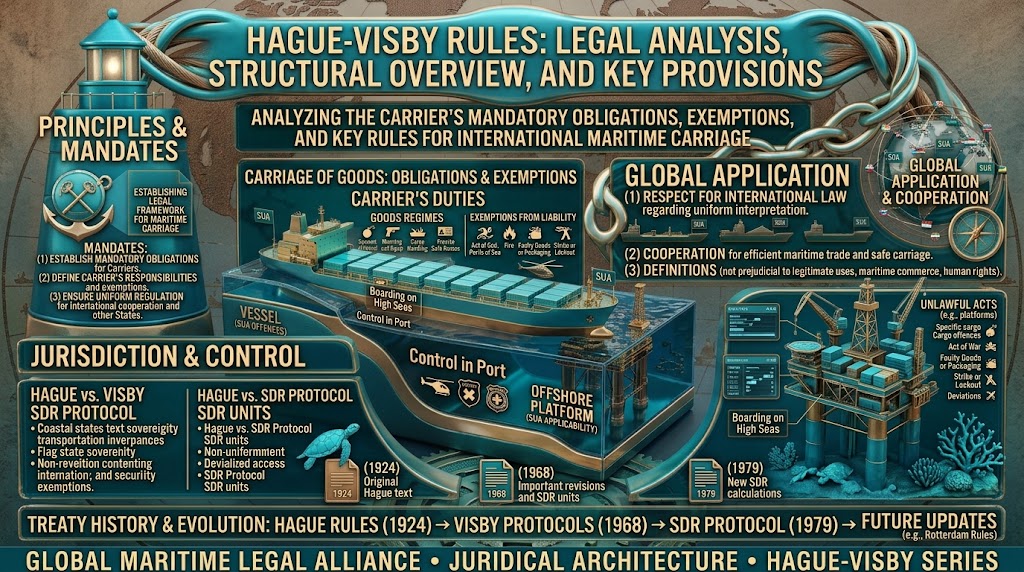
The Protocol to Amend the International Convention for the Unification of Certain Rules of Law Relating to Bills of Lading, commonly referred to as the Hague-Visby Rules, represents the cornerstone of modern maritime cargo liability. Established to modernize the original 1924 Hague Rules, this legal framework balances the interests of shipowners and cargo interests by providing a mandatory set of minimum obligations and maximum liabilities. In the contemporary era of global trade, understanding the nuances of the Hague-Visby Rules is essential for maritime practitioners, insurers, and legal scholars alike. This article provides a rigorous legal analysis of its structure, key provisions, and the jurisprudential evolution that defines its application in the 21st century.
Abstract
The Hague-Visby Rules function as a mandatory international legal regime governing the carriage of goods by sea under a bill of lading or similar document of title. This analysis examines the historical transition from the 1924 Brussels Convention to the 1968 Visby Protocol and the subsequent 1979 SDR Protocol. It scrutinizes the carrier duties of seaworthiness and cargo care under Article III, the catalogue of immunities under Article IV, and the limitation of liability provisions. Furthermore, the article explores the jurisdictional reach of the Rules, the impact of the Himalaya Clause, and the interpretive challenges posed by containerization and electronic commerce. By synthesizing authoritative case law and secondary sources, the study evaluates the continued relevance of the Rules against the backdrop of the Hamburg and Rotterdam Rules.
Keywords
Maritime Law, Bill of Lading, Hague-Visby Rules, Carrier Liability, Seaworthiness, Package Limitation, SDR Protocol, International Trade Law, Admiralty Jurisdiction.
Historical Background and Legal Evolution
The genesis of the Hague-Visby Rules lies in the late 19th-century struggle between cargo owners and shipowners. Historically, under the doctrine of freedom of contract, carriers utilized expansive exculpatory clauses in bills of lading to avoid liability for almost any loss or damage. This led to significant legal uncertainty and international friction. The United States Harter Act of 1893 was the first major legislative attempt to curb these abuses, establishing a compromise that influenced the original 1924 Hague Rules (the Brussels Convention).
The Hague Rules (1924) aimed to create a uniform international standard. However, by the mid-20th century, the rise of containerization and inflation rendered the original limitation figures obsolete. In 1968, the Visby Protocol was adopted to modernize the regime, followed by the 1979 Protocol which replaced the Poincare gold franc with Special Drawing Rights (SDRs) as the unit of account for liability limitations. The resulting amalgam, known as the Hague-Visby Rules, remains the most widely adopted maritime liability regime globally.
Legal Status and Scope of Application
The Hague-Visby Rules apply by force of law (ex proprio vigore) in specific circumstances defined by Article X. Unlike the original Hague Rules, which applied only to bills of lading issued in a contracting state, the Hague-Visby Rules expand this scope to include:
- Bills of lading issued in a contracting state;
- Carriage from a port in a contracting state;
- Contracts of carriage that explicitly incorporate the Rules (Clause Paramount).
Crucially, the Rules apply only to contracts of carriage covered by a bill of lading or any similar document of title. They do not apply to charterparties unless a bill of lading is issued and governs the relationship between the carrier and the holder. Furthermore, Article I(c) excludes live animals and cargo which by the contract of carriage is stated as being carried on deck and is so carried, although modern practice and local laws often extend the Rules to deck cargo through specific contractual inclusions.
What are the carrier duties under Hague-Visby Rules?
The heart of the Hague-Visby Rules lies in Article III, which sets forth the mandatory obligations of the carrier. These duties are considered overriding in many jurisdictions, meaning the carrier cannot benefit from the Article IV immunities if it has failed to fulfill its primary obligations under Article III.
Article III, Rule 1: The Duty of Seaworthiness
The carrier is bound, before and at the beginning of the voyage, to exercise due diligence to: (a) make the ship seaworthy; (b) properly man, equip, and supply the ship; and (c) make the holds, refrigerating and cool chambers, and all other parts of the ship in which goods are carried, fit and safe for their reception, carriage, and preservation.
The standard of due diligence is an objective one, equivalent to the exercise of reasonable care and skill. It is a non-delegable duty. As established in the landmark case The Muncaster Castle [1961], a carrier is liable for the negligence of an independent contractor (such as a reputable ship repairer) if that contractor fails to exercise due diligence in making the ship seaworthy. The duty is not a continuous one throughout the voyage; it attaches before and at the beginning of the voyage, which includes the period from at least the commencement of loading until the vessel sails from the loading port.
Article III, Rule 2: Care of Cargo
Subject to the provisions of Article IV, the carrier shall properly and carefully load, handle, stow, carry, keep, care for, and discharge the goods carried. While the duty of seaworthiness is specific to the timing of the voyage, the duty to care for the cargo is continuous throughout the period the goods are in the carrier's custody. The term properly has been interpreted by courts (e.g., The Jordan II [2003]) as meaning in accordance with a sound system, which may depend on the specific nature of the cargo and the prevailing maritime standards.
What are the exceptions to carrier liability?
Article IV provides a shield for the carrier, listing seventeen specific exceptions (the catalogue) where the carrier is not responsible for loss or damage. However, the burden of proof initially rests on the claimant to show that the goods were lost or damaged while in the carrier's custody. Once established, the carrier must prove that the loss falls within one of the Article IV exceptions and that they exercised due diligence regarding seaworthiness.
The Nautical Fault Exception
Article IV, Rule 2(a) provides immunity for loss or damage arising from the act, neglect, or default of the master, mariner, pilot, or the servants of the carrier in the navigation or in the management of the ship. This is a unique feature of maritime law, exempting the carrier from vicarious liability for the professional negligence of the crew in navigating the vessel, provided the carrier fulfilled the initial duty to provide a competent crew and a seaworthy ship.
Fire and Perils of the Sea
Rule 2(b) protects the carrier from liability for fire, unless caused by the actual fault or privity of the carrier. Rule 2(c) covers perils, dangers, and accidents of the sea or other navigable waters. To qualify as a peril of the sea, the incident must generally be of a nature that could not be foreseen or guarded against as one of the ordinary incidents of the voyage.
The Catch-All Exception: Rule 2(q)
Commonly known as the q-clause, this exception covers any other cause arising without the actual fault or privity of the carrier, or without the fault or neglect of the agents or servants of the carrier. The burden of proof here is particularly heavy; the carrier must affirmatively prove the absence of any contributory negligence on their part or their servants' part.
How is package limitation calculated under the Hague-Visby Rules?
One of the most significant updates in the Visby Protocol was the revision of the limitation of liability. Article IV, Rule 5 provides a financial ceiling on the carrier's liability, preventing catastrophic claims from destabilizing the shipping industry while ensuring cargo owners receive meaningful compensation.
Under the 1979 SDR Protocol, the limits are set at the higher of:
- 666.67 SDR per package or unit; or
- 2 SDR per kilogram of gross weight of the goods lost or damaged.
The SDR (Special Drawing Right) is a basket of currencies maintained by the International Monetary Fund (IMF), providing a stable value regardless of individual currency fluctuations. To determine the limit, the court or arbitrator must calculate both the package-based and weight-based figures and apply the higher of the two. This is particularly relevant for heavy machinery (where weight-based limits prevail) versus high-value electronics in small boxes (where package-based limits prevail).
The Container Clause
In the era of containerization, Article IV, Rule 5(c) clarifies what constitutes a package or unit. If a container, pallet, or similar article of transport is used to consolidate goods, the number of packages or units enumerated in the bill of lading as packed in such article of transport shall be deemed the number of packages or units. If no such enumeration exists, the container itself is treated as the package. This provision incentivizes shippers to accurately list the contents of containers to maximize their potential recovery in the event of loss.
Breaking the Limits: Loss of Right to Limit
The limitation of liability is not absolute. Under Article IV, Rule 5(e), neither the carrier nor the ship shall be entitled to the benefit of the limitation of liability if it is proved that the damage resulted from an act or omission of the carrier done with intent to cause damage, or recklessly and with knowledge that damage would probably result. This is a very high threshold, requiring proof of subjective intent or a high degree of recklessness. It is notoriously difficult to break the limits under the Hague-Visby Rules compared to other regimes.
What is the time bar for cargo claims?
Article III, Rule 6 establishes a strict temporal limit for bringing legal action against the carrier. The carrier and the ship are discharged from all liability whatsoever in respect of the goods unless suit is brought within one year of their delivery or of the date when they should have been delivered.
This one-year period is a substantive time bar, not merely a procedural one; it extinguishes the claim itself. The term suit has been interpreted broadly to include the commencement of litigation or arbitration proceedings. It is common for parties to agree to extensions of this time bar during settlement negotiations. However, failure to secure a formal extension or file suit within the year generally results in the total loss of the claim. Rule 6 bis provides an exception for indemnity actions (e.g., a charterer seeking indemnity from a shipowner), allowing such actions to be brought even after the expiration of the one year, provided they are brought within the time allowed by the law of the court seized of the case (usually an additional three to six months).
The Himalaya Clause and Article IV bis
Historically, cargo owners attempted to bypass the carrier's limitations by suing the carrier's employees or agents (such as the master or stevedores) in tort. The name derives from the case Adler v Dickson [1955], involving the vessel Himalaya. To counter this, the Visby Protocol introduced Article IV bis.
Article IV bis, Rule 2 states that if an action is brought against a servant or agent of the carrier (such servant or agent not being an independent contractor), such servant or agent shall be entitled to avail himself of the defenses and limits of liability which the carrier is entitled to invoke under these Rules. This effectively extends the protection of the Rules to the crew, though it notably excludes independent contractors like stevedores in many jurisdictions, necessitating the continued use of contractual Himalaya Clauses in the bill of lading to protect third-party service providers.
Jurisdiction and Enforcement Mechanisms
The Hague-Visby Rules do not contain a specific article governing jurisdiction or arbitration venues. Consequently, the enforceability of the Rules often depends on the private international law of the forum and the presence of a jurisdiction or arbitration clause in the bill of lading. However, Article III, Rule 8 prohibits any clause in a contract of carriage that relieves the carrier from liability or lessens it otherwise than as provided in the Rules. In some jurisdictions, such as Australia and Canada, this has been interpreted as making certain foreign jurisdiction clauses unenforceable if they would result in the application of a regime less favorable than the Hague-Visby Rules.
Are electronic bills of lading covered by Hague-Visby?
One of the most pressing contemporary challenges is the transition from paper-based bills of lading to electronic records. The Hague-Visby Rules, drafted in 1968, refer throughout to documents and the exchange of paper. This has led to significant legal debate over whether an electronic bill of lading (e-BL) satisfies the definition of a bill of lading or similar document of title under Article I(b).
While some modern courts strive to interpret the Rules in a functionally equivalent manner, many jurisdictions have found it necessary to enact domestic legislation (such as the UK Carriage of Goods by Sea Act 1992 or the Electronic Trade Documents Act 2023) to ensure that electronic equivalents carry the same legal weight as paper. The Rotterdam Rules were designed specifically to address this gap, but their lack of widespread ratification means that for now, the application of Hague-Visby to e-BLs remains largely a matter of contractual agreement and specific national enabling laws.
Relationship with Other Legal Instruments
The Hague-Visby Rules exist in a fractured international landscape. They sit between the older 1924 Hague Rules and the 1978 Hamburg Rules. The Hamburg Rules, favored by developing nations (cargo-exporting states), are generally more pro-shipper, removing the nautical fault exception and imposing a presumed fault standard on the carrier. More recently, the 2008 Rotterdam Rules (the UN Convention on Contracts for the International Carriage of Goods Wholly or Partly by Sea) attempted to create a comprehensive door-to-door regime. However, the Rotterdam Rules have yet to receive the requisite number of ratifications from major maritime nations, leaving the Hague-Visby Rules as the prevailing practical standard for international shipping.
Critical Assessment and Contemporary Challenges
The Hague-Visby Rules are often criticized for being a relic of a bygone era. The nautical fault exception is frequently cited as an anachronism that has no place in modern commerce where GPS and advanced communication should theoretically eliminate navigational errors. Furthermore, the exclusion of deck cargo and the limited definition of goods (excluding live animals) creates gaps that must be filled by complex contractual drafting.
However, the Rules possess the immense advantage of certainty. Decades of litigation in major maritime centers like London, Singapore, and New York have provided a stable body of case law. For P&I Clubs (Protection and Indemnity) and cargo insurers, this predictability is more valuable than the theoretical perfection of newer, unproven regimes. The Rules' ability to balance the risk between the ship and the cargo has provided a foundational framework that has supported the expansion of global trade for over half a century.
Conclusion
The Hague-Visby Rules remain a vital instrument of international maritime law. By codifying the duties of seaworthiness and cargo care while providing a clear framework for immunities and liability limits, they provide the necessary legal infrastructure for the carriage of goods by sea. While the digital revolution and changing global economic dynamics pose challenges to its terminology, the underlying principles of the Rules continue to govern the majority of the world's ocean-borne trade. As long as the Rotterdam Rules remain in limbo, the Hague-Visby regime will continue to serve as the definitive benchmark for maritime liability, reflecting a pragmatic compromise that has stood the test of time.
References
- Protocol to Amend the International Convention for the Unification of Certain Rules of Law Relating to Bills of Lading, Feb. 23, 1968, 1412 U.N.T.S. 127.
- International Convention for the Unification of Certain Rules of Law Relating to Bills of Lading, Aug. 25, 1924, 120 L.N.T.S. 155.
- Maxine Footwear Co Ltd v Canadian Government Merchant Marine Ltd [1959] AC 589.
- Riverstone Meat Co Pty Ltd v Lancashire Shipping Co Ltd (The Muncaster Castle) [1961] AC 807.
- Effort Shipping Co Ltd v Linden Management SA (The Giannis NK) [1998] AC 605.
- The Starsin [2003] UKHL 12.
- Hvala-Kari, A. (2021). Liability of the Sea Carrier. Taylor & Francis.
- Schmitthoff’s Export Trade: The Law and Practice of International Trade (12th ed.). Sweet & Maxwell.
- Baughen, S. (2019). Shipping Law. Routledge.
Comments
No comments yet.