Legal Analysis and Provisions of the Hague Rules
A comprehensive academic legal analysis of the International Convention for the Unification of Certain Rules of Law Relating to Bills of Lading.
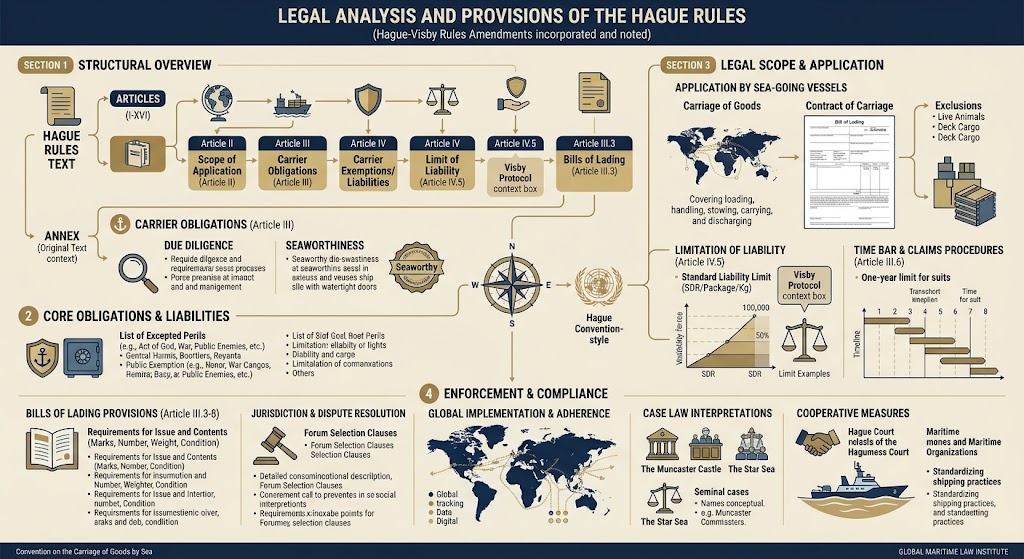
Abstract
This article presents a rigorous academic legal analysis of the International Convention for the Unification of Certain Rules of Law Relating to Bills of Lading, commonly known as the Hague Rules, signed at Brussels on August 25, 1924. It examines the historical background, legal status, scope, structural framework, and principal provisions of the treaty. Special attention is devoted to the allocation of carrier liabilities and immunities under Article 3 and Article 4, the mechanisms of cargo claims, jurisdictional considerations, and the treaty's enduring legacy within international maritime law. Furthermore, the article explores the evolution toward subsequent modernization instruments such as the Visca and Rotterdam Rules, assessing contemporary legal challenges and jurisprudential controversies.
Introduction
The international carriage of goods by sea has historically been characterized by an inherent tension between commercial shipping interests (carriers) and cargo-owning interests (shippers, consignees, and underwriters). During the nineteenth century, freedom of contract predominated, allowing powerful shipowners to insert sweeping exemption clauses into bills of lading. These clauses frequently relieved carriers of virtually all liability for loss or damage to cargo, even when caused by their own negligence or the unseaworthiness of the vessel. The resulting legal fragmentation and perceived inequity necessitated international standardization. The International Convention for the Unification of Certain Rules of Law Relating to Bills of Lading, established at Brussels in 1924 and subsequently amended, provided a uniform legal regime designed to strike a fair balance of risk and responsibility between ocean carriers and cargo interests.
Historical Background and Legal Status
The genesis of the Hague Rules can be traced to the efforts of the Comité Maritime International (CMI) and the International Law Association. Prior to 1924, divergent national laws governed maritime transport contracts, creating severe uncertainty in international trade. The Hague Rules of 1921 represented an initial attempt at voluntary unification through standard bill of lading clauses. However, voluntary adoption proved insufficient, leading to the diplomatic conference in Brussels and the formal adoption of the International Convention on August 25, 1924.
Legally, the Hague Rules operate as an international treaty that achieves domestic effect only when incorporated into national legislation. Prominent legislative implementations include the United Kingdom's Carriage of Goods by Sea Act 1924 and the United States Carriage of Goods by Sea Act of 1936 (COGSA 1936), which adopted the substantive principles of the Hague Rules with minor domestic modifications. The legal status of the treaty rests upon its widespread ratification during the mid-twentieth century, establishing an internationally recognized baseline for mandatory carrier obligations.
Scope of Application and Material Definitions
To understand the operational reach of the convention, one must examine what is the exact scope of application under the Hague Rules? Article 1 defines the key terms utilized throughout the instrument, including 'carrier', 'contract of carriage', 'goods', 'ship', and 'carriage of goods'. The convention applies exclusively to contracts of carriage covered by a bill of lading or any similar document of title, insofar as such document relates to the carriage of goods by sea from ports in one Contracting State to ports in another Contracting State.
Crucially, Article 1(b) specifies that the convention applies from the time when the goods are loaded on to the ship to the time they are discharged from the ship, encompassing the traditional maritime phrase 'tackle-to-tackle'. Excluded from this mandatory scope are live animals and cargo which by the contract of carriage is stated as being carried on deck and is so carried. The spatial and temporal limitations of the Hague Rules have significant legal implications for multimodal transport operations, where goods are frequently transported under combined transport bills of lading involving inland legs.
What are the fundamental obligations of the carrier under Article 3?
Article 3 of the Hague Rules establishes the cornerstone obligations of the carrier, fundamentally altering the pre-contractual power dynamic by imposing non-waivable duties. Specifically, Article 3(1) mandates that the carrier shall be bound, before and at the beginning of the voyage, to exercise due diligence to:
- Make the ship seaworthy;
- Properly man, equip, and supply the ship; and
- Make the holds, refrigerating and cool chambers, and all other parts of the ship in which goods are carried, fit and safe for their reception, carriage and preservation.
The legal standard established here is not an absolute warranty of seaworthiness, but rather an obligation of 'due diligence'. In landmark English jurisprudence such as The Eurasian Dream [2002] 1 Lloyd's Rep 719, courts affirmed that due diligence requires the carrier to take all reasonable steps to ensure the vessel is fit for the intended adventure, encompassing the personal acts of the carrier as well as agents and independent contractors.
Additionally, Article 3(2) dictates that the carrier shall properly and carefully load, handle, stow, carry, keep, care for, and discharge the goods carried. Following receipt of the goods, Article 3(3) requires the carrier to issue a bill of lading containing specific particulars regarding leading marks, number of packages, and the apparent order and condition of the goods. Under Article 3(4), such a bill of lading serves as prima facie evidence of the receipt by the carrier of the goods as therein described.
How do the carrier immunities and exceptions operate under Article 4?
While Article 3 imposes strict duties, Article 4 provides a comprehensive list of defenses and immunities that protect the carrier from liability. Article 4(1) reiterates that neither the carrier nor the ship shall be liable for loss or damage arising or resulting from unseaworthiness unless caused by want of due diligence. More extensively, Article 4(2) enumerates seventeen distinct exceptions where neither the carrier nor the ship shall be responsible for loss or damage arising or resulting from:
- Act, neglect, or default of the master, mariner, pilot, or the servants of the carrier in the navigation or in the management of the ship (the nautical fault exception);
- Fire, unless caused by the actual fault or privity of the carrier;
- Perils, dangers and accidents of the sea or other navigable waters;
- Act of God;
- Act of war;
- Act of public enemies;
- Arrest or restraint of princes, rulers or people, or seizure under legal process;
- Quarantine restrictions;
- Act or omission of the shipper or owner of the goods, his agent or representative;
- Strikes or lockouts or stoppage or restraint of labour;
- Riots and civil commotions;
- Saving or attempting to save life or property at sea;
- Melting in bulk or wastage in bulk or weight or any other loss or damage arising from inherent defect, quality or vice of the goods;
- Insufficiency of packing;
- Insufficiency or inadequacy of marks;
- Latent defects not discoverable by due diligence; and
- Any other cause arising without the actual fault or privity of the carrier.
The inclusion of the nautical fault defense (Article 4(2)(a)) has been one of the most controversial aspects of the Hague Rules, shielding shipowners from liability when navigational errors by crew members result in cargo loss. Furthermore, Article 4(5) establishes a statutory limitation of liability, originally set at £100 per package or unit, designed to protect carriers from catastrophic financial exposure.
Rights and Obligations of the Shipper
The Hague Rules also delineate specific rights and obligations for the cargo owner or shipper. Under Article 3(5), the shipper is deemed to have guaranteed to the carrier the accuracy at the time of shipment of the marks, number, quantity, and weight furnished by them, and the shipper must indemnify the carrier against all loss, damages, and expenses arising from inaccuracies in such particulars. Moreover, Article 4(6) grants the carrier the right to land, destroy, or render innocuous dangerous, inflammable, or explosive goods shipped without the carrier's consent, without incurring liability for compensation.
Jurisdiction, Time Bars, and Dispute Settlement
Procedural aspects of cargo claims under the Hague Rules are regulated primarily through limitation periods and provisions governing forum selection. Article 3(6) establishes a critical time bar, stipulating that the carrier and the ship shall be discharged from all liability in respect of loss or damage unless suit is brought within one year of delivery of the goods or the date when the goods should have been delivered. This short limitation period serves to ensure prompt resolution of maritime disputes and protects carriers from protracted litigation.
Regarding jurisdiction, the Hague Rules do not contain explicit forum selection clauses, which historically led to complex conflicts of law. However, Article 3(8) invalidates any clause, covenant, or agreement in a contract of carriage relieving the carrier from liability or lessening such liability otherwise than as provided in the convention. Courts have frequently interpreted this nullification provision to strike down unreasonable forum selection or arbitration clauses that effectively deprive cargo owners of an effective remedy.
Relationships with Subsequent Legal Instruments
The legal framework established in 1924 has undergone significant evolution. The limitations and archaic nature of the Hague Rules led to the adoption of the Protocol to Amend the International Convention for the Unification of Certain Rules of Law Relating to Bills of Lading (the Visby Rules) in 1968. The Visby Rules updated the package limitation amounts, introduced a container limitation formula, and neutralized the effect of time-bar provisions in third-party indemnity actions.
Subsequently, the United Nations Convention on the Carriage of Goods by Sea (the Hamburg Rules) of 1978 sought to rebalance carrier and cargo interests by abolishing the nautical fault exception and increasing carrier liability, though it achieved limited ratification among major trading nations. Most recently, the United Nations Convention on Contracts for the International Carriage of Goods Wholly or Partly by Sea (the Rotterdam Rules) of 2008 represents an ambitious attempt to create a comprehensive modern legal regime for door-to-door multimodal transport, though widespread international adoption remains pending.
Contemporary Legal Challenges and Critical Assessment
Evaluating the Hague Rules in the twenty-first century reveals several profound structural limitations:
- Technological Obsolescence: Conceived in an era of paper bills of lading and break-bulk cargo, the Hague Rules struggle to accommodate electronic bills of lading and modern containerized shipping.
- The Nautical Fault Controversy: The exemption for navigational negligence remains heavily criticized by cargo interests and insurers as an anachronistic privilege granted to shipowners at the expense of cargo owners.
- Inadequate Financial Limits: The original monetary limits, even where updated by the Visby Protocol, often fail to reflect the high commercial value of modern specialized container cargoes.
Despite these criticisms, the Hague Rules have demonstrated remarkable resilience. Their terminology and foundational risk-allocation mechanisms have been incorporated into the domestic legislation of numerous maritime nations, providing a familiar and judicially tested framework for international trade finance.
Conclusion
The International Convention for the Unification of Certain Rules of Law Relating to Bills of Lading of 1924 represents a monumental achievement in the harmonization of international maritime law. By establishing a mandatory statutory regime that supersedes freedom of contract, the Hague Rules successfully introduced predictability and fairness to ocean transport. Although subsequent instruments such as the Visby and Rotterdam Rules address many of the technological and economic shifts of the modern era, the principles codified in the Hague Rules continue to underpin contemporary maritime jurisprudence and commercial practice worldwide.
References
- International Convention for the Unification of Certain Rules of Law Relating to Bills of Lading (Hague Rules), Brussels, August 25, 1924.
- Carriage of Goods by Sea Act 1971 (United Kingdom).
- Carriage of Goods by Sea Act (COGSA), 46 U.S.C. §§ 30701 et seq. (United States).
- Tetley, William. Marine Cargo Claims. 4th ed., Éditions Yvon Blais, 2008.
- Carver, Thomas Gilbert. Carver on Bills of Lading. Edited by Sir Guenter Treitel and Francis Reynolds, 4th ed., Sweet & Maxwell, 2017.
- Scrutton, Thomas Edward. Scrutton on Charterparties and Bills of Lading. 23rd ed., Sweet & Maxwell, 2021.
- The Eurasian Dream [2002] 1 Lloyd's Rep 719.
Comments
No comments yet.