Legal Analysis, Structural Overview, and Key Provisions of the Convention on the Territorial Sea and the Contiguous Zone
A comprehensive examination of the 1958 Geneva Convention, its codification of maritime sovereignty, the right of innocent passage, and its lasting impact on modern international law.
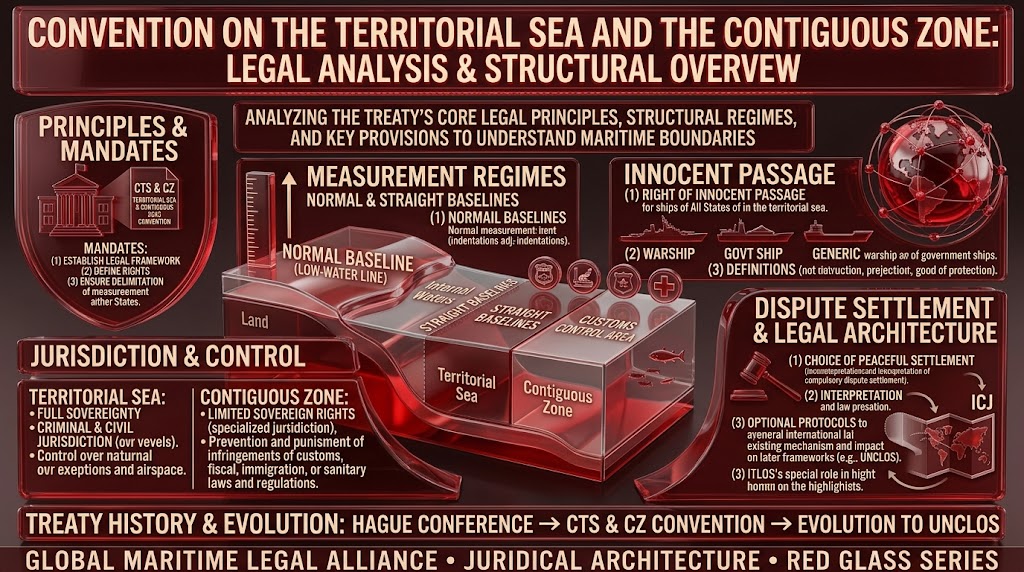
The 1958 Convention on the Territorial Sea and the Contiguous Zone stands as a foundational pillar in the modern codification of international maritime law. Concluded as part of the first United Nations Conference on the Law of the Sea (UNCLOS I) in Geneva, this treaty represents the transition from centuries of fragmented customary international law to a structured, treaty-based legal order. While many of its provisions were later incorporated into or modified by the 1982 United Nations Convention on the Law of the Sea (UNCLOS), the 1958 Convention remains a primary source of legal obligation for several states and continues to inform the interpretation of maritime rights and duties globally.
Abstract
This article provides a rigorous legal analysis of the Convention on the Territorial Sea and the Contiguous Zone. It examines the historical impetus behind its creation, its structural framework, and the specific legal mechanisms it established to balance the sovereignty of coastal states with the global necessity for freedom of navigation. Key areas of focus include the methodology for delimiting baselines, the intricate legal nuances of the right of innocent passage, and the functional jurisdiction exercised within the contiguous zone. Furthermore, this analysis considers the Convention’s relationship with subsequent legal instruments and its contemporary relevance in an era of rising sea levels and maritime security challenges.
Historical Background and the Path to Geneva
The quest for a codified law of the sea began in earnest in the early 20th century. Before 1958, maritime jurisdiction was largely governed by the Grotian principle of mare liberum (freedom of the seas) and the conflicting concept of mare clausum (closed seas). The League of Nations attempted to codify these rules at the 1930 Hague Codification Conference, but the effort failed primarily due to disagreements regarding the maximum breadth of the territorial sea. Coastal states were divided between the traditional three-nautical-mile limit (the cannon-shot rule) and claims for broader zones to protect fisheries and security interests.
Following World War II, the newly formed United Nations tasked the International Law Commission (ILC) with the systematic development and codification of international law. From 1949 to 1956, the ILC drafted a comprehensive set of articles that formed the basis for the four 1958 Geneva Conventions: (1) The Convention on the Territorial Sea and the Contiguous Zone; (2) The Convention on the High Seas; (3) The Convention on Fishing and Conservation of the Living Resources of the High Seas; and (4) The Convention on the Continental Shelf. The Convention on the Territorial Sea and the Contiguous Zone entered into force on September 10, 1964, marking a significant milestone in diplomatic consensus.
Legal Status and Scope
The Convention is a multilateral treaty that codifies existing customary law while also introducing elements of progressive development. Its scope is restricted to the maritime areas immediately adjacent to a state's land territory. Unlike the Convention on the High Seas, which deals with res communis (common property), this Convention focuses on the extension of state sovereignty into the maritime domain. It establishes that the sovereignty of a state extends beyond its land territory and internal waters to a belt of sea adjacent to its coast, described as the territorial sea.
What are the rules for delimiting baselines?
The delimitation of the territorial sea begins with the baseline, the line from which maritime zones are measured. The Convention provides several methodologies for determining these lines, reflecting the geographical diversity of the world's coastlines. Under Article 3, the normal baseline is the low-water line along the coast as marked on large-scale charts officially recognized by the coastal state.
Straight Baselines
Article 4 codifies the principles established by the International Court of Justice (ICJ) in the Anglo-Norwegian Fisheries Case (United Kingdom v. Norway, 1951). It allows states with deeply indented coastlines or a fringe of islands in the immediate vicinity of the coast to use straight baselines joining appropriate points. However, the Convention imposes strict limitations: the drawing of such baselines must not depart to any appreciable extent from the general direction of the coast, and the sea areas lying within the lines must be sufficiently closely linked to the land domain to be subject to the regime of internal waters.
Bays and Internal Waters
One of the most technically precise provisions is found in Article 7, which addresses the closing of bays. A bay is defined as a well-marked indentation whose penetration is in such proportion to the width of its mouth as to contain land-locked waters and constitute more than a mere curvature of the coast. The Convention introduced the semi-circle test: an indentation shall not be regarded as a bay unless its area is as large as, or larger than, that of the semi-circle whose diameter is a line drawn across the mouth of that indentation. If the distance between the low-water marks of the natural entrance points of a bay does not exceed 24 nautical miles, a closing line may be drawn, and the waters enclosed therein shall be considered internal waters.
What is the right of innocent passage?
The most critical balance struck by the Convention is the preservation of the right of innocent passage. While the coastal state exercises sovereignty over its territorial sea, this sovereignty is not absolute. Article 14 dictates that ships of all states, whether coastal or not, shall enjoy the right of innocent passage through the territorial sea.
The Definition of Passage
Passage is defined as navigation through the territorial sea for the purpose either of traversing that sea without entering internal waters or of proceeding to internal waters or making for the high seas from internal waters. Passage must be continuous and expeditious, though it includes stopping and anchoring in so far as the same are incidental to ordinary navigation or are rendered necessary by force majeure or distress.
The Requirement of Innocence
Article 14(4) defines the qualitative requirement for passage: it is innocent so long as it is not prejudicial to the peace, good order, or security of the coastal state. Such passage shall take place in conformity with these articles and other rules of international law. For submarines, the Convention requires that they navigate on the surface and show their flag (Article 14(6)).
Can a coastal state suspend innocent passage?
A frequent point of legal contention is the extent to which a coastal state can regulate or halt passage. Article 15(1) prohibits the coastal state from hampering innocent passage through the territorial sea. However, Article 16 provides specific exceptions. The coastal state may take the necessary steps in its territorial sea to prevent passage which is not innocent. Furthermore, in the case of ships proceeding to internal waters, the coastal state also has the right to take the necessary steps to prevent any breach of the conditions to which admission of those ships to those waters is subject.
Critically, the coastal state may, without discrimination amongst foreign ships, suspend temporarily in specified areas of its territorial sea the innocent passage of foreign ships if such suspension is essential for the protection of its security. Such suspension shall take effect only after having been duly published. However, there shall be no suspension of the innocent passage of foreign ships through straits which are used for international navigation between one part of the high seas and another part of the high seas or the territorial sea of a foreign state. This rule reflects the Corfu Channel Case (United Kingdom v. Albania, 1949), where the ICJ upheld the right of passage through international straits even during times of political tension.
How does criminal jurisdiction work in the territorial sea?
The Convention delineates the boundaries of legal authority between the coastal state and the flag state (the state where the ship is registered). Under Article 19, the criminal jurisdiction of the coastal state should not be exercised on board a foreign ship passing through the territorial sea to arrest any person or to conduct any investigation in connection with any crime committed on board the ship during its passage, save only in the following cases:
- If the consequences of the crime extend to the coastal state;
- If the crime is of a kind to disturb the peace of the country or the good order of the territorial sea;
- If the assistance of the local authorities has been requested by the captain of the ship or by the consul of the country whose flag the ship flies; or
- If it is necessary for the suppression of illicit traffic in narcotic drugs.
These provisions reflect a restrictive approach to coastal state jurisdiction, favoring the freedom of the flag state unless a direct impact on the coastal state's interests is demonstrable. Regarding civil jurisdiction (Article 20), the coastal state should not stop or divert a foreign ship passing through the territorial sea for the purpose of exercising civil jurisdiction in relation to a person on board the ship, nor should it levy execution against or arrest the ship for the purpose of any civil proceedings, save only in respect of obligations or liabilities assumed or incurred by the ship itself in the course or for the purpose of its voyage through the waters of the coastal state.
How is the contiguous zone defined?
Article 24 of the Convention introduced the concept of the contiguous zone, a belt of sea contiguous to the territorial sea where the coastal state exercises limited functional jurisdiction rather than full sovereignty. The contiguous zone may not extend beyond 12 nautical miles from the baseline from which the breadth of the territorial sea is measured.
In this zone, the coastal state may exercise the control necessary to:
- Prevent infringement of its customs, fiscal, immigration, or sanitary regulations within its territory or territorial sea;
- Punish infringement of the above regulations committed within its territory or territorial sea.
It is important to note that the contiguous zone does not grant the coastal state rights over the seabed or fisheries; those rights were later expanded under the Exclusive Economic Zone (EEZ) concept in the 1982 Convention. In the 1958 framework, the contiguous zone served primarily as a protective buffer for the administrative and legal integrity of the coastal state's land territory.
Comparative Analysis: 1958 Convention vs. 1982 UNCLOS
While the 1958 Convention was a massive success in codification, it left one major question unanswered: the maximum breadth of the territorial sea. Article 6 merely stated that the outer limit of the territorial sea is the line every point of which is at a distance from the nearest point of the baseline equal to the breadth of the territorial sea. It did not specify if that breadth was 3, 6, or 12 miles. This ambiguity led to the Second UN Conference on the Law of the Sea (UNCLOS II) in 1960, which also failed to reach an agreement.
The 1982 UNCLOS finally resolved this by setting the limit at 12 nautical miles. Furthermore, UNCLOS 1982 expanded the contiguous zone to 24 nautical miles. For states that are parties to both, the 1982 Convention prevails (Article 311 of UNCLOS). However, for states like the United States, which has not ratified UNCLOS 1982 but is a party to the 1958 Convention, the 1958 text remains the primary treaty-based legal instrument, although many 1982 provisions are now considered customary international law.
Contemporary Legal Challenges and Critical Assessment
The 1958 Convention faces significant challenges in the 21st century, particularly concerning environmental change and technological advancement.
Sea-Level Rise and Ambulatory Baselines
The Convention assumes a relatively stable coastline. As sea levels rise due to climate change, low-water lines (the normal baselines) retreat inland. This creates legal uncertainty regarding the permanence of maritime boundaries. Modern legal scholars are debating whether baselines should be fixed (frozen) to provide stability or remain ambulatory as the Convention’s text suggests.
Technological Developments
The rise of Unmanned Maritime Systems (UMSs) and autonomous vessels challenges the traditional definition of a ship and the requirements of innocent passage. Can an autonomous drone ship be considered a ship for the purposes of Article 14? Does its lack of a human crew change the assessment of its innocence? The Convention’s silence on these matters requires evolving interpretation through state practice and judicial decisions.
Enforcement and Dispute Settlement
The 1958 Convention lacked the robust, mandatory dispute settlement mechanisms found in Part XV of UNCLOS 1982. Disputes under the 1958 Convention typically relied on the Optional Protocol Concerning the Compulsory Settlement of Disputes, which provided for the jurisdiction of the International Court of Justice. This has led to a more fragmented judicial application compared to the more centralized system of the International Tribunal for the Law of the Sea (ITLOS).
Conclusion
The Convention on the Territorial Sea and the Contiguous Zone remains a cornerstone of international law. By articulating the rules for baselines, the doctrine of innocent passage, and the functional nature of the contiguous zone, it provided the essential vocabulary and structural logic that underpins all subsequent maritime legal developments. While it has been largely eclipsed in practice by the 1982 UNCLOS, its historical importance and continued legal validity for certain states ensure its place in the canon of international legal scholarship. As the world confronts new maritime frontiers, from deep-sea mining to the protection of underwater cultural heritage, the principles of sovereignty and freedom established in 1958 continue to provide the necessary framework for global maritime stability.
References
- Convention on the Territorial Sea and the Contiguous Zone, 516 U.N.T.S. 205 (1958).
- United Nations Convention on the Law of the Sea, 1833 U.N.T.S. 3 (1982).
- Fisheries Case (United Kingdom v. Norway), Judgment of December 18, 1951, I.C.J. Reports 1951, p. 116.
- Corfu Channel Case (United Kingdom v. Albania), Judgment of April 9, 1949, I.C.J. Reports 1949, p. 4.
- International Law Commission, Draft Articles on the Law of the Sea with Commentaries, Yearbook of the ILC, 1956, Vol. II.
- Churchill, R. R., & Lowe, A. V. (1999). The Law of the Sea. Manchester University Press.
- Rothwell, D. R., & Stephens, T. (2016). The International Law of the Sea. Hart Publishing.
Comments
No comments yet.