Navigating Conflict of Laws: Jurisdiction and Choice of Law in Modern Maritime Disputes
Maritime law operates across borders, creating complex legal challenges. This article explores how courts determine jurisdiction and choice of law in global shipping.
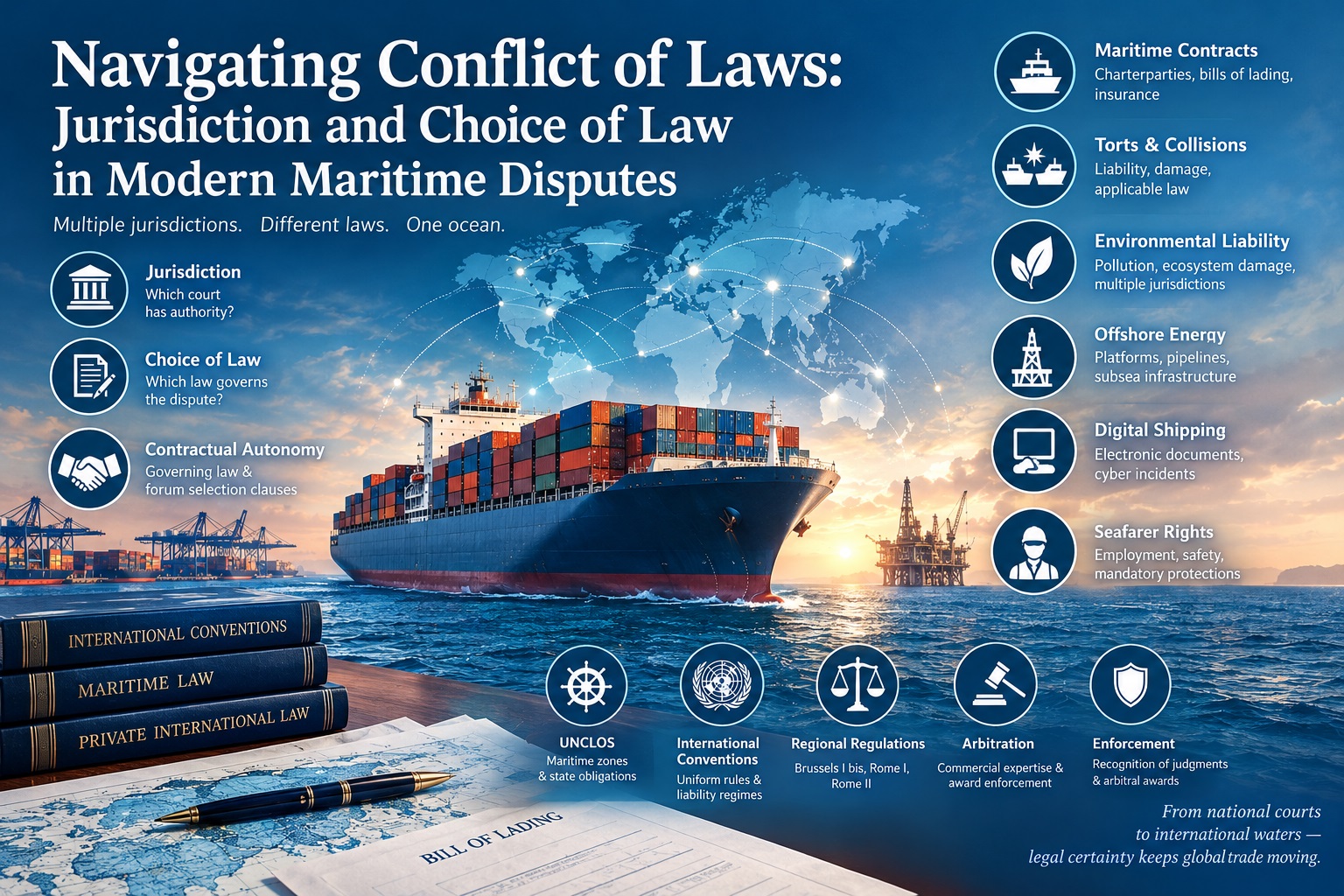
Abstract
Maritime disputes increasingly involve parties, vessels, cargoes, insurers, and contractual relationships connected to multiple jurisdictions. A collision may occur in international waters between vessels registered in different states, carrying cargo owned by foreign interests and insured under policies governed by another legal system. Similarly, disputes arising from bills of lading, charterparties, marine pollution, ship arrest, and offshore operations may generate competing claims to judicial authority and divergent rules of substantive law. In such circumstances, conflict of laws performs a fundamental function by determining which court may adjudicate a dispute and which legal system governs its merits. This article examines the relationship between international jurisdiction and choice of law in contemporary maritime litigation. It analyzes the principal connecting factors, including contractual autonomy, flag state, place of occurrence, habitual residence, and the location of maritime assets. It also considers international conventions, regional instruments, forum selection clauses, arbitration agreements, and the practical consequences of parallel proceedings. Particular attention is given to maritime claims that transcend conventional territorial boundaries, including environmental damage, offshore energy activities, and digitally mediated shipping transactions. The article argues that maritime conflict-of-laws rules must reconcile predictability and commercial autonomy with effective access to justice, environmental accountability, and the distinctive operational characteristics of international shipping. Greater coordination between jurisdictional and choice-of-law frameworks is essential to achieving consistent and enforceable outcomes.
Keywords: conflict of laws; private international law; maritime jurisdiction; choice of law; international shipping; forum selection; maritime arbitration; marine environmental liability.
1. Introduction
International shipping constitutes one of the most geographically dispersed and legally complex forms of commercial activity. A single maritime transaction may involve a shipowner incorporated in one state, a vessel registered in another, a charterer established elsewhere, cargo interests located across several jurisdictions, and insurers operating under different national legal systems. The vessel itself may travel through territorial seas, straits, exclusive economic zones, and the high seas before a dispute emerges. Consequently, maritime litigation frequently raises a preliminary question that is distinct from the substantive merits: which court has authority to determine the dispute, and which law should that court apply?
These questions represent the two central dimensions of private international law. Jurisdiction determines the adjudicative authority of a court over the parties or subject matter. Choice of law identifies the substantive legal rules governing the parties’ rights and obligations. Although related, the two inquiries are not interchangeable. A court may possess jurisdiction while being required to apply foreign law. Conversely, the law governing a contract does not, without more, establish which court may hear a claim arising from that contract.
The distinction has considerable practical importance in maritime disputes. An English court, for example, may adjudicate a contractual claim involving a vessel operating in Asian waters, while applying a foreign law if the applicable conflict rules so require. Alternatively, a court may apply its own substantive law to a dispute involving foreign parties because the relevant connecting factors or statutory rules point to that legal system. The outcome depends on the applicable jurisdictional regime, the nature of the claim, contractual arrangements, and the relevant international instruments.
Maritime law possesses a distinctive combination of international uniformity and national legal diversity. International conventions regulate matters such as collision liability, carriage of goods, limitation of liability, marine pollution, and ship arrest. Nevertheless, these instruments do not establish a comprehensive, universal system for resolving every jurisdictional and choice-of-law question. National procedural law, domestic conflict rules, regional agreements, and contractual provisions therefore continue to play substantial roles.
This article examines how jurisdiction and choice of law operate in modern maritime disputes. It argues that effective resolution requires a coordinated approach that respects international conventions and legitimate contractual expectations while preventing opportunistic forum selection and ensuring that injured parties can obtain meaningful remedies.
2. The Conceptual Foundations of Maritime Conflict of Laws
2.1 Jurisdiction and adjudicative authority
International jurisdiction concerns the circumstances in which a national court may exercise judicial authority over a dispute involving a foreign element. In maritime litigation, jurisdiction may derive from the defendant’s domicile, submission to the court, a contractual jurisdiction clause, the place where a harmful event occurred, or a specific statutory basis connected with maritime property.
The legal basis for jurisdiction varies significantly between legal systems. Common-law jurisdictions have historically attached importance to service of process, submission, and the presence or arrest of a vessel. Civil-law systems may rely more extensively on codified jurisdictional rules based on domicile, contractual performance, or the place of the harmful event. Regional instruments can impose more specific and predictable criteria where their territorial and substantive requirements are satisfied.
The existence of jurisdiction must also be distinguished from the exercise of jurisdiction. A court may be legally competent to hear a case yet consider whether proceedings should be stayed because of an arbitration agreement, an exclusive jurisdiction clause, or another proceeding already pending elsewhere. Questions of recognition and enforcement arise later still: a judgment validly rendered in one jurisdiction may not automatically be enforceable in another.
2.2 Choice of law as a separate inquiry
Choice of law determines the substantive rules applicable to the dispute. These rules may govern contractual interpretation, breach, causation, damages, limitation periods, contributory negligence, or the allocation of liability among multiple parties.
The governing law may be selected expressly by the parties or identified through objective connecting factors. In contractual disputes, the parties’ choice is often decisive, subject to mandatory rules and applicable international instruments. In non-contractual disputes, the relevant legal system may depend on the place of the harmful event, the location of damage, the parties’ relationship, or a specialized maritime rule.
The distinction between jurisdiction and applicable law prevents a frequent analytical error: assuming that the court hearing a case must apply its own substantive law. Courts generally apply their own procedural rules, but the substantive law may be foreign. The classification of a particular issue as procedural or substantive can itself be contested, especially in matters involving limitation periods, evidentiary presumptions, damages, and liability caps.
2.3 The significance of maritime connecting factors
Traditional conflict-of-laws analysis uses connecting factors to identify the legal system most closely associated with a dispute. Maritime cases complicate this process because several factors may point in different directions.
The vessel’s flag can connect a ship to its state of registration, particularly in matters involving ship status, public regulation, and certain incidents on the high seas. However, flag state law does not automatically govern every private dispute involving a vessel. The location of a collision, the domicile of a defendant, the place of contractual performance, and the terms of a bill of lading may be more relevant to particular questions.
The place of damage may also be difficult to identify. Physical damage to a ship may occur in international waters, while financial losses are experienced in several countries. Marine pollution may originate from a vessel in one jurisdiction, spread through another state’s maritime zones, and damage resources belonging to multiple coastal communities. The resulting fragmentation demonstrates why no single connecting factor can provide a universal solution.
3. Jurisdiction in International Maritime Disputes
3.1 General jurisdiction and jurisdiction based on the claim
A fundamental distinction exists between general jurisdiction, commonly associated with a defendant’s domicile or equivalent connection, and specific jurisdiction, which depends on a sufficient relationship between the dispute and the forum.
In maritime contract litigation, specific jurisdiction may arise from an agreement to submit disputes to a designated court, the place of contractual performance, or a statutory provision governing international commercial claims. In tort litigation, the place where the harmful event occurred may be significant. Nevertheless, the precise conditions depend on the governing jurisdictional framework.
The Brussels I bis Regulation, Regulation (EU) No 1215/2012, provides an important regional example. Within its scope, it establishes rules concerning jurisdiction and the recognition and enforcement of judgments in civil and commercial matters. Article 4 generally provides jurisdiction in the Member State where the defendant is domiciled, while Article 7 contains special jurisdictional grounds, including rules concerning contractual and tortious matters. Article 25 addresses agreements conferring jurisdiction on the courts of a Member State, subject to its requirements.
The Regulation does not apply universally to maritime disputes, and its provisions must be considered alongside relevant conventions, including the 1952 International Convention Relating to the Arrest of Sea-Going Ships where applicable. The relationship between international conventions and regional jurisdictional legislation requires careful examination rather than an assumption that a single instrument governs every issue.
3.2 Ship arrest and the relationship between jurisdiction and security
Ship arrest is one of the most distinctive procedural mechanisms in maritime litigation. It enables a claimant, subject to the applicable legal requirements, to obtain security against a maritime claim by arresting a vessel. The practical significance of arrest is considerable because a ship is a mobile asset that may otherwise leave the jurisdiction before a judgment can be obtained.
The 1952 Arrest Convention and the 1999 International Convention on Arrest of Ships establish different international frameworks for arresting vessels in states where the relevant convention applies. Their provisions differ in important respects, including the treatment of maritime claims, the relationship between the claim and the vessel, and the circumstances in which associated vessels may be arrested.
Arrest, however, should not be confused with a final determination of the merits. A court’s authority to arrest a ship does not necessarily mean that it has jurisdiction to adjudicate every substantive issue arising from the underlying dispute. Likewise, the arrest of a vessel does not automatically establish that the forum’s law governs the contractual or tortious claim.
This distinction is especially important where a ship is arrested to secure a claim that is subject to a foreign jurisdiction clause or arbitration agreement. The court may have to determine whether the arrest is permissible as a provisional measure, whether proceedings on the merits should be stayed, and what security is appropriate under the applicable law.
3.3 Forum selection and parallel proceedings
Commercial parties frequently select a particular court to reduce uncertainty and control litigation costs. English law, Singapore law, and other established maritime legal systems are commonly chosen in shipping contracts because of their developed maritime jurisprudence, specialist courts, or commercial infrastructure.
An exclusive jurisdiction clause can promote predictability by identifying the forum before a dispute arises. Its effectiveness, however, depends on its wording, the parties bound by it, applicable mandatory rules, and the legal framework governing recognition of the clause. A clause in a charterparty, for instance, does not necessarily bind every cargo owner or consignee who is not legally subject to that agreement.
Parallel proceedings create an additional challenge. A claimant may initiate proceedings in one state while the defendant brings a related action elsewhere. Courts may then confront questions of lis pendens, related actions, anti-suit relief, or the priority of an agreed forum.
The legal treatment of these issues varies between jurisdictions. Under Brussels I bis, Article 31(2) gives priority, in specified circumstances, to the chosen court in an exclusive jurisdiction agreement, notwithstanding the ordinary first-seised rule. Outside such harmonized regimes, the outcome may depend on domestic procedural law and the applicable rules governing forum agreements.
A further concern is forum shopping: selecting a court primarily because its procedural rules, damages principles, limitation periods, or approach to liability are perceived as more favorable. Not every choice of forum is abusive. Parties may legitimately seek a commercially appropriate court. The difficulty arises when procedural strategies undermine contractual expectations, fragment related claims, or impair the rights of parties who did not participate in selecting the forum.
4. Determining the Applicable Law
4.1 Party autonomy in maritime contracts
Party autonomy is a central principle of international commercial contracting. Shipowners, charterers, carriers, cargo interests, and insurers frequently incorporate express governing-law clauses into charterparties, bills of lading, marine insurance policies, and related agreements.
An effective choice-of-law clause can reduce uncertainty by specifying the substantive law applicable to the contract. Nevertheless, its scope must be interpreted carefully. A clause may govern contractual obligations without necessarily extending to independent tort claims, claims involving non-parties, or matters governed by overriding mandatory provisions.
In the European Union, Regulation (EC) No 593/2008, commonly known as Rome I, establishes rules for determining the law applicable to contractual obligations in civil and commercial matters. Article 3 recognizes the parties’ freedom to choose the governing law, subject to the Regulation’s conditions and limitations. Article 9 addresses overriding mandatory provisions, while Article 21 provides a public-policy exception in specified circumstances.
Rome I contains special rules for certain contracts, but its maritime application must be assessed according to the specific relationship involved. Article 5 addresses contracts of carriage of passengers, while Article 7 concerns insurance contracts. Contracts for the carriage of goods are generally assessed under Article 5(1), which establishes a structured approach where the parties have not made an effective choice. The scope of these provisions and the Regulation’s interaction with other applicable instruments must be determined in each case.
Party autonomy is not unlimited. A choice of law cannot necessarily displace mandatory regulatory requirements, applicable international conventions, or protective rules that the relevant legal system treats as non-derogable. Nor can contractual drafting automatically bind third parties who have not become subject to the relevant agreement under applicable law.
4.2 Bills of lading and charterparties
Bills of lading and charterparties frequently generate complex choice-of-law questions because they serve different commercial functions and may govern different relationships.
A charterparty ordinarily regulates the contractual relationship between a shipowner or disponent owner and a charterer. A bill of lading may serve as a receipt for goods, evidence of a contract of carriage, and a document of title. Cargo interests may acquire rights under a bill of lading without being original parties to the charterparty.
Consequently, a governing-law or jurisdiction clause contained in a charterparty does not automatically govern a claim brought by a bill-of-lading holder. Incorporation wording, the terms of the bill, the identity of the claimant, and applicable statutory rules must be examined. Courts may also distinguish between the incorporation of arbitration clauses and the incorporation of other contractual terms.
The Hague Rules, the Hague-Visby Rules, and the Hamburg Rules provide different regimes for aspects of the carriage of goods by sea, depending on their applicability and the relevant state’s treaty commitments. The Rotterdam Rules were adopted in 2008 to establish a more comprehensive regime for certain international contracts of carriage involving an international sea leg, but their entry into force has not been achieved. Their provisions should therefore not be treated as universally operative law.
These instruments may establish mandatory standards or influence the interpretation of contractual rights, but they do not eliminate every choice-of-law question. Their application depends on matters such as the scope of the instrument, the relevant ports, the transport document, the contracting parties, and the applicable national implementing legislation.
4.3 Tort claims and the place of the harmful event
Non-contractual maritime claims require a different analysis. Collisions, negligent navigation, personal injury, environmental damage, and damage to port infrastructure may arise without a direct contractual relationship between the claimant and defendant.
The traditional lex loci delicti approach points toward the law of the place where the tort occurred. However, maritime incidents can make this connection uncertain. A collision on the high seas does not take place within the territorial jurisdiction of a coastal state merely because a damaged vessel later enters that state’s port. Moreover, the place where conduct occurred may differ from the place where legally relevant damage materialized.
The Rome II Regulation, Regulation (EC) No 864/2007, generally identifies the law of the country in which damage occurs as the applicable law for non-contractual obligations, irrespective of the country in which the event giving rise to the damage occurred or the indirect consequences arose. Article 4 also contains exceptions, including a common habitual residence rule and a closer-connection provision.
However, Rome II expressly excludes certain matters from its scope, including non-contractual obligations arising out of the law of companies and other bodies in specified circumstances, as well as certain obligations arising from nuclear damage. Article 1(2)(d) also excludes non-contractual obligations arising out of the law of negotiable instruments. Its maritime relevance must be determined issue by issue, and it should not be assumed that every collision, pollution claim, or claim governed by an international maritime convention falls within its ordinary rules without qualification.
Where a specialized convention governs liability or limitation, that convention may take precedence within its scope. National conflict rules remain relevant to matters the convention does not resolve.
5. International Conventions and the Pursuit of Uniformity
International maritime conventions seek to reduce the uncertainty created by divergent national laws. Their significance extends beyond substantive liability: they may also affect jurisdiction, limitation, procedural rights, and the recognition of claims.
The 1910 International Convention for the Unification of Certain Rules of Law with respect to Collisions between Vessels established an important historical foundation for harmonizing collision liability. The 1972 Convention on the International Regulations for Preventing Collisions at Sea (COLREGs) establishes international navigation rules intended to reduce the risk of collisions. COLREGs provide substantive navigational standards, but they do not independently settle every private international law question concerning jurisdiction, applicable law, or damages.
The 1976 Convention on Limitation of Liability for Maritime Claims, as amended by the 1996 Protocol where applicable, establishes an international framework for limiting liability for specified maritime claims. Its operation depends on the convention’s scope, the relevant state’s participation, applicable amendments, and any permissible reservations or domestic implementing rules.
Similarly, the International Convention on Civil Liability for Oil Pollution Damage, 1992, establishes a specialized liability and compensation framework for qualifying pollution damage caused by persistent oil from covered ships. Its scope is not equivalent to a general international regime for every form of marine pollution. The International Convention on Civil Liability for Bunker Oil Pollution Damage, 2001, addresses a different category of pollution damage, subject to its own requirements.
The United Nations Convention on the Law of the Sea (UNCLOS) provides the broader public international law framework governing maritime zones, navigational rights, coastal-state powers, and state obligations. It does not function as a comprehensive code of private international law for commercial shipping disputes. Its provisions may nevertheless be relevant to determining the legal setting in which a maritime incident occurred and the powers exercised by coastal or flag states.
The principal limitation of international harmonization is fragmentation. Different conventions address different subjects, have different participation profiles, and may apply only when specified connecting conditions are satisfied. A court must therefore identify the relevant instrument, determine its temporal and territorial application, and establish whether it governs the particular issue before considering residual national law.
Uniform substantive standards can reduce differences in legal outcomes, but they do not necessarily eliminate disagreement over jurisdiction, evidence, limitation periods, enforcement, or the classification of claims. Harmonization is therefore an ongoing process rather than a completed achievement.
6. Maritime Arbitration and Contractual Dispute Resolution
Arbitration plays a prominent role in international shipping because it can offer commercial expertise, procedural flexibility, and a forum perceived as independent of the parties’ national courts. London, Singapore, and other commercial centers host arbitration proceedings involving charterparties, cargo claims, shipbuilding, marine insurance, and offshore projects.
The New York Convention on the Recognition and Enforcement of Foreign Arbitral Awards, 1958, is a principal instrument facilitating cross-border enforcement of arbitration agreements and awards. Subject to its requirements and the law of the relevant state, it obliges contracting states to recognize qualifying arbitration agreements and provides a framework for recognition and enforcement of foreign awards, subject to limited grounds for refusal.
An arbitration clause does not remove every role for national courts. Courts may be asked to determine whether an arbitration agreement exists, whether it binds a particular party, whether the dispute falls within its scope, or whether interim relief is available. They may also assist with evidence, asset preservation, or enforcement where permitted by applicable law.
Maritime contracts often contain arbitration clauses that are incorporated by reference into bills of lading. Whether the clause has been effectively incorporated is a recurring legal issue. The answer depends on the wording of the bill, the document incorporated, the governing law, and the applicable rules governing consent and incorporation. A clause that binds a charterer may not necessarily bind an independent cargo owner.
Arbitration can also produce conflicts with court proceedings. A party may seek to commence litigation despite an arbitration agreement, while the opposing party requests a stay or an order enforcing the agreement. Courts must balance the parties’ consent to arbitration against the requirements of their domestic arbitration legislation and applicable international obligations.
Confidentiality and procedural flexibility may be commercially attractive, but arbitration is not invariably less expensive, faster, or more predictable than litigation. Multi-party disputes, complex evidence, enforcement proceedings, and challenges to jurisdiction can generate substantial costs. The appropriate dispute-resolution mechanism therefore depends on the nature of the transaction, the identity of potential claimants, the location of assets, and the need for effective interim measures.
7. Contemporary Challenges in Maritime Conflict of Laws
7.1 Marine environmental damage
Environmental claims expose the limits of traditional territorial approaches to jurisdiction and applicable law. Oil spills, chemical releases, underwater infrastructure damage, and other pollution events may affect several coastal states and generate claims by public authorities, commercial operators, fishers, tourism businesses, and environmental organizations.
UNCLOS imposes obligations on states concerning the protection and preservation of the marine environment and addresses the exercise of jurisdiction in different maritime zones. Specialized pollution conventions may establish particular liability and compensation regimes. Yet questions concerning standing, causation, recoverable damage, limitation, and the applicable law may remain disputed.
Where a single event produces damage in several jurisdictions, courts may have to determine whether different national laws apply to separate categories of damage. The result can be a fragmented liability assessment, particularly when claimants seek compensation in multiple forums.
A more coherent approach should distinguish between public international law obligations, treaty-based civil liability, and residual domestic tort law. Conflating these legal categories risks overstating the direct effect of international obligations in private litigation and obscuring the applicable procedural requirements.
7.2 Offshore energy and seabed infrastructure
Offshore oil and gas installations, floating production facilities, submarine cables, pipelines, and offshore renewable energy projects introduce further jurisdictional complexity. Such operations may involve a coastal state’s regulatory authority, foreign contractors, international financing, multinational insurance arrangements, and equipment manufactured in several countries.
A dispute over damage to a submarine cable, for example, may involve a vessel registered in one state, a cable owned by a company established in another, a construction contract governed by a third state’s law, and damage occurring across an extended maritime area. The applicable legal framework may combine UNCLOS, domestic offshore legislation, contractual risk allocation, and general private international law.
The legal status of the relevant maritime zone is important but not determinative of every private-law issue. A coastal state’s sovereign rights over natural resources in its exclusive economic zone do not mean that its domestic law automatically governs every contract or tort connected with an offshore installation. The relationship between public regulatory authority and private liability must be analyzed separately.
7.3 Digital shipping and electronic documentation
The increasing use of electronic bills of lading, digital trade platforms, automated logistics systems, and data-driven vessel management creates new questions about consent, jurisdiction, and governing law.
Electronic documents can facilitate international transactions, but they may also complicate the identification of contracting parties and the location of relevant conduct. Standard-form digital terms may designate a governing law or forum without ensuring that every participant has validly agreed to those terms. Intermediaries, platform operators, cargo owners, and carriers may have different contractual relationships.
The United Nations Commission on International Trade Law’s Model Law on Electronic Transferable Records, adopted in 2017, provides a framework for the legal recognition of qualifying electronic transferable records. Its practical effect depends on adoption and implementation by relevant jurisdictions. It does not itself establish a universal choice-of-law rule for all electronic shipping transactions.
Cyber incidents affecting navigation, port operations, cargo records, or ship systems can also generate difficult questions of causation and jurisdiction. The physical location of a vessel may be distinct from the location of the server, the operator responsible for a cyber incident, or the parties experiencing economic loss. Existing connecting factors may remain applicable, but their interpretation requires careful attention to the structure of the transaction and the nature of the alleged harm.
7.4 Human rights and seafarer claims
Seafarer disputes can combine employment contracts, personal injury, social protection, immigration status, and maritime safety obligations. A seafarer may be recruited in one state, employed by a company incorporated in another, serve aboard a vessel registered in a third, and suffer injury in international waters.
The employment contract may contain a choice-of-law or jurisdiction clause, but its validity and effect depend on the applicable legal framework. Mandatory employment protections, collective agreements, and relevant international labor standards may limit the ability of parties to exclude particular protections through contractual drafting.
The Maritime Labour Convention, 2006, establishes important international standards concerning seafarers’ working and living conditions, subject to its scope and implementation. However, it does not eliminate every jurisdictional or choice-of-law issue arising from an employment relationship. Courts may still need to determine which national law governs particular contractual questions and which forum can provide an effective remedy.
These disputes illustrate a broader principle: commercial predictability is important, but it should not automatically override mandatory protections or prevent vulnerable parties from obtaining access to justice.
8. Recognition, Enforcement, and the Practical Effectiveness of Judgments
A favorable judgment has limited value if it cannot be enforced against assets in a jurisdiction where the defendant holds property. Maritime litigation therefore requires a practical assessment of enforcement at the outset, rather than treating enforcement as a secondary procedural concern.
Ships are mobile assets, and their ownership structures may involve single-ship companies, beneficial owners, bareboat charterers, mortgagees, and affiliated entities. A judgment against one company does not automatically permit execution against the assets of another company within the same corporate group. The availability of security, the ownership of the vessel, and the relevant national enforcement rules must be established independently.
Recognition of foreign judgments depends on the applicable international instruments, regional regimes, bilateral agreements, and national law. The Hague Convention of 2 July 2019 on the Recognition and Enforcement of Foreign Judgments in Civil or Commercial Matters provides a multilateral framework for recognizing and enforcing qualifying judgments between contracting states, subject to its scope and conditions. Its application must be assessed in light of the states concerned, the date and nature of the proceedings, and the Convention’s exclusions.
Arbitral awards may benefit from the New York Convention, but enforcement remains subject to its requirements and limited defenses. Neither a court judgment nor an arbitral award should be assumed to have automatic worldwide effect.
Effective litigation strategy therefore requires early consideration of jurisdiction, security, interim relief, the location of assets, and the legal basis for recognition and enforcement. A forum that offers a theoretically favorable substantive law may be less useful than one that can deliver a timely and enforceable remedy.
9. Toward a More Coherent Framework
A more effective approach to maritime conflict of laws should begin with a disciplined separation of jurisdiction, applicable law, and enforcement. Each question serves a different legal function and may be governed by a different instrument.
First, courts and practitioners should identify applicable international conventions before relying on general national conflict rules. This requires determining treaty participation, temporal applicability, territorial scope, and the specific issues regulated by the instrument. A convention governing liability cannot automatically be assumed to resolve jurisdiction or enforcement.
Second, contractual drafting should identify the governing law, forum, and arbitration mechanism with precision. Clauses should address their intended scope, the parties bound, incorporation into transport documents, and the relationship between contractual remedies and mandatory law. Standard-form clauses should be assessed in the context of the actual transaction rather than treated as universally binding.
Third, jurisdictional analysis should consider the interests of parties who did not negotiate the relevant contract. Cargo interests, injured third parties, seafarers, and public authorities may not be bound by the same dispute-resolution arrangements as shipowners and charterers. An approach that prioritizes contractual autonomy without examining third-party rights risks producing inconsistent or inaccessible remedies.
Fourth, courts should take account of parallel proceedings and enforcement prospects at an early stage. Greater procedural coordination, respect for valid forum agreements, and appropriate mechanisms for preventing duplicative litigation can improve efficiency without denying legitimate access to justice.
Finally, the development of electronic shipping documents, offshore infrastructure, and maritime cyber operations requires continued clarification of connecting factors. International organizations and national legislators should consider whether existing rules adequately address cross-border digital conduct, geographically dispersed environmental damage, and complex multi-party supply chains.
Uniformity should not be pursued at the expense of legitimate differences between legal systems. Rather, the objective should be predictable coordination: a framework in which courts can identify the applicable instrument, explain the basis of their jurisdiction, determine the governing law transparently, and produce outcomes capable of effective enforcement.
10. Conclusion
Conflict of laws occupies a central position in modern maritime dispute resolution because international shipping routinely connects multiple legal systems within a single transaction or harmful event. Jurisdiction determines where a dispute may be adjudicated, while choice of law identifies the substantive rules governing the parties’ rights and obligations. The two inquiries interact, but neither can substitute for the other.
International conventions have substantially improved uniformity in areas such as collision liability, carriage of goods, limitation of liability, marine pollution, ship arrest, and arbitral enforcement. Nevertheless, maritime law remains institutionally fragmented. Treaty participation differs between states, conventions address distinct subject matters, and national rules continue to govern important questions of procedure, contractual interpretation, tort liability, and enforcement.
The challenges are particularly pronounced in environmental litigation, offshore energy operations, digital shipping, and seafarer claims. These disputes demonstrate that traditional connecting factors may be difficult to apply where conduct, assets, contractual relationships, and damage span several jurisdictions.
The most defensible approach is neither unrestricted party autonomy nor an exclusive reliance on territorial connections. Instead, maritime conflict-of-laws analysis should integrate international conventions, clear contractual drafting, principled jurisdictional rules, protection of mandatory rights, and realistic enforcement planning. By coordinating these elements, courts and commercial actors can strengthen legal certainty while preserving fairness and effective remedies in an increasingly interconnected maritime economy.
References
International Conventions and Legal Instruments
Convention for the Unification of Certain Rules of Law with respect to Collisions between Vessels (Brussels, 23 September 1910).
International Convention Relating to the Arrest of Sea-Going Ships (Brussels, 10 May 1952).
International Convention on Civil Liability for Oil Pollution Damage (Brussels, 29 November 1969), as amended by the 1992 Protocol.
International Convention on the Limitation of Liability for Maritime Claims (London, 19 November 1976), as amended by the 1996 Protocol.
International Convention on Arrest of Ships (Geneva, 12 March 1999).
International Convention on Civil Liability for Bunker Oil Pollution Damage (London, 23 March 2001).
International Convention for the Safety of Life at Sea (SOLAS), 1974, as amended.
International Convention on the Prevention of Marine Pollution from Ships (MARPOL), 1973/1978, as amended.
Maritime Labour Convention, 2006, as amended.
United Nations Convention on the Law of the Sea (Montego Bay, 10 December 1982).
United Nations Convention on Contracts for the International Carriage of Goods Wholly or Partly by Sea (Rotterdam Rules, 2008).
Convention on the Recognition and Enforcement of Foreign Arbitral Awards (New York, 10 June 1958).
Hague Convention of 2 July 2019 on the Recognition and Enforcement of Foreign Judgments in Civil or Commercial Matters.
UNCITRAL Model Law on Electronic Transferable Records (2017).
Regulation (EC) No 593/2008 of the European Parliament and of the Council on the law applicable to contractual obligations (Rome I).
Regulation (EC) No 864/2007 of the European Parliament and of the Council on the law applicable to non-contractual obligations (Rome II).
Regulation (EU) No 1215/2012 of the European Parliament and of the Council on jurisdiction and the recognition and enforcement of judgments in civil and commercial matters (Brussels I bis).
Selected Academic Literature
Tetley, William. International Maritime and Admiralty Law. Éditions Yvon Blais, 2002.
Dicey, Morris & Collins. The Conflict of Laws. Sweet & Maxwell, latest applicable edition.
Briggs, Adrian. The Conflict of Laws. Oxford University Press, latest applicable edition.
Cheshire, North & Fawcett. Private International Law. Oxford University Press, latest applicable edition.
Girvin, Stephen. Carriage of Goods by Sea. Oxford University Press, latest applicable edition.
Griggs, Patrick, Richard Williams, and Jeremy Farr. Limitation of Liability for Maritime Claims. Lloyd’s of London Press, relevant edition.
UNCITRAL. Explanatory Note to the UNCITRAL Model Law on Electronic Transferable Records (2017).
Citation note: The instruments and literature listed above provide a research foundation for the article. Before submission to a peer-reviewed journal, verify the latest editions, pinpoint references, treaty status in the relevant jurisdictions, and the precise applicability of each convention to the issue discussed. The article is a general comparative analysis and does not replace jurisdiction-specific legal research.
Comments
No comments yet.