The International Tribunal for the Law of the Sea: Jurisdictional Competence and Institutional Architecture
An in-depth legal analysis of ITLOS under UNCLOS Part XV, examining contentious competence, advisory functions, institutional chambers, and systemic jurisdictional friction.
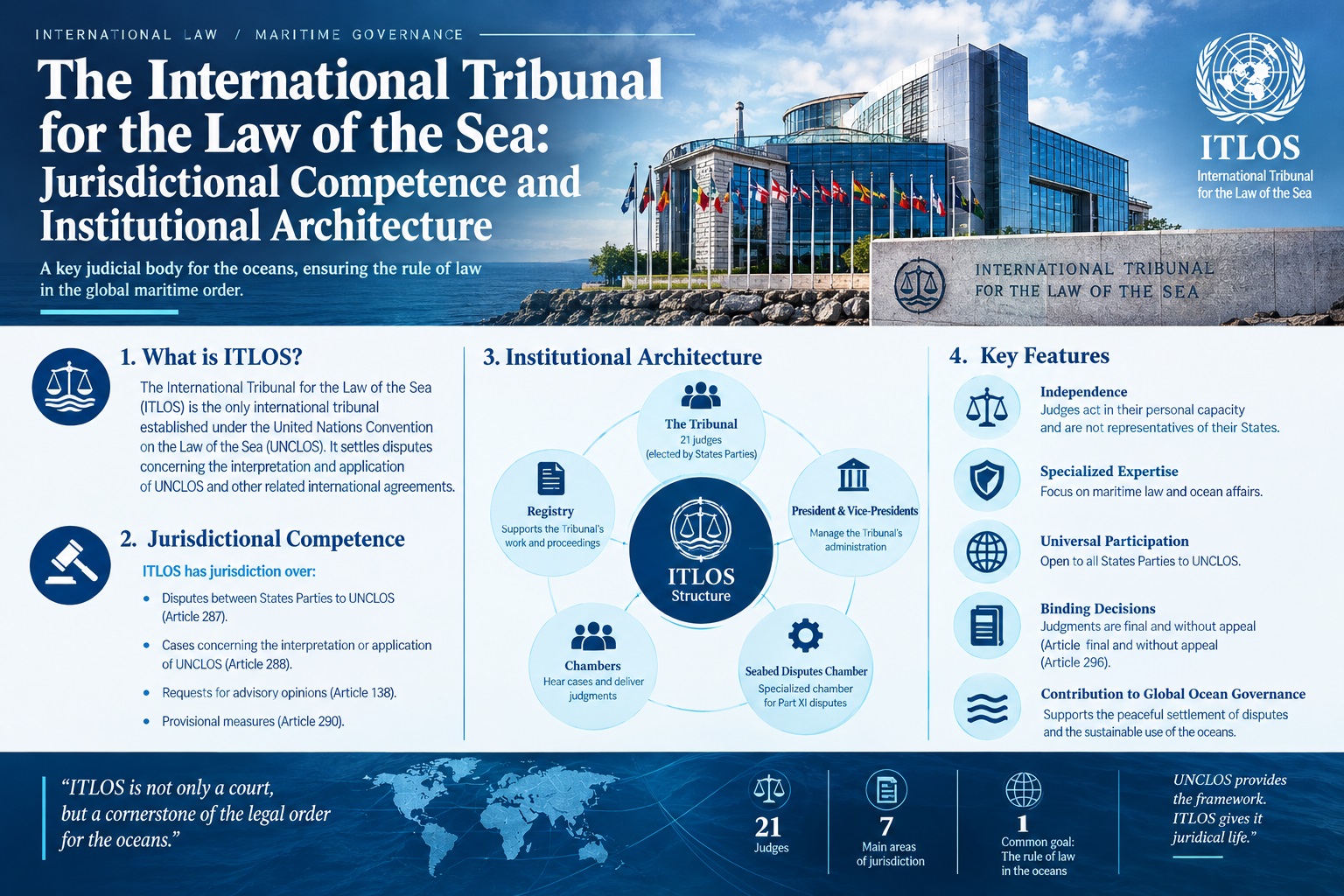
When the Third United Nations Conference on the Law of the Sea concluded in 1982, the resulting United Nations Convention on the Law of the Sea (UNCLOS) established not merely a comprehensive constitution for the oceans, but an intricate system of dispute resolution. Central to this institutional design is the International Tribunal for the Law of the Sea (ITLOS), seated in the Free and Hanseatic City of Hamburg. Conceived as a specialized judicial organ, the Tribunal operates within a decentralized and pluralistic architecture under Part XV of the Convention. Its mandate reflects an uneasy balance between the traditional prerogative of sovereign consent and the structural necessity of compulsory adjudicative procedures to preserve the integrity of the conventional regime. An assessment of its institutional framework, jurisdictional mechanics, and jurisprudence reveals how the Tribunal navigates the tensions inherent in contemporary international adjudication.
The Institutional Architecture and Composition of the Tribunal
The organic statute of the Tribunal, contained in Annex VI to UNCLOS, outlines an institutional apparatus designed to guarantee both maritime expertise and structural impartiality. In accordance with Article 2 of the Statute, the Tribunal consists of 21 independent members elected from among persons enjoying the highest reputation for fairness and integrity and of recognized competence in the field of the law of the sea. The election mechanism, governed by Article 4 of Annex VI, takes place among the States Parties to the Convention, with each State Party entitled to nominate up to two candidates.
To ensure global legitimacy, the composition of the bench must reflect the representation of the principal legal systems of the world and equitable geographical distribution. Article 3(2) of Annex VI operationalizes this imperative by establishing that there must be no fewer than three members from each geographical group established by the General Assembly of the United Nations: the African States, the Asian States, the Latin American and Caribbean States, the Western European and Other States, and the Eastern European States. Judges serve a staggered nine-year term and are eligible for re-election pursuant to Article 5 of the Statute. The deliberative autonomy of the Tribunal is fortified by diplomatic privileges and immunities under Article 10 of the Statute and the 1997 Agreement on the Privileges and Immunities of the International Tribunal for the Law of the Sea.
Specialized and Ad Hoc Chambers
Beyond the plenary bench, the Statute provides for the functional subdivision of the Tribunal into standing and ad hoc chambers. This institutional elasticity is intended to reconcile the demands of specialized adjudication with the procedural preferences of disputing sovereigns.
- The Seabed Disputes Chamber: Established under Part XI, Section 5, and Article 14 of Annex VI, this 11-member body occupies a sui generis position. Its members are selected by the plenary Tribunal from among its own judges for a three-year term, with particular regard to equitable geographical representation and the concurrence of the Assembly of the International Seabed Authority (ISA). The Chamber possesses distinct contentious and advisory jurisdiction over activities in the Area, serving as the sole judicial arbiter over the common heritage of mankind.
- Standing Chambers: Pursuant to Article 15(1) of Annex VI, the Tribunal has formed standing chambers to address distinct categories of disputes. These include the Chamber for Marine Environment Disputes, the Chamber for Maritime Delimitation Disputes, and the Chamber for Fisheries Disputes.
- Ad Hoc Chambers: Under Article 15(2) of Annex VI, the Tribunal may constitute a chamber to handle a particular dispute if the parties so request. The composition of such a chamber is determined by the Tribunal with the approval of the parties. This mechanism was notably deployed in the dispute concerning delimitation of the maritime boundary between Ghana and Côte d'Ivoire in the Atlantic Ocean (Case No. 23), offering an alternative that blends the institutional stability of a standing court with the party autonomy characteristic of Annex VII arbitral tribunals.
- Chamber of Summary Procedure: Constituted annually pursuant to Article 15(3) of the Statute, this five-member chamber is designed to facilitate the expeditious dispatch of procedural business and urgent proceedings.
What is the jurisdiction of ITLOS under UNCLOS?
The contentious jurisdiction of the Tribunal is divided into two distinct legal modalities: general contentious jurisdiction dependent on reciprocal jurisdictional choices under Part XV, and residual or compulsory exclusive jurisdiction directly conferred by the Convention regardless of declaration status under Article 287.
General Contentious Jurisdiction under Article 288(1) and Article 21 of the Statute
Under Article 288(1) of UNCLOS, the Tribunal possesses jurisdiction over any dispute concerning the interpretation or application of the Convention submitted to it in accordance with Part XV. However, this general competence is bounded by the procedural framework of Article 287. Article 287 establishes a cafeteria approach, allowing States Parties to declare a preference among four procedures: ITLOS, the International Court of Justice (ICJ), an arbitral tribunal constituted under Annex VII, or a special arbitral tribunal under Annex VIII. Under Article 287(3) and (5), an Annex VII arbitral tribunal functions as the default forum. Consequently, ITLOS possesses general contentious jurisdiction under Part XV only where both disputing States have deposited matching declarations accepting its jurisdiction, or where they conclude a special agreement (compromis) referring the specific case to Hamburg.
Additionally, Article 288(2) and Article 21 of the Statute extend the competence of the Tribunal to disputes concerning the interpretation or application of an international agreement related to the purposes of the Convention, provided the agreement confers such jurisdiction. This provision enables multilateral and bilateral treaties—such as the 1995 United Nations Fish Stocks Agreement—to integrate ITLOS into their dispute resolution mechanisms.
Compulsory Residual Jurisdiction: Article 290(5) Provisional Measures
The structural primacy of Annex VII arbitration within Part XV is counterbalanced by the urgent powers vested in ITLOS under Article 290(5). When an Annex VII tribunal has been invoked but not yet constituted, and the disputing parties fail to agree on another forum within two weeks from the date of a request for provisional measures, ITLOS holds compulsory residual jurisdiction to prescribe provisional measures. To do so, the Tribunal must determine that prima facie the tribunal which is to be constituted would have jurisdiction and that the urgency of the situation so requires.
The jurisprudence of the Tribunal under Article 290(5) demonstrates an active approach to safeguarding sovereign rights and preserving the marine environment. In the Southern Bluefin Tuna Cases (New Zealand v. Japan; Australia v. Japan), ITLOS prescribed provisional measures requiring the parties to act with prudence and caution to ensure that effective conservation measures were taken. Similarly, in the MOX Plant Case (Ireland v. United Kingdom), the Tribunal emphasized the duty of cooperation under Part XII, ordering the parties to consult concerning the ecological risks of the nuclear facility. In the Enrica Lexie Incident (Italy v. India, Case No. 24) and the Case concerning the detention of three Ukrainian naval vessels (Ukraine v. Russian Federation, Case No. 26), ITLOS clarified that its role under Article 290(5) is strictly preservationist, designed to freeze the status quo ante and avert non-compensable harm while the merits panel forms.
Compulsory Jurisdiction over Prompt Release: Article 292
Article 292 of UNCLOS establishes an expedited procedure for the prompt release of vessels and crews. If the authorities of a State Party have detained a vessel flying the flag of another State Party and it is alleged that the detaining State has failed to comply with the provisions of the Convention for the prompt release of the vessel or its crew upon the posting of a reasonable bond or other financial security, the question of release may be submitted to ITLOS, unless the parties agree otherwise within 10 days of detention.
The Tribunal has delineated the doctrinal contours of Article 292 through cases such as the M/V Saiga (No. 1) (Saint Vincent and the Grenadines v. Guinea), the Camouco (Panama v. France), the Monte Confurco (Seychelles v. France), the Volga (Russian Federation v. Australia), and the M/V Louisa (Saint Vincent and the Grenadines v. Kingdom of Spain). The primary provisions triggering Article 292 are Article 73(2) (fisheries enforcement in the Exclusive Economic Zone), Article 220(7) (vessel-source marine pollution enforcement), and Article 226(1)(c) (investigation of foreign vessels). In resolving these applications, the Tribunal is prohibited by Article 292(3) from addressing the merits of domestic proceedings against the vessel. Instead, it assesses the reasonableness of the bond, weighing factors such as the gravity of the alleged offenses, the domestic penalties, the value of the detained vessel and cargo, and the degree of financial exposure imposed on the shipowner.
| Adjudicative Mechanism | Legal Basis | Jurisdictional Basis | Access by Non-State Actors | Nature of the Decision |
|---|---|---|---|---|
| General Contentious Proceedings | UNCLOS Art. 288(1); Annex VI Art. 21 | Reciprocal Art. 287 declarations or special agreement (compromis) | Strictly restricted to States Parties (with exceptions under Part XI) | Final, binding on disputing parties (Statute Art. 33) |
| Provisional Measures (Pre-Annex VII) | UNCLOS Art. 290(5) | Compulsory residual jurisdiction; prima facie threshold | States Parties only | Binding interlocutory order pending merits tribunal |
| Prompt Release of Vessels and Crews | UNCLOS Art. 292 | Direct statutory jurisdiction failing bilateral agreement | Flag State or entities acting on its behalf (Annex VI Art. 291) | Binding judgment on release and quantum of security |
| Seabed Disputes Contentious Cases | UNCLOS Part XI, Sec. 5; Art. 187 | Compulsory exclusive jurisdiction over activities in the Area | States Parties, ISA, natural or juridical persons, state enterprises | Final, enforceable as domestic judgments (Statute Art. 39) |
| Advisory Jurisdiction (Full Tribunal) | ITLOS Rules Art. 138; Statutory inference | Conferred by international agreement related to UNCLOS purposes | International organizations authorized by relevant agreement | Non-binding, authoritative legal clarification |
How does ITLOS exercise advisory jurisdiction?
While the contentious jurisdiction of ITLOS has evolved steadily, its advisory competence has produced significant institutional debate. Unlike the ICJ Statute, which explicitly provides for advisory opinions in Chapter IV, the Statute of ITLOS (Annex VI) makes no direct textual provision for the advisory jurisdiction of the plenary Tribunal. Advisory competence is explicitly vested only in the Seabed Disputes Chamber under Article 191 of UNCLOS, which directs the Chamber to provide advisory opinions at the request of the Assembly or the Council of the ISA on legal questions arising within the scope of their activities.
The Evolution of Article 138 of the Rules
To fill this institutional space, the Tribunal adopted Article 138 of its Rules of the Tribunal. Paragraph 1 provides that the Tribunal may give an advisory opinion on a legal question if an international agreement related to the purposes of the Convention specifically provides for the submission to the Tribunal of a request for such an opinion. Paragraph 2 mandates that any request must be submitted by whatever body was authorized by or in accordance with the agreement to make the request.
The inclusion of Article 138 prompted doctrinal scrutiny from several international lawyers and respondent States, who argued that creating advisory competence through internal rules of procedure was an ultra vires expansion of the Statute. The validity of this provision was tested directly in 2013, when the Sub-Regional Fisheries Commission (SRFC), a West African intergovernmental body, submitted a request for an advisory opinion regarding illegal, unreported, and unregulated (IUU) fishing.
The SRFC and Climate Change Advisory Opinions
In the SRFC Advisory Opinion (Case No. 21, 2015), the Tribunal rejected arguments challenging its jurisdiction. ITLOS concluded that Article 138 of the Rules was not an unauthorized expansion of power, but an operationalization of the broader mandate flowing from Article 21 of the Statute, which encompasses all matters specifically provided for in any other agreement which confers jurisdiction on the Tribunal. The Tribunal established three cumulative requirements for its plenary advisory jurisdiction:
- An international agreement related to the purposes of the Convention must exist;
- The agreement must provide for the submission of a request for an advisory opinion to the Tribunal; and
- The request must be transmitted by a body authorized by or in accordance with that agreement.
This doctrine was reaffirmed and expanded in Request for an Advisory Opinion submitted by the Commission of Small Island States on Climate Change and International Law (COSIS) (Case No. 31, delivered on May 21, 2024). In that case, COSIS, an organization established via international agreement, asked the Tribunal to clarify the legal obligations of States Parties under UNCLOS regarding climate change mitigation, the protection of the marine environment from anthropogenic greenhouse gas emissions, and ocean acidification.
In its unanimous advisory opinion, the Tribunal confirmed its jurisdiction under Article 138 of the Rules. It ruled that greenhouse gases absorbed by the ocean constitute pollution of the marine environment under Article 1(1)(4) of UNCLOS. ITLOS held that States Parties bear an obligation of due diligence under Article 194(1) to take all necessary measures to prevent, reduce, and control marine pollution from greenhouse gas emissions, and that this standard is informed by objective international benchmarks, including the United Nations Framework Convention on Climate Change (UNFCCC) and the Paris Agreement. The COSIS opinion demonstrated the Tribunal's willingness to use its advisory function to integrate general international environmental norms into the law of the sea.
The Jurisprudential Impact on Maritime Delimitation and Law Enforcement
Beyond urgent and advisory proceedings, the Tribunal has contributed to the development of maritime boundary delimitation and the legal limits of law enforcement at sea. Historically, States favored the ICJ or ad hoc arbitral panels for boundary disputes, but ITLOS has established itself as an influential alternative.
Maritime Delimitation: Bangladesh/Myanmar and Ghana/Côte d'Ivoire
In the Dispute concerning delimitation of the maritime boundary between Bangladesh and Myanmar in the Bay of Bengal (Case No. 16, 2012), ITLOS addressed an issue neither the ICJ nor an arbitral tribunal had resolved: the delimitation of the continental shelf beyond 200 nautical miles. The Tribunal held that it possessed jurisdiction to delimit the continental shelf in its entirety under Article 83 of UNCLOS, including the outer continental shelf, even in the absence of definitive recommendations by the Commission on the Limits of the Continental Shelf (CLCS) under Article 76(8).
ITLOS reasoned that refusing to exercise its adjudicative function would create an untenable procedural deadlock, leaving the legal regime governing the seabed beyond 200 nautical miles unsettled. Methodologically, the Tribunal reaffirmed the three-stage delimitation approach: the construction of a provisional equidistance line, the assessment of relevant circumstances justifying an adjustment, and the application of a disproportionality test to verify that the result does not yield an inequitable outcome. The Special Chamber followed this method in Ghana/Côte d'Ivoire (Case No. 23, 2017), helping entrench consistency between ITLOS jurisprudence and that of the ICJ.
Jurisdiction over Maritime Law Enforcement: The Use of Force and Human Rights
Through its merits judgments, the Tribunal has clarified the limits of sovereign power during law enforcement operations at sea. In the M/V Saiga (No. 2) (Saint Vincent and the Grenadines v. Guinea, Case No. 2), the Tribunal set out the legal principles governing the use of force by coastal state enforcement vessels:
Although the Convention does not contain express provisions on the use of force in the arrest of ships, international law, which is applicable by virtue of article 293 of the Convention, requires that the use of force must be avoided as far as possible and, where force is unavoidable, it must not go beyond what is reasonable and necessary in the circumstances. Considerations of humanity must apply in the law of the sea, as they do in other areas of international law.
This principle was refined in the M/V Virginia G (Panama v. Guinea-Bissau, Case No. 19), where the Tribunal evaluated the legality of the confiscation of an oil tanker providing bunkering services to foreign fishing vessels in the Exclusive Economic Zone. While confirming that coastal state legislative jurisdiction under Article 56 includes the regulation of bunkering when ancillary to fishing activities, ITLOS held that the enforcement sanctions imposed must satisfy the customary standard of proportionality. Confiscating the vessel, in the circumstances of the case, constituted an excessive and unlawful sanction under international law.
Jurisdictional Friction: ITLOS within the Pluralistic Architecture of Part XV
The cafeteria model of Article 287 creates the potential for jurisdictional overlap and doctrinal friction across international courts. When a single marine dispute engages obligations under both UNCLOS and regional treaties, systemic questions of jurisdictional priority arise.
This friction surfaced during the Southern Bluefin Tuna dispute. After ITLOS prescribed provisional measures under Article 290(5), the Annex VII Arbitral Tribunal dismissed the claims on the merits. The arbitral tribunal concluded that the dispute also arose under the 1993 Convention for the Conservation of Southern Bluefin Tuna, whose dispute resolution clause excluded compulsory procedures under UNCLOS Part XV via Article 281(1). This decision prompted scholarly criticism for prioritizing a regional fisheries agreement over the comprehensive framework of UNCLOS.
A different form of institutional friction emerged in the MOX Plant dispute. Following ITLOS provisional measures, the European Court of Justice (ECJ, now CJEU) ruled in Commission v. Ireland (Case C-459/03) that Ireland had violated its obligations under European Community law by initiating UNCLOS dispute proceedings against the United Kingdom without consulting community institutions, because the relevant marine environmental provisions formed part of the Community legal order. These episodes demonstrate that, despite its central position under UNCLOS, ITLOS must navigate overlapping competencies with regional courts and specialized arbitral bodies.
The Deep Seabed and the Sui Generis Status of the Seabed Disputes Chamber
The Seabed Disputes Chamber requires distinct legal analysis. Unlike the full Tribunal, whose contentious jurisdiction relies largely on sovereign choice, the Chamber possesses compulsory exclusive jurisdiction over disputes regarding the Area under Part XI, Section 5. Under Article 187 of the Convention, the Chamber has jurisdiction over disputes between:
- States Parties concerning the interpretation or application of Part XI;
- A State Party and the Authority regarding acts or omissions of the Authority or violations of the Convention;
- Parties to a contract (including the Authority, state enterprises, and registered corporate contractors) concerning the interpretation, application, or execution of a relevant contract; and
- Disputes where the liability of the Authority or a contractor is alleged under Annex III.
By granting non-state corporate contractors direct access under Article 187(c)-(e), UNCLOS departed from the traditional principle limiting international adjudication to sovereign States. Furthermore, under Article 39 of Annex VI, the decisions of the Chamber are enforceable in the territories of States Parties in the same manner as judgments or orders of the highest court of the State Party in whose territory enforcement is sought.
The Chamber exercised its advisory competence in Responsibilities and obligations of States sponsoring persons and entities with respect to activities in the Area (Case No. 17, 2011). In that opinion, the Chamber clarified the meaning of the due diligence obligation incumbent on sponsoring States under Article 139 and Annex III, Article 4(4). The Chamber ruled that this duty is an obligation of conduct, requiring the sponsoring State to adopt laws, regulations, and administrative measures within its domestic legal system to secure compliance by deep-sea mining operators. It also confirmed that the precautionary approach and the obligation to conduct environmental impact assessments form part of customary international law and bind sponsoring States directly.
The Institutional Trajectory of ITLOS
Over nearly three decades of judicial work, the International Tribunal for the Law of the Sea has evolved well beyond its early reputation as primarily a forum for prompt release and emergency relief. While procedures under Article 290(5) and Article 292 provided early foundational jurisprudence, ITLOS has expanded into complex boundary delimitation, substantive enforcement reviews, and broad environmental advisory rulings.
The Tribunal's advisory opinions—particularly in the SRFC and COSIS proceedings—demonstrate its willingness to clarify global marine obligations through the systemic integration mandated by Article 293 of UNCLOS and Article 31(3)(c) of the Vienna Convention on the Law of Treaties. As maritime challenges grow increasingly complex, from climate-driven sea-level rise to deep-seabed resource exploitation, ITLOS continues to operate as both a specialized judicial body and an authoritative interpreter of the international law of the sea.
Comments
No comments yet.