Gateways of Global Commerce: Freedom of Navigation and the Law of International Straits
A comprehensive examination of how international maritime law balances the sovereign rights of coastal states with global transit passage through strategic chokepoints.
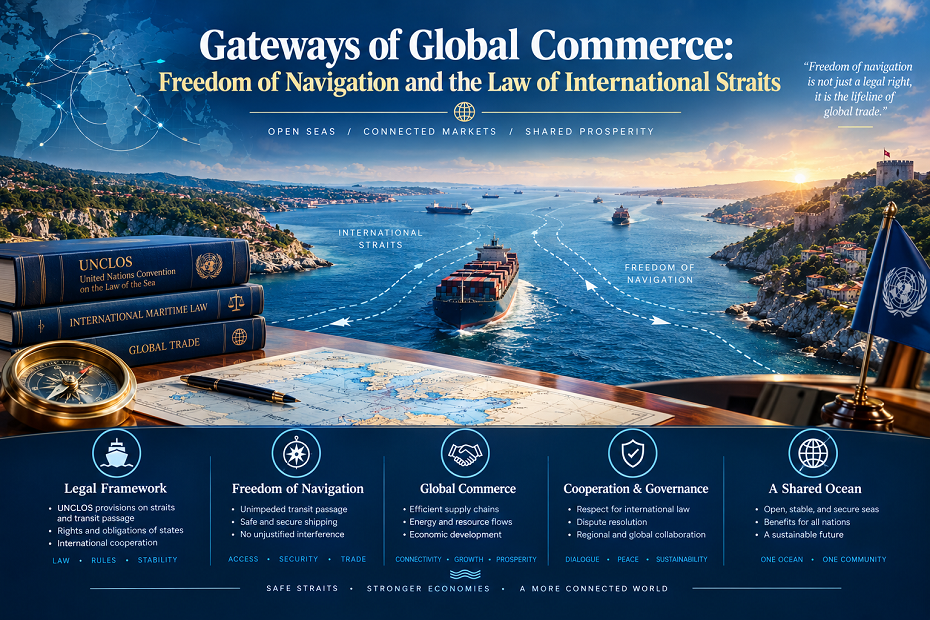
Narrow maritime corridors have shaped the geopolitical destiny of nations for centuries. From the Strait of Malacca to the Bab el-Mandeb and the Strait of Hormuz, these geographical choke points serve as critical arteries for energy supplies, commercial shipping, and military mobility. When the international community undertook the ambitious codification of the law of the sea during the third United Nations Conference on the Law of the Sea (UNCLOS III) between 1973 and 1982, the legal status of these strategic passages stood at the very center of multilateral negotiations. The central challenge was reconciling two historically conflicting doctrines: the sovereign authority of coastal states over their adjacent maritime territory and the imperative of maritime nations to preserve uninterrupted global navigation.
The resulting legal framework, enshrined in Part III of the 1982 United Nations Convention on the Law of the Sea (UNCLOS), created a bespoke legal compromise known as the transit passage regime. Understanding this regime requires examining its origins, the technical nuances that distinguish it from other navigation doctrines, the obligations it imposes on both coastal and flag states, and how contemporary geopolitical tensions continue to test its legal foundations.
The Evolution of Strait Regimes in International Law
Prior to UNCLOS III, maritime law recognized a traditional territorial sea belt extending only three nautical miles from coastal baselines. Under this narrow territorial boundary, a substantial number of the world’s major international straits contained continuous corridors of high seas running down their midlines. In these central corridors, vessels and aircraft enjoyed absolute high seas freedoms, including unrestricted surface navigation, submerged passage for submarines, and overflight rights for civil and military aviation.
However, when the international consensus shifted toward recognizing a 12-nautical-mile territorial sea, more than one hundred straits worldwide suddenly risked being enveloped entirely by coastal territorial waters. If the traditional regime of innocent passage were applied indiscriminately to these newly enclosed waters, the operational reach of commercial and naval fleets would be curtailed. Aircraft had no right of innocent passage through territorial airspace without prior permission, submarines were legally required to navigate on the surface while flying their flag, and coastal states retained the discretionary authority to suspend innocent passage temporarily for national security purposes.
Judicial precedent had previously addressed straits in a more limited scope. In the landmark Corfu Channel case of 1949, the International Court of Justice (ICJ) affirmed that, under customary international law, foreign vessels enjoyed a non-suspendable right of innocent passage through straits used for international navigation between two parts of the high seas. This principle was subsequently codified in Article 16, paragraph 4, of the 1958 Geneva Convention on the Territorial Sea and the Contiguous Zone. Yet, this provision failed to satisfy the demands of naval powers for overflight and submerged transit, prompting the intensive negotiations that ultimately created the autonomous regime of transit passage in the 1982 Convention.
What is transit passage in international law?
Transit passage is a distinct legal right codified in Articles 37 to 44 of UNCLOS, specifically designed for straits used for international navigation connecting one part of the high seas or an exclusive economic zone (EEZ) with another part of the high seas or an EEZ. Rather than subordinating maritime transport to the standard rules of the territorial sea, the Convention established an elevated standard of operational freedom.
Under Article 38, all ships and aircraft enjoy the freedom of navigation and overflight solely for the purpose of continuous and expeditious transit through the strait. The legal structure rests on a delicate reciprocal balance between transiting vessels and the states bordering the strait:
- Continuous and Expeditious Transit: Vessels and aircraft must proceed without delay through or over the strait, avoiding unnecessary deviations or lingering activities.
- Prohibition of Threats or Force: Transiting entities must refrain from any threat or use of force against the sovereignty, territorial integrity, or political independence of states bordering the strait, adhering strictly to the principles of international law embodied in the Charter of the United Nations.
- Restriction of Research and Survey Activities: Under Article 40, foreign ships, including marine scientific research and hydrographic survey vessels, may not carry out any research or survey activities without the prior authorization of the bordering states.
- Compliance with Safety and Environmental Regulations: Ships must comply with generally accepted international regulations, procedures, and practices for safety at sea, notably the International Regulations for Preventing Collisions at Sea (COLREGs), and for the prevention, reduction, and control of pollution from ships, primarily under the MARPOL framework.
What is the difference between innocent passage and transit passage?
The distinction between innocent passage and transit passage is one of the most critical structural divides in public international law. While both doctrines govern the movement of vessels through waters that fall within the sovereignty of a coastal state, their operational freedoms, jurisdictional limits, and exceptions diverge sharply.
| Legal Element | Innocent Passage (Part II, Section 3) | Transit Passage (Part III, Section 2) |
|---|---|---|
| Overflight | Prohibited for all aircraft without coastal state permission. | Fully permitted for civil and military aircraft. |
| Submerged Transit | Submarines must navigate on the surface and display their national flag. | Permitted if submerged navigation constitutes the normal mode of operation. |
| Suspendability | May be suspended temporarily in specified areas for security (except in non-transit straits). | Strictly non-suspendable under any circumstances. |
| Scope of Application | Applies across the general territorial sea and internal archipelagic waters. | Applies exclusively to straits used for international navigation between EEZs/high seas. |
| Coastal State Regulation | Broader legislative scope over customs, fiscal, immigration, and environmental matters. | Restricted strictly to safety, pollution control, fishing prevention, and customs/sanitary loading. |
As illustrated above, transit passage preserves freedoms that are closer to high seas liberties than to the restrictive regime of innocent passage. For commercial operators, it guarantees predictability without fear of unilateral administrative closure. For military commands, it ensures the preservation of global mobility without having to notify coastal administrations of planned transits or reveal submarine operational profiles.
Do submarines have the right of transit passage submerged?
One of the most consequential legal debates during UNCLOS III concerned the operational posture of naval vessels, specifically whether submarines were legally permitted to traverse straits while submerged. Article 39, paragraph 1(c) of the Convention mandates that vessels during transit passage shall refrain from any activities other than those incident to their normal modes of continuous and expeditious transit.
Major maritime nations, including the United States, the United Kingdom, and the Soviet Union, argued successfully that the normal mode for a military submarine is to navigate submerged. Submerged transit is critical for submarine safety, ballast stability, and acoustic stealth. If a submarine were compelled to surface, its operational efficacy would be undermined, and navigating narrow, congested surface channels could present distinct navigational hazards.
Although certain strait states initially resisted this interpretation, arguing that the protection of coastal security required surface transit as prescribed in Article 20 for innocent passage, the textual contrast between Part II and Part III is decisive. Article 20 explicitly demands that submarines navigate on the surface and show their flag in the territorial sea, whereas Article 39 contains no such requirement, deliberately employing the phrase normal modes. Consequently, prevailing state practice and predominant legal doctrine recognize that submarines possess the legal right to transit international straits submerged, provided the transit remains continuous, expeditious, and non-threatening.
Can a coastal state suspend transit passage?
The definitive answer under international treaty law is no. Article 44 of UNCLOS addresses the duties of states bordering straits and establishes an unequivocal standard: States bordering straits shall not hamper transit passage and shall give appropriate publicity to any danger to navigation or overflight within or over the strait. There shall be no suspension of transit passage.
This categorical prohibition on suspension represents the core of the historic bargain struck at UNCLOS III. Coastal states agreed to surrender their customary prerogative to close their territorial sea corridors in exchange for comprehensive international recognition of their sovereign authority over an expanded 12-mile territorial belt, extended exclusive economic zones, and continental shelves.
Even in instances of profound political discord or regional instability, a bordering state cannot unilaterally suspend transit passage. If a commercial vessel commits an infraction of international environmental or navigational standards, the coastal state’s recourse is narrowly defined. Under Article 42, coastal states may adopt laws and regulations relating to transit passage, but such measures must not discriminate among foreign ships, nor may they in their application have the practical effect of denying, hampering, or impairing the right of transit passage.
Should a transiting vessel cause or threaten major damage to the marine environment through a violation of safety or pollution regulations, bordering states may take appropriate enforcement measures under Article 233. However, these enforcement powers are tightly circumscribed; they apply only when a ship has committed a willful and serious act of pollution, and enforcement actions must remain proportionate and non-arbitrary, never amounting to a blanket suspension of the corridor for other traffic.
Which straits are subject to the transit passage regime?
Not all maritime bottlenecks are governed by the transit passage provisions of Part III, Section 2. The Convention establishes distinct geographic, functional, and legal categories, ensuring that different regimes apply based on historical status and geographic configuration.
1. Standard International Straits
The default transit passage regime applies to straits used for international navigation connecting one part of the high seas or an exclusive economic zone to another part of the high seas or an exclusive economic zone, pursuant to Article 37. Key global waterways in this category include the Strait of Gibraltar, connecting the Atlantic Ocean to the Mediterranean Sea, and the Strait of Malacca and Singapore Strait, which connect the Indian Ocean to the South China Sea.
2. Straits with Alternative Routes of Similar Convenience
Under Article 36, if a route through the high seas or through an exclusive economic zone of similar convenience with respect to navigational and hydrographical characteristics exists through the strait, the transit passage regime does not apply. In such corridors, freedom of navigation and overflight operates along the high seas or EEZ route. Examples include the Florida Strait between Florida and Cuba, and the Taiwan Strait, where wide channels of exclusive economic zone waters allow high seas navigation outside the territorial waters of the littoral states.
3. The Messina Exception
Article 38, paragraph 1, creates what is commonly known as the Messina Exception. Transit passage does not apply if the strait is formed by an island of a state bordering the strait and its mainland, provided there exists seaward of the island a route through the high seas or through an exclusive economic zone of similar convenience. The classic archetype is the Strait of Messina, situated between mainland Italy and the island of Sicily. In such channels, navigation is governed by non-suspendable innocent passage pursuant to Article 45, paragraph 1(a), routing international shipping seaward around the island whenever feasible.
4. Straits Governed by Long-Standing International Conventions
Article 35(c) provides that nothing in Part III affects the legal regime in straits in which passage is regulated in whole or in part by long-standing international conventions in force specifically relating to such straits. This grandfather clause preserves preexisting specialized regimes that have proven historically durable, including:
- The Turkish Straits (the Bosphorus and Dardanelles): Regulated by the 1936 Montreux Convention Regarding the Regime of the Straits, which establishes precise tonnage, notification, and weapon restrictions for warships entering the Black Sea.
- The Danish Straits (the Sound, the Great Belt, and the Little Belt): Governed by the 1857 Treaty of Copenhagen, which dissolved ancient Danish Sound dues and established free navigation for commercial vessels.
- The Strait of Magellan: Governed by the 1881 Boundary Treaty between Argentina and Chile, guaranteeing neutral and free navigation for all flags.
5. Dead-End Straits and Non-Transit Passages
Under Article 45, paragraph 1(b), straits connecting an area of the high seas or an EEZ with the territorial sea of a third-party coastal state are excluded from transit passage. Navigation through these dead-end straits is governed by the regime of non-suspendable innocent passage. A prominent example is the Strait of Tiran, which connects the Red Sea to the Gulf of Aqaba, giving access to the coasts of Jordan and Israel.
Rights and Responsibilities of Bordering States
While the transit passage regime severely restricts the coastal state’s ability to interrupt navigation, it does not leave strait states without authority. The law of the sea provides coastal nations with mechanisms to safeguard their security, prevent environmental catastrophe, and manage shipping density.
Traffic Separation Schemes and Sea Lanes
Under Article 41, states bordering straits may designate sea lanes and prescribe traffic separation schemes (TSS) where necessary to promote the safe passage of ships. However, to prevent unilateral overreach and guarantee harmonization across global transit routes, the Convention requires bordering states to refer proposals to the competent international organization—universally acknowledged as the International Maritime Organization (IMO). The IMO evaluates, adjusts, and officially adopts these schemes before they can be given binding legal effect. Transiting vessels are legally bound to respect all adopted sea lanes and traffic separation schemes.
Cooperative Mechanisms under Article 43
Recognizing the substantial financial and environmental burdens shouldered by littoral states that manage high-volume straits, Article 43 encourages user states and strait states to establish cooperative agreements. These cooperative frameworks are directed toward two vital objectives:
- The establishment and maintenance of necessary navigational and safety aids or other improvements in aid of international navigation.
- The prevention, reduction, and control of pollution from ships.
The most successful real-world implementation of this principle is found in the Cooperative Mechanism for the Straits of Malacca and Singapore, established in 2007 by Indonesia, Malaysia, and Singapore alongside international user states and industry bodies. This framework channels voluntary funding, technology sharing, and capacity building to ensure navigational safety and environmental monitoring in one of the busiest maritime arteries on earth.
Contemporary Legal and Geopolitical Challenges
Despite its detailed codification, the legal regime of international straits continues to face serious legal controversies, geopolitical friction, and environmental challenges.
The Status of Customary Law and Non-Parties
A persistent debate concerns whether the transit passage regime has crystalized into customary international law, binding upon states that have not ratified UNCLOS. The United States, which has never ratified the Convention, maintains that Part III reflects customary international law, asserting its right to exercise transit passage for its naval vessels and military aircraft worldwide. Conversely, certain coastal states contend that transit passage is purely a conventional right created by treaty, accessible only to states parties that have assumed the corresponding obligations of the entire UNCLOS package deal.
This friction emerges periodically in flashpoints such as the Strait of Hormuz. Iran, which signed but never ratified UNCLOS, asserts that only innocent passage applies through its territorial sea within the strait, arguing that transit passage is unavailable to non-party states like the United States. In contrast, most naval and maritime commercial states contend that the freedoms of transit passage apply universally through all straits meeting the objective geographic and functional criteria of Article 37.
Environmental Vulnerability versus Freedom of Navigation
As maritime vessels grow in both size and volume, the risk of catastrophic maritime casualties in ecologically sensitive straits has intensified. A prominent legal confrontation arose in the Torres Strait, situated between Australia and Papua New Guinea. Citing the fragile ecology of the Great Barrier Reef and the hazardous coral navigation of the strait, Australia instituted a system of compulsory pilotage in 2006.
Several maritime states, backed by debates within the IMO’s Legal Committee, objected that making pilotage mandatory under penalty of criminal prosecution violated the right of transit passage. The dispute underscored the delicate friction between a coastal state’s sovereign duty to protect its marine environment and the strict international prohibition against placing conditions, fees, or procedural obstacles that could hamper the freedom of transit passage.
Emerging Arctic Passages
Climate change and retreating polar ice have introduced new legal frontiers in the Arctic Ocean, specifically concerning the Northwest Passage through the Canadian Arctic Archipelago and the Northern Sea Route along the Russian Federation’s northern coast. Canada and Russia both assert that these polar passages traverse historic internal waters enclosed by straight baselines, granting them comprehensive sovereignty to regulate, inspect, license, or prohibit foreign vessel transits.
In contrast, the United States and the European Union contend that both maritime routes represent straits used for international navigation connecting the Atlantic and Pacific oceans. Under this view, once commercial viability increases and international traffic rises, the transit passage regime must govern these waters, guaranteeing free access without prior unilateral authorization. Resolving this Arctic controversy will test the balance between sovereign baseline claims and the functional tests codified in Part III of UNCLOS.
The Enduring Balance of the Strait Regime
The legal regime governing international straits and transit passage represents one of the most sophisticated compromises in modern international law. By decoupling passage through strategic bottlenecks from the restrictive, coastal-centric doctrine of innocent passage, the framers of UNCLOS preserved the physical continuity of global supply chains and global maritime security.
Simultaneously, the framework places meaningful duties upon transiting states to respect the safety, territorial sovereignty, and environmental integrity of bordering nations. Although geopolitical friction and ecological pressures will continue to challenge its parameters, the transit passage regime remains the legal bedrock ensuring that the world’s vital waterways remain open, secure, and regulated under the rule of law.
Comments
No comments yet.