Legal Analysis, Structural Overview, and Key Provisions of the International Convention on Salvage
A comprehensive academic legal analysis of the International Convention on Salvage 1989, examining its structural framework, key provisions, and jurisprudence.
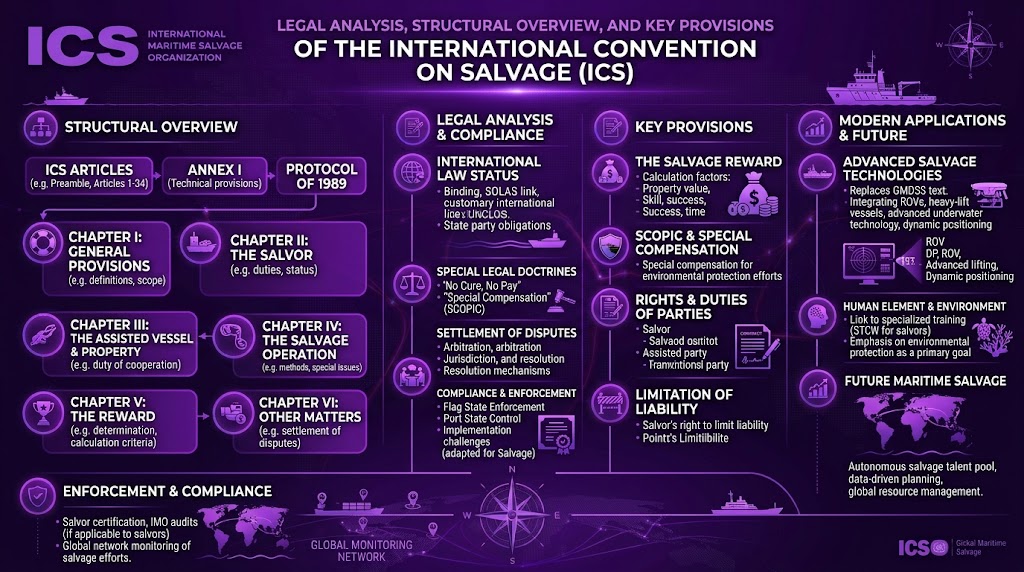
Abstract
This article provides a rigorous academic legal analysis of the International Convention on Salvage, 1989 (hereinafter the 1989 Salvage Convention or the Convention), which replaced the Brussels Convention of 1910. The study examines the historical evolution of maritime salvage law, transitioning from the traditional no cure, no pay regime to a modern legal framework that actively integrates environmental protection imperatives. Through a systematic examination of the Convention's structural components, principal provisions, jurisdictional dynamics, and the introduction of special compensation via Article 14 (and its subsequent replacement by SCOPIC clauses), this analysis evaluates how international maritime law balances commercial property interests with ecological preservation. Furthermore, the relationship between salvage operations and the law of the sea, relevant arbitral jurisprudence, and contemporary legal challenges are comprehensively addressed.
Introduction
Maritime salvage represents one of the oldest branches of admiralty law, rooted in the customary law of the sea and driven by the imperative to encourage voluntary assistance to ships and cargoes in peril. Historically, the governing legal principle was succinctly captured by the maxim no cure, no pay, codified internationally by the International Convention for the Unification of Certain Rules of Law Relating to Assistance and Salvage at Sea, signed at Brussels on September 23, 1910. Under the 1910 Brussels Convention, a salvor who achieved no positive result—regardless of the effort expended—was entitled to no remuneration.
However, the dramatic evolution of commercial shipping in the twentieth century, marked by the advent of massive oil tankers, hazardous cargo carriers, and heightened environmental awareness, exposed the severe inadequacies of the 1910 regime. Most notably, a salvor facing a potential environmental disaster caused by a leaking tanker would abandon the operation if the vessel itself was beyond saving, as expending resources on containment without rescuing property yielded zero financial reward under strict no cure, no pay rules. To rectify this structural flaw, the International Maritime Organization (IMO), in cooperation with the Comité Maritime International (CMI), drafted the International Convention on Salvage, 1989, which entered into force on July 14, 1996. This article provides a comprehensive legal dissection of the Convention, analyzing its underlying philosophy, structural design, operative provisions, and ongoing interaction with modern standard-form contracts.
Historical Background and Legal Status of the 1989 Convention
The genesis of the 1989 Salvage Convention lies in the growing international consensus during the late 1970s and 1980s that maritime law could no longer treat environmental protection as a mere incidental benefit of property salvage. The catalyst for reform was amplified by catastrophic maritime casualties, such as the grounding of the Torrey Canyon in 1967 and subsequent tanker incidents, which demonstrated that traditional salvage law offered no financial incentive to prevent pollution when saving the ship was economically unviable.
Diplomatic efforts culminated in the International Conference on Salvage held in London in April 1989, resulting in the adoption of the International Convention on Salvage, 1989. The treaty attained the requisite number of ratifications and entered into force on July 14, 1996, in accordance with Article 30. As a specialized convention under international maritime law, it binds state parties to modernize their domestic admiralty statutes, ensuring that national courts and arbitral tribunals apply uniform rules to international salvage operations.
What is the Scope and Objectives of the International Convention on Salvage?
The scope and objectives of the 1989 Convention are explicitly delineated in its opening provisions. According to Article 1, definitions are established for terms such as salvage operation, vessel, property, damage to the environment, payment, and organization. Article 2 establishes the territorial scope, providing that the Convention applies to judicial or arbitral proceedings relating to salvage operations in any State Party.
Crucially, Article 3 introduces a specific exclusion regarding fixed and floating platforms or units of mobile offshore drilling units (MODUs) when such platforms are engaged in the exploration, exploitation, or production of seabed mineral resources. Under Article 3, the Convention does not apply to such offshore units when they are stationed on location. Furthermore, Article 4 addresses State-owned vessels, establishing that the Convention does not apply to warships or other non-commercial vessels owned or operated by a State and entitled to sovereign immunity, unless the State decides otherwise pursuant to Article 4(2).
The primary objectives of the Convention, as reflected in its preamble and operational articles, are threefold: first, to maintain the traditional commercial incentives for salvors to rescue property at sea; second, to incorporate a mandatory legal mechanism for environmental protection; and third, to streamline salvage procedures and enhance predictability in international maritime dispute resolution.
How Do the Rights and Obligations of Salvors, Owners, and Masters Operate?
The legal relationship among the salvor, the shipowner, and the master of the vessel in distress is governed by a carefully balanced matrix of duties and rights set forth in Chapter II of the Convention. Article 8 outlines the duties of the salvor, mandating that the salvor shall carry out the salvage operations with due care (Article 8(1)(a)), exercise due care to prevent or minimize damage to the environment (Article 8(1)(b)), seek assistance from other salvors when reasonably necessary (Article 8(1)(c)), and accept the intervention of other salvors when reasonably requested by the owner or master (Article 8(1)(d)).
Conversely, Article 8(2) establishes the correlative duties of the owner and master. They are legally bound to cooperate fully with the salvor during the course of the operations, exercise due care to prevent or minimize damage to the environment, and accept the return of the vessel when reasonably requested by the salvor. These statutory duties elevate salvage from a purely voluntary commercial transaction into a cooperative legal enterprise imbued with public interest obligations.
Article 6 addresses salvage contracts, confirming the fundamental principle of freedom of contract. Parties remain entirely free to enter into standard-form salvage agreements, such as Lloyd's Open Form (LOF). However, Article 6(2) and (3) establish protective boundaries, stipulating that the master or shipowner has the authority to bind the owners of the cargo, and that terms contrary to the Convention's provisions on environmental protection or salvor misconduct may be subject to judicial or arbitral nullification.
What is the Remuneration Structure and Special Compensation Regime?
The financial architecture of the 1989 Convention represents its most significant departure from the 1910 Brussels regime. The remuneration structure is divided into two primary mechanisms: traditional salvage reward under Article 12 and special compensation under Article 14.
Criteria for Fixing the Salvage Reward (Article 13)
Article 13 codifies the long-standing criteria used by courts and arbitrators to determine the quantum of the salvage award. The reward must be fixed with a view to encouraging salvage operations, taking into account the following specific criteria without any order of priority:
- the salved value of the vessel and other property;
- the skill and efforts of the salvors in preventing or minimizing damage to the environment;
- the measure of success obtained by the salvor;
- the nature and degree of the danger;
- the skill and efforts of the salvors in salving the vessel, other property, and life;
- the time used and expenses and losses incurred by the salvors;
- the risk of liability and other risks run by the salvors or their equipment;
- the promptness of the services rendered;
- the availability and use of vessels or other equipment intended for salvage operations;
- the state of readiness and efficiency of the salvor's equipment and the value thereof.
Pursuant to Article 13(2), the reward—exclusive of any interest and recoverable legal costs—must not exceed the salved value of the vessel and other property. Furthermore, Article 15 governs the apportionment of the reward between the owner of the salvage vessel, the master, and other members of the crew.
The Special Compensation Mechanism (Article 14) and SCOPIC
The defining innovation of the 1989 Convention is Article 14, designed to overcome the harshness of the no cure, no pay rule in environmental salvage scenarios. Article 14(1) provides that if a salvor has carried out operations with respect to a vessel which by itself or its cargo threatened damage to the environment and has failed to earn an Article 13 reward at least equivalent to the special compensation calculable under this Article, the salvor is entitled to special compensation from the shipowner equivalent to their expenses.
Under Article 14(2), if the salvor has prevented or minimized damage to the environment, the special compensation payable by the owner to the salvor under paragraph 1 may be increased up to a maximum of 30 percent of the expenses incurred by the salvor. Article 14(3) allows the tribunal to increase this increment up to 100 percent if deemed fair and equitable. Expenses under Article 14 are defined in paragraph 3 as out-of-pocket expenses reasonably incurred by the salvor and a fair rate for equipment and personnel actually and reasonably used.
Despite its noble intent, Article 14 proved notoriously litigious in practice. The phrase expenses incurred by the salvor generated vast controversy over whether it included overhead costs, and the threshold of preventing or minimizing environmental damage led to complex, expert-heavy arbitrations. To bypass the interpretive ambiguities of Article 14, maritime industry stakeholders developed the Special Compensation P&I Club Clause (SCOPIC) in 1999, incorporated into standard contracts like LOF 2000 and subsequent iterations. The SCOPIC clause establishes a tariff-based system for special compensation, removing the requirement to prove environmental enhancement under Article 14 while operating in parallel with the 1989 Convention framework.
How Does Jurisdiction, Enforcement, and Dispute Settlement Function?
Chapter IV of the Convention addresses claims, actions, and limitation periods. Article 21 sets a strict two-year limitation period for the commencement of judicial or arbitral proceedings relating to salvage claims, calculated from the day on which the salvage operations terminated, subject to suspension or interruption provisions under the law of the forum state.
Jurisdiction is primarily determined by domestic admiralty laws, but the widespread incorporation of standard forms like LOF routinely embeds arbitration clauses, specifically pointing to London arbitration administered by Lloyd's. Maritime liens play a critical enforcement role: salvors possess a high-ranking maritime lien over the salved vessel and cargo. Article 20 empowers the salvor to demand satisfactory security—typically in the form of a P&I Club guarantee or bank undertaking—before releasing the salved property from their possession.
What is the Relationship with Other International Legal Instruments?
The 1989 Salvage Convention operates within a complex ecosystem of international maritime law treaties. Its interface with environmental conventions, such as the International Convention Relating to Intervention on the High Seas in Cases of Oil Pollution Casualties (Intervention Convention 1969) and the United Nations Convention on the Law of the Sea (UNCLOS), is governed by the principle of harmonious interpretation. Article 28 of the Convention explicitly safeguards state sovereignty and public law enforcement powers, ensuring that coastal states retain the authority to take measures to protect their coastline from pollution despite ongoing private salvage operations.
Additionally, the Convention coordinates closely with liability and compensation regimes such as the International Convention on Civil Liability for Oil Pollution Damage (CLC) and the International Convention on the Establishment of an International Fund for Compensation for Oil Pollution Damage (Fund Convention). Where salvor expenses or liabilities intersect with shipowner liability limits under conventions such as the Convention on Limitation of Liability for Maritime Claims (LLMC 1976/1996), intricate legal questions arise regarding whether special compensation under Article 14 or SCOPIC is subject to statutory limitation.
What Are the Contemporary Legal Challenges and Critical Assessments?
Decades after its entry into force, the 1989 Salvage Convention faces novel challenges arising from technological advancements and evolving commercial realities in the maritime sector:
- Mega-Container Ships: Modern ultra-large container vessels present unprecedented salvage hazards. Salvors face immense difficulties in stabilizing mega-ships, offloading thousands of heterogeneous containers, and managing liability exposure when hazardous materials are misdeclared.
- Autonomous and Remotely Operated Vessels: The rise of Maritime Autonomous Surface Ships (MASS) disrupts traditional legal assumptions regarding the presence of a master and crew on board, complicating the reciprocal duties of cooperation outlined in Article 8.
- Green Energy Transitions: The transport of alternative fuels, such as liquefied natural gas (LNG), ammonia, hydrogen, and massive lithium-ion battery packs on electric vehicle carriers, introduces extreme thermal runaway and explosion risks that challenge traditional salvor equipment and safety protocols.
- Wreck Removal Integration: The 1989 Convention focuses strictly on salvage (saving property and life in peril), drawing a sharp legal line between salvage and wreck removal. The subsequent adoption of the Nairobi International Convention on the Removal of Wrecks, 2007, attempted to bridge this gap, but jurisdictional friction between salvors and coastal state wreck removal mandates persists.
Conclusion
The International Convention on Salvage, 1989, stands as a cornerstone of modern admiralty law, successfully bridging the historical divide between commercial property recovery and contemporary environmental imperatives. By replacing the uncompromising strictures of the 1910 Brussels Convention with a sophisticated dual-track remuneration system encompassing traditional salvage awards and special compensation for environmental protection, the 1989 Convention transformed maritime salvage into an active instrument of marine ecological preservation. Although practical friction surrounding Article 14 necessitated industry-led contractual innovations like the SCOPIC clause, and contemporary maritime developments such as mega-ships and alternative fuels pose ongoing stress tests, the Convention's foundational principles of cooperation, equitable reward, and environmental vigilance remain indispensable to the stability and safety of international shipping.
References
- International Maritime Organization (IMO). International Convention on Salvage, 1989. London: IMO Publishing.
- Comité Maritime International (CMI). Travaux Préparatoires of the 1989 Salvage Convention. CMI Documentation.
- Brindle, Michael, and Bennett, Raymond. The 1989 Salvage Convention: A Commentary. Lloyd's of London Press.
- Gauci, Gotthard. The 1989 Salvage Convention and the Protection of the Marine Environment. Journal of Maritime Law and Commerce.
- Rose, Francis. The Modern Law of Pilotage and Salvage. Sweet & Maxwell.
- Griggs, Patrick, Williams, Richard, and Farr, Jeremy. Limitation of Liability for Maritime Claims. Informa Law from Routledge.
Comments
No comments yet.