Deep-Sea Mining and the Protection of the Marine Environment: Legal Frameworks, Gaps, and Jurisprudence
An exhaustive legal inquiry into the environmental governance of the Area under UNCLOS Part XI, evaluating state liability, ISA oversight, and precautionary obligations.
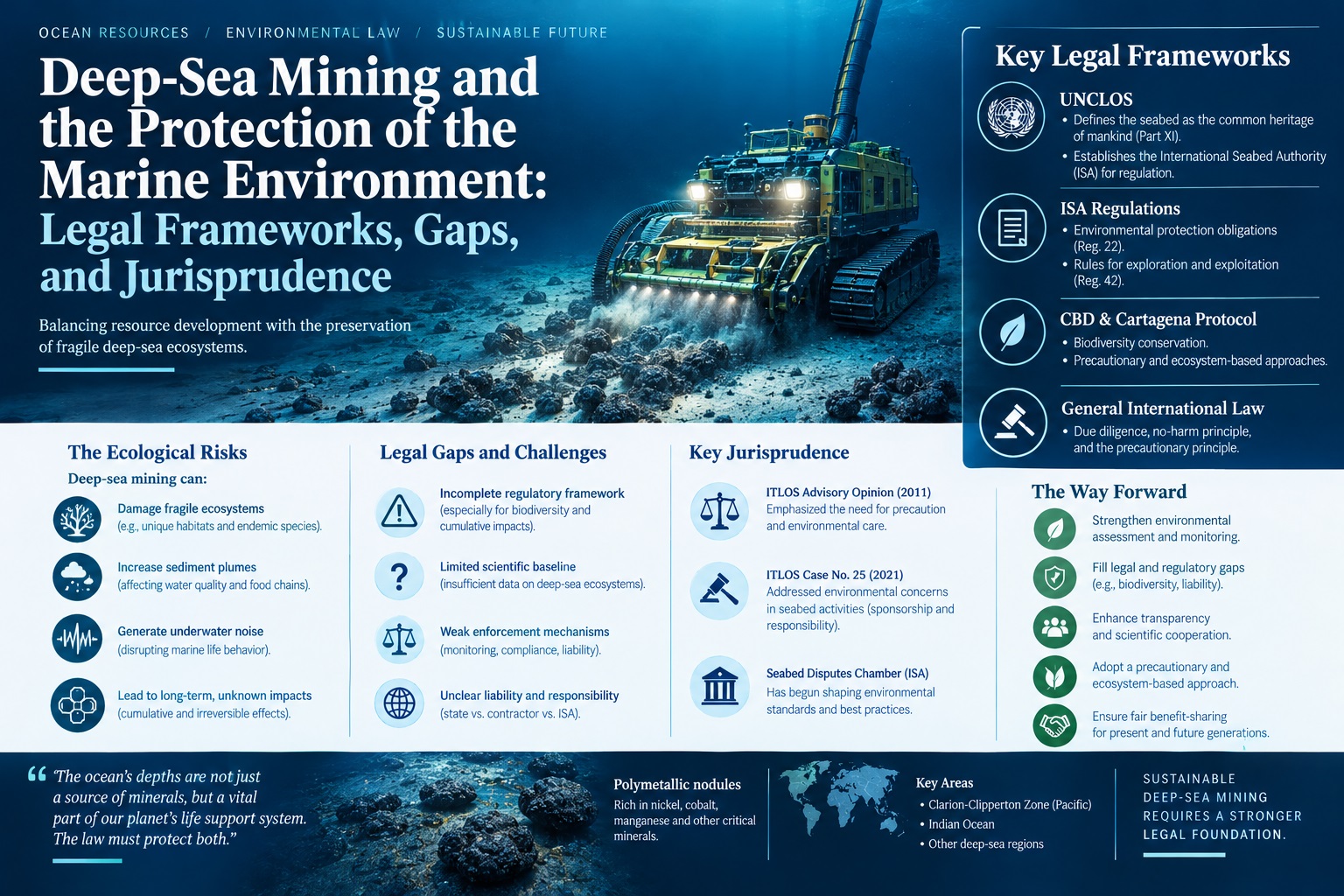
The legal architecture governing the seabed, ocean floor, and subsoil beyond the limits of national jurisdiction—designated as the Area under Article 1(1)(1) of the United Nations Convention on the Law of the Sea (UNCLOS)—rests upon an unresolved normative tension. Declared the common heritage of mankind by Arvid Pardo before the United Nations General Assembly in 1967 and subsequently codified in Article 136 of UNCLOS, the Area was conceived as an international commons subject neither to sovereign appropriation nor unilateral exploitation. Simultaneously, Part XI of the Convention, as fundamentally reshaped by the 1994 Agreement relating to the Implementation of Part XI of the United Nations Convention on the Law of the Sea, established an institutional mechanism to facilitate the commercial extraction of mineral resources.
As technological capabilities converge with surging industrial demand for energy transition minerals—principally cobalt, nickel, manganese, and copper—the prospective transition from scientific prospecting to commercial exploitation exposes severe fissures in the international legal order. The central challenge resides in reconciling the mandate of the International Seabed Authority (ISA) to organize and control activities in the Area pursuant to Article 157 with its affirmative obligation under Article 145 to ensure effective protection for the marine environment from harmful effects which may arise from such activities. This analysis evaluates the normative, jurisdictional, and procedural mechanics of deep-sea mining governance, tracing the evolution of sponsoring state liability, the application of customary environmental norms, institutional capture within the ISA, and the interface between UNCLOS and newly emerging instruments of international environmental law.
What are the environmental risks of deep-sea mining?
Evaluating the legal duties codified within UNCLOS requires a granular understanding of the physical and ecological domains subject to commercial interest. Mineral deposits targeted for extraction fall into three distinct geological categories: polymetallic nodules, situated on abyssal plains between 3,500 and 6,000 meters depth; seafloor massive sulfides, formed through hydrothermal activity along mid-ocean ridges; and cobalt-rich ferromanganese crusts, precipitated onto seamounts at depths ranging from 800 to 2,500 meters. Each formation hosts uniquely adapted, slow-growing ecological communities characterized by extreme longevity, low metabolic rates, and pronounced vulnerability to anthropogenic perturbation.
In the Clarion-Clipperton Zone (CCZ) of the central Pacific Ocean, polymetallic nodules serve as the sole hard substrate across vast expanses of soft sediment, providing an irreplaceable habitat for sessile epifauna such as hexactinellid sponges and xenophyophores. The physical harvesting of these nodules by mechanical collectors inflicts direct and permanent physical destruction upon the benthic substrate. Due to extremely low sedimentation rates—often measured in millimeters per millennium—the physical disruption of the benthic interface cannot naturally regenerate within human timeframes, rendering the disturbance ecologically permanent.
Beyond mechanical stripping, the generation of operational and discharge sediment plumes presents a trans-water-column hazard. Collector devices operating on the seabed mobilize particulate plumes that drift across hundreds of kilometers, smothering filter-feeding benthic fauna, clogging respiratory apparatuses, and disrupting biogeochemical cycling. Concurrently, the surface or mid-water discharge of residual slurry—after ore separation on production vessels—releases fine particulate matter, elevated heavy metal concentrations, and dissolved toxins into the mesopelagic zone, an ecologically critical stratum supporting commercial fisheries and oceanic carbon sequestration.
Anthropogenic acoustic emissions and artificial illumination introduced by extraction machinery compound these impacts. Ambient sound levels in the abyssal plain are exceptionally low; the deployment of heavy industrial equipment generates continuous, low-frequency acoustic vibrations capable of traveling immense distances in the deep sound channel (SOFAR), disorienting marine mammals, altering fish behavior, and disrupting communication systems of mesopelagic organisms. The convergence of these stressors threatens catastrophic biodiversity loss, irreversible genetic degradation, and the impairment of fundamental biosphere regulatory functions.
What legal obligations bind sponsoring states under UNCLOS?
The regulatory architecture of Part XI delegates commercial activity to private corporations and state-backed entities, provided they obtain sponsorship from a state party to UNCLOS. Under Article 139(1) of the Convention, states parties bear the responsibility to ensure that activities in the Area, whether carried out by states parties or state enterprises, or by natural or juridical persons possessing the nationality of states parties or effectively controlled by them, conform with the provisions of Part XI. This framework generated profound legal uncertainty regarding the precise nature, scope, and liability thresholds of the sponsoring state, culminating in the landmark Advisory Opinion delivered by the Seabed Disputes Chamber (SDC) of the International Tribunal for the Law of the Sea (ITLOS) in 2011.
In Case No. 17, Responsibilities and obligations of States sponsoring persons and entities with respect to activities in the Area, the Chamber rendered an exhaustive interpretation of the obligations of sponsoring states. Resolving ambiguities embedded in Article 139 and Annex III, Article 4(4) of UNCLOS, the SDC affirmed that the sponsoring state does not bear an absolute obligation to guarantee compliance by the sponsored contractor, nor does it incur strict liability for damage resulting from the contractor's actions. Instead, the primary obligation of the sponsoring state is an obligation of conduct characterized by due diligence.
The obligation of the sponsoring State to ensure that the contractor complies with its obligations under the Convention and related instruments is an obligation of conduct, not of result. It is an obligation of due diligence, requiring the sponsoring State to make best efforts, to take all appropriate measures, and to exercise continuous control over the activities of the contractor.
The Chamber elucidated that due diligence is an objective and evolving standard, demanding a heightened degree of vigilance proportionate to the gravity and risk of the activity. To discharge this obligation, a sponsoring state must enact domestic legal frameworks, establish administrative monitoring mechanisms, and enforce regulatory controls no less effective than international rules and regulations established by the ISA. Failure to enact such domestic measures deprives the sponsoring state of the liability shield provided by Article 139(2), exposing it to state responsibility under international law should environmental damage ensue.
Critically, the SDC identified several direct obligations that bind sponsoring states independent of their due diligence posture toward contractors. These direct obligations operate as peremptory treaty obligations, encompassing:
- The obligation to assist the Authority in the exercise of its control over activities in the Area pursuant to Article 153(4);
- The obligation to apply the precautionary approach as incorporated in Principle 15 of the Rio Declaration and ISA regulations;
- The obligation to apply best environmental practices;
- The obligation to conduct and enforce comprehensive Environmental Impact Assessments (EIAs) in accordance with Article 206 of UNCLOS; and
- The obligation to provide recourse for compensation through domestic legal avenues pursuant to Article 235(2).
A contentious debate addressed by the Chamber centered on whether developing sponsoring states could claim differentiated, less onerous responsibilities. Rejecting arguments grounded in special and differential treatment, the SDC held that the standard of due diligence applies identically across all sponsoring states, irrespective of their economic developmental status. The Chamber observed that creating relaxed obligations for developing states would induce a jurisdictional race to the bottom, incentivizing transnational mining conglomerates to establish front companies in lightly regulated developing jurisdictions—a maritime equivalent of flags of convenience.
How does the precautionary approach apply to seabed exploitation?
The interpretation and implementation of the precautionary approach in deep-sea mining exemplifies the convergence of customary international law and specialized treaty regimes. While Part XI of UNCLOS does not explicitly invoke the term precaution—reflecting the drafting environment of the 1970s—the Seabed Disputes Chamber in its 2011 Advisory Opinion crystallized the integration of the principle into the operational architecture of the Area.
The SDC bridged the statutory divide by linking the ISA's regulatory instruments, such as the Regulations on Prospecting and Exploration for Polymetallic Nodules, with customary international law. The Chamber observed that the precautionary approach, as formulated in Principle 15 of the 1992 Rio Declaration on Environment and Development, has become an integral component of the general obligation of due diligence binding upon all states. Where scientific plausibility suggests that an activity carries a risk of serious or irreversible harm, the absence of full scientific certainty shall not be used as a reason for postponing cost-effective measures to prevent environmental degradation.
This formulation operates in dynamic tension with other international jurisprudential benchmarks. In the Pulp Mills on the River Uruguay case (2010), the International Court of Justice (ICJ) affirmed that while the precautionary approach informs the interpretation and application of treaty provisions, it does not automatically reverse the burden of proof unless express treaty language dictates such a shift. Within the seabed regime, however, the statutory threshold established by Article 145 of UNCLOS—mandating effective protection from harmful effects—operates alongside the ISA's exploration regulations to establish a quasi-reversal of the evidentiary burden.
The practical application of precaution in the Area faces acute procedural complications. The prevailing baseline in the abyssal environment is an extraordinary deficit of scientific knowledge; deep-sea ecosystems remain overwhelmingly unmapped, poorly described taxonomically, and inadequately monitored over temporal scales. Under classic formulations of precaution, an activity that threatens irreversible ecological alteration cannot proceed absent sufficient baseline data to evaluate its systemic risks. Yet, the commercial trajectory pursued by prospective mining entities and sponsoring states seeks to use the exploration phase to justify a transition to exploitation, claiming that comprehensive data can only be gathered via actual operational testing.
The following comparative matrix illustrates the evolution of environmental due diligence and precautionary jurisprudence across international tribunals, contextualizing its application to deep-sea mineral exploitation:
| Jurisdiction / Forum | Landmark Ruling | Core Legal Principle Articulated | Application to the Deep Seabed Regime |
|---|---|---|---|
| International Tribunal for the Law of the Sea (ITLOS) | Responsibilities and Obligations in the Area (Case No. 17, 2011) | Due diligence standard; direct obligations; customary status of Rio Principle 15; rejection of developing state exemption. | Binds sponsoring states to strict legislative and enforcement duties; mandates EIA and precaution as customary norms under UNCLOS. |
| International Court of Justice (ICJ) | Pulp Mills on the River Uruguay (Argentina v. Uruguay, 2010) | Due diligence requires an EIA prior to project authorization where transboundary harm is plausible; continuous monitoring duty. | Reinforces Article 206 of UNCLOS; requires long-term environmental surveillance of sediment plume dispersion. |
| Permanent Court of Arbitration (PCA) | South China Sea Arbitration (Philippines v. China, 2016) | Articles 192 and 194 impose an affirmative, unqualified duty to protect the marine environment from state and corporate activities. | Extends environmental protection beyond sovereignty; harmonizes Part XII environmental baselines with activities in the Area. |
| International Court of Justice (ICJ) | Gabčíkovo-Nagymaros Project (Hungary/Slovakia, 1997) | Peril must be grave and imminent; states must continually assess newly discovered environmental vulnerabilities. | Demands adaptive management and potential suspension of commercial contracts upon emergence of ecological hazards. |
The friction between progressive customary norms and economic contract rights became intensely acute following the invocation of the so-called two-year rule by the Republic of Nauru in June 2021. Acting pursuant to Section 1, Paragraph 15 of the Annex to the 1994 Implementation Agreement, Nauru notified the ISA Council of its intention to sponsor an application for an exploitation plan of work on behalf of Nauru Ocean Resources Inc. (NORI). This provision stipulates that if a member state requests the completion of the commercial exploitation code, the Council must finalize and adopt the rules, regulations, and procedures within two years.
Crucially, the clause provides that if the Council fails to finalize the exploitation code within the prescribed timeframe, it must nonetheless consider and provisionally approve the application based on the provisions of the Convention and whatever provisional rules the Council has developed. The expiration of this two-year deadline in July 2023 without an agreed exploitation code exposed an institutional void. Legally, the mandatory language of Section 1, Paragraph 15 directly clashes with the substantive obligations codified in Article 145 and the customary duties of precaution and EIA affirmed in Case No. 17. Approving an exploitation contract in the absence of comprehensive regulatory thresholds, monitoring standards, and environmental baselines constitutes a breach of the sponsoring state's and the ISA's obligation to prevent serious harm to the marine environment.
Can the International Seabed Authority prevent environmental harm?
The institutional capacity of the ISA to function as an independent, rigorous environmental regulator is deeply compromised by systemic structural conflicts embedded in its constituent treaties. Established by UNCLOS Part XI, the Authority operates through an Assembly representing all states parties, a 36-member executive Council, and a specialized administrative arm known as the Legal and Technical Commission (LTC). The institutional design reflects an outdated mid-twentieth-century industrial paradigm that prioritizes mineral supply security over planetary boundary preservation.
The most acute institutional vulnerability lies in the composition and working methods of the Legal and Technical Commission. Under Article 165 of UNCLOS, the LTC is tasked with reviewing applications for plans of work, formulating draft environmental rules, and making recommendations directly to the Council. Despite possessing sweeping regulatory authority, the LTC operates largely behind closed doors, shielding contractor data, environmental impact reports, and internal deliberations from public scrutiny under broad assertions of commercial confidentiality. This lack of transparency severely impairs peer review by the global scientific community and inhibits meaningful oversight by civil society.
Furthermore, the voting geometry within the ISA Council creates a powerful bias toward project approval. Pursuant to Article 162(2)(j) of UNCLOS, if the Legal and Technical Commission issues a recommendation to approve an application for a plan of work, that recommendation is deemed approved unless the Council rejects it by a two-thirds majority of members present and voting, including a majority within each of the Council's constituent chambers. Consequently, a small coalition of mining-aligned states can easily prevent the Council from overturning a positive LTC recommendation, effectively delegating ultimate discretionary power to a non-elected, closed body of technical specialists.
The Authority also suffers from a fundamental conflict of interest inherent to its mandate. Under Part XI, the ISA is structured not merely as a neutral regulatory agency, but as an administrative beneficiary of exploitation. The Authority is legally mandated to collect royalties, distribute economic benefits derived from deep-sea mining to developing nations, and, via its operational arm known as the Enterprise, directly engage in commercial extraction. The Authority's institutional revenue model is therefore intimately linked to the realization of commercial extraction, creating a structural incentive toward project approval that directly conflicts with its conservation mandates under Article 145.
In response to growing environmental critique, the ISA has pursued spatial planning mechanisms, designating Regional Environmental Management Plans (REMPs) across target zones such as the Clarion-Clipperton Zone. These frameworks establish Areas of Particular Environmental Interest (APEIs), within which commercial mining is strictly prohibited to preserve representative benthic habitats. While APEIs constitute a step toward systemic planning, marine biologists point out that these protected zones were delineated without comprehensive baseline data, leaving high-density mining exploration blocks directly contiguous to preservation sites and vulnerable to sediment plume contamination.
Emerging Jurisdictional Frontiers: The BBNJ Agreement and Moratorium Movements
The normative landscape governing deep-sea areas has expanded significantly with the adoption of the Agreement under the United Nations Convention on the Law of the Sea on the Conservation and Sustainable Use of Marine Biological Diversity of Areas Beyond National Jurisdiction (BBNJ Agreement) in 2023. This modern treaty instrument introduces new legal tensions regarding jurisdictional boundaries and cumulative environmental management.
Article 8 of the BBNJ Agreement contains a non-prejudice clause designed to prevent the new instrument from undermining existing international frameworks and bodies, including the ISA. However, the BBNJ Agreement introduces rigorous, modern standards for environmental impact assessments, strategic environmental assessments, and the creation of comprehensive marine protected areas (MPAs) in the water column above the seabed. This dual governance framework creates a bifurcated regime:
- The water column, harboring critical mesopelagic, bathypelagic, and epipelagic biodiversity, falls increasingly under the conservation imperatives, transparency standards, and stakeholder obligations of the BBNJ framework;
- The underlying seabed remains governed by the resource-centric, extractive orientation of the ISA under Part XI.
This statutory bifurcation is biologically untenable. Mining operations occurring on the benthic floor directly compromise the overlying water column via discharged sediment plumes, acoustic interference, and chemical contamination. Should an MPA be established under the BBNJ Agreement in high-seas waters situated directly above an ISA-licensed mining concession, severe jurisdictional conflicts will inevitably emerge regarding the spatial authority to prohibit particulate discharge into designated conservation zones.
Simultaneously, state practice regarding the Area is fracturing along political and normative fault lines. A growing coalition of states—including France, Germany, Chile, Costa Rica, Palau, and Canada—has actively advocated for a precautionary pause, a temporary moratorium, or a outright ban on commercial deep-sea mining until the ecological risks are comprehensively understood, environmental baselines established, and enforceable exploitation regulations adopted. Conversely, a counter-coalition of states, led by China, the Russian Federation, and specific Pacific island states including Nauru, asserts the strict legal primacy of the 1994 Agreement, demanding that the Council execute its statutory duty to evaluate applications under the two-year rule.
This deepening divergence points to a potential jurisdictional showdown before the Seabed Disputes Chamber or the International Court of Justice. If the ISA Council provisionally approves an exploitation contract without having completed binding environmental standards or establishing satisfactory baseline protections, affected coastal states or members of the Assembly could initiate contentious proceedings pursuant to Section 5 of Part XI. Potential claims could center on violations of Article 145, procedural breaches under Article 162, or an administrative failure to respect customary obligations of due diligence as articulated in Case No. 17.
The Path Toward Systemic Reconciliation
The regime governing the Area stands at a critical juncture between late-twentieth-century industrial extractivism and contemporary international environmental norms. The common heritage of mankind concept—historically interpreted primarily as a mechanism for the equitable redistribution of mineral wealth—must be re-evaluated through the lens of modern international law. The common heritage of mankind cannot be reduced solely to monetary gains derived from extraction; it inherently encompasses the common interest in planetary life-support systems, ecological stability, and intergenerational equity.
Resolving this systemic governance crisis requires profound structural and statutory reforms within the ISA. First, the Legal and Technical Commission must open its deliberations, publish all contractor environmental monitoring data, and integrate independent scientific oversight into its assessment mechanisms. Second, the threshold for serious harm under Article 145 must be codified with quantitative, scientifically defined criteria rather than left to ambiguous, contractor-led interpretations. Third, the legal mechanism of the two-year rule must be authoritatively reconciled with the substantive environmental imperatives of UNCLOS, establishing unequivocally that procedural timelines cannot override the substantive obligation to prevent irreversible damage to the marine environment.
Ultimately, international ocean governance cannot treat the seabed as a detached, exploitable domain while simultaneously attempting to protect the high-seas biosphere. Until the international community establishes a comprehensive, transparent, and ecologically robust regulatory regime capable of ensuring absolute compliance with the precautionary approach, authorizing commercial extraction in the Area risks compromising the common heritage of mankind for the short-term benefit of a few actors, inflicting irreversible harm on one of the planet's most critical and vulnerable ecosystems.
Comments
No comments yet.