Legal Analysis, Structural Overview, and Key Provisions of the Convention on the High Seas
A comprehensive academic legal analysis of the 1958 Convention on the High Seas, examining its structural framework, customary international law foundations, and enduring principles.
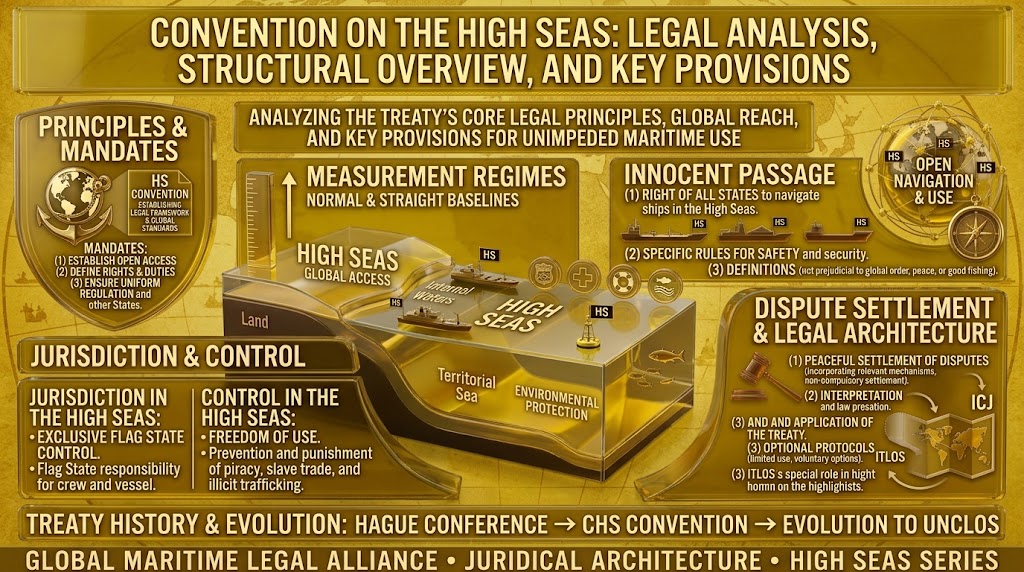
Abstract: This article provides a rigorous legal analysis of the 1958 Convention on the High Seas, one of the four foundational instruments adopted at the First United Nations Conference on the Law of the Sea (UNCLOS I). The study examines the historical evolution of the doctrine of the freedom of the high seas, deconstructs the structural framework of the convention, and evaluates its principal substantive provisions. Particular attention is devoted to the jurisdictional regime of the flag state, exceptions to exclusive flag state jurisdiction including piracy, unauthorized broadcasting, hot pursuit, and the right of visit. Furthermore, the article explores the transition from the 1958 Geneva framework to the 1982 United Nations Convention on the Law of the Sea, assessing the customary international law status of key provisions and addressing contemporary legal challenges concerning marine biodiversity, high seas governance, and enforcement mechanisms.
Introduction and Contextual Foundation
The legal regime governing the maritime spaces situated beyond the outer limits of the territorial sea has historically represented a cornerstone of international law and interstate relations. For centuries, the tension between mare liberum—the doctrine of the freedom of the seas championed by Hugo Grotius—and mare clausum—the assertion of sovereign dominion over maritime areas by various maritime powers—shaped the architecture of international jurisprudence. By the mid-twentieth century, the international community recognized an urgent necessity to codify and progressively develop customary international maritime law. This imperative culminated in the convening of the First United Nations Conference on the Law of the Sea (UNCLOS I) in Geneva in 1958.
UNCLOS I successfully produced four separate conventions: the Convention on the Territorial Sea and the Contiguous Zone, the Convention on the Continental Shelf, the Convention on Fishing and Conservation of the Living Resources of the High Seas, and the Convention on the High Seas. Among these instruments, the Convention on the High Seas stands as a monumental achievement, consolidating decades of customary practice into a coherent multilateral treaty. Adopted on April 29, 1958, and entering into force on September 30, 1962, the convention sought to codify the established principles of international law relating to the high seas, ensuring that these vast oceanic spaces remained open to all nations on an equitable basis.
To fully appreciate the normative weight of the convention, one must examine the socio-political and technological context of the post-Second World War era. Rapid advancements in maritime technology, the intensification of global trade, and the expansion of distant-water fishing fleets necessitated clear legal delineations regarding rights, duties, and enforcement jurisdictions upon the global commons. The 1958 Geneva Convention provided the foundational scaffolding upon which modern international law of the sea was constructed, bridging the gap between classical customary rules and the complex multilateral frameworks that emerged later in the twentieth century.
What is the historical background and legal status of the 1958 Convention?
The historical genesis of the 1958 Convention on the High Seas is deeply rooted in the codification efforts undertaken by the International Law Commission (ILC) of the United Nations. Established by the General Assembly in 1947, the ILC embarked upon a comprehensive study of the regime of the high seas and territorial waters. Through successive reports drafted by esteemed special rapporteurs, the ILC synthesized state practice, judicial decisions, and scholarly writings into draft articles that served as the primary basis for negotiation at UNCLOS I.
From a formal legal perspective, the Convention on the High Seas represents a multilateral treaty concluded under the auspices of the United Nations. As of its adoption, it bound those states that formally expressed their consent to be bound through ratification or accession. However, the legal significance of the convention extends far beyond its formal party-state relationships. The International Court of Justice (ICJ), along with various arbitral tribunals and national courts, has repeatedly recognized that many provisions of the 1958 convention served to codify existing rules of customary international law or have subsequently crystallized into customary law binding upon all states, regardless of formal treaty participation.
The legal status of the convention must also be evaluated in light of its relationship with subsequent codification efforts, most notably the Third United Nations Conference on the Law of the Sea (UNCLOS III) and the resulting 1982 United Nations Convention on the Law of the Sea (LOSC). Article 311 of the 1982 LOSC addresses its relationship with prior conventions, establishing that the 1982 convention prevails between states parties to it over the 1958 Geneva conventions. Nevertheless, for states not party to the 1982 convention—such as the United States, which nevertheless treats most of the LOSC as reflective of customary international law—the 1958 convention retains historical and analytical relevance. Furthermore, provisions of the 1958 convention that were carried over substantially unchanged into the 1982 LOSC derive their contemporary authority from their dual status as customary international law and treaty law.
What are the foundational principles and scope of the convention?
The substantive scope of the Convention on the High Seas is delineated in its opening articles, which establish the spatial and normative boundaries of the regime. Article 1 defines the high seas by exclusion, stating that the term means all parts of the sea that are not included in the territorial sea or in the internal waters of a state. This negative definition underscores the residual nature of the high seas regime: it applies wherever national sovereignty or sovereign rights do not extend. With the subsequent evolution of the law of the sea—specifically the establishment of the exclusive economic zone (EEZ) under the 1982 LOSC—the spatial application of the high seas regime has been modified, yet the core principles codified in 1958 continue to govern the water column beyond national jurisdictions.
At the heart of the convention lies Article 2, which proclaims the foundational doctrine of the freedom of the high seas. This provision reads: "The high seas being open to all nations, no State may validly purport to subject any part of them to its sovereignty." Article 2 proceeds to enumerate non-exhaustive examples of these freedoms, which include:
- Freedom of navigation;
- Freedom of fishing;
- Freedom to lay submarine cables and pipelines;
- Freedom to fly over the high seas.
The enumeration in Article 2 is explicitly stated to be without prejudice to the freedoms recognized by the general principles of international law. Consequently, subsequent freedoms—such as marine scientific research and the construction of artificial islands and installations permitted under international law—have been integrated into the high seas regime over time.
Crucially, Article 2 introduces a vital qualification to the exercise of these freedoms: "These freedoms, and others which are recognized by the general principles of international law, shall be exercised by all States with reasonable regard to the interests of other States in their exercise of the freedom of the high seas." This standard of "reasonable regard" establishes a legal balancing mechanism designed to prevent any single state from unilaterally monopolizing or destroying the utility of the global commons. It imposes a correlative duty of due diligence on all flag states and their vessels, ensuring that high seas freedoms are not interpreted as absolute licenses for unrestrained exploitation.
Rights, Obligations, and the Flag State Regime
The structural integrity of the high seas legal order relies heavily upon the principle of exclusive flag state jurisdiction. Underpinning this regime is the requirement established in Article 5 of the convention, which mandates that each state shall fix the conditions for the grant of its nationality to ships, for the registration of ships in its territory, and for the right to fly its flag. Ships have the nationality of the state whose flag they are entitled to fly. Crucially, Article 5 stipulates that there must exist a genuine link between the state and the ship; the state must effectively exercise its jurisdiction and control in administrative, technical, and social matters over ships flying its flag.
The concept of the "genuine link" has generated substantial academic commentary and judicial scrutiny. While the 1958 convention introduced the requirement, it did not prescribe precise objective criteria to determine whether a genuine link exists, leading to the proliferation of open registries or flags of convenience. Despite this enforcement ambiguity, the legal effect of nationality is clear: under Article 6, ships shall sail under the flag of one state only and, save in exceptional cases expressly provided for in international treaties or in the convention, shall be subject to its exclusive jurisdiction on the high seas. A ship may not change its flag during a voyage or while in a port of call, save in the case of a real transfer of ownership or change of registry.
Complementing the flag state regime, the convention imposes specific affirmative obligations on states to ensure safety at sea and prevent maritime disasters. Article 10 obliges every state to take such measures for ships flying its flag as are necessary to ensure safety at sea with regard to, inter alia: (a) the construction, equipment, and seaworthiness of ships; (b) the manning of ships and labor conditions for crews, taking into account the applicable international labour instruments; (c) the use of signals, the maintenance of communications, and the prevention of collisions. Furthermore, Article 11 imposes a strict legal duty in the event of a collision or any other incident of navigation concerning a ship on the high seas. The master of the ship is obliged, to the extent that he can do so without serious danger to his ship, crew, and passengers, to render assistance to any person found at sea in danger of being lost, to proceed with all possible speed to the rescue of persons in distress, and, after a collision, to inform the other ship of its identity and status.
Additionally, Article 12 addresses the duty to render assistance to persons at sea, reinforcing humanitarian imperatives that have long characterized maritime law. States are required to promote the establishment and maintenance of an adequate and effective search and rescue service regarding safety on and over the sea and, where circumstances so require, to collaborate with neighboring states for this purpose. These obligations transform what were once purely moral maritime traditions into binding legal duties enforceable under international law.
Exceptions to Exclusive Flag State Jurisdiction
While exclusive flag state jurisdiction is the bedrock principle of the high seas regime, the convention recognizes specific, narrowly defined exceptions where warships or authorized vessels of any state may lawfully interfere with foreign-flagged ships. These exceptions are codified to balance the protection of international navigation against the collective interest of the international community in suppressing universal crimes and safeguarding maritime order.
Piracy jure gentium
Articles 14 through 22 of the convention establish the legal regime governing piracy. Article 15 provides the classic definition of piracy, defining it as any illegal acts of violence, detention, or any act of depredation, committed for private ends by the crew or the passengers of a private ship or a private aircraft, and directed on the high seas, against another ship or aircraft, or against persons or property on board outside the jurisdiction of any state. Acts committed by a warship or government ship whose crew has mutinied and taken control of the ship are assimilated to acts committed by a private ship.
The defining characteristic of piracy under international law is its jurisdictional consequence: piracy is a crime *jure gentium*. Under Article 19, on the high seas, or in any other place outside the jurisdiction of any State, every State may seize a pirate ship or aircraft, or a ship taken by piracy and under the control of pirates, and arrest the persons and seize the property on board. The courts of the State which carried out the seizure may pronounce judgments and decide the penalties to be imposed, subject to the rights of third parties acting in good faith. This universal jurisdiction reflects the status of pirates as hostis humani generis—enemies of all mankind.
Unauthorized Broadcasting
Article 23 of the convention addresses unauthorized broadcasting from the high seas. Recognizing the disruptive potential of radio or television transmissions intended for reception by the general public contrary to international regulations from a ship or installation on the high seas, the convention empowers states with jurisdiction over the transmission to prosecute persons engaged in unauthorized broadcasting. Any state where the transmissions can be received, or where authorized radio communication is suffering interference, may exercise jurisdiction over the persons and ships engaged in such activity.
The Right of Visit and Inspection
As a general rule under Article 22, a warship which encounters a foreign merchant ship on the high seas is not justified in boarding her unless there is reasonable ground for suspecting:
- That the ship is engaged in piracy;
- That the ship is engaged in the slave trade;
- That, though flying a foreign flag or refusing to show its flag, the ship is, in reality, of the same nationality as the warship.
If suspicions prove to be unfounded, and provided that the ship boarded has not committed any act justifying them, it shall be compensated for any loss or damage that may have been sustained. This strict liability standard underscores the protective legal barrier surrounding legitimate commercial navigation.
The Doctrine of Hot Pursuit
Article 23 (subsequently expanded in the 1982 LOSC) codifies the customary international law doctrine of hot pursuit. Hot pursuit allows a coastal state to chase and subsequently arrest a foreign ship that has violated its laws while within its internal waters, territorial sea, or contiguous zone, provided that the pursuit was commenced when the foreign ship was within those zones and continued uninterrupted onto the high seas.
The legal conditions governing hot pursuit are rigorous. The pursuit must be commenced when the foreign ship or one of its boats is within the internal waters, the territorial sea, or the contiguous zone of the pursuing State, and may only be undertaken if the pursuing ship has satisfied itself by such practicable means as may be available that the ship pursued is within the limits of the territorial sea, or, as the case may be, within the contiguous zone. Furthermore, the pursuit can only be commenced after a visual or auditory signal to stop has been given at a distance which enables it to be seen or heard by the foreign ship. Crucially, hot pursuit may only be exercised by warships or military aircraft, or other ships or aircraft on government service specially authorized to that effect.
Environmental Protection and Submarine Cables
Although the 1958 convention predates the modern era of comprehensive international environmental law, it contains foundational provisions addressing the protection of the marine environment and critical maritime infrastructure. Pollution of the high seas was recognized as a growing threat, prompting the drafters to include specific injunctions regarding hazardous substances.
Article 24 explicitly mandates that every State shall draw up regulations to prevent pollution of the seas by the discharge of oil from ships or pipelines or resulting from the exploitation and exploration of the seabed and its subsoil, taking account of existing treaty provisions on the subject. Similarly, Article 25 requires states to take measures to prevent pollution of the seas from the dumping of radioactive waste, cooperating with competent international organizations in taking such action. These provisions laid the groundwork for subsequent specialized environmental treaties, such as the MARPOL Convention and the London Dumping Convention.
In addition to environmental safeguards, the convention addresses the protection of submarine cables and pipelines in Articles 26 through 29. Recognizing that submarine telegraph, telephone, and high-voltage power cables are essential for global communications and energy transmission, the convention makes it a punishable offense to break or injure a submarine cable beneath the high seas done willfully or through culpable negligence. States are required to enact legislation providing that the breaking or injury of such cables shall be a punishable offense. Furthermore, owners of ships who can prove that they have sacrificed an anchor, a net, or any other fishing gear in order not to injure a cable shall be indemnified by the owner of the cable, provided that the shipowner has taken all necessary precautionary measures.
Analysis of Dispute Settlement and Institutional Mechanisms
Unlike the 1982 LOSC, which established a comprehensive, compulsory, and binding dispute settlement architecture centered around the International Tribunal for the Law of the Sea (ITLOS) and Annex VII arbitrations, the 1958 Convention on the High Seas reflects the traditional bilateral and consensual approach of mid-twentieth-century international law.
The convention did not create a permanent institutional machinery or specialized tribunal for the administration of high seas disputes. Instead, dispute settlement was governed by the general rules of international law, relying primarily upon diplomatic negotiations, mediation, conciliation, arbitration, or judicial settlement before the International Court of Justice, provided that the disputing states had accepted the compulsory jurisdiction of the ICJ under Article 36, paragraph 2, of its Statute, or had concluded a specific compromis.
This absence of a dedicated institutional mechanism created significant enforcement vulnerabilities. Without a centralized judicial or supervisory organ, compliance with the convention depended almost entirely upon the diligence of individual flag states and the political willingness of injured states to invoke diplomatic remedies. The procedural deficiencies of the 1958 framework were a primary motivating factor for the structural innovations introduced at UNCLOS III, where states demanded a robust, institutionalized dispute settlement system capable of authoritatively interpreting maritime rights and obligations.
Relevant International Jurisprudence and Legal Effects
Over the decades, international courts and tribunals have interpreted and applied the principles codified in the 1958 Convention on the High Seas, shaping their contemporary legal effects. Landmark cases have clarified the interaction between high seas freedoms and coastal state jurisdiction, particularly in zones adjacent to territorial waters.
A prime example is found in the jurisprudence of the International Court of Justice and various arbitral awards concerning fisheries management and maritime delimitation. While the 1958 Convention on Fishing and Conservation of the Living Resources of the High Seas addressed conservation directly, the High Seas Convention's principle of "reasonable regard" (Article 2) has been invoked frequently in disputes involving overfishing, marine pollution, and military exercises on the high seas. Tribunals have consistently held that the freedom of fishing and freedom of navigation are not absolute and must be balanced against the environmental and security interests of neighboring or affected states.
Furthermore, jurisprudence concerning the doctrine of hot pursuit—such as the *M/V Saiga* case adjudicated by ITLOS (though primarily governed by the 1982 LOSC)—has reaffirmed the strict evidentiary standards required when coastal states interfere with foreign vessels. The legal effect of these judicial pronouncements is to reinforce the protective threshold of flag state jurisdiction, ensuring that exceptions such as the right of visit and hot pursuit are not abused by overzealous enforcement agencies.
Relationships with Other Legal Instruments
The 1958 Convention on the High Seas does not operate in a legal vacuum; rather, it occupies a specific position within the broader tapestry of international law. Its relationship with other legal instruments can be analyzed across three distinct dimensions:
- Preceding Customary International Law: The convention codified centuries of maritime practice, transforming unwritten customary norms—such as the freedom of navigation and the prohibition of piracy—into written treaty law.
- Subsequent Codification (The 1982 LOSC): The 1982 United Nations Convention on the Law of the Sea represents a comprehensive overhaul of the law of the sea. Parts VII (High Seas) and related sections of the 1982 LOSC largely reproduce or refine the core provisions of the 1958 convention, updating them to reflect modern technological and environmental realities.
- Specialized Sectoral Treaties: The convention interacts dynamically with specialized environmental, safety, and labor instruments, such as conventions adopted under the International Maritime Organization (IMO) and the International Labour Organization (ILO). These instruments operationalize the general duties outlined in Articles 10 and 24 of the 1958 convention.
Contemporary Legal Challenges and Critical Assessment
Evaluating the Convention on the High seas from a contemporary vantage point reveals both its historical brilliance and its inherent limitations in addressing twenty-first-century maritime challenges. As the global commons face unprecedented anthropogenic pressures, the adequacy of legal frameworks governing areas beyond national jurisdiction (ABNJ) has become a subject of intense international negotiation.
One of the most pressing contemporary legal challenges concerns the governance and conservation of marine biodiversity in areas beyond national jurisdiction (BBNJ). While the 1958 convention established the freedom of fishing as a cornerstone high seas freedom, it did so in an era when oceanic resources were perceived as inexhaustible. Today, industrial overfishing, destructive bottom trawling, and the bioprospecting of marine genetic resources expose the severe limitations of a legal framework that lacks comprehensive area-based management tools, marine protected areas (MPAs), and mandatory environmental impact assessments (EIAs) for high seas activities.
To address these governance gaps, the international community recently concluded negotiations under the auspices of the United Nations for a new legally binding instrument under the 1982 LOSC on the conservation and sustainable use of marine biological diversity of areas beyond national jurisdiction (the BBNJ Agreement or High Seas Treaty). This treaty builds upon the foundational principles of the 1958 convention and the 1982 LOSC while introducing modern ecological management paradigms that supersede the fragmented sectoral approach of the past.
Another critical assessment concerns the enforcement deficit inherent in the flag state principle. While exclusive flag state jurisdiction is essential for maintaining order and preventing arbitrary interference by foreign navies, it frequently results in regulatory failure when applied to "flags of convenience." States with open registries often lack the administrative capacity, financial resources, or political will to effectively police vessels flying their flag, leading to widespread illegal, unreported, and unregulated (IUU) fishing, sub-standard shipping practices, and marine pollution impunity. Bridging this enforcement gap remains one of the most formidable challenges facing international maritime law.
Conclusion
The Convention on the High Seas of 1958 stands as a monument to the codification and stabilization of international maritime law. By formally anchoring the doctrine of the freedom of the high seas, establishing the centrality of flag state jurisdiction, and delineating precise exceptions for the suppression of universal threats such as piracy, the convention provided a reliable legal architecture for global trade and interstate relations during the post-war era.
Despite its structural limitations—most notably the absence of compulsory dispute settlement mechanisms, the ambiguities surrounding the genuine link requirement, and its reactive environmental posture—the convention successfully bridged classical customary law and modern multilateral treaty-making. Its core principles live on, having been integrated and expanded within the 1982 United Nations Convention on the Law of the Sea and contemporary instruments addressing marine biodiversity. As the international community grapples with the anthropogenic transformation of the global oceans, the historical legacy and foundational doctrines of the 1958 convention continue to inform the ongoing evolution of the law of the sea.
References
- United Nations Convention on the High Seas, opened for signature April 29, 1958, 450 U.N.T.S. 11.
- United Nations Convention on the Law of the Sea, opened for signature December 10, 1982, 1833 U.N.T.S. 3.
- International Law Commission, Yearbook of the International Law Commission, 1956, Vol. II.
- Brownlie, Ian. Principles of Public International Law. 7th ed. Oxford University Press, 2008.
- Churchill, Robin R., and Alan V. Lowe. The Law of the Sea. 3rd ed. Manchester University Press, 1999.
- Oppenheim, L. International Law: A Treatise. Vol. 1, Peace. Edited by Robert Jennings and Arthur Watts. 9th ed. Oxford University Press, 1992.
Comments
No comments yet.