Legal Analysis, Structural Overview, and Key Provisions of the Convention on the Continental Shelf
A comprehensive academic legal study analyzing the 1958 Geneva Convention on the Continental Shelf, its structural framework, jurisprudence, and modern UNCLOS evolution.
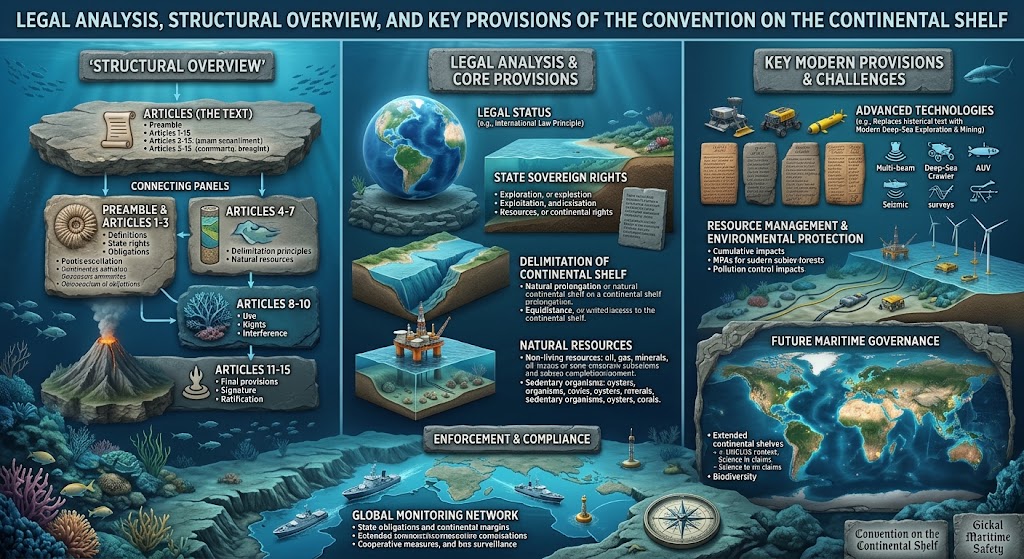
Abstract: The 1958 Convention on the Continental Shelf represents a pivotal milestone in the codification and progressive development of international law of the sea. Concluded under the auspices of the United Nations at the First Geneva Conference on the Law of the Sea, the instrument institutionalized the legal concept of the continental shelf, establishing that coastal states possess inherent, exclusive sovereign rights over the seabed and subsoil adjacent to their coasts for exploration and exploitation of natural resources. This article presents an exhaustive legal analysis of the instrument, examining its historical genesis from the 1945 Truman Proclamation through the preparatory work of the International Law Commission, its structural design, the dual criteria of bathymetry and exploitability under Article 1, the legal nature of sovereign rights under Article 2, the preservation of high seas status of superjacent waters under Article 3, and the equidistance-special circumstances framework set forth in Article 6. Furthermore, this study evaluates the seminal jurisprudence of the International Court of Justice and arbitral tribunals that shaped the interpretation of the treaty, most notably the North Sea Continental Shelf cases and the Anglo-French Continental Shelf Arbitration, and traces the operational transition from the 1958 regime to Part VI of the 1982 United Nations Convention on the Law of the Sea.
Introduction
The legal regime governing the seabed and subsoil beyond the territorial sea underwent a profound transformation in the middle of the twentieth century. Prior to this period, international law recognized a strict dichotomy between the narrow belt of territorial waters subject to coastal sovereignty and the res communis regime of the high seas. Rapid technological advances following the Second World War, particularly in offshore petroleum extraction and geophysical survey techniques, exposed the legal void regarding submerged landmasses extending beyond traditional territorial limits. Coastal nations recognized that off-shore mineral resources were accessible, commercially viable, and strategically critical.
To prevent chaotic unilateral appropriations and establish legal order over offshore economic activities, the international community undertook the formal codification of continental shelf law. The result was the adoption on April 29, 1958, of the Convention on the Continental Shelf, one of four conventions generated by the First United Nations Conference on the Law of the Sea in Geneva. Entered into force on June 10, 1964, upon receiving its twenty-second ratification, the treaty codified for the first time in treaty law the doctrine that coastal states hold ipso facto and ab initio rights over the seabed and subsoil of their adjacent continental margins.
How Did the Truman Proclamation Shape the Law of the Sea?
The legal conceptualization of the continental shelf as a distinct maritime zone originated with Proclamation No. 2667, issued by President Harry S. Truman of the United States on September 28, 1945, titled Policy of the United States With Respect to the Natural Resources of the Subsoil and Sea Bed of the Continental Shelf. The Truman Proclamation declared that the Government of the United States regarded the natural resources of the subsoil and sea bed of the continental shelf beneath the high seas but contiguous to the coasts of the United States as appertaining to the United States, subject to its jurisdiction and control. Crucially, the proclamation explicitly affirmed that the character as high seas of the waters above the continental shelf and the right to their free and unimpeded navigation were in no way affected.
The Proclamation was grounded in three fundamental legal rationales. First, it asserted an explicit geological link, positing that the continental shelf constitutes an extension of the land mass of the coastal nation and thus naturally appertains to it. Second, it relied upon self-protection and security, arguing that coastal state supervision of offshore activities was essential for order and resource conservation. Third, it cited economic necessity, observing that modern technology made off-shore resource extraction feasible, requiring substantial capital investments that could only be secured through recognized exclusive rights.
The Truman Proclamation acted as a catalyst for immediate international state practice. Numerous states, particularly in Latin America, issued unilateral proclamations claiming jurisdiction over offshore areas. However, several Latin American states, such as Mexico, Chile, Peru, and Ecuador, went significantly beyond the Truman Proclamation by claiming full state sovereignty over both the seabed and the superjacent water column up to two hundred nautical miles. This divergence highlighted the urgent necessity for uniform international regulation.
In 1949, the newly created International Law Commission of the United Nations selected the law of the sea as a priority topic for codification and progressive development. Under the guidance of Special Rapporteur J.P.A. François, the International Law Commission spent seven years drafting comprehensive articles concerning the regime of the high seas and territorial waters. The final draft articles, adopted by the Commission at its eighth session in 1956, formed the direct working basis for the 1958 Geneva Conference, leading directly to the adoption of the Convention on the Continental Shelf.
What is the Continental Shelf in International Law?
Article 1 of the 1958 Convention provided the first authoritative multilateral legal definition of the continental shelf. Under Article 1, the term continental shelf is defined as referring to:
a) to the seabed and subsoil of the submarine areas adjacent to the coast but outside the area of the territorial sea, to a depth of 200 metres or, beyond that limit, to where the depth of the superjacent waters admits of the exploitation of the natural resources of the said areas;
b) to the seabed and subsoil of similar submarine areas adjacent to the coasts of islands.
This definition introduced a flexible hybrid test incorporating two alternative criteria: a fixed bathymetric limit set at two hundred metres depth, and a dynamic functional criterion based on exploitability. The two hundred-metre depth contour was chosen because it represented the approximate geological break-of-slope where the gently sloping continental shelf transitions into the steeper continental slope in most regions of the world.
However, the inclusion of the alternative exploitability criterion proved highly contentious. Designed as a progressive mechanism to accommodate future technological developments, the criterion established that as offshore drilling and extraction technology advanced into deeper waters, the outer legal limit of the shelf automatically expanded seaward. Legal scholars and states quickly recognized the legal defect of this open-ended formulation. Taken to its extreme legal interpretation, the exploitability criterion threatened to allow coastal states with advanced deep-sea technology to extend their unilateral jurisdiction across entire ocean basins, effectively dividing the deep ocean floor among coastal nations.
Article 1 also confirmed that islands possess their own continental shelves under identical legal parameters as continental landmasses. The text did not differentiate between islands based on size, population, or economic capability, establishing that any naturally formed area of land surrounded by water which is above water at high tide generates a entitlement to adjacent submarine areas.
What Rights Do Coastal States Have Over the Continental Shelf?
Article 2 of the Convention establishes the substantive character and scope of the coastal state\'s legal authority over the continental shelf. Paragraph 1 provides that the coastal state exercises over the continental shelf sovereign rights for the purpose of exploring it and exploiting its natural resources. The choice of the precise legal term sovereign rights, rather than full sovereignty, was a deliberate drafting decision by the International Law Commission. Sovereign rights denote functional, purpose-specific legal authority limited strictly to activities related to the exploration and exploitation of natural resources. The coastal state does not possess territorial sovereignty over the shelf or its superjacent space.
Paragraph 2 of Article 2 reinforces the exclusive character of these rights by providing that the rights referred to in paragraph 1 are exclusive in the sense that if the coastal state does not explore the continental shelf or exploit its natural resources, no one may undertake these activities, or make a claim to the continental shelf, without the express consent of the coastal state.
Paragraph 3 contains a provision of fundamental importance regarding the legal origin of these rights. It states that the rights of the coastal state over the continental shelf do not depend on occupation, effective or notion, or on any express proclamation. As subsequently affirmed by international tribunals, rights over the continental shelf exist ipso facto and ab initio by virtue of the state\'s sovereignty over the adjacent land territory. No formal administrative act, military presence, or legal declaration is required to establish or preserve the coastal state\'s title.
Scope of Natural Resources and the Sedentary Species Doctrine
Article 2, paragraph 4 defines the scope of natural resources covered by the coastal state\'s exclusive regime:
The natural resources referred to in these articles consist of the mineral and other non-living resources of the seabed and subsoil together with living organisms belonging to sedentary species, that is to say, organisms which, at the harvestable stage, either are immobile on or under the seabed or are unable to move except in constant physical contact with the seabed or the subsoil.
This definition creates a clear distinction between free-swimming fish species, which remained part of the high seas regime under the 1958 legal framework, and sedentary biological organisms attached to or reliant upon the seabed floor. The legal classification of specific marine organisms gave rise to significant diplomatic and legal controversies.
A prime historic example occurred in the early 1960s during the Lobster War between France and Brazil. Brazil asserted that lobsters crawl along the continental shelf and therefore constitute sedentary species under Article 2(4), granting Brazil exclusive rights to harvest them off its coast. France argued that lobsters swim through short hops in the water column and could not be characterized as immobile or in constant physical contact with the seabed. Similarly, disputes arose between the United States and Japan regarding the status of King Crabs in the Bering Sea. These disputes underscored the technical complexity of applying biological criteria within legal definitions.
Preservation of High Seas Status and Rights of Other States
A core objective of the 1958 legal compromise was ensuring that the recognition of sovereign rights over the seabed did not undermine traditional freedoms of the high seas in the superjacent water column and airspace. This delicate equilibrium is codified across Articles 3, 4, and 5 of the Convention.
Article 3 establishes an explicit legal firewall, declaring that the rights of the coastal state over the continental shelf do not affect the legal status of the superjacent waters as high seas, or that of the airspace above those waters. Consequently, the rights of foreign vessels to navigate freely and foreign aircraft to overfly the superjacent waters remain entirely unimpaired by the coastal state\'s shelf rights.
Article 4 protects international communication infrastructure by providing that, subject to its right to take reasonable measures for the exploration of the continental shelf and the exploitation of its natural resources, the coastal state may not impede the laying or maintenance of submarine cables or pipelines on the continental shelf.
Installations, Safety Zones, and Marine Scientific Research
Article 5 balances the operational needs of offshore resource extraction against international rights of navigation and scientific inquiry. Under Article 5(1), the exploration of the continental shelf and the exploitation of its natural resources must not result in any unjustifiable interference with navigation, fishing, or the conservation of the living resources of the sea, nor result in any interference with fundamental oceanographic or other scientific research carried out with the intention of open publication.
Article 5 paragraphs 2 through 7 authorize coastal states to construct and maintain installations and other devices necessary for resource exploitation, and to establish safety zones extending up to a distance of 500 metres around such installations. Vessels of all nationalities are obligated to respect these safety zones. However, Article 5(5) establishes an absolute limitation: installations and safety zones may not be established where interference may be caused to the use of recognized sea lanes essential to international navigation.
Article 5(8) regulates marine scientific research on the shelf. It mandates that the consent of the coastal state shall be obtained in respect of any research concerning the continental shelf and undertaken there. However, it explicitly obligates the coastal state not to withhold its consent if the request is submitted by a qualified institution with a view to purely scientific research into the physical or biological characteristics of the shelf, subject to the coastal state\'s right to participate in the research project.
How is the Continental Shelf Boundary Delimited Between Adjacent States?
When two or more states share a common geological continental shelf, determining the boundary of their respective sovereign rights presents complex legal challenges. Article 6 of the 1958 Convention established the primary treaty-based rule governing maritime boundary delimitation between opposite and adjacent states.
| Geographical Relationship | Primary Treaty Rule (Article 6) | Role of Agreement | Exceptions to Standard Line |
|---|---|---|---|
| Opposite Coasts (Article 6, Paragraph 1) | Median line equidistant from the nearest points of the baselines | Applies unless another boundary line is justified by agreement | Special circumstances may justify another boundary line |
| Adjacent Coasts (Article 6, Paragraph 2) | Equidistance principle from the nearest points of the baselines | Applies unless another boundary line is justified by agreement | Special circumstances may justify another boundary line |
Article 6 establishes a triadic legal formula often termed the equidistance-special circumstances rule. In the absence of agreement, and unless another boundary line is justified by special circumstances, the boundary is the median or equidistant line. The text reflects an integrated legal norm where equidistance and special circumstances are not hierarchical choices, but rather a combined rule designed to achieve an equitable outcome.
Special circumstances were not explicitly defined in the text of the treaty, leaving interpretation to jurisprudence and diplomatic negotiation. In practice, special circumstances include unusual coastal geography such as macro-concavities or convexities, offshore islands situated near an opposite coast, historic titles, and specific navigational or ecological factors.
Structural Architecture of the 1958 Convention
The Convention on the Continental Shelf is structured into fifteen concise articles. The substantive legal norms are concentrated in Articles 1 through 6, while Articles 7 through 15 address administrative, formal, and procedural provisions:
- Article 7: Clarifies that the treaty provisions do not prejudice the right of a coastal state to exploit subsoil by tunneling, irrespective of the depth of water above the subsoil.
- Article 8: Regulates the mechanics of signature until October 31, 1958, opening the treaty to all Member States of the United Nations or specialized agencies.
- Article 9: Governs ratification instruments deposited with the Secretary-General of the United Nations.
- Article 10: Governs accession procedures for non-signatory states.
- Article 11: Establishes the entry-into-force mechanism, setting the threshold at thirty days following the deposit of the twenty-second instrument of ratification or accession.
- Article 12: Regulates reservations. Crucially, Article 12(1) allows states to make reservations to any article of the Convention except Articles 1 to 3 inclusive. This meant states were permitted to enter reservations to Article 6 governing boundary delimitation.
- Article 13: Governs denunciation and requests for revision after five years from entry into force.
- Article 14: Establishes that the Secretary-General shall inform all signatory and acceding states of notifications, deposits, and effective dates.
- Article 15: Designates authentic text languages as Chinese, English, French, Russian, and Spanish.
Jurisprudential Evolution and International Case Law
The operational application and custom-generating capacity of the 1958 Convention were thoroughly tested before international courts and arbitral panels. This body of jurisprudence radically redefined maritime delimitation law and clarified the interaction between treaty norms and customary international law.
The North Sea Continental Shelf Cases (1969)
The landmark judgment of the International Court of Justice in the North Sea Continental Shelf cases (Federal Republic of Germany v. Denmark; Federal Republic of Germany v. Netherlands) remains the foundational cornerstone of continental shelf jurisprudence. The Federal Republic of Germany had signed but not ratified the 1958 Convention. Denmark and Netherlands, which were parties to the treaty, argued that the equidistance principle set forth in Article 6(2) had passed into customary international law and was therefore binding on Germany.
Because the German coastline along the North Sea forms a pronounced concave recess, drawing pure equidistance lines between Germany and its adjacent neighbors (Denmark to the north and the Netherlands to the west) caused the two outer equidistance lines to meet closely off the German coast. This geometric effect cut off Germany from reaching the central, resource-rich portion of the North Sea continental shelf, leaving it with a disproportionately small shelf area relative to its coastline length.
The International Court of Justice rejected the Danish and Dutch arguments in a historic ruling, holding that:
- Article 6 of the 1958 Convention had not embodied a pre-existing rule of customary international law at the time of its drafting.
- The treaty provision had not subsequently transformed into customary international law through state practice and opinio juris, noting particularly that the ability to enter reservations under Article 12 to Article 6 demonstrated the non-normative character of the equidistance rule.
- The fundamental principle underlying continental shelf law is that rights exist ipso facto and ab initio based on natural prolongation of land territory, famously stating that the continental shelf is a natural prolongation of its land territory into and under the sea.
- Delimitation must be effected by agreement in accordance with equitable principles, taking into account all relevant circumstances, so as to leave to each party all those parts of the continental shelf that constitute a natural prolongation of its land territory without encroaching on the natural prolongation of another state.
The Anglo-French Continental Shelf Arbitration (1977)
The 1977 Delimitation of the Continental Shelf between the United Kingdom and France decision rendered by an Ad Hoc Court of Arbitration addressed the precise mechanics of Article 6 where both contesting nations were parties to the 1958 Convention. However, France had attached a reservation to Article 6 upon accession, stating that in the absence of a specific agreement, no boundary line could be invoked against France if it fell within areas where special circumstances were claimed. The United Kingdom objected to the French reservation.
The Arbitral Tribunal held that the UK objection prevented the treaty from entering into force between the two states to the extent of the reservation. Consequently, the legal regime governing the boundary between France and the United Kingdom was customary international law, though the Tribunal noted that in practice, the combined equidistance-special circumstances rule under Article 6 and the equitable principles rule under customary law led to identical legal analysis.
To achieve an equitable result in specific sectors, the Tribunal instituted innovative legal mechanisms:
- In the Channel Islands sector, where British sovereign islands lay directly off the French mainland coast, the Tribunal refused to draw an equidistance line that would sever Normandy from the main Channel shelf. Instead, it drew a primary median line through the middle of the English Channel and granted the Channel Islands a enclosed 12-nautical-mile continental shelf enclave to the north and west.
- In the Atlantic Approaches (Scilly Isles) sector, the Tribunal found that the projection of the Scilly Isles doubled the seaward distortion of the UK baseline. To remedy this disparity, the Tribunal applied a half-effect method, constructing two lines—one giving full effect to the Scilly Isles and one ignoring them entirely—and placing the final boundary line exactly midway between the two.
Subsequent Jurisprudential Transitions: Tunisia/Libya, Gulf of Maine, and Libya/Malta
Subsequent decisions progressively shifted the legal focus from strict physical geology toward geometric equity and distance-based criteria. In the Tunisia/Libya Continental Shelf case (ICJ 1982), the Court recognized that geology was no longer the sole governing test, emphasizing that delimitation must achieve an equitable result based on legal balance.
In the Gulf of Maine case (ICJ 1984), a Chamber of the Court was requested to draw a single maritime boundary for both the continental shelf and the exclusive fishery zone between Canada and the United States. The Chamber applied neutral geometric criteria that could apply equally to both the seabed and superjacent waters, further diminishing the primacy of pure geological prolongations.
Finally, in the Libya/Malta Continental Shelf case (ICJ 1985), the Court formally severed the reliance on physical geomorphology for shelf claims within two hundred nautical miles of the coast. The Court held that for distance up to 200 nautical miles, the continental shelf entitlement is determined by distance from the baseline rather than physical geological criteria, rendering bathymetry irrelevant within the standard 200-nautical-mile distance limit.
What is the Difference Between the 1958 Convention and UNCLOS?
The structural legal defects of the 1958 Convention—most notably the open-ended exploitability criterion in Article 1 and the absence of a compulsory dispute resolution mechanism—led the international community to re-evaluate the legal regime during the Third United Nations Conference on the Law of the Sea (UNCLOS III), which met from 1973 to 1982. The resulting instrument, the 1982 United Nations Convention on the Law of the Sea (UNCLOS), superseded the 1958 Geneva Conventions among its states parties, establishing a unified legal framework under Part VI (Articles 76–85).
| Legal Dimension | 1958 Geneva Convention | 1982 UNCLOS (Part VI) |
|---|---|---|
| Spatial Definition | 200-metre bathymetry depth OR exploitability criterion (Article 1) | Geological natural prolongation OR fixed 200 nautical miles minimum (Article 76) |
| Extended Shelf Limits | Undefined; expands infinitely as offshore technology advances | Complex formula limits: maximum 350 nautical miles OR 100 nautical miles from 2500m isobath |
| Institutional Oversight | None; self-delineation by coastal states | Commission on the Limits of the Continental Shelf (CLCS) reviews technical data |
| Revenue Sharing | None; coastal state retains 100% of non-living resource revenues | Mandatory financial payments/contributions for exploitation beyond 200 nm (Article 82) |
| Boundary Delimitation | Equidistance-Special Circumstances Rule (Article 6) | Equitable solution norm without mandatory reference to equidistance (Article 83) |
Under Article 76 of UNCLOS, the legal definition of the continental shelf was completely rewritten. Article 76(1) establishes that every coastal state possesses an automatic continental shelf extending up to 200 nautical miles from its baselines, regardless of whether the geological shelf physically extends to that distance. If the physical continental margin extends beyond 200 nautical miles, the state may claim an extended continental shelf up to maximum distance cut-off lines (350 nautical miles from baselines or 100 nautical miles from the 2,500-metre isobath) based on technical formulas evaluating sediment thickness (Gardiner formula) or distance from the foot of the continental slope (Hedberg formula).
To prevent arbitrary state claims over extended continental shelves, UNCLOS established an expert body: the Commission on the Limits of the Continental Shelf (CLCS). Coastal states seeking to establish outer limits beyond 200 nautical miles must submit detailed scientific and geodetic data to the Commission. The limits established by a coastal state on the basis of the recommendations of the Commission are final and binding.
Additionally, UNCLOS introduced an innovative distributive justice mechanism under Article 82. Coastal states that exploit non-living resources on the extended continental shelf beyond 200 nautical miles are legally obligated to make annual payments or contributions in kind to the International Seabed Authority. These payments begin in the sixth year of commercial production at one percent of site value and increase by one percent annually until capping at seven percent, for distribution to developing countries.
Contemporary Legal Challenges and Critical Assessment
Despite being superseded by UNCLOS for its 170 state parties, the 1958 Convention on the Continental Shelf retains legal significance in modern international law. First, for states that are parties to the 1958 Convention but have not ratified UNCLOS (most notably the United States of America), the 1958 Convention remains active treaty law governing their treaty-based relationships with other 1958 convention parties.
Second, the key structural provisions of the 1958 instrument—specifically Article 2 regarding the exclusive, inherent sovereign nature of shelf rights, and Article 3 preserving the high seas character of superjacent waters—reflect customary international law binding on all nations worldwide.
However, contemporary ocean governance presents severe challenges that test the limits of continental shelf legal regimes:
- Sea-Level Rise and Baseline Inadequacy: Anthropogenic climate change is causing rising sea levels, which threaten to erode coastal baseline features. Because continental shelf outer limits and equidistance lines are calculated from low-water baselines, retreating coastlines raise legal questions regarding whether existing shelf limits remain permanently fixed or shift dynamically inward.
- Overlapping Extended Shelf Claims in the Arctic: Declining sea ice cover has opened access to vast seabed resources in the Arctic Ocean. Arctic coastal states (Canada, Denmark/Greenland, Norway, the Russian Federation, and the United States) have submitted competing claims to the Commission on the Limits of the Continental Shelf covering the Lomonosov and Gakkel ridges, leading to complex geopolitical overlapping claims over the Arctic seabed.
- Deep Seabed Mining Intersecting the Shelf: Technological readiness for seabed mineral harvesting has created operational boundary friction between extended continental shelf areas controlled by coastal states and the global commons Area managed by the International Seabed Authority.
Conclusion
The 1958 Convention on the Continental Shelf stands as a monumental legal text that successfully balance coastal state economic development with global freedom of navigation. By translating the unilateral claims of the post-1945 era into a structured legal instrument, the Geneva Convention codified the fundamental legal doctrine that coastal states hold inherent, exclusive sovereign rights over offshore seabed resources.
Though its Article 1 definition was rendered obsolete by the technological realities of deep-sea drilling, and its boundary delimitation mechanics under Article 6 required judicial refinements through landmark cases like the North Sea Continental Shelf judgment, the 1958 Convention laid the essential legal baseline for contemporary ocean governance. Its central principles remain permanently entrenched within Part VI of UNCLOS and continue to define the balance between national jurisdiction and the international law of the sea.
References
- Convention on the Continental Shelf, opened for signature April 29, 1958, 499 U.N.T.S. 311 (entered into force June 10, 1964).
- United Nations Convention on the Law of the Sea, opened for signature December 10, 1982, 1833 U.N.T.S. 397 (entered into force November 16, 1994).
- United States, President Proclamation No. 2667, Policy of the United States With Respect to the Natural Resources of the Subsoil and Sea Bed of the Continental Shelf (Truman Proclamation), 10 Fed. Reg. 12303 (Sept. 28, 1945).
- International Law Commission, Report of the International Law Commission Covering the Work of Its Eighth Session, U.N. Doc. A/3159 (1956).
- North Sea Continental Shelf Cases (Federal Republic of Germany/Denmark; Federal Republic of Germany/Netherlands), Judgment, 1969 I.C.J. Reports 3.
- Delimitation of the Continental Shelf between the United Kingdom of Great Britain and Northern Ireland and the French Republic (Anglo-French Continental Shelf Arbitration), Decision of July 30, 1977, 18 R.I.A.A. 3.
- Continental Shelf (Tunisia/Libyan Arab Jamahiriya), Judgment, 1982 I.C.J. Reports 18.
- Delimitation of the Maritime Boundary in the Gulf of Maine Area (Canada/United States of America), Judgment, 1984 I.C.J. Reports 246.
- Continental Shelf (Libyan Arab Jamahiriya/Malta), Judgment, 1985 I.C.J. Reports 13.
- Bowett, D. W. The Law of the Sea. Manchester University Press, 1967.
- Jennings, Robert Y. The Acquisition of Territory in International Law. Manchester University Press, 1963.
- Nandan, Satya N., and Shabtai Rosenne, eds. United Nations Convention on the Law of the Sea 1982: A Commentary. Vol. II. Martinus Nijhoff Publishers, 1993.
Comments
No comments yet.