Antitrust at Sea: Competition Law, Consortia, and the Regulation of Global Maritime Trade
This analysis examines the tension between maritime exemptions and global competition law, evaluating the legal status of carrier consortia in international markets.
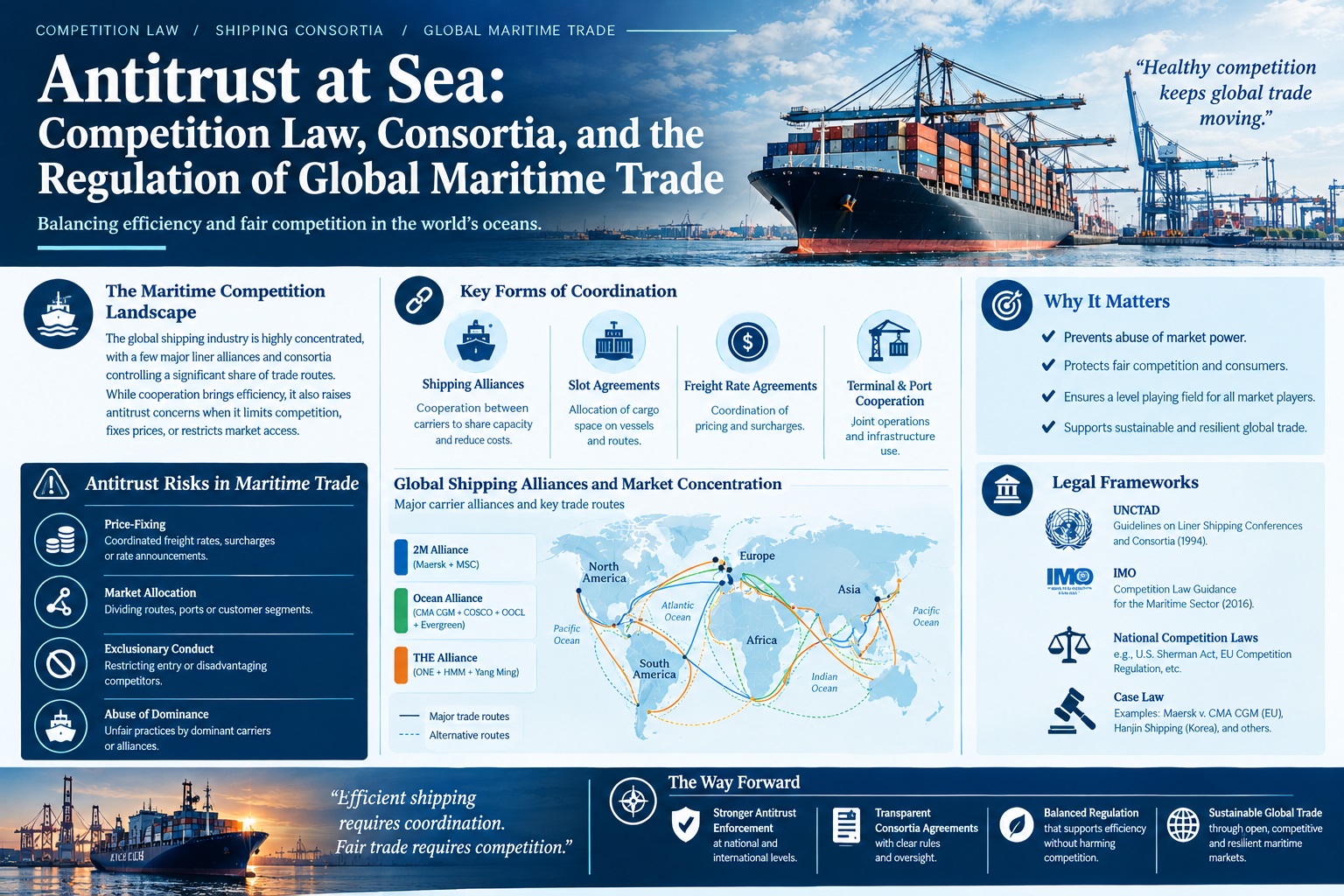
The Structural Paradox of Maritime Competition
International maritime transport serves as the circulatory system of the global economy, yet it operates under a legal architecture distinct from nearly every other industrial sector. The maritime industry has historically been characterized by extreme capital intensity and the inherent volatility of trade cycles. Consequently, regulators have long grappled with the question of whether traditional antitrust doctrines—designed for land-based competition—are appropriate for a sector that relies on the complex synchronization of global vessel sharing agreements (VSAs) and consortia. While competition law generally favors fragmentation to prevent monopolistic price-setting, the maritime sector necessitates a degree of cooperation to ensure service reliability, capacity management, and the massive investments required for containerized shipping.
The regulatory framework governing this tension is not uniform. While the European Union, the United States, and various Asian jurisdictions share the goal of protecting consumer interests, they diverge significantly in their tolerance for industry-wide coordination. This divergence creates a fragmented legal landscape where multinational shipping entities must navigate shifting sandbars of compliance, often balancing the mandates of the Federal Maritime Commission in Washington with the stringent oversight of the European Commission in Brussels.
How do carrier consortia function within modern competition law?
Carrier consortia are contractual arrangements between shipping lines to cooperate in the provision of liner shipping services. By pooling vessels and sharing port terminal operations, these consortia achieve economies of scale that would be impossible for individual carriers. Under traditional competition logic, such coordination might be viewed as a prohibited cartel. However, most legal regimes provide a block exemption or a safe harbor status, provided that the combined market share of the participating entities remains below a certain threshold—frequently stipulated at thirty percent.
The legitimacy of these arrangements rests on the assumption that the efficiencies gained—lower fuel consumption through better capacity utilization and more frequent port calls—outweigh the potential for market distortion. Yet, legal scholars frequently point to the inherent ambiguity in assessing these efficiencies. When three major alliances control over 80 percent of the east-west trade routes, the threshold for a 'safe harbor' becomes a point of intense juridical debate. The European Union’s decision to allow the Consortia Block Exemption Regulation to expire in 2024 marks a pivotal shift, moving away from categorical immunity toward a more rigorous, case-by-case assessment under general antitrust principles.
| Jurisdiction | Regulatory Approach | Key Enforcement Body |
|---|---|---|
| European Union | Evolution from block exemption to general compliance | European Commission |
| United States | Section 6(g) Shipping Act assessment | Federal Maritime Commission |
| China | Antimonopoly Law scrutiny on alliances | SAMR |
Why is the regulation of maritime capacity legally contentious?
The core of the legal contention lies in the definition of market power. Historically, maritime law operated under the assumption that shipping was a low-margin, commoditized service where carriers were 'price takers.' However, recent supply chain disruptions have challenged this narrative. As carriers transitioned from being simple transport providers to integrated logistics conglomerates, their ability to influence freight rates through capacity management has drawn the scrutiny of competition authorities globally.
In a competitive market, supply adjustments are expected. In a market dominated by three structural alliances, however, a synchronized reduction in capacity by all members to sustain freight levels may be interpreted not as market adjustment, but as concerted practice, which sits at the heart of antitrust prohibitions.
The fundamental problem remains the difficulty of proving 'concerted practice' within the context of an exempted consortium. When individual shipping lines observe the capacity adjustments of their competitors within an alliance, the line between legitimate operational planning and illegal information exchange becomes perilously thin. This ambiguity is exacerbated by the rise of digital platforms and real-time data sharing, which provide the mechanism for a level of transparency that arguably undermines independent price formation.
Who is liable for anticompetitive behavior in global maritime networks?
Establishing liability in international maritime disputes requires navigating multiple jurisdictional layers. When a global alliance engages in conduct that adversely impacts regional markets, the question of 'who is liable' hinges on whether the conduct was orchestrated at the alliance level or if it constitutes an individual breach by a constituent member. Under current international norms, such as those discussed within the framework of the International Chamber of Commerce (ICC) and various maritime arbitration forums, liability is often attributed to the individual corporate entity rather than the consortium itself, as the latter often lacks independent legal personality.
However, this traditional view is under threat. Recent interventions suggest that competition authorities are increasingly looking past the corporate veil of the member lines to the alliance board level. If an alliance structure facilitates price-fixing or discriminatory practices, regulators are beginning to argue that the governance structure of the alliance must be held accountable. This evolution represents a departure from classical maritime law, moving toward an integrated model where competition law dictates the operational boundaries of international logistics alliances.
Toward a harmonized maritime antitrust doctrine
The future of maritime competition law will likely be defined by the tension between the push for regional protectionism and the reality of an intrinsically globalized shipping network. If jurisdictions continue to drift apart in their enforcement priorities, the global shipping industry may face a period of significant volatility, where a single operational decision by a carrier could be deemed lawful in one port and a breach of antitrust law in another. Harmonization remains elusive, as the political weight of domestic shipping interests often clashes with the theoretical purity of global competition standards.
Ultimately, the legal architecture of maritime competition is shifting from a paradigm of immunity to one of transparency and accountability. As vessels become more digitally connected and the data footprint of maritime operations expands, the capacity for regulators to monitor and audit these complex logistical webs will only increase. Whether this transition will result in lower costs for consumers or merely shift the operational burden onto carriers remains a subject of intense academic and policy debate. The industry must prepare for a future where 'seaworthiness' is matched by 'compliance-worthiness,' with competition law serving as a permanent, rather than peripheral, navigational constraint.
Comments
No comments yet.