Legal Analysis, Structural Overview, and Key Provisions of the BBNJ Agreement
A comprehensive academic legal analysis of the BBNJ Agreement under UNCLOS, examining marine genetic resources, area-based management tools, and institutional architecture.
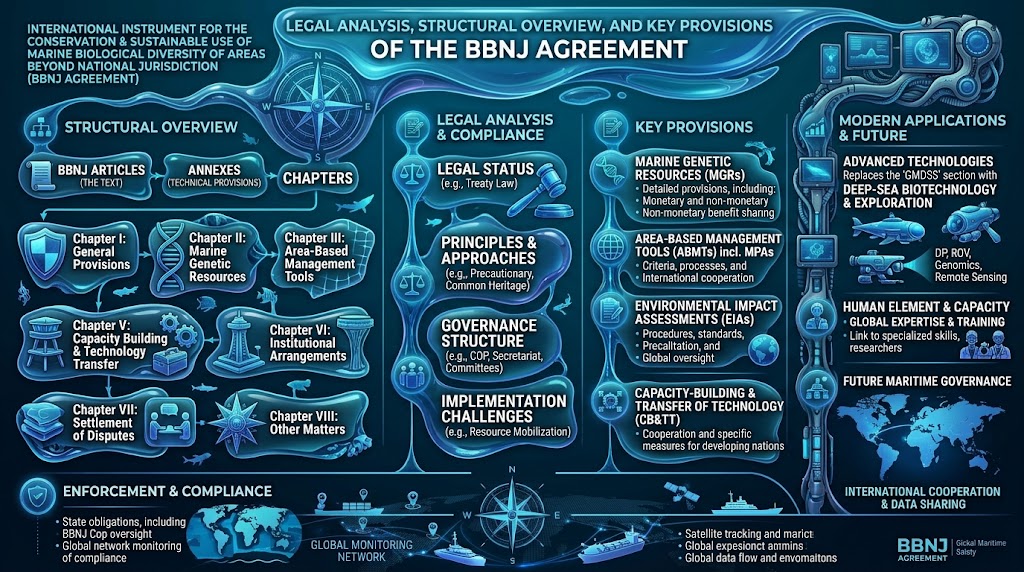
Abstract: The Agreement under the United Nations Convention on the Law of the Sea on the Conservation and Sustainable Use of Marine Biological Diversity of Areas Beyond National Jurisdiction, adopted by consensus on 19 June 2023, represents the most consequential codification effort in international ocean governance since the conclusion of the United Nations Convention on the Law of the Sea (UNCLOS) in 1982. Formulated as a third implementing agreement under UNCLOS, the instrument seeks to reconcile deep-seated legal tensions between the high seas regime governed by the principle of freedom and the international seabed Area governed by the common heritage of humankind. This article provides a comprehensive academic analysis of the BBNJ Agreement. It evaluates the instrument legal status, historical gestation, and architectural structure, dissecting its four core substantive packages: marine genetic resources, including the fair and equitable sharing of benefits; area-based management tools, notably marine protected areas; environmental impact assessments; and capacity-building and the transfer of marine technology. The analysis further explores the institutional machinery, compulsory dispute settlement frameworks, jurisdictional delineations, and normative interactions with relevant regional and sectoral bodies.
Historical Background and Legal Genesis of the BBNJ Agreement
The legal architecture governing the world ocean under UNCLOS established a bifurcated spatial regime for maritime spaces situated beyond national sovereignty and sovereign rights. In the water column constituting the high seas, Part VII of UNCLOS codified traditional freedoms, including navigation, overflight, fishing, and scientific research, subject to the conditions laid down by the Convention and other rules of international law. Conversely, Part XI of UNCLOS, as subsequently modified by the 1994 Agreement relating to the Implementation of Part XI, designated the international seabed, ocean floor, and subsoil beyond the limits of national jurisdiction (the Area) and its mineral resources as the common heritage of humankind. Over subsequent decades, rapid technological advancement unlocked unprecedented access to deep-sea ecosystems, hydrothermal vents, cold seeps, and the pelagic water column, exposing significant normative, institutional, and spatial gaps in the 1982 framework.
UNCLOS did not expressly anticipate modern marine biotechnology, nor did it establish dedicated mechanisms for cross-sectoral conservation measures or standardized environmental impact assessments for activities targeting biological resources in areas beyond national jurisdiction. The legal vacuum prompted protracted deliberations within the United Nations General Assembly. In 2004, the General Assembly established an Ad Hoc Open-ended Informal Working Group to study issues relating to the conservation and sustainable use of marine biological diversity beyond national jurisdiction (Resolution 59/24). Over a decade of exploratory work culminated in 2011 with the emergence of the package deal, a political and legal compromise encompassing four interconnected thematic pillars: marine genetic resources, including questions on the sharing of benefits; area-based management tools, including marine protected areas; environmental impact assessments; and capacity-building and the transfer of marine technology.
Recognizing the necessity of a binding multilateral convention, the General Assembly adopted Resolution 69/292 in 2015, establishing a Preparatory Committee to formulate substantive recommendations. Subsequently, Resolution 72/249 of December 2017 convened an Intergovernmental Conference with an express mandate to draft the text of an international legally binding instrument under UNCLOS. Following five formal substantive sessions, an operational pause necessitated by the COVID-19 pandemic, and two resumed iterations of the fifth session, the Intergovernmental Conference adopted the BBNJ Agreement on 19 June 2023. The instrument opened for signature on 20 September 2023 at United Nations Headquarters in New York, attracting over ninety signatures on its inaugural day, thereby initiating the process toward the sixty ratifications required for its entry into force pursuant to Article 68.
Legal Character, Spatial Scope, and General Principles
The BBNJ Agreement is formally designated as an implementing agreement under UNCLOS. Its legal character is fundamentally conditioned by its relationship with the parent convention, maintaining an umbilical legal connection while establishing autonomous institutional mechanisms. Article 3 delineates the spatial scope of the Agreement, specifying that it applies to areas beyond national jurisdiction, an umbrella legal category encompassing both the high seas defined under Article 86 of UNCLOS and the Area defined under Article 1(1)(1) of UNCLOS. The Agreement does not apply to any warship, naval auxiliary, or other vessels or aircraft owned or operated by a State and used, for the time being, only on government non-commercial service, maintaining standard sovereign immunity exemptions under Article 10, while enjoining flag States to ensure that such vessels act in a manner consistent with the Agreement so far as is reasonable and practicable.
The normative core of the Agreement is articulated in Article 7, which codifies a suite of general principles and approaches intended to govern the interpretation and implementation of all subsequent substantive obligations. Crucially, the Agreement bridges the historic ideological divide between developed maritime nations and the Global South by incorporating both the principle of the common heritage of humankind and the freedom of marine scientific research alongside other freedoms of the high seas. The text avoids declaring that marine genetic resources themselves are the common heritage of humankind, instead listing the principle among the general tenets that guide the overall instrument, thereby achieving a calculated construct of constructive ambiguity.
Article 7 further incorporates foundational tenets of modern international environmental law, including:
- The polluter-pays principle, establishing financial responsibility for pollution remediation and ecological degradation.
- The precautionary principle or precautionary approach, directing that where there are threats of serious or irreversible damage, lack of full scientific certainty shall not be used as a reason for postponing cost-effective measures to prevent environmental degradation.
- An ecosystem approach and an integrated approach to ocean management, demanding that high seas conservation moves beyond fragmented, sector-by-sector governance models.
- The use of the best available science and scientific information, combined with relevant traditional knowledge of Indigenous Peoples and local communities.
- The non-transfer of damage or hazards from one area to another and the non-transformation of one type of pollution into another, reflecting customary obligations codified in Article 195 of UNCLOS.
What are the legal rules for marine genetic resources?
Part II of the Agreement (Articles 9 to 16) governs marine genetic resources, representing the most economically contentious and conceptually complex chapter of the treaty negotiations. The fundamental legal question addressed by Part II is whether physical specimens and digital information derived from deep-sea genetic materials found in areas beyond national jurisdiction are subject to the unilateral capture regime of high seas freedoms or the distributive equity imperatives of common heritage. The Agreement crafts a sui generis legal regime that bypasses the binary sovereign property paradigm.
Under Article 9, the material scope of Part II encompasses marine genetic resources collected in situ in areas beyond national jurisdiction, accessed ex situ or in silico (as digital sequence information on marine genetic resources), and derivatives thereof. Importantly, it excludes fishing regulated under relevant international law and fish or other living marine resources known to have been taken in fishing activities, except where such organisms are subsequently utilized for biotechnological research and bioprospecting. This jurisdictional boundary prevents normative collision with regional fisheries management organizations (RFMOs) while closing potential regulatory loopholes regarding dual-use marine resources.
The operational mechanism established by Part II hinges upon transparency, notifications, and mandatory benefit-sharing. Article 12 institutes a centralized multilateral notification system administered through the BBNJ Clearing-House Mechanism. States Parties must ensure that activities with respect to marine genetic resources of areas beyond national jurisdiction are notified prior to in situ collection, including the provision of collection coordinates, cruise schedules, targeted taxa, and participating institutions. Upon collection, unique identifiers must be generated and deposited alongside associated data in publicly accessible repositories.
Benefit-sharing obligations are articulated in Article 14, distinguishing between non-monetary and monetary modalities:
| Modality | Operational Forms under Article 14 | Legal Character and Triggers |
|---|---|---|
| Non-Monetary Sharing | Access to open-access scientific repositories; transfer of technology; scientific collaboration; open access to digital sequence information; capacity-building initiatives. | Mandatory for all Parties; applies at the stages of in situ collection, ex situ storage, and generation of digital sequence information. |
| Monetary Sharing | Annual contributions by developed States Parties; tiered commercial milestone payments; commercial royalties; payments linked to the commercialization of products derived from MGRs. | Mandatory modalities to be operationalized by the Conference of the Parties (COP); funds earmarked exclusively for conservation, sustainable use, and developing-State capacity. |
The monetary benefit-sharing framework was among the final compromises reached during negotiations. Article 14(7) requires developed States Parties to pay an annual contribution to a special fund upon the Agreement entry into force, while tasking the Conference of the Parties (COP) with deciding the modalities for commercialization-based financial payments, ensuring that developing States derive tangible economic dividends from deep-sea biotechnological patents without placing fatal regulatory burdens on upstream marine scientific research.
How are marine protected areas established under BBNJ?
Part III of the BBNJ Agreement (Articles 17 to 26) provides an international legal mechanism for establishing area-based management tools (ABMTs), including marine protected areas (MPAs), in areas beyond national jurisdiction. Historically, high seas conservation relied on an ad hoc patchwork of sector-specific instruments, such as the International Maritime Organization (IMO) for Particularly Sensitive Sea Areas, the International Seabed Authority (ISA) for Areas of Particular Environmental Interest, and various RFMOs for vulnerable marine ecosystems. This institutional fragmentation meant there was no legal mechanism capable of establishing comprehensive, multi-sectoral marine reserves across the global commons.
The establishment procedure instituted by Part III establishes an iterative, multilateral administrative process:
- Proposal Submission: Pursuant to Article 19, States Parties, individually or collectively, submit proposals for the establishment of ABMTs or MPAs to the Secretariat. Proposals must include geographic coordinates, an environmental baseline assessment, conservation objectives, and a draft management plan grounded in the best available science and traditional knowledge.
- Preliminary Review and Consultation: Under Article 20, the proposal is made publicly available through the Clearing-House Mechanism. The Secretariat coordinates an exhaustive consultation process involving coastal States whose sovereign rights or jurisdiction may be affected, regional and sectoral bodies (such as the ISA, IMO, and RFMOs), scientific bodies, civil society, and Indigenous Peoples.
- Scientific Evaluation: The Scientific and Technical Body established under Article 49 reviews the proposal, assessing its scientific merit, ecological coherence, and compatibility with adjacent coastal zones, and issues formal recommendations to the COP.
- Decision-Making by the COP: Pursuant to Article 22, the Conference of the Parties decides on the establishment of the ABMT or MPA and adopts related management measures. While the COP must strive to achieve decisions by consensus, Article 23 provides that where consensus cannot be reached, decisions on matters of substance may be taken by a two-thirds majority of Parties present and voting.
A critical legal challenge in this process concerns the not undermining clause set forth in Article 8, which mandates that measures adopted under the BBNJ Agreement shall not undermine relevant legal instruments and frameworks and relevant global, regional, subregional and sectoral bodies. In legal practice, this prevents the BBNJ COP from directly revoking or unilaterally overriding fishing quotas issued by an RFMO or navigational designations promulgated by the IMO. Instead, Article 22 equips the COP with a complementary dual-track power: it can establish binding management measures regarding activities within its direct competency, while making formal, coordinated recommendations to specialized international bodies to take complementary protective measures within their respective mandates.
Article 26 further establishes an emergency measure mechanism. Where a natural disaster or human-caused phenomenon causes serious or irreversible harm to marine biological diversity, the COP, or an interim subsidiary organ, may adopt temporary emergency conservation measures to mitigate the ecological threat, ensuring rapid administrative responsiveness in the absence of a plenary consensus.
What triggers an environmental impact assessment under BBNJ?
Part IV of the BBNJ Agreement (Articles 27 to 41) operationalizes and expands the customary obligation of States to conduct transboundary environmental impact assessments (EIAs), as articulated in Article 206 of UNCLOS and reaffirmed by the International Court of Justice in Pulp Mills on the River Uruguay (Argentina v. Uruguay) and the International Tribunal for the Law of the Sea (ITLOS) in the Responsibilities and Obligations of States Sponsoring Persons and Entities with Respect to Activities in the Area Advisory Opinion.
The threshold criteria governing the obligation to conduct an EIA are codified in Article 28. The Agreement introduces a tiered screening threshold:
When a State Party has reasonable grounds for believing that planned activities under its jurisdiction or control may cause more than a minor or transitory effect on the marine environment, or the effects of the activity are unknown or poorly understood, it shall conduct a screening of the potential effects of the activity... When a State Party determines that the planned activity may cause substantial pollution of or significant and harmful changes to the marine environment, the State Party shall ensure that an environmental impact assessment of such activity is conducted.
The substantive threshold—substantial pollution of or significant and harmful changes—mirrors the language of Article 206 of UNCLOS, while the preliminary screening requirement for activities with more than a minor or transitory effect imports standards developed under the 1991 Protocol on Environmental Protection to the Antarctic Treaty (Madrid Protocol). This dual-tier model closes the subjective discretion historically retained by flag States under Article 206.
The operational mechanics of the EIA process under Part IV entail several mandatory stages: scoping, impact assessment, mitigation planning, public notification and consultation, report preparation, and post-activity monitoring. Article 32 mandates that consultations must be open, inclusive, and transparent, explicitly providing affected coastal States and the public opportunities to submit comments. Crucially, Article 34 outlines the decision-making framework: while the final authorization of an activity remains vested in the Party exercising jurisdiction or control over the planned activity, that Party must ensure the assessment complies with international standards, give full consideration to the advice of the Scientific and Technical Body, and publicly disclose its reasoned determination along with approved mitigation measures.
Part IV also introduces Strategic Environmental Assessments (SEAs) under Article 39. Unlike project-level EIAs, SEAs allow Parties, individually or through the COP, to evaluate the cumulative, long-term environmental consequences of broad governmental plans, industrial programs, or emerging sectoral developments in areas beyond national jurisdiction, establishing a legal mechanism to assess climate change impacts, ocean acidification, and combined ecological stressors across vast pelagic expanses.
Capacity-Building, Technology Transfer, and Institutional Mechanisms
Part V of the Agreement (Articles 43 to 47) addresses capacity-building and the transfer of marine technology, forming the critical legal consideration for developing States in the global bargain. Article 43 establishes a mandatory, cooperative duty for Parties to cooperate directly or through international organizations to assist developing States Parties in achieving the objectives of the Agreement. This obligation is linked to the operational modalities in Article 45, which stipulate that technology transfer must be conducted on fair and most favourable terms, including on concessional and preferential terms, while respecting intellectual property rights and international trade rules.
To supervise these obligations, Article 46 creates a dedicated Capacity-Building and Transfer of Marine Technology Committee. This body conducts periodic needs assessments, reviews regional marine science hubs, tracks financial allocations, and advises the COP on remedying institutional deficiencies in developing States, ensuring Part V does not languish as an aspirational, non-binding declaration.
The institutional machinery of the BBNJ Agreement, established under Part VI (Articles 48 to 53), forms an autonomous administrative structure designed to operate in institutional synergy with UNCLOS:
- Conference of the Parties (Article 48): The supreme decision-making and administrative organ of the Agreement. The COP is charged with reviewing the implementation of the instrument, adopting MPAs, reviewing EIAs, determining benefit-sharing quotas, and establishing subsidiary bodies.
- Scientific and Technical Body (Article 49): An expert multidisciplinary organ serving as the independent scientific advisory apparatus to the COP. It is responsible for reviewing MPA proposals, establishing EIA standards, providing guidelines for marine scientific research, and assessing ecological vulnerabilities.
- Secretariat (Article 50): Initially provided by the Division for Ocean Affairs and the Law of the Sea (DOALOS) of the United Nations Office of Legal Affairs, with the future potential for establishing an independent permanent international secretariat.
- Clearing-House Mechanism (Article 51): A centralized digital open-access platform managed by the Secretariat, facilitating the exchange of information regarding marine genetic resources, digital sequence information, EIA public registers, and capacity-building opportunities.
- Financial Mechanism (Article 52): A dedicated funding structure consisting of a voluntary trust fund to facilitate participation of developing States, a special fund financed through mandatory and voluntary contributions to support conservation programs, and an institutional allocation from the Global Environment Facility (GEF).
- Implementation and Compliance Committee (Article 53): A non-adversarial, transparent, and facilitative body tasked with examining individual and systemic compliance with the Agreement, reporting annually to the COP.
Jurisdiction, Dispute Settlement, and Jurisprudential Interactions
The dispute settlement architecture under the BBNJ Agreement is codified in Part VII (Articles 55 to 61). Article 55 establishes a categorical obligation for Parties to settle disputes concerning the interpretation or application of the Agreement by peaceful means, referencing the mechanisms in Article 33 of the Charter of the United Nations. Where a dispute cannot be resolved through voluntary diplomatic channels, Part VII incorporates by reference the compulsory binding procedures set forth in Part XV of UNCLOS.
Pursuant to Article 56, the dispute settlement mechanisms of Part XV of UNCLOS apply mutatis mutandis to any dispute between States Parties to the BBNJ Agreement, regardless of whether a State Party to the BBNJ Agreement is also a State Party to UNCLOS. This jurisdictional cross-referencing mechanism allows non-parties to UNCLOS (such as the United States) who ratify the BBNJ Agreement to accept the jurisdiction of courts and tribunals listed under Article 287 of UNCLOS—namely, the International Tribunal for the Law of the Sea, the International Court of Justice, or Annex VII arbitral tribunals—specifically for disputes arising out of the BBNJ text.
This integration connects the BBNJ Agreement directly to the evolving jurisprudence of international courts and tribunals. In the South China Sea Arbitration (Philippines v. China, Award of 12 July 2016), the Annex VII Tribunal established that Part XII of UNCLOS (Articles 192 and 194) imposes an absolute, unqualified due diligence duty on States to protect and preserve the marine environment, extending to regions beyond sovereign territory. Furthermore, in its Advisory Opinion of 21 May 2024 on Climate Change and International Law (Case No. 31), ITLOS ruled that greenhouse gas emissions absorbed by the global ocean constitute marine pollution under Article 1(1)(4) of UNCLOS, and that States Parties possess an erga omnes due diligence obligation to take all necessary measures to prevent, reduce, and control such degradation.
The substantive provisions of the BBNJ Agreement—particularly the Part IV EIAs that evaluate cumulative climate impacts and the Part III spatial protection tools—provide precise administrative criteria through which the broad due diligence duties identified by ITLOS and arbitral tribunals will be evaluated in future contentious proceedings.
Relationship with Other Instruments and Institutional Fragmentation
The primary systemic challenge confronting the BBNJ Agreement is navigating the legal friction between its broad mandate and existing sectoral regimes. Article 5 provides that the Agreement shall be interpreted and applied in the context of and in a manner consistent with UNCLOS, while reiterating in Article 8 that its implementation must not undermine relevant global, regional, subregional, and sectoral bodies.
This not undermining standard has sparked intense academic debate. Historically, dominant maritime and distant-water fishing nations interpreted this phrase restrictively, arguing that the BBNJ instrument should have no competence over activities regulated by RFMOs, the ISA under Part XI, or the IMO under the MARPOL regime. However, legal analysis of the text shows a coordinated approach: not undermining denotes not rendering ineffective the conservation mandates of external bodies, rather than precluding the BBNJ COP from taking decisive action where sectoral regimes lack comprehensive authority.
Key institutional interactions include:
- International Seabed Authority (ISA): The ISA regulates mineral exploration and exploitation in the international seabed Area under Part XI of UNCLOS. While the ISA retains regulatory authority over mineral resources, benthic fauna, biological organisms residing on or within polymetallic nodules, and genetic resources within hydrothermal vent plumes fall under the substantive scope of the BBNJ Agreement Part II benefit-sharing and Part III protection mechanisms.
- Regional Fisheries Management Organizations (RFMOs): While high seas fishing as a commercial extraction activity remains governed by RFMOs and the 1995 United Nations Fish Stocks Agreement, the wider ecosystem impacts of fishing, destructive gear practices, and the protection of vulnerable species fall within the conservation purview of BBNJ-designated MPAs.
- Convention on Biological Diversity (CBD): The BBNJ Agreement directly advances the Kunming-Montreal Global Biodiversity Framework, particularly Target 3 (the 30x30 target), which requires protecting at least 30 percent of terrestrial, inland water, and coastal and marine areas by 2030. Without the spatial conservation mechanics in Part III of the BBNJ Agreement, achieving this target in high seas environments would be legally and institutionally impossible.
Contemporary Legal Challenges and Critical Assessment
Despite its historic adoption, the BBNJ Agreement faces substantial legal and structural hurdles. First, the entry into force threshold set by Article 68 requires sixty ratifications. Navigating diverse domestic legislative procedures across sixty jurisdictions presents a prolonged temporal lag during which destructive deep-sea practices may accelerate in a regulatory interregnum.
Second, the Agreement suffers from a foundational limitation of public international law: the pacta tertiis nec nocent nec prosunt principle codified in Article 34 of the Vienna Convention on the Law of Treaties. Under this doctrine, treaties do not bind non-party States without their consent. If major maritime, fishing, or industrial mining nations choose not to ratify the Agreement, their flag vessels are not legally bound by MPAs or EIA authorizations adopted by the BBNJ COP, raising complex questions about flag-State jurisdiction under Article 92 of UNCLOS and the potential use of port State measures to enforce compliance.
Third, the governance of digital sequence information (DSI) remains technically complex. Tracing the commercial applications of genetic data downloaded from open-access databases, decoupling physical marine samples from digital codes, and enforcing monetary payment triggers across private pharmaceutical and agricultural corporations will require unprecedented coordination between the BBNJ Secretariat, domestic patent offices, and the World Intellectual Property Organization (WIPO).
Conclusion
The BBNJ Agreement is a milestone in the evolution of modern public international law. By engineering a functional synthesis between the high seas regime and the principle of the common heritage of humankind, the instrument transforms the normative framework governing the global ocean commons. The traditional Grotian doctrine of mare liberum, which treated the high seas as an open-access zone of unregulated extraction, has been definitively tempered by international environmental law obligations of conservation, equity, precaution, and accountability.
The ultimate success of the BBNJ Agreement will depend on whether its institutional machinery can overcome fragmented institutional mandates, command broad ratification across both industrialized and developing nations, and establish enforceable conservation measures capable of preserving the ecological integrity of the marine biosphere beyond national boundaries.
References
- United Nations Convention on the Law of the Sea, opened for signature 10 December 1982, 1833 U.N.T.S. 397 (entered into force 16 November 1994).
- Agreement under the United Nations Convention on the Law of the Sea on the Conservation and Sustainable Use of Marine Biological Diversity of Areas Beyond National Jurisdiction, adopted 19 June 2023, UN Doc. A/CONF.232/2023/4.
- Vienna Convention on the Law of Treaties, opened for signature 23 May 1969, 1155 U.N.T.S. 331 (entered into force 27 January 1980).
- International Tribunal for the Law of the Sea, Responsibilities and Obligations of States Sponsoring Persons and Entities with Respect to Activities in the Area, Advisory Opinion of 1 February 2011, ITLOS Reports 2011, p. 10.
- International Tribunal for the Law of the Sea, Request for an Advisory Opinion submitted by the Commission of Small Island States on Climate Change and International Law, Advisory Opinion of 21 May 2024, Case No. 31.
- Permanent Court of Arbitration, The South China Sea Arbitration (The Republic of Philippines v. The People's Republic of China), PCA Case No. 2013-19, Award of 12 July 2016.
- International Court of Justice, Pulp Mills on the River Uruguay (Argentina v. Uruguay), Judgment, I.C.J. Reports 2010, p. 14.
- United Nations General Assembly, Resolution 72/249: International legally binding instrument under the United Nations Convention on the Law of the Sea on the conservation and sustainable use of marine biological diversity of areas beyond national jurisdiction, UN Doc. A/RES/72/249 (24 December 2017).
Comments
No comments yet.